
A Great Variety of Oxidation States
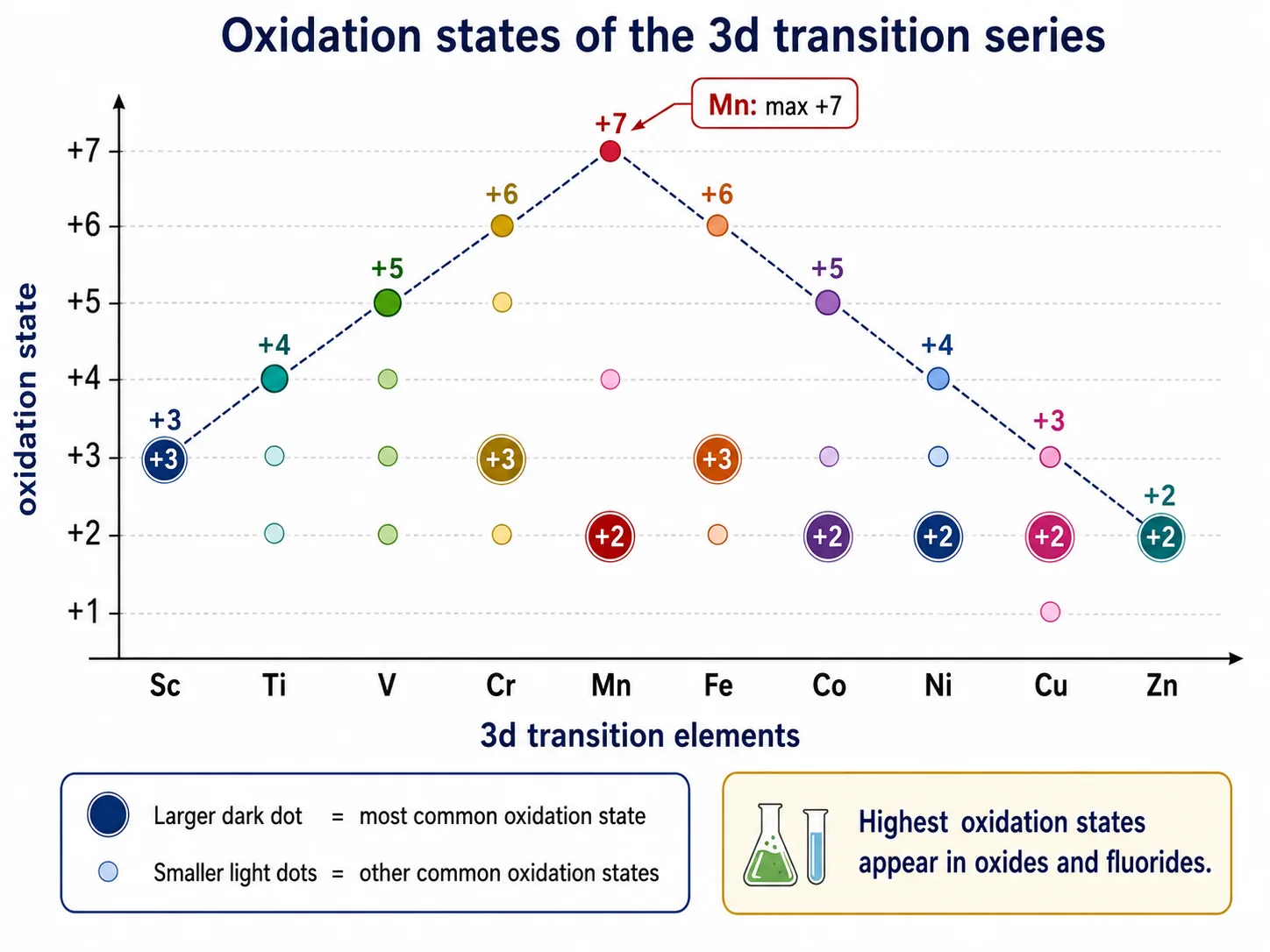
The single most distinctive chemical feature of transition metals is their variety of oxidation states. Manganese, for example, shows every state from +2 to +7.
Why? Because the and electrons have similar energies, so both sets can take part in bonding. An element can use just its electrons (giving lower states like +2) or also involve electrons (giving higher states).
Contrast with main-group elements, which usually show one or two oxidation states differing by 2. Transition metals show many states differing by 1 (e.g. Mn: +2, +3, +4, +5, +6, +7).
Trends in Oxidation States
Maximum oxidation state: rises to a maximum in the middle of the 3d series. The highest is +7 for manganese (: all seven outer electrons can be involved). After Mn the maximum falls, because the increasing nuclear charge holds the electrons more tightly.
Where do the highest states appear? Almost always in oxides and fluorides — the most electronegative, small ligands that can stabilise high oxidation states (e.g. , , , ). Fluorine and oxygen, being highly electronegative, can support a metal in a very high oxidation state.
The +2 state becomes more and more stable (relative to higher states) across the series. From Mn onwards, the +2 ion is the most common because the 4s electrons are easily lost and the remaining electrons are increasingly hard to remove.
[JEE Tip] "Why is the highest oxidation state shown in the oxide or fluoride?" — because O and F are highly electronegative and small, able to form strong bonds that stabilise the metal's high oxidation state. This is a recurring exam answer.
Relative Stability of Oxidation States
Some pairs of ions have the same -configuration but very different behaviour — and the reason is the drive toward a stable , , or configuration:
- Cr is a strong reducing agent (); it readily oxidises to Cr (), which is especially stable in an octahedral field.
- Mn is a strong oxidising agent (); it readily gains one electron to give Mn (), the stable half-filled configuration.
Both Cr and Mn are , yet one is reducing and the other oxidising — decided by which stable configuration they move toward.
Similarly:
- Mn () is especially stable (half-filled), so manganese resists oxidation beyond +2 in many situations.
- Cu disproportionates in water () because the hydration energy and stability favour Cu.
Key Point: To compare the stability or redox behaviour of two transition-metal ions, look at the configuration they move toward — anything heading to or is favoured.
Solved Examples
Example 1: Why so many oxidation states?
Why do transition metals show a variety of oxidation states?
Solution: The and electrons are close in energy, so both can take part in bonding. An element may lose only its electrons (lower state) or additionally some electrons (higher states), giving many possible oxidation states differing by 1.
Example 2: Highest oxidation state in the 3d series
Which element shows the highest oxidation state in the 3d series, and what is it?
Solution: Manganese, with a maximum of +7 (as in ), because all seven of its electrons can be involved.
Example 3: Cr2+ reducing vs Mn3+ oxidising
Both Cr and Mn are . Why is Cr a reducing agent but Mn an oxidising agent?
Solution:
- Cr () is easily oxidised to Cr (), which is very stable in solution — so Cr acts as a reducing agent.
- Mn () is easily reduced to Mn (), a stable half-filled configuration — so Mn acts as an oxidising agent.
Example 4: Why high states in oxides/fluorides
Why is the highest oxidation state of a metal shown in its oxide or fluoride?
Solution: Oxygen and fluorine are small and highly electronegative, forming strong bonds that stabilise the metal in its highest oxidation state (e.g. Mn in , ).
Example 5: Stronger reducing agent
Which is a stronger reducing agent, Cr or Fe, and why?
Solution: Cr is the stronger reducing agent. Cr () is readily oxidised to the very stable Cr (). Fe () oxidises to Fe (); although is stable, the change for Cr is more favourable, making Cr the stronger reducing agent.
Example 6: Stability of +2 across the series
How does the stability of the +2 oxidation state change across the 3d series?
Solution: The +2 state becomes increasingly stable from left to right (especially from Mn onward), because the 4s electrons are lost easily while the remaining electrons become progressively harder to remove.
Example 7: Disproportionation of Cu+
Why is Cu unstable in aqueous solution?
Solution: Cu disproportionates: . The high hydration enthalpy of Cu (more than compensating its higher second ionisation enthalpy) makes Cu + Cu more stable than 2 Cu in water.
Example 8: Mn2+ stability
Why are Mn compounds more stable to oxidation than Fe compounds?
Solution: Mn is — a stable half-filled subshell — so it resists oxidation to Mn (). Fe is and is readily oxidised to the stable Fe (). Hence Mn is more stable toward oxidation.
Example 9: Maximum oxidation state of chromium
What is the maximum oxidation state of chromium, and in what species does it appear?
Solution: +6, as in the dichromate () and chromate () ions and . Chromium () can involve up to six electrons.
Example 10: Predict the stable state
A 3d-series element has the configuration . What is its likely maximum oxidation state?
Solution: With 3 + 2 = 5 available electrons (3d and 4s), the maximum oxidation state is +5 (this is vanadium, which shows +5 in / ).