
Potassium Permanganate — Preparation and Structure
Potassium permanganate () is a deep purple crystalline solid and one of the most widely used oxidising agents. Manganese is in the +7 oxidation state.
It is prepared from the mineral pyrolusite () in two steps:
- Fuse with KOH and an oxidising agent (air or KNO) to get green potassium manganate (, Mn +6):
- Oxidise the manganate (electrolytically or with Cl) to permanganate:
The permanganate ion () is tetrahedral. Its intense purple colour arises not from a d-d transition (Mn is ) but from a charge-transfer transition (electron movement from oxygen to manganese).
Oxidising Action in Acidic Medium
is a powerful oxidising agent, and its behaviour depends on the medium. In acidic solution it is strongest, with the half-reaction ( V):
Note: 5 electrons gained; Mn goes +7 → +2 (purple → almost colourless/pale pink).
Standard oxidations by acidified :
- Iron(II) to iron(III):
- Oxalate (CO) to CO:
- Iodide to iodine:
Key Point: In acid, permanganate gains 5 electrons (Mn → Mn), so its equivalent mass is (molar mass)/5 = 158/5 = 31.6 — essential for permanganometric titrations.
Oxidising Action in Neutral/Alkaline Media
The number of electrons changes with the medium:
- Neutral or faintly alkaline medium (Mn → Mn, 3 electrons): (e.g. oxidation of iodide to iodate, . )
- Strongly alkaline medium (Mn → Mn, 1 electron):
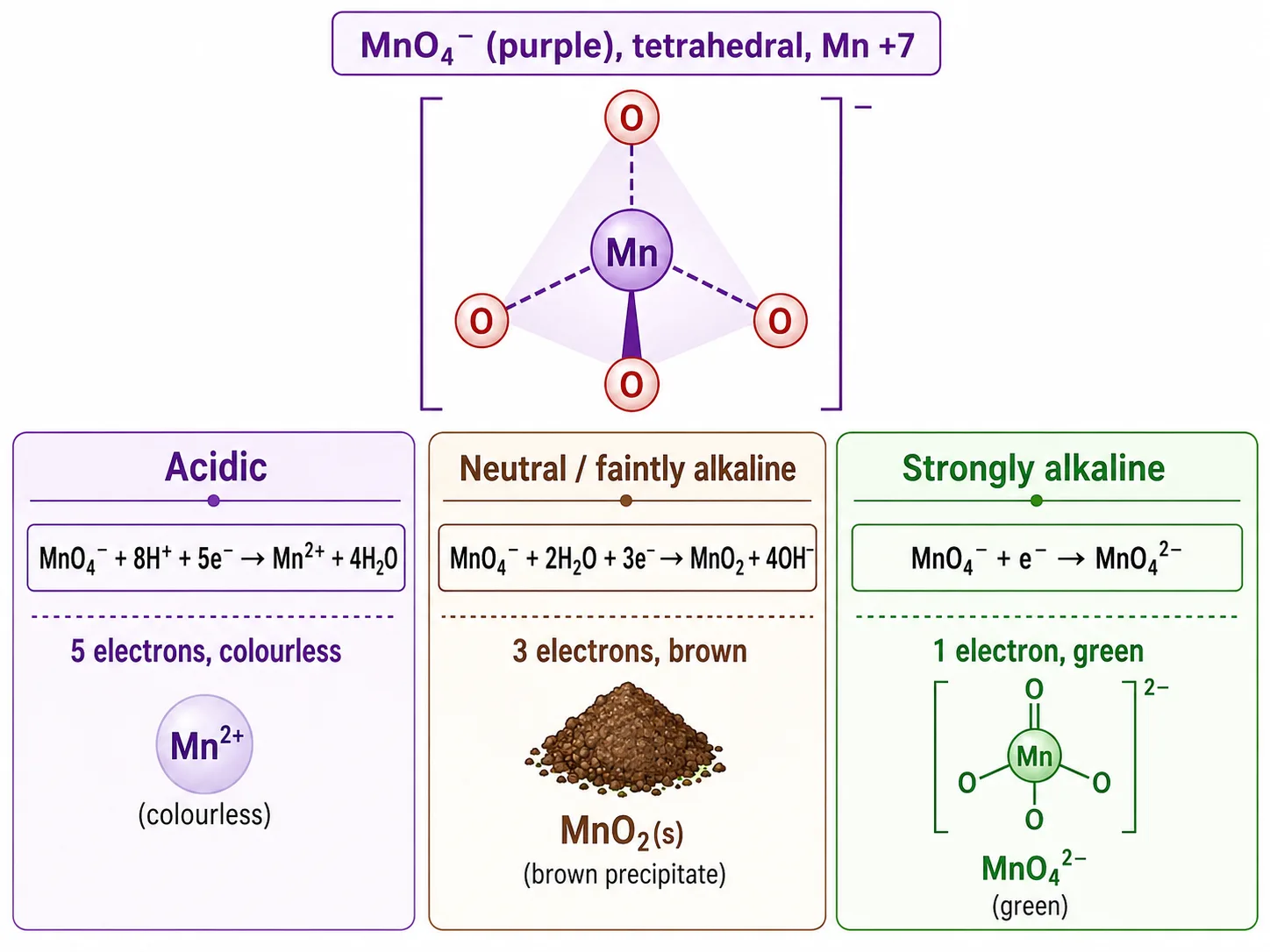
Summary of electrons gained: acidic → 5 (Mn); neutral → 3 (MnO); strongly alkaline → 1 (MnO).
[NEET Important] The electron count by medium (5 / 3 / 1) is a guaranteed exam point. In acid the colour goes deep purple → colourless; in neutral it gives a brown MnO precipitate.
Solved Examples
Example 1: Oxidation state of Mn in permanganate
What is the oxidation state of manganese in ?
Solution: . Manganese is in the +7 state.
Example 2: Electrons gained in acid
How many electrons does gain in acidic medium?
Solution: From , it gains 5 electrons (Mn +7 → +2).
Example 3: Equivalent mass of KMnO4 in acid
The molar mass of is 158 g mol. Find its equivalent mass in acidic medium.
Solution: It gains 5 electrons in acid, so equivalent mass g equiv.
Example 4: Reaction with oxalate
Write the ionic equation for the oxidation of oxalate by acidified permanganate.
Solution: .
Example 5: Why MnO4- is coloured though Mn is d0
The Mn in is , yet permanganate is intensely purple. Explain.
Solution: With there can be no d-d transition. The colour comes from a charge-transfer transition — an electron is momentarily transferred from oxygen (ligand) to manganese — which absorbs strongly in the visible region.
Example 6: Electrons in neutral medium
How many electrons does gain in neutral/faintly alkaline medium, and what is the product?
Solution: 3 electrons (Mn +7 → +4), giving MnO: .
Example 7: Reaction with Fe2+
Write the equation for the oxidation of Fe by acidified .
Solution: .
Example 8: Electrons in strongly alkaline medium
How many electrons does gain in strongly alkaline medium?
Solution: 1 electron (Mn +7 → +6): (green manganate).
Example 9: Colour change in acidic titration
What colour change marks the end point when acidified is used as a self-indicator?
Solution: During titration the purple is decolourised (reduced to nearly colourless Mn). At the end point one excess drop turns the solution permanent pink — so KMnO is its own indicator.
Example 10: Oxidation of iodide in acid
Write the equation for the oxidation of iodide by acidified permanganate.
Solution: .