
Cells You Actually Use
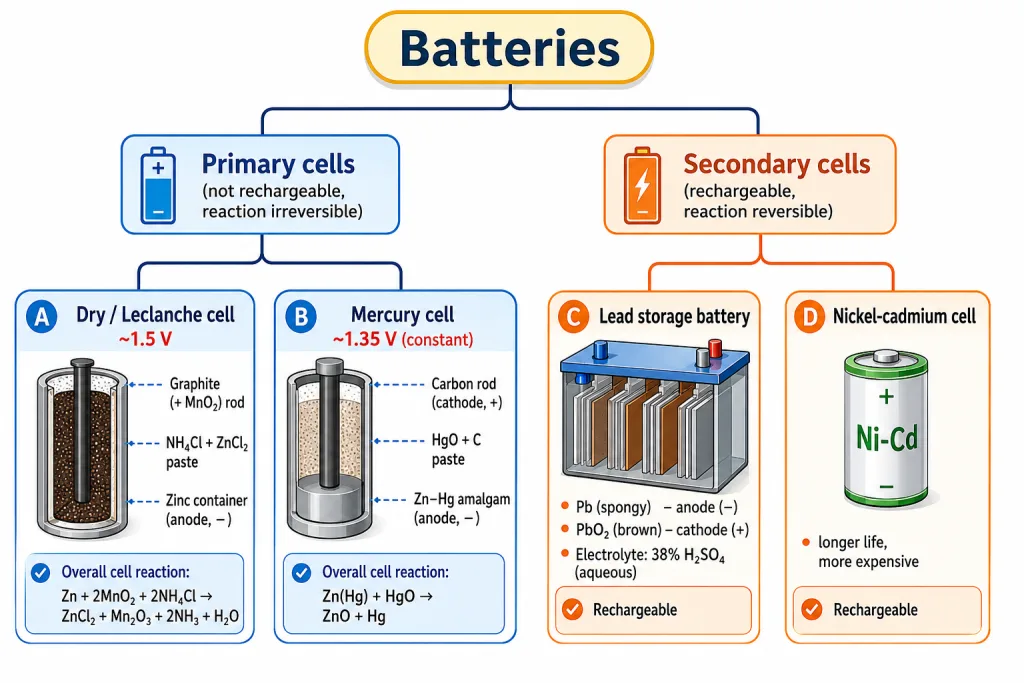
A battery is just one or more galvanic cells packaged to deliver a steady, portable supply of electricity. NCERT divides them into two families:
- Primary cells — the reaction happens once and cannot be reversed. When the reactants are used up, the cell is dead and discarded. (Dry cell, mercury cell.)
- Secondary cells — can be recharged by passing current in the opposite direction, reversing the cell reaction. They survive many discharge-charge cycles. (Lead storage battery, nickel-cadmium cell.)
This section covers the four NCERT cells and their exact electrode reactions — which are common Board questions.
Primary Cells
Dry cell (Leclanché cell) — ~1.5 V
Used in torches, clocks and remotes. A zinc container acts as the anode; a graphite (carbon) rod surrounded by MnO2 and carbon powder is the cathode. The electrolyte is a moist paste of NH4Cl and ZnCl2.
- Anode (oxidation):
- Cathode (reduction):
Manganese is reduced from the +4 to the +3 state. The cell potential is about 1.5 V.
Mercury cell — ~1.35 V (constant)
Used in hearing aids and watches (low, steady current). Zinc-mercury amalgam is the anode; a paste of HgO and carbon is the cathode; the electrolyte is a paste of KOH and ZnO.
- Anode:
- Cathode:
- Overall:
[NEET Important] The mercury cell's voltage stays constant (~1.35 V) throughout its life because the overall reaction involves no ions in solution whose concentration changes — there's no concentration term in the Nernst equation to shift the potential.
Secondary Cells
Lead storage battery
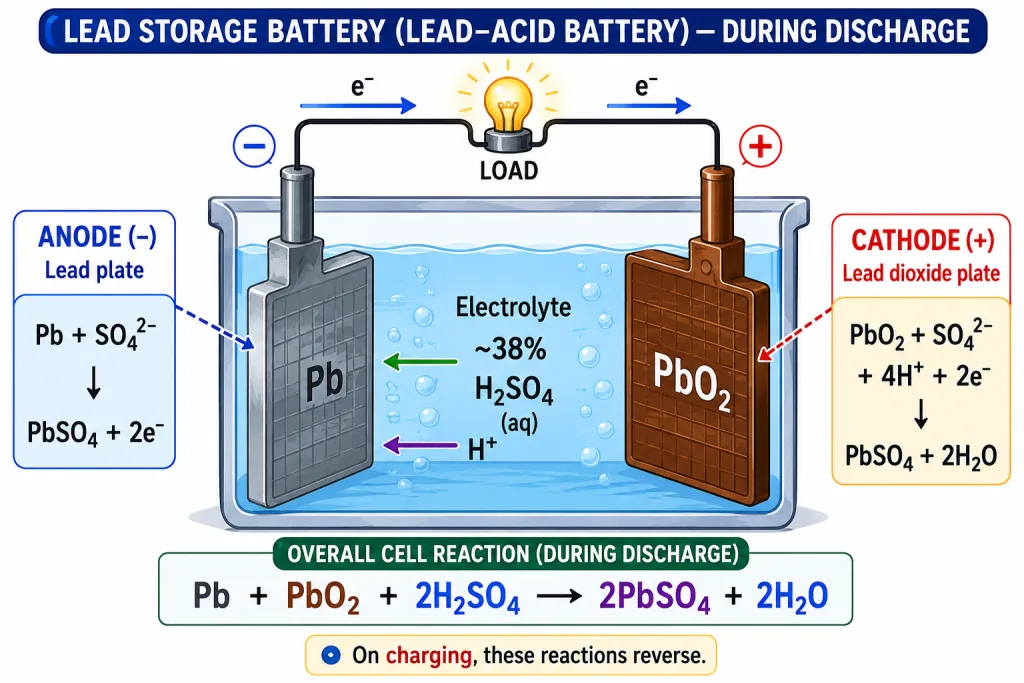
The workhorse of cars and inverters. A lead (Pb) anode and a grid packed with lead dioxide (PbO2) as the cathode, immersed in ~38% sulphuric acid.
On discharge (in use):
- Anode:
- Cathode:
- Overall:
On charging, the reaction is reversed: PbSO4 on both plates converts back to Pb (anode) and PbO2 (cathode). (Note how H2SO4 is consumed on discharge, so a discharged battery's acid is more dilute.)
Nickel-cadmium cell
A rechargeable cell with longer life than the lead storage battery but more expensive to make. It also undergoes many charge-discharge cycles.
Primary vs Secondary — The Big Picture
| Feature | Primary cell | Secondary cell |
|---|---|---|
| Rechargeable? | No | Yes |
| Reaction | Irreversible | Reversible |
| Examples | Dry cell, mercury cell | Lead storage, Ni-Cd |
| Use | One-time / low current | Repeated heavy use |
Key Point: A secondary cell acts as a galvanic cell on discharge (chemical → electrical) and as an electrolytic cell on charging (electrical → chemical, reaction reversed). This dual nature is exactly why it can be reused.
[Board Important] Be ready to write the discharge electrode reactions of the lead storage battery and to explain that the mercury cell holds a constant voltage because no ionic concentration changes during its operation. Both are recurring Board questions.
Solved Examples
Example 1: Classify the cell
Classify the dry cell and the lead storage battery as primary or secondary, and state why.
Solution: The dry cell is a primary cell — its reaction is irreversible and it cannot be recharged. The lead storage battery is a secondary cell — its reaction is reversible, so it can be recharged by passing current in the opposite direction.
Example 2: Anode reaction of the dry cell
Write the anode reaction of the Leclanché (dry) cell and identify what is oxidised.
Solution: Anode: . Zinc (the container) is oxidised — it acts as the anode.
Example 3: Why is the mercury cell's voltage constant?
Explain why the mercury cell maintains a steady potential (~1.35 V) throughout its life.
Solution: Its overall reaction, Zn(Hg) + HgO → ZnO + Hg, involves only solids and liquids — no ions in solution whose concentration changes. With no concentration term to feed into the Nernst equation, the potential stays constant at ~1.35 V.
Example 4: Lead storage discharge reactions
Write the anode and cathode reactions of the lead storage battery during discharge.
Solution:
- Anode:
- Cathode: .
Example 5: What happens to the acid on discharge?
Why does the density of the sulphuric acid in a lead storage battery fall as it discharges?
Solution: The overall discharge reaction Pb + PbO2 + 2H2SO4 → 2PbSO4 + 2H2O consumes H2SO4 and produces water, diluting the electrolyte. So the acid density (and concentration) drops — a discharged battery can be detected by its low acid density.
Example 6: Charging the lead battery
What happens to PbSO4 when the lead storage battery is recharged?
Solution: Charging reverses the reactions: PbSO4 on the anode is converted back to Pb, and PbSO4 on the cathode back to PbO2, while H2SO4 is regenerated. The cell is restored to its charged state.
Example 7: Identify the electrodes of the mercury cell
Name the anode and cathode materials of the mercury cell.
Solution: Anode: zinc-mercury amalgam, Zn(Hg); cathode: a paste of mercury(II) oxide, HgO, with carbon. Electrolyte: a paste of KOH and ZnO.
Example 8: Primary vs secondary identification
A cell can be recharged hundreds of times in a power tool. Is it primary or secondary, and which two NCERT examples fit?
Solution: Rechargeable → secondary cell. NCERT examples: the lead storage battery and the nickel-cadmium cell.
Example 9: Overall reaction of the mercury cell
Write the overall reaction of the mercury cell and identify the oxidising and reducing agents.
Solution: Overall: . Zinc is oxidised → zinc is the reducing agent; HgO is reduced → HgO is the oxidising agent.
Example 10: A secondary cell's two roles
Explain how a secondary cell behaves during discharge versus charging.
Solution: On discharge it works as a galvanic cell, converting chemical energy to electrical energy spontaneously. On charging it works as an electrolytic cell, using external electricity to drive the reverse (non-spontaneous) reaction and restore the reactants.