
Driving a Reaction Backwards
A galvanic cell lets a spontaneous reaction produce electricity. An electrolytic cell does the reverse: it uses an external power supply to force a non-spontaneous reaction to happen. This is electrolysis — the basis of metal extraction, electroplating, and the manufacture of chlorine, aluminium and sodium.
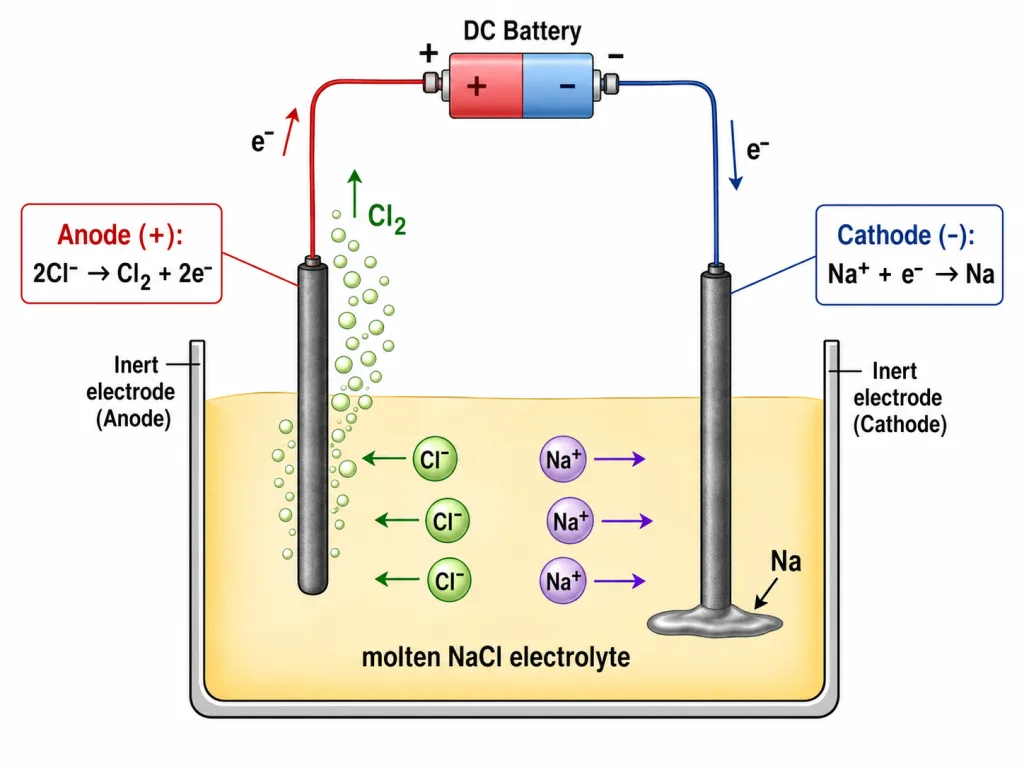
In an electrolytic cell:
- The anode is connected to the positive terminal of the battery (oxidation still happens here).
- The cathode is connected to the negative terminal (reduction still happens here).
Note the polarity is opposite to a galvanic cell, but the chemistry rule is unchanged: oxidation at anode, reduction at cathode.
Example — molten NaCl: passing current through molten NaCl gives Na metal at the cathode (Na⁺ + e⁻ → Na) and Cl₂ gas at the anode (2Cl⁻ → Cl₂ + 2e⁻). This is how sodium is manufactured.
Products of Electrolysis
Predicting electrolysis products is not always trivial — in aqueous solutions, water itself can be oxidised or reduced, competing with the ions. The product that actually forms is the one that is easiest to discharge (considering electrode potentials and overpotential).
For example, electrolysis of aqueous NaCl (brine):
- At the cathode, H₂ is released (water reduced) rather than Na, because reducing water is far easier than reducing Na⁺.
- At the anode, Cl₂ is released (despite water's lower oxidation potential) because of the high overpotential for O₂ evolution.
Key Point: In aqueous solutions, electrode potentials plus overpotential decide the product. Active electrodes (like Cu) can themselves dissolve at the anode. Always consider whether water competes.
[NEET Important] Electrolysis of molten NaCl gives Na + Cl₂; electrolysis of aqueous NaCl gives H₂ + Cl₂ + NaOH. The state of the electrolyte changes the cathode product entirely.
Faraday's Laws of Electrolysis
The quantitative side of electrolysis is governed by two laws stated by Michael Faraday.
Faraday's First Law: The mass () of substance deposited or liberated at an electrode is directly proportional to the quantity of electricity () passed:
where is current (A), time (s), the charge (coulombs), and the electrochemical equivalent.
Faraday's Second Law: When the same quantity of electricity passes through different electrolytes, the masses deposited are proportional to their equivalent masses.
The connecting constant is the Faraday: the charge on one mole of electrons:
To deposit one mole of a metal requires faradays ( C). The practical recipe:
[JEE Tip] Steps for any electrolysis numerical: (1) charge ; (2) moles of electrons ; (3) moles of product moles of electrons (electrons per ion); (4) mass moles molar mass.
Solved Examples
Example 1: Charge for a given deposit
How much charge is required to reduce 1 mole of Al³⁺ to Al?
Solution: Al³⁺ + 3e⁻ → Al needs 3 moles of electrons = 3 faradays = C.
Answer: 2.895 × 10⁵ C (3 F).
Example 2: Mass deposited by a current
A current of 5 A flows for 30 minutes through molten AlCl₃. What mass of Al (M = 27) is deposited?
Solution:
- C.
- Moles of electrons mol.
- Al³⁺ needs 3 e⁻, so moles of Al mol.
- Mass g.
Answer: 0.84 g of aluminium.
Example 3: Copper deposition
How much copper (M = 63.5) is deposited when 2 A flows for 965 s through CuSO₄ solution?
Solution:
- C.
- Moles of electrons mol.
- Cu²⁺ + 2e⁻ → Cu, so moles of Cu mol.
- Mass g.
Answer: 0.635 g of copper.
Example 4: Faradays for silver
How many faradays are needed to deposit 0.5 mol of silver (Ag⁺ + e⁻ → Ag)?
Solution: Each Ag⁺ needs 1 electron, so 0.5 mol Ag needs 0.5 mol of electrons = 0.5 F C.
Answer: 0.5 F (48 250 C).
Example 5: Time to deposit a mass
How long must a current of 3 A flow to deposit 1.08 g of silver (M = 108, n = 1)?
Solution:
- Moles of Ag mol → 0.01 mol electrons.
- C.
- s.
Answer: ≈ 322 s (about 5.4 minutes).
Example 6: Faraday's second law
The same charge is passed through solutions of AgNO₃ and CuSO₄ in series. If 1.08 g of Ag (eq. mass 108) is deposited, what mass of Cu (eq. mass 31.75) is deposited?
Solution: By Faraday's second law, masses are proportional to equivalent masses: g.
Answer: 0.3175 g of copper.
Example 7: Volume-free gas deposition (moles)
A current of 0.5 A flows for 2 hours through acidified water. How many moles of electrons pass?
Solution:
- C.
- Moles of electrons mol.
Answer: 0.0373 mol of electrons.
Example 8: Products of molten vs aqueous NaCl
State the cathode product when (a) molten NaCl and (b) aqueous NaCl are electrolysed.
Solution: (a) Molten NaCl → Na metal at the cathode (only Na⁺ available). (b) Aqueous NaCl → H₂ gas at the cathode (water is reduced more easily than Na⁺).
Example 9: Charge to liberate hydrogen
What charge is needed to liberate 1 mole of H₂ gas at the cathode (2H⁺ + 2e⁻ → H₂)?
Solution: 1 mole of H₂ requires 2 moles of electrons = 2 F C.
Answer: 1.93 × 10⁵ C (2 F).
Example 10: Mass of chlorine from charge
What mass of Cl₂ (M = 71) is liberated by 96500 C at the anode (2Cl⁻ → Cl₂ + 2e⁻)?
Solution:
- 96500 C = 1 mole of electrons.
- Cl₂ needs 2 e⁻ per molecule, so moles Cl₂ mol.
- Mass g.
Answer: 35.5 g of Cl₂.