
Why Dilution Changes Conductivity and Molar Conductivity in Opposite Ways
This is a favourite conceptual trap, so let's nail it.
Conductivity () decreases on dilution. Conductivity measures the conductance of a fixed volume of solution. Diluting spreads the ions out, so fewer ions are present in that fixed volume → fewer charge carriers per unit volume → lower .
Molar conductivity () increases on dilution. Molar conductivity measures the conductance of the volume of solution containing one mole of electrolyte. On dilution, ions move further apart, interionic attractions weaken, ions move more freely, and (for weak electrolytes) more of them dissociate — so the total conductance per mole rises.
Key Point: On dilution, falls (fewer ions per unit volume) but rises (each mole's ions conduct more freely). They move in opposite directions — examiners test this every year.
As dilution approaches infinity, approaches a maximum limiting value called the limiting molar conductivity, (molar conductivity at infinite dilution).
Strong vs Weak Electrolytes
The way rises with dilution differs sharply between the two classes — and this difference is itself diagnostic.
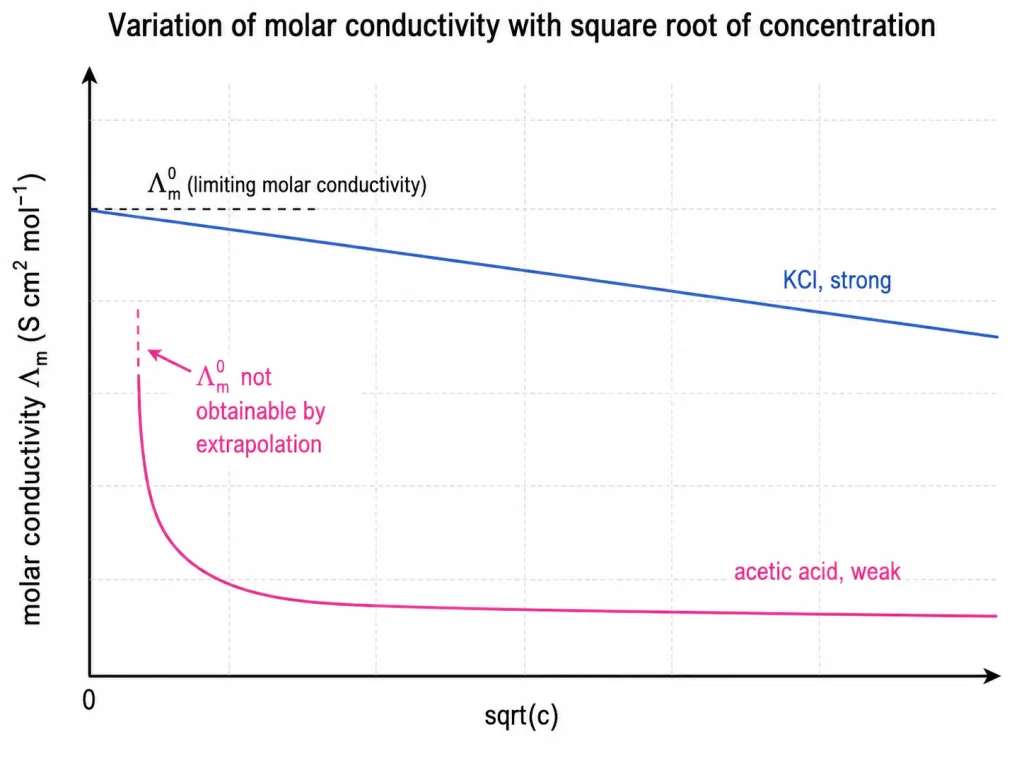
Strong electrolytes (KCl, NaCl, HCl, etc.) are almost completely ionised in solution. Their increases only slightly on dilution (mainly because interionic attractions decrease). The variation is approximately described by the Debye-Hückel-Onsager equation:
A plot of vs is a straight line; extrapolating to gives directly.
Weak electrolytes (acetic acid, NHOH) are only partly ionised, and the degree of ionisation rises steeply on dilution. Their increases sharply near infinite dilution and the curve shoots up almost vertically - so cannot be found by simple extrapolation from the curved region. We use Kohlrausch's law instead.
Kohlrausch's Law of Independent Migration
Kohlrausch found that at infinite dilution, where ions are effectively independent, each ion contributes a fixed amount to the total molar conductivity, regardless of the other ion present.
Kohlrausch's law: The limiting molar conductivity of an electrolyte is the sum of the individual limiting contributions of its cation and anion:
where and are the limiting molar conductivities of the cation and anion, and , their numbers per formula unit.
Applications:
- Finding of a weak electrolyte (which can't be extrapolated). For acetic acid:
- Degree of dissociation: (ratio of molar conductivity at concentration to its limiting value).
- Dissociation constant of a weak electrolyte: .
[JEE Tip] The combination "CHCOONa + HCl - NaCl" works because adding and subtracting the ionic contributions leaves exactly H + CHCOO. Build such combinations by cancelling spectator ions.
Solved Examples
Example 1: Kohlrausch sum
Given and S cm mol, find of NaCl.
Solution: S cm mol.
Answer: 126.4 S cm mol.
Example 2: of a weak electrolyte
Find of acetic acid given : CHCOONa = 91.0, HCl = 425.9, NaCl = 126.4 S cm mol.
Solution: (CHCOOH) = 91.0 + 425.9 - 126.4 = 390.5 S cm mol.
Answer: 390.5 S cm mol.
Example 3: Degree of dissociation
The molar conductivity of 0.001 M acetic acid is 49.5 S cm mol and S cm mol. Find the degree of dissociation.
Solution: .
Answer: (12.7% dissociated).
Example 4: Dissociation constant
For the acetic acid of Example 3 ( M, ), find .
Solution: .
Answer: .
Example 5: Conductivity vs molar conductivity on dilution
State how and each change when an electrolyte solution is diluted.
Solution: On dilution, decreases (fewer ions per unit volume) while increases (ions conduct more freely and, for weak electrolytes, dissociate more). They change in opposite directions.
Example 6: of MgCl
Given and S cm mol, find of MgCl.
Solution: MgCl Mg + 2Cl, so S cm mol.
Answer: 258.6 S cm mol.
Example 7: Why weak electrolytes need Kohlrausch's law
Why can't of acetic acid be found by extrapolating its -vs- plot?
Solution: For a weak electrolyte, rises steeply and non-linearly as because the degree of dissociation changes rapidly, so the curve has no reliable straight portion to extrapolate. Kohlrausch's law lets us build from strong-electrolyte values instead.
Example 8: Degree of dissociation from given data
A weak acid has and S cm mol at a concentration. Find .
Solution: .
Answer: (5% dissociated).
Example 9: of NHOH via Kohlrausch
Find of NHOH given : NHCl = 149.7, NaOH = 248.1, NaCl = 126.4 S cm mol.
Solution: (NHOH) = (NHCl) + (NaOH) - (NaCl) = 149.7 + 248.1 - 126.4 = 271.4 S cm mol.
Answer: 271.4 S cm mol.
Example 10: Strong-electrolyte extrapolation
For a strong electrolyte, . If S cm mol, (in matching units), find at M.
Solution: . S cm mol.
Answer: 411.2 S cm mol.