
The Whole Chapter in One Glance
Electrochemistry connects redox reactions with electricity. A galvanic cell turns a spontaneous reaction into current; an electrolytic cell uses current to drive a non-spontaneous one. The Nernst equation links potential to concentration; thermodynamics links it to and . Conductance describes how solutions carry current; Kohlrausch's law dissects it ion by ion; Faraday's laws quantify electrolysis; and batteries, fuel cells and corrosion are the real-world payoff.
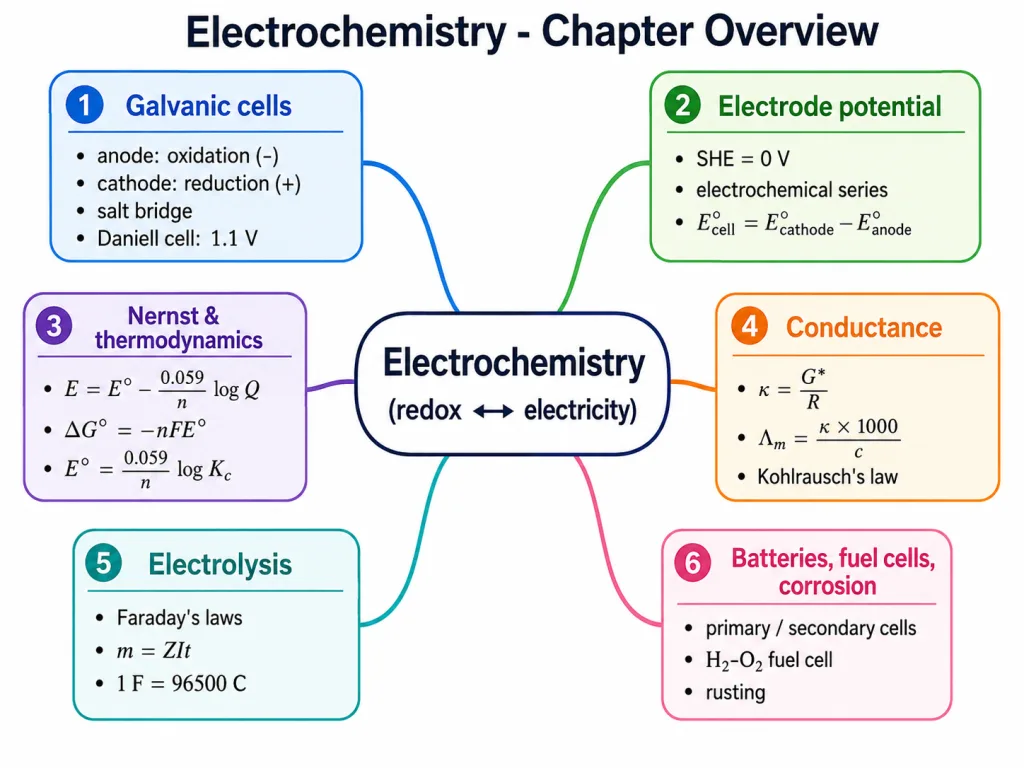
Slot every concept and numerical into one of these six branches.
Master Formula Sheet
Cell potential: (reduction potentials). Positive → spontaneous.
Nernst equation (298 K):
Thermodynamic links:
Conductance:
- Conductivity , or when cell constant
- Molar conductivity (S cm² mol⁻¹)
- Kohlrausch:
- Degree of dissociation ;
Faraday's laws: ; moles deposited ; C mol⁻¹.
Constants: V at 298 K; .
Quick Comparison Tables
Galvanic vs Electrolytic cell
| Feature | Galvanic | Electrolytic |
|---|---|---|
| Energy | Chemical → electrical | Electrical → chemical |
| Reaction | Spontaneous | Non-spontaneous |
| Anode | Negative | Positive |
| Cathode | Positive | Negative |
| (Oxidation at anode, reduction at cathode in both) |
Strong vs Weak electrolyte (conductivity)
| Feature | Strong | Weak |
|---|---|---|
| Dissociation | Complete | Partial |
| vs | Straight line | Steep curve near c=0 |
| By extrapolation | By Kohlrausch's law |
Primary vs Secondary cell
| Feature | Primary | Secondary |
|---|---|---|
| Rechargeable | No | Yes |
| Examples | Dry cell, mercury cell | Lead storage, Ni-Cd |
Last-Minute Memory Hooks
- An Ox, Red Cat: Anode = Oxidation, Cathode = Reduction (in both cell types). Only the terminal sign flips between galvanic and electrolytic.
- ; positive → spontaneous → → .
- Nernst: more product / less reactant lowers . Dead cell: , .
- 0.059 is the magic number at 298 K — appears in Nernst and in .
- On dilution: down, up (opposite directions).
- Kohlrausch combo for acetic acid: CH₃COONa + HCl − NaCl.
- Faraday recipe: mol e⁻ mol product mass.
- Mercury cell = constant voltage (no ionic concentration change). Lead battery acid dilutes on discharge.
- Rusting needs water + O₂; protect with Zn/Mg (more reactive, sacrificial).
One-line revision flow: Galvanic cell → electrode potential & SHE → Nernst → ΔG & Kc → conductance & Kohlrausch → electrolysis & Faraday → batteries, fuel cells, corrosion.