From Cell Potential to Thermodynamics
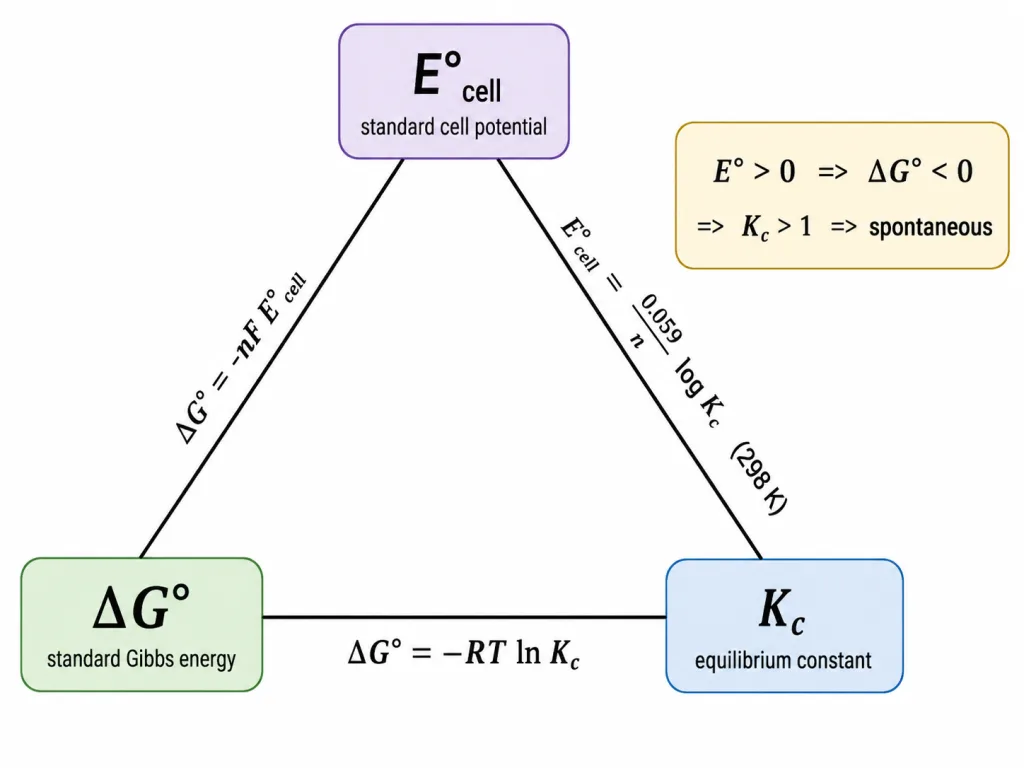
A galvanic cell does electrical work. The maximum electrical work a cell can do is directly linked to the Gibbs energy change of its reaction. This is one of the most beautiful connections in chemistry — it ties the electrochemistry we've built to the thermodynamics of spontaneity.
The relation is:
ΔrG∘=−nFEcell∘
- ΔrG∘ = standard Gibbs energy change of the cell reaction (in J mol−1).
- n = moles of electrons transferred.
- F = Faraday constant = 96487 C mol−1 (≈ 96500).
- Ecell∘ = standard cell potential (V).
The minus sign captures the logic: a positive Ecell∘ (spontaneous cell) gives a negative ΔrG∘ (spontaneous reaction). The two ways of saying "spontaneous" agree.
Maximum work: the maximum electrical work obtainable is wmax=−ΔrG∘=nFEcell∘.
Linking Potential to the Equilibrium Constant
Combining ΔrG∘=−nFEcell∘ with the thermodynamic relation ΔrG∘=−RTlnKc gives a direct bridge between the standard cell potential and the equilibrium constant:
nFEcell∘=RTlnKc⇒Ecell∘=nFRTlnKc
At 298 K, using the 0.059 shortcut:
Ecell∘=n0.0591logKc
This makes intuitive sense via the Nernst equation: at equilibrium Ecell=0 and Q=Kc, so 0=Ecell∘−n0.0591logKc, which rearranges to exactly this.
Reading the Signs
The three quantities Ecell∘, ΔrG∘ and Kc are three views of the same thing — how far and which way a reaction goes:
| Ecell∘ |
ΔrG∘ |
Kc |
Reaction |
| Positive |
Negative |
> 1 |
Spontaneous (forward) |
| Zero |
Zero |
= 1 |
At equilibrium |
| Negative |
Positive |
< 1 |
Non-spontaneous (reverse favoured) |
[JEE Tip] Watch your units. With F=96487 C mol−1 and E∘ in volts, ΔrG∘ comes out in joules per mole. Divide by 1000 for kJ mol−1. A frequent error is mixing kJ and J when comparing with ΔG=−RTlnK.
Key Point: ΔrG∘=−nFEcell∘ converts a voltmeter reading into a thermodynamic spontaneity statement. It is the most important single equation connecting the two halves of physical chemistry.
Solved Examples
Example 1: Gibbs energy from cell potential
Calculate ΔrG∘ for the Daniell cell (Ecell∘=1.10 V, n=2). (F=96487 C mol−1)
Solution: ΔrG∘=−nFEcell∘=−2×96487×1.10=−212,271 J ≈−212.3 kJ mol−1.
Answer: −212.3 kJ mol−1 (negative → spontaneous).
Example 2: Equilibrium constant from E°
For a cell with Ecell∘=0.295 V and n=2, find logKc and Kc.
Solution: Ecell∘=n0.0591logKc⇒logKc=0.0591nEcell∘=0.05912×0.295≈9.98≈10.
So Kc≈1010.
Answer: logKc≈10, Kc≈1×10¹⁰.
Example 3: Maximum work
What is the maximum electrical work obtainable from the Daniell cell per mole of reaction? (E∘=1.10 V, n=2)
Solution: wmax=nFEcell∘=2×96487×1.10=212,271 J ≈212.3 kJ mol−1.
Answer: 212.3 kJ mol−1 of work per mole.
Example 4: Sign check
A cell reaction has Ecell∘=−0.25 V. Is it spontaneous, and what is the sign of ΔrG∘?
Solution: ΔrG∘=−nFEcell∘. With Ecell∘ negative, ΔrG∘ is positive → the reaction is non-spontaneous as written (the reverse is favoured).
Example 5: Kc for the Daniell cell
Estimate Kc for the Daniell cell (Ecell∘=1.10 V, n=2).
Solution: logKc=0.0591nE∘=0.05912×1.10≈37.2. So Kc≈1037.2≈2×1037.
Answer: Kc≈1037 — enormous, confirming the reaction goes essentially to completion.
Example 6: ΔG° from electrode potentials
For Mg + 2Ag+ → Mg2+ + 2Ag, Ecell∘=3.16 V, n=2. Find ΔrG∘.
Solution: ΔrG∘=−nFE∘=−2×96487×3.16=−609,880 J ≈−609.9 kJ mol−1.
Answer: −609.9 kJ mol−1.
Example 7: Finding E° from ΔG°
A reaction transferring 2 electrons has ΔrG∘=−193 kJ mol−1. Find Ecell∘. (F=96500)
Solution: Ecell∘=−nFΔrG∘=−2×96500−193000=1.0 V.
Answer: 1.0 V.
Example 8: Relating Kc and spontaneity
If Kc=1 for a cell reaction, what is Ecell∘?
Solution: Ecell∘=n0.0591logKc=n0.0591log1=0 V. With Kc=1 the system is balanced, so Ecell∘=0 and ΔrG∘=0.
Example 9: Two-electron cell Kc
A cell has Ecell∘=0.118 V and n=2. Find Kc.
Solution: logKc=0.05912×0.118≈3.99≈4.0. Kc≈104.
Answer: Kc≈1×10⁴.
Example 10: ΔG° in kJ from a 1-electron cell
For a cell with Ecell∘=0.80 V and n=1, find ΔrG∘ in kJ. (F=96500)
Solution: ΔrG∘=−1×96500×0.80=−77,200 J =−77.2 kJ.
Answer: −77.2 kJ mol−1.
