
Why an Electrode Develops a Potential
Dip a metal rod into a solution of its own ions. Two things compete: metal atoms may lose electrons and go into solution as ions (), or ions may grab electrons and deposit on the rod (). This sets up a separation of charge between the metal and the solution — an electrode potential.
We can't measure the potential of a single electrode in isolation (there's no second terminal to connect to). We can only measure a difference between two electrodes. So chemists agreed on a reference electrode with an assigned potential of exactly zero, and measure every other electrode against it.
Standard electrode potential (): the potential of an electrode measured against the standard hydrogen electrode, under standard conditions — 298 K, 1 bar pressure for gases, and 1 M concentration for ions.
The Standard Hydrogen Electrode (SHE)
The agreed zero-reference is the standard hydrogen electrode (SHE), assigned V at all temperatures.
It consists of a platinum electrode coated with platinum black, dipped in 1 M H solution, with pure H gas bubbled over it at 1 bar:
By connecting any electrode to the SHE and measuring the cell emf, we obtain that electrode's standard electrode potential.
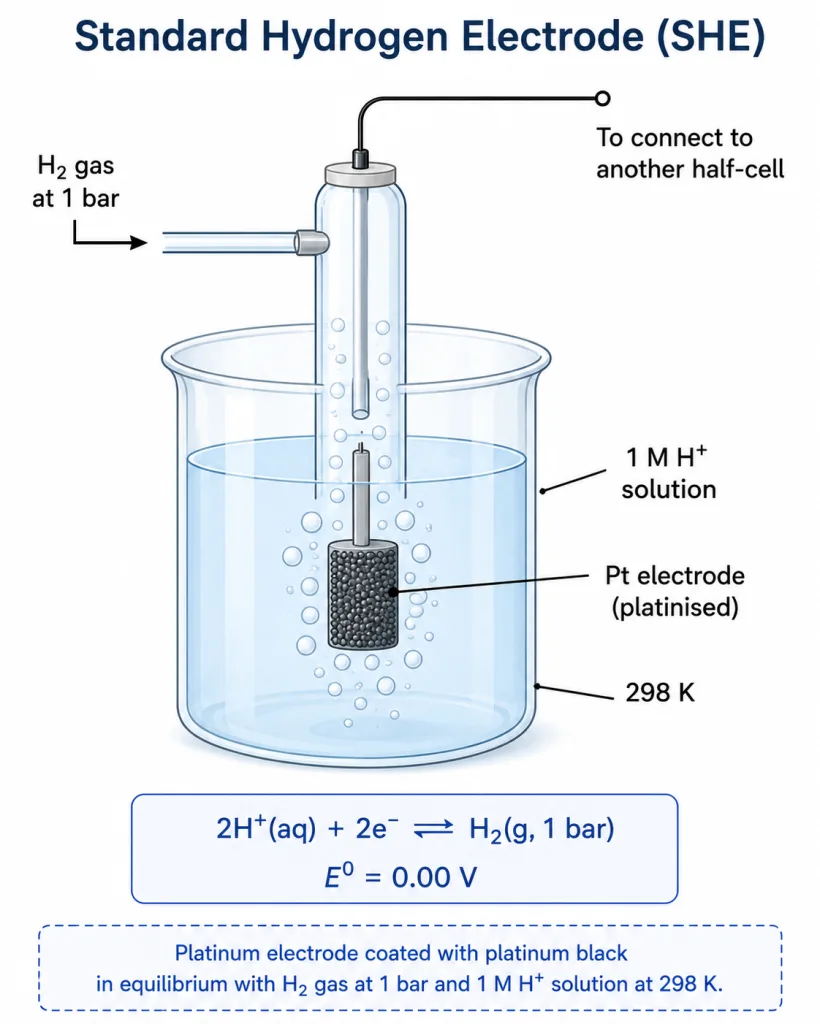
[Board Important] The SHE's potential is defined as zero — it is a reference, not a measured value. All standard potentials are quoted relative to it.
Sign Convention and Reduction Potentials
By IUPAC convention, all standard electrode potentials are quoted as standard reduction potentials (the electrode written as a reduction, ).
- A positive means the species is more easily reduced than H — a good oxidising agent. (e.g. V.)
- A negative means the species is less easily reduced than H — it tends to be oxidised, a good reducing agent. (e.g. V.)
For a full cell, the standard cell potential is:
where both are the standard reduction potentials. A positive means the cell reaction is spontaneous as written.
For the Daniell cell: V. ✓
The Electrochemical Series
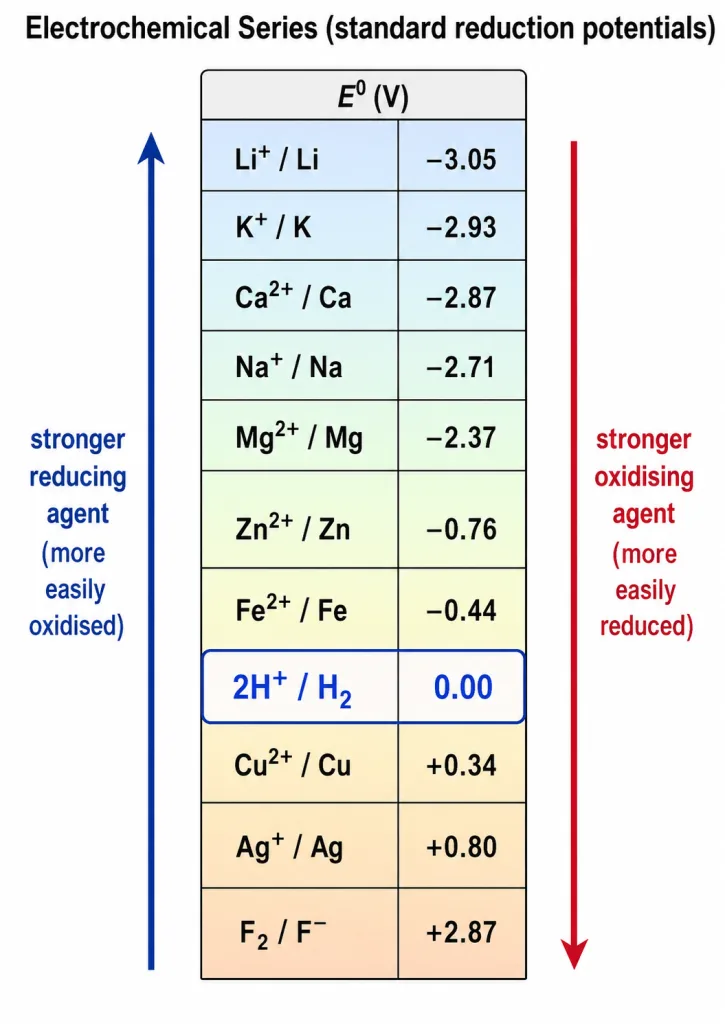
Arranging electrodes by their standard reduction potentials (most negative at top to most positive at bottom) gives the electrochemical series (or activity series). A condensed version:
| Electrode (reduction) | / V |
|---|---|
| Li⁺ + e⁻ → Li | −3.05 |
| K⁺ + e⁻ → K | −2.93 |
| Ca²⁺ + 2e⁻ → Ca | −2.87 |
| Na⁺ + e⁻ → Na | −2.71 |
| Mg²⁺ + 2e⁻ → Mg | −2.36 |
| Zn²⁺ + 2e⁻ → Zn | −0.76 |
| Fe²⁺ + 2e⁻ → Fe | −0.44 |
| 2H⁺ + 2e⁻ → H₂ | 0.00 |
| Cu²⁺ + 2e⁻ → Cu | +0.34 |
| Ag⁺ + e⁻ → Ag | +0.80 |
| F₂ + 2e⁻ → 2F⁻ | +2.87 |
How to use it:
- More negative → stronger reducing agent (more easily oxidised). Li is the strongest reducing agent.
- More positive → stronger oxidising agent (more easily reduced). F₂ is the strongest oxidising agent.
- A metal higher in the series (more negative) will displace a metal lower down from its salt solution.
[JEE Tip] To check if a reaction is feasible, compute . If it's positive, the reaction is spontaneous. This single test answers most "can metal X displace metal Y" questions.
Solved Examples
Example 1: Standard cell potential of the Daniell cell
Given V and V, find .
Solution: Copper (higher ) is the cathode; zinc is the anode.
Answer: 1.10 V (positive → spontaneous).
Example 2: Feasibility of a reaction
Will copper displace silver from AgNO solution? ( V, V)
Solution: Reaction: Cu + 2Ag⁺ → Cu²⁺ + 2Ag. Cu is oxidised (anode), Ag⁺ reduced (cathode). Positive → yes, the reaction is feasible; copper displaces silver.
Example 3: Which is the stronger reducing agent?
Using V and V, identify the stronger reducing agent.
Solution: The more negative reduction potential means the species is more easily oxidised — a stronger reducing agent. Zn (−0.76) is more negative than Fe (−0.44), so zinc is the stronger reducing agent.
Example 4: Stronger oxidising agent
Between Cu²⁺ ( V) and Ag⁺ ( V), which is the stronger oxidising agent?
Solution: The more positive reduction potential means more easily reduced — a stronger oxidising agent. Ag⁺ (+0.80 V) is the stronger oxidising agent.
Example 5: Predicting displacement
Can zinc displace copper from CuSO₄ solution? Justify.
Solution: Zn is above Cu in the electrochemical series (more negative ). Reaction Zn + Cu²⁺ → Zn²⁺ + Cu has V (positive). Yes, zinc displaces copper.
Example 6: Storing a solution
Can copper sulphate solution be stored in a zinc vessel? Why or why not?
Solution: No. Zinc is more reactive (more negative ) and would displace copper: Zn + Cu²⁺ → Zn²⁺ + Cu, corroding the vessel. CuSO₄ must not be stored in a zinc container.
Example 7: Cell potential with given electrodes
Calculate for Mg | Mg²⁺ || Ag⁺ | Ag, given V and V.
Solution: Cathode = Ag (right), anode = Mg (left).
Answer: +3.16 V.
Example 8: SHE as anode vs cathode
When an electrode of unknown potential is connected to the SHE and the SHE acts as the anode, the measured cell emf is +0.34 V. What is the standard reduction potential of the unknown electrode?
Solution: V. So V (this is copper).
Example 9: Arrange reducing power
Arrange Na, Zn, and Ag in increasing order of reducing power. (: Na −2.71, Zn −0.76, Ag +0.80 V)
Solution: Reducing power increases as becomes more negative. Order of : Ag (+0.80) > Zn (−0.76) > Na (−2.71). So increasing reducing power: Ag < Zn < Na.
Example 10: Identify the cathode from potentials
For a cell built from Ni²⁺/Ni ( V) and Cu²⁺/Cu ( V), which electrode is the cathode and what is ?
Solution: The electrode with the higher (more positive) reduction potential is the cathode → Cu is the cathode. V.