
Electricity from a Chemical Reaction
Electrochemistry is the study of the two-way relationship between chemical reactions and electrical energy: how a spontaneous reaction can be made to push electrons through a wire (producing electricity), and how electricity can be used to drive a non-spontaneous reaction (electrolysis).
Think of it this way: a redox reaction involves the transfer of electrons from one species to another. If we can force those electrons to travel through an external wire instead of jumping directly, we capture their flow as an electric current. That's the whole idea behind a battery.
Two types of electrochemical cells:
- Galvanic (voltaic) cell — a spontaneous redox reaction produces electrical energy. (A battery.)
- Electrolytic cell — external electrical energy drives a non-spontaneous reaction. (Electrolysis, electroplating.)
This section builds the galvanic cell from the ground up using the classic Daniell cell.
The Daniell Cell
Place a zinc rod in zinc sulphate solution and a copper rod in copper sulphate solution, and connect them. The spontaneous reaction is:
Zinc is more reactive, so it gives up electrons. Instead of letting them pass directly to Cu²⁺, the Daniell cell separates the reaction into two half-cells connected by a wire, so the electrons must travel through the external circuit - doing electrical work along the way.
The two half-reactions are:
- At the zinc electrode (oxidation):
- At the copper electrode (reduction):
A Daniell cell under standard conditions (1 mol dm⁻³ ions) has an emf of 1.1 V.
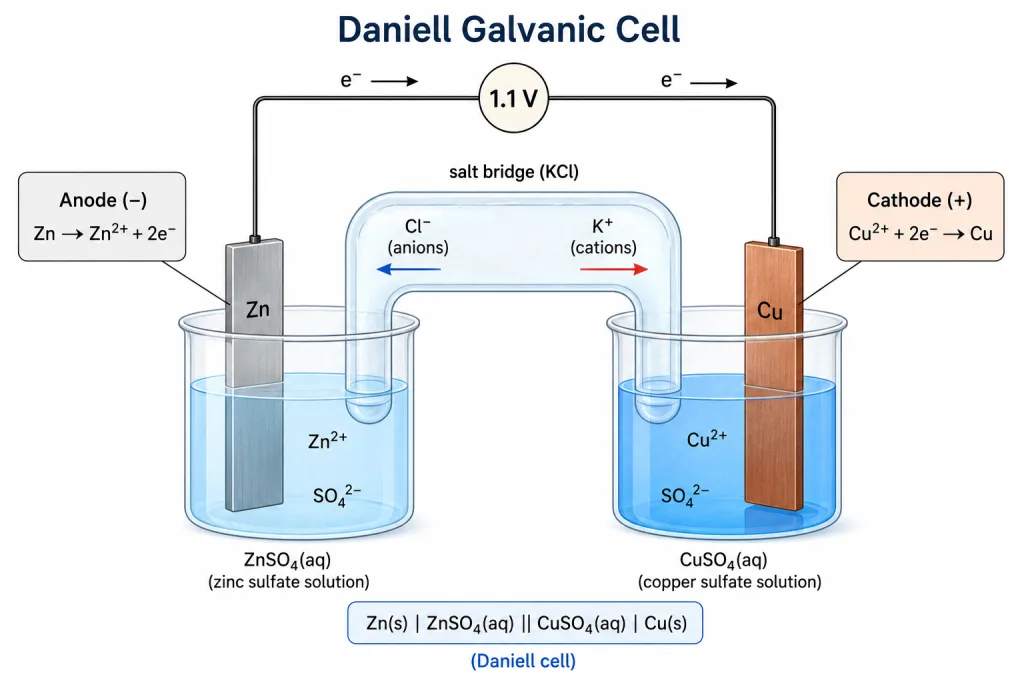
Anode, Cathode and Electron Flow
The naming is fixed and worth memorising precisely:
- Anode — where oxidation happens. In a galvanic cell it is the negative terminal. (Zinc here.)
- Cathode — where reduction happens. In a galvanic cell it is the positive terminal. (Copper here.)
A memory hook: An Ox (Anode = Oxidation) and Red Cat (Reduction = Cathode).
Electrons flow through the external wire from anode (Zn) to cathode (Cu). Conventional current flows the opposite way (cathode to anode externally). Inside the solution, the circuit is completed by ions migrating through the salt bridge.
[JEE Tip] In a galvanic cell, anode is negative and cathode is positive. In an electrolytic cell the polarity is reversed (anode positive, cathode negative) — but oxidation still happens at the anode and reduction at the cathode in both cell types. Never tie "anode" to a charge sign; tie it to oxidation.
The Salt Bridge and Cell Representation
As the cell runs, the anode beaker accumulates positive Zn²⁺ ions and the cathode beaker loses positive Cu²⁺ ions — a charge imbalance that would quickly halt the reaction. The salt bridge (a U-tube of inert electrolyte like KCl or KNO₃ in a gel) fixes this:
- It completes the electrical circuit by allowing ion flow.
- It maintains electrical neutrality — anions move toward the anode, cations toward the cathode.
IUPAC cell notation
A galvanic cell is written anode on the left, cathode on the right:
- A single vertical line
|= a phase boundary (electrode | solution). - A double vertical line
||= the salt bridge.
The standard cell potential is (both as reduction potentials) — the central formula we develop in the next section.
Key Point: Oxidation always at the anode (left), reduction always at the cathode (right). The salt bridge keeps both halves electrically neutral so current keeps flowing.
Solved Examples
Example 1: Identify anode and cathode
In the Daniell cell, Zn(s) + Cu²⁺ → Zn²⁺ + Cu(s), identify the anode, the cathode, and the electrode where oxidation occurs.
Solution:
- Zinc loses electrons (Zn → Zn²⁺ + 2e⁻): oxidation → zinc is the anode (negative terminal).
- Copper ions gain electrons (Cu²⁺ + 2e⁻ → Cu): reduction → copper is the cathode (positive terminal).
Takeaway: "An Ox, Red Cat" — Anode = Oxidation, Cathode = Reduction.
Example 2: Direction of electron flow
In the Daniell cell, in which direction do electrons flow through the external wire?
Solution: Electrons are released at the zinc anode and travel through the external wire from the zinc (anode) to the copper (cathode). Conventional current flows in the opposite direction.
Example 3: Role of the salt bridge
State two functions of the salt bridge in a galvanic cell.
Solution:
- It completes the circuit by permitting the flow of ions between the two half-cells.
- It maintains electrical neutrality in both half-cells (anions move to the anode compartment, cations to the cathode compartment), preventing charge build-up that would stop the reaction.
Example 4: Write the cell representation
Write the IUPAC cell notation for a cell made of a magnesium electrode in Mg²⁺ solution and a silver electrode in Ag⁺ solution, where Mg is oxidised.
Solution: Anode (oxidation) on the left, cathode (reduction) on the right:
Example 5: Galvanic vs electrolytic
Classify each as galvanic or electrolytic: (a) a torch battery lighting a bulb, (b) electroplating a spoon with silver.
Solution: (a) A battery converts a spontaneous chemical reaction into electricity → galvanic cell. (b) Electroplating uses external electricity to drive a non-spontaneous deposition → electrolytic cell.
Example 6: Half-reactions from a net reaction
For the cell reaction Fe(s) + Cu²⁺ → Fe²⁺ + Cu(s), write the oxidation and reduction half-reactions and identify the anode.
Solution:
- Oxidation (anode): .
- Reduction (cathode): . Iron is oxidised, so iron is the anode.
Example 7: Reading cell notation
For the cell , identify the cathode and the reaction occurring there.
Solution: By convention the right side is the cathode → silver is the cathode, where reduction occurs: .
Example 8: Why no direct contact?
Why are the two electrodes of a Daniell cell kept in separate beakers rather than dipped in the same solution?
Solution: If both were in one solution, electrons would transfer directly from zinc to Cu²⁺ at the metal surface, releasing energy as heat with no usable current. Separating the half-cells forces the electrons through the external wire, capturing their flow as electrical work.
Example 9: Terminal polarity
In a working galvanic cell, which electrode is the negative terminal and why?
Solution: The anode is the negative terminal. Oxidation there releases electrons, giving that electrode an excess of electrons (negative charge) which then flow out through the wire.
Example 10: Current vs electron direction
If electrons flow from electrode A to electrode B in the external circuit of a galvanic cell, which is the cathode?
Solution: Electrons flow from anode to cathode, so they leave A (anode) and arrive at B. Therefore B is the cathode (reduction occurs there; B is the positive terminal).