Potentials Depend on Concentration
So far every potential was a standard potential — measured at 1 M concentration. But real cells rarely sit at 1 M. As a cell discharges, reactant ions are consumed and product ions build up, so the cell potential changes. The Nernst equation tells us exactly how.
The key insight: electrode potential depends on the concentration (activity) of the ions involved and on temperature. The Nernst equation quantifies this dependence.
For a single electrode reaction Mn++ne−→M:
E(Mn+/M)=E(Mn+/M)∘−nFRTln[Mn+]1
where R = gas constant, T = temperature (K), n = electrons transferred, F = Faraday constant (96487 C mol−1).
Substituting R=8.314 J K−1 mol−1, T=298 K, F=96487 C mol−1, and converting ln to log10 (factor 2.303) gives the exam-ready form:
E=E∘−n0.059logQ
For a full cell with reaction aA+bB→cC+dD transferring n electrons:
Ecell=Ecell∘−n0.059log[reactants][products]
where Q is the reaction quotient (product concentrations over reactant concentrations, each raised to its stoichiometric power; pure solids and liquids are taken as 1).
Key Point: The constant F2.303RT=0.059 V at 298 K. This number appears in nearly every Nernst numerical - commit it to memory.
[JEE Tip] A common trap: n is the number of electrons in the balanced cell reaction, not in one half-reaction written casually. Balance first, then read off n.
Applying the Nernst Equation
For the Daniell cell, Zn + Cu2+ → Zn2+ + Cu (n=2):
Ecell=Ecell∘−20.059log[Cu2+][Zn2+]
Notice only the ion concentrations appear; the solid metals (Zn, Cu) are taken as 1.
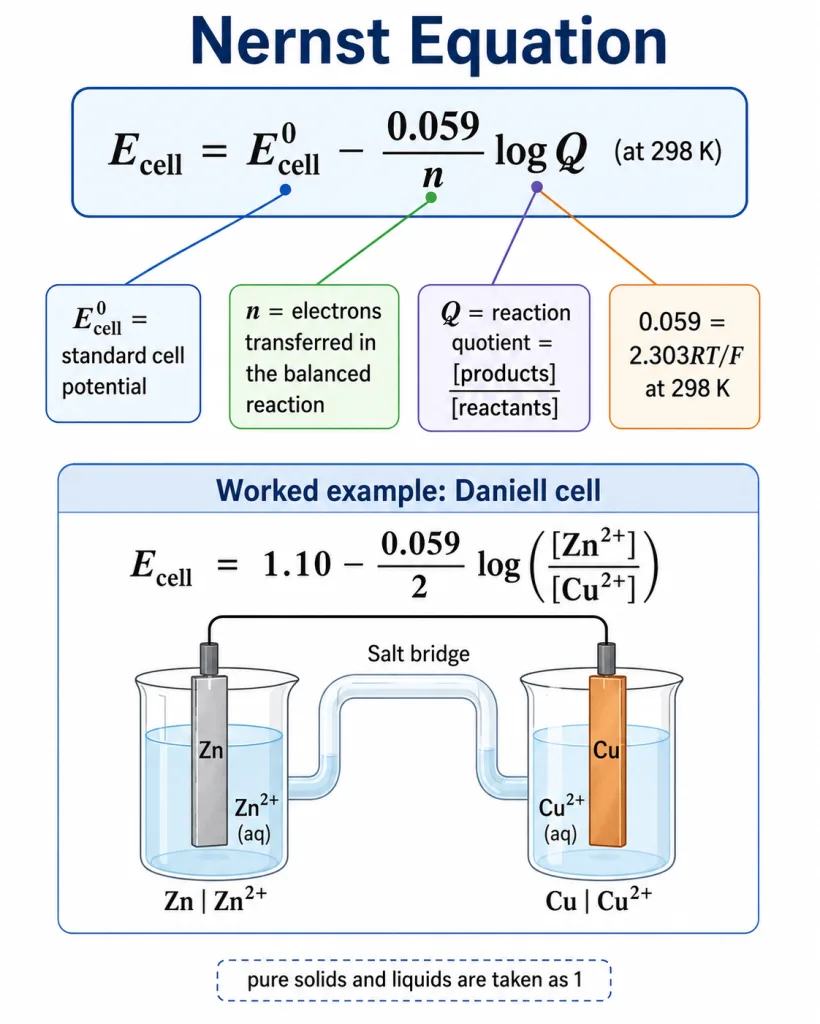
As the cell runs, [Zn2+] rises and [Cu2+] falls, so logQ grows and Ecell decreases — until it reaches zero, at which point the cell is dead (equilibrium).
Solved Examples
Example 1: Electrode potential at non-standard concentration
Calculate the potential of a Zn2+/Zn electrode in 0.1 M Zn2+. (E∘=−0.76 V)
Solution: E=E∘−n0.059log[Zn2+]1, n=2.
E=−0.76−20.059log0.11=−0.76−0.0295×1=−0.7895 V.
Answer: −0.79 V.
Example 2: Cell emf at given concentrations
For Zn | Zn2+(0.1 M) || Cu2+(1.0 M) | Cu, find Ecell. (Ecell∘=1.10 V)
Solution: Ecell=1.10−20.059log[Cu2+][Zn2+]=1.10−0.0295log1.00.1.
=1.10−0.0295(−1)=1.10+0.0295=1.13 V.
Answer: 1.13 V.
Example 3: Effect of dilution on cathode
How does decreasing [Cu2+] affect the Daniell cell emf?
Solution: Ecell=E∘−20.059log[Cu2+][Zn2+]. Lowering [Cu2+] increases Q, so logQ rises and Ecell decreases. (A cathode running low on its ion weakens the cell.)
Example 4: Hydrogen electrode at a given pH
Calculate the potential of a hydrogen electrode in contact with a solution of pH = 5 (H2 at 1 bar).
Solution: For 2H+ + 2e− → H2, E=E∘−20.059log[H+]2pH2 with E∘=0, pH2=1.
=−20.059log[H+]21=−0.059log[H+]1=−0.059×pH.
=−0.059×5=−0.295 V.
Answer: −0.295 V.
Example 5: Concentration cell
A concentration cell has the same metal in both half-cells: Cu | Cu2+(0.01 M) || Cu2+(0.1 M) | Cu. Find Ecell (note Ecell∘=0).
Solution: Ecell=0−20.059log[Cu2+]cathode[Cu2+]anode=−20.059log0.10.01.
=−0.0295×(−1)=+0.0295 V.
Answer: 0.0295 V. (In a concentration cell, the dilute side is the anode and emf comes purely from the concentration difference.)
Example 6: When is the cell dead?
At what value of Ecell has a galvanic cell reached equilibrium ("dead battery")?
Solution: At equilibrium no net reaction occurs and no work can be drawn, so Ecell=0. (Then Q=K, the equilibrium constant.)
Example 7: Finding n from the balanced reaction
For 2Al + 3Cu2+ → 2Al3+ + 3Cu, what value of n goes into the Nernst equation?
Solution: Balance electrons: Al → Al3+ + 3e− (×2 gives 6e−); Cu2+ + 2e− → Cu (×3 gives 6e−). So n = 6 electrons transferred.
Example 8: emf with both concentrations non-standard
For Zn | Zn2+(0.5 M) || Cu2+(0.05 M) | Cu, Ecell∘=1.10 V. Find Ecell.
Solution: Q=0.050.5=10. Ecell=1.10−20.059log10=1.10−0.0295=1.0705 V.
Answer: ≈ 1.07 V.
Example 9: Increasing emf
For the Daniell cell, how should you change [Cu2+] and [Zn2+] to increase the emf?
Solution: Ecell=E∘−20.059log[Cu2+][Zn2+]. To increase Ecell, make Q smaller: increase [Cu2+] and/or decrease [Zn2+].
Example 10: emf of a silver concentration cell
Ag | Ag+(0.001 M) || Ag+(0.1 M) | Ag. Find Ecell (n=1).
Solution: Ecell=−0.059log0.10.001=−0.059log(0.01)=−0.059×(−2)=+0.118 V.
Answer: 0.118 V.
