
Fuel Cells — Electricity Straight from Fuel
Thermal power plants burn fuel to make heat, heat to make steam, steam to spin a turbine — and lose most of the energy at each step (efficiency ~40%). A fuel cell skips all that: it converts the chemical energy of a fuel directly into electricity, far more efficiently and with little pollution.
Fuel cell: a galvanic cell that converts the energy of combustion of a fuel (H₂, CH₄, CH₃OH, etc.) directly into electrical energy, running continuously as long as the reactants are supplied.
The most famous example is the hydrogen-oxygen fuel cell, used to power the Apollo space programme (the water produced was even used as drinking water for astronauts).
The Hydrogen-Oxygen Fuel Cell
Hydrogen and oxygen are bubbled through porous carbon electrodes into concentrated aqueous NaOH. Catalysts of finely divided platinum or palladium speed up the electrode reactions.
- Cathode (reduction):
- Anode (oxidation):
- Overall:
The only product is water — no pollutants.
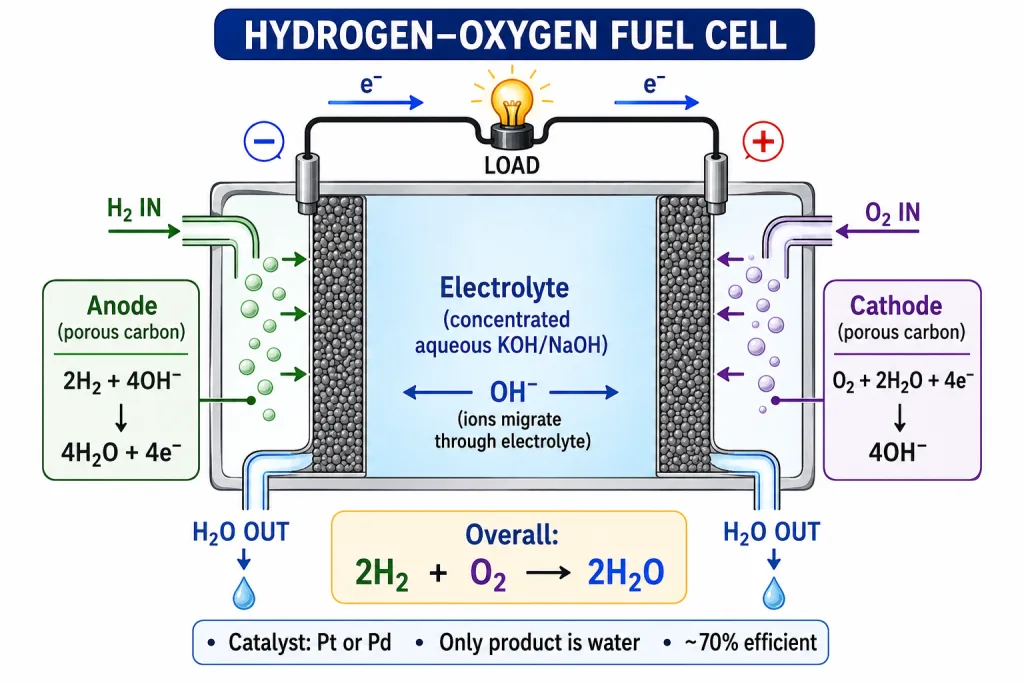
[Board Important] Fuel cells can reach about 70% efficiency, versus about 40% for thermal plants, and are pollution-free. These facts, along with the three electrode reactions, are standard exam points.
Corrosion — An Unwanted Galvanic Cell
Corrosion is the slow oxidation of a metal by its environment, coating it with oxides or salts. Everyday examples: rusting of iron, tarnishing of silver, and the green coating on copper/bronze. It costs the economy enormous sums every year.
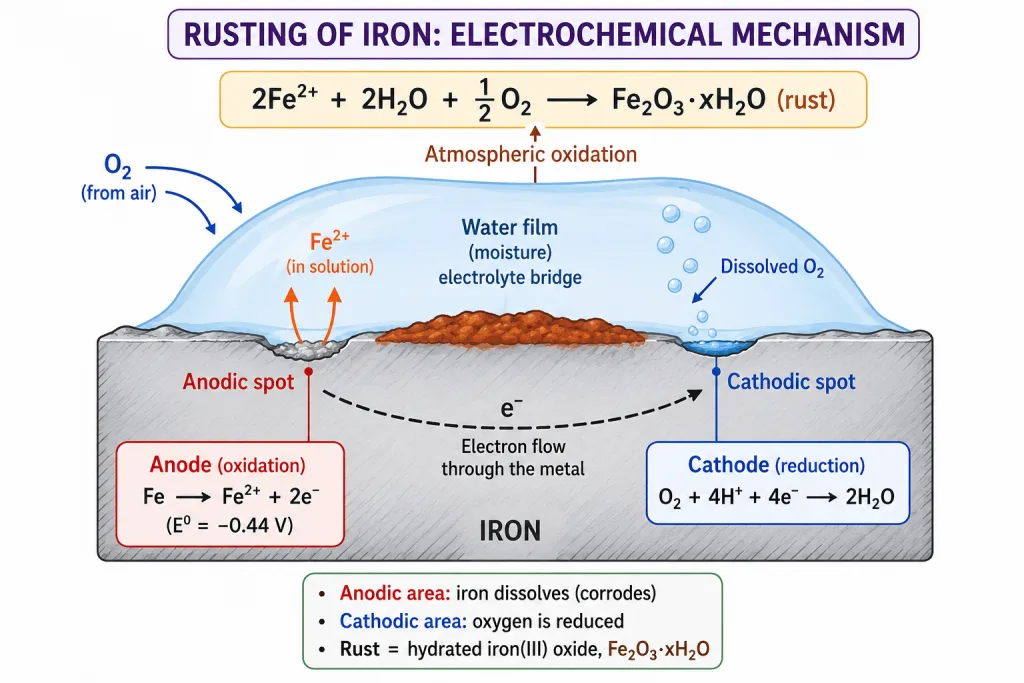
The rusting of iron is essentially a tiny galvanic cell set up on the metal surface in the presence of water and air:
- Anodic spot (oxidation): ( V)
- Cathodic spot (reduction of O₂):
- Atmospheric oxidation:
The Fe²⁺ is further oxidised by atmospheric O₂ to hydrated ferric oxide, Fe₂O₃·xH₂O — rust. Electrons released at the anodic spot travel through the metal to a cathodic spot where oxygen is reduced.
Key Point: Rusting needs both water and oxygen. Salts (electrolytes) speed it up by improving conductivity — which is why iron rusts faster near the sea.
Preventing Corrosion
Because corrosion is electrochemical, we prevent it by blocking the mini-cell:
- Barrier protection — painting, greasing, or coating with another metal (e.g. tin) to keep out air and moisture.
- Galvanisation — coating iron with a layer of zinc. Zinc is more reactive (more negative ), so it corrodes preferentially, protecting the iron even if the coating is scratched.
- Sacrificial protection / cathodic protection — connecting iron to a block of a more reactive metal (Mg or Zn). The reactive metal acts as the anode and is "sacrificed," keeping the iron as the cathode (protected). Used on ships' hulls and underground pipelines.
- Alloying — e.g. stainless steel (Fe + Cr + Ni) resists corrosion.
[NEET Important] Galvanisation and sacrificial protection both work on the same principle: a more reactive metal corrodes in place of iron. The protecting metal must be above iron in the electrochemical series (more negative ) — that's why Zn and Mg are used, not Cu or Sn for sacrificial protection.
Solved Examples
Example 1: Fuel cell electrode reactions
Write the anode and cathode reactions of the H₂-O₂ fuel cell (alkaline electrolyte).
Solution:
- Anode:
- Cathode:
- Overall:
Example 2: Why are fuel cells preferred?
Give two advantages of a fuel cell over a thermal power plant.
Solution: (1) Higher efficiency — about 70% versus about 40% for thermal plants. (2) Pollution-free — the H₂-O₂ cell produces only water, no smoke or CO₂.
Example 3: Product of the H₂-O₂ fuel cell
What is the only product of the hydrogen-oxygen fuel cell, and why was this useful in space missions?
Solution: The only product is water (). In the Apollo programme this water was condensed and used as drinking water for the astronauts.
Example 4: Conditions for rusting
What two substances must both be present for iron to rust?
Solution: Water (moisture) and oxygen (air) must both be present. In their absence (e.g. dry air or oxygen-free water), iron does not rust. Dissolved salts accelerate rusting by improving conductivity.
Example 5: Anode reaction in rusting
Write the reaction occurring at the anodic spot during the rusting of iron and give its standard potential.
Solution: Anodic spot (oxidation): , with V. Iron is oxidised at this spot.
Example 6: Composition of rust
What is the chemical nature of rust?
Solution: Rust is hydrated iron(III) oxide, Fe₂O₃·xH₂O, formed when Fe²⁺ is further oxidised by atmospheric oxygen in the presence of water.
Example 7: How galvanisation protects iron
Explain why a scratched galvanised (zinc-coated) iron sheet still resists rusting.
Solution: Zinc is more reactive than iron (more negative : Zn −0.76 V vs Fe −0.44 V). Even where the coating is scratched, the zinc corrodes preferentially as the anode, protecting the underlying iron (cathode). So the iron is shielded electrochemically, not just physically.
Example 8: Sacrificial protection
Why is a block of magnesium attached to the steel hull of a ship?
Solution: Magnesium is more reactive than iron, so it acts as the sacrificial anode — it corrodes instead of the iron hull, which remains the protected cathode. The Mg block is replaced periodically. This is cathodic (sacrificial) protection.
Example 9: Choosing a sacrificial metal
Which of Cu, Sn, Zn could be used for sacrificial protection of iron, and why?
Solution: Only Zn — it lies above iron in the electrochemical series (more negative ), so it corrodes preferentially. Cu and Sn are less reactive than iron and would not provide sacrificial protection.
Example 10: Cathodic reaction in rusting
Write the reaction at the cathodic spot during rusting and state what is reduced.
Solution: Cathodic spot: . Oxygen is reduced (in the presence of H⁺) using the electrons that travelled through the metal from the anodic spot.