
How Solutions Carry Current
Metals conduct electricity by the flow of electrons. Electrolyte solutions conduct by the flow of ions. This section is about measuring and understanding that ionic conduction — a topic that delivers reliable numerical marks.
Start from Ohm's law. A conductor of resistance obeys . Resistance depends on the conductor's length and cross-sectional area :
where (rho) is the resistivity (units: m). Its reciprocal is the conductivity (kappa):
Conductivity has units S m⁻¹ (siemens per metre), though chemists often use S cm⁻¹. Useful conversion: .
Conductivity () is the conductance of a solution contained in a cube of side 1 m (or 1 cm), i.e. the conductance of a solution of unit length and unit cross-sectional area.
Cell Constant and Conductance
Conductance is the reciprocal of resistance: , units siemens (S).
Combining :
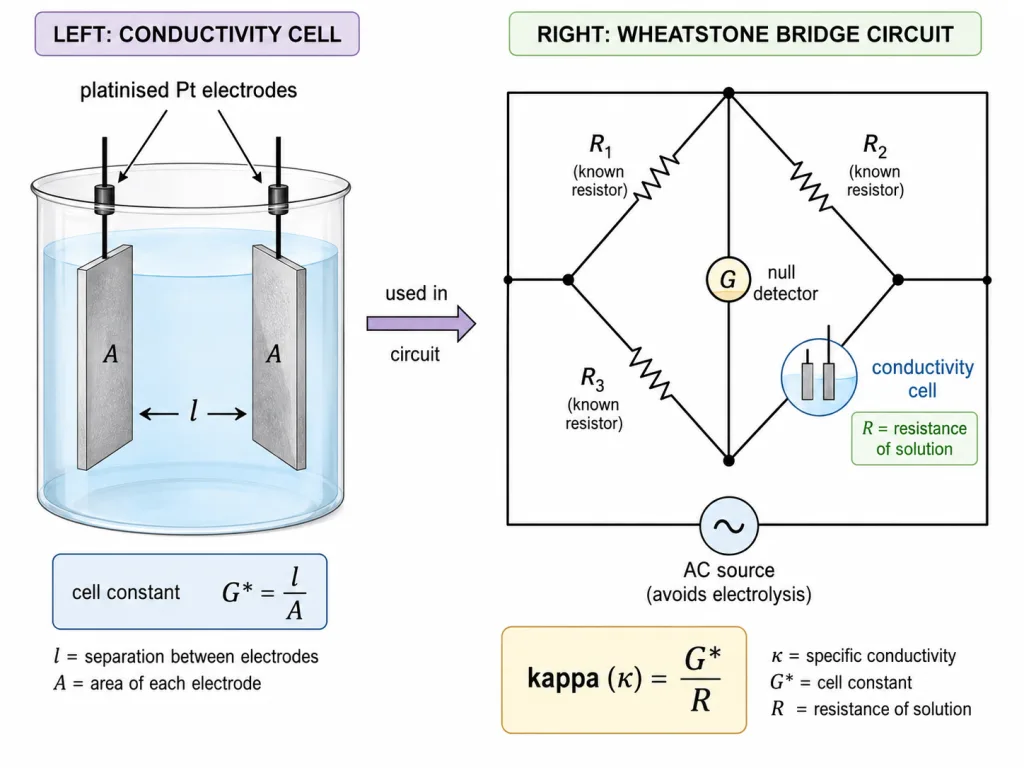
The geometric factor is the cell constant (units: m⁻¹ or cm⁻¹). It depends only on the electrode geometry, so we measure it once using a solution of known conductivity (standard KCl), then use it for all subsequent measurements:
Molar Conductivity
Conductivity alone doesn't fairly compare electrolytes, because it depends on how many ions are present. To compare on a per-mole basis we use molar conductivity (lambda):
where is the concentration. When is in S cm⁻¹ and in mol L⁻¹ (mol dm⁻³), the working formula is:
with in S cm² mol⁻¹. (The 1000 converts litres to cm³: 1 L = 1000 cm³.)
Key Point: Molar conductivity is the conductance contributed by all the ions produced by 1 mole of electrolyte when the solution is considered appropriately diluted; it allows fair comparison of electrolytes.
[JEE Tip] Mind the units. If is given in S m⁻¹ and in mol m⁻³, then directly in S m² mol⁻¹. The factor of 1000 only appears in the S cm⁻¹ / mol L⁻¹ version. Getting this conversion wrong is the single most common error in conductance numericals.
Solved Examples
Example 1: Conductivity from resistance and cell constant
A conductivity cell with cell constant 1.25 cm⁻¹ has a resistance of 100 Ω when filled with a solution. Find the conductivity.
Solution: S cm⁻¹.
Answer: 0.0125 S cm⁻¹.
Example 2: Molar conductivity
The conductivity of a 0.20 M KCl solution at 298 K is 0.0248 S cm⁻¹. Calculate its molar conductivity.
Solution: S cm² mol⁻¹.
Answer: 124 S cm² mol⁻¹.
Example 3: Cell constant from a known solution
A cell filled with 0.1 M KCl (conductivity 1.29 S m⁻¹) has resistance 100 Ω. Find the cell constant.
Solution: m⁻¹.
Answer: 129 m⁻¹ (= 1.29 cm⁻¹).
Example 4: Conductance to conductivity
A solution in a cell of cell constant 0.5 cm⁻¹ has conductance S. Find its conductivity.
Solution: S cm⁻¹.
Answer: S cm⁻¹.
Example 5: Molar conductivity with unit care
The conductivity of 0.001 M acetic acid is S cm⁻¹. Find its molar conductivity.
Solution: S cm² mol⁻¹.
Answer: 49.5 S cm² mol⁻¹.
Example 6: Resistance from conductivity
A 0.1 M solution has conductivity 0.012 S cm⁻¹ in a cell of cell constant 1.5 cm⁻¹. Find the resistance.
Solution: .
Answer: 125 Ω.
Example 7: Converting conductivity units
Convert a conductivity of 0.025 S cm⁻¹ into S m⁻¹.
Solution: , so S m⁻¹.
Answer: 2.5 S m⁻¹.
Example 8: Molar conductivity in SI units
A 0.5 mol m⁻³ solution has conductivity S m⁻¹. Find in S m² mol⁻¹.
Solution: S m² mol⁻¹.
Answer: S m² mol⁻¹.
Example 9: Conductance of a solution
A solution has resistance 50 Ω. What is its conductance?
Solution: S.
Answer: 0.02 S.
Example 10: Finding concentration from molar conductivity
A KCl solution has conductivity 0.014 S cm⁻¹ and molar conductivity 140 S cm² mol⁻¹. Find its concentration.
Solution: mol L⁻¹.
Answer: 0.1 M.