
When Molar Masses Come Out "Wrong"
Every colligative formula so far assumed the solute dissolves as simple, intact molecules that neither split apart nor stick together. But many real solutes break this assumption — and when they do, the molar mass you calculate from a colligative property is abnormal (either too low or too high).
Two things can happen in solution:
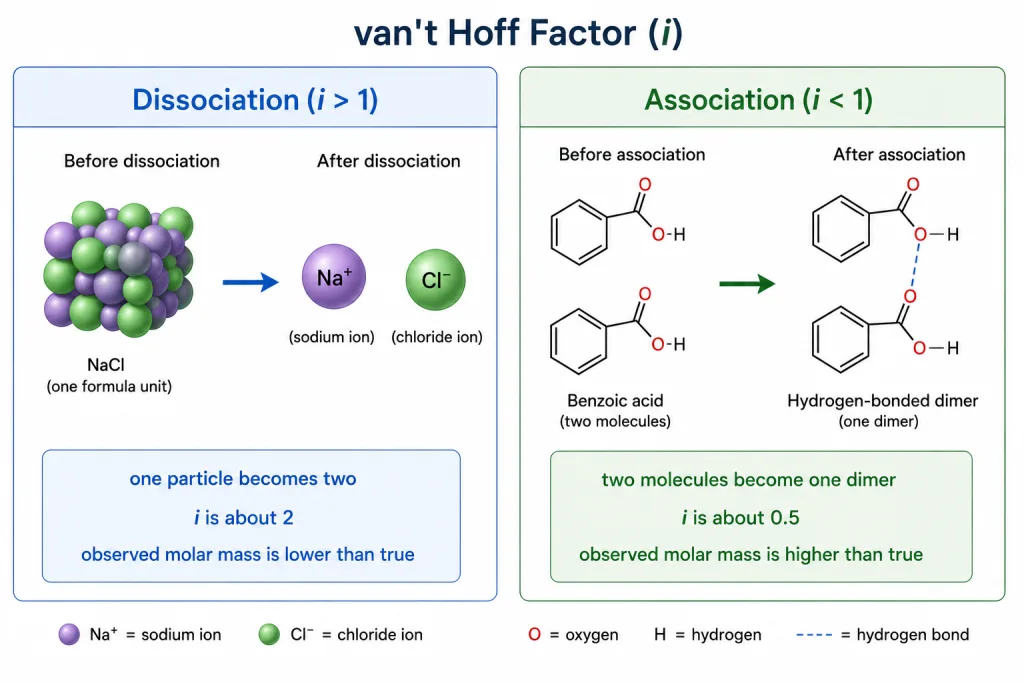
- Dissociation: an electrolyte splits into ions. 1 mol of NaCl gives about 2 mol of particles (Na + Cl); 1 mol of CaCl gives about 3 mol. More particles than expected → colligative effect is larger → calculated molar mass is smaller than the true value.
- Association: molecules clump together. In benzene, benzoic acid pairs up into dimers, so 1 mol of molecules behaves like about 0.5 mol of particles. Fewer particles than expected → colligative effect is smaller → calculated molar mass is larger than the true value.
Key Point: Colligative properties count particles. Anything that changes the particle count away from "one molecule = one particle" makes the experimentally determined molar mass abnormal.
The van't Hoff Factor (i)
To fix the formulas, van't Hoff introduced a correction factor :
Equivalently, in terms of measurable quantities:
Reading the value of :
- → dissociation (e.g. NaCl: ; CaCl: ; KSO: ).
- → association (e.g. benzoic acid dimer in benzene: ).
- → normal (no dissociation or association; e.g. glucose, urea).
All four colligative equations get an in front:
Degree of Dissociation and Association
The factor is linked to how much the solute dissociates or associates.
For dissociation — if one molecule gives ions and a fraction (degree of dissociation) dissociates:
So for NaCl (): . For full dissociation () of NaCl, .
For association — if molecules associate into one and a fraction (degree of association) associates:
For benzoic acid dimerising (): . Full dimerisation () gives .
[JEE Tip] These two formulas are heavily tested. Identify (number of ions for dissociation, or molecules per associated unit) and whether the process is dissociation () or association () before plugging in.
Putting It All Together
A complete recipe for an abnormal-molar-mass problem:
- Compute the normal (theoretical) value of the colligative property assuming no dissociation/association.
- Compare with the observed value to get (= observed/normal).
- Find from (dissociation) or (association).
- Or get the abnormal molar mass directly from .
Why this matters: the van't Hoff factor reconnects the "clean" colligative formulas to messy real solutions. It explains why a 1 molal salt solution depresses the freezing point far more than a 1 molal sugar solution, and it's the key to almost every tricky colligative numerical in JEE and NEET.
[NEET Important] Order of for strong electrolytes at the same concentration: Al(SO) (5 ions) > KSO / NaPO (4 ions for NaPO; 5 ions for Al(SO)) > NaCl (2 ions) > glucose (1). More ions → larger → greater colligative effect. Ranking colligative effects = ranking total particle count ( concentration).
Solved Examples
Example 1: van't Hoff factor for a strong electrolyte
Predict the van't Hoff factor for (a) NaCl, (b) CaCl, (c) K[Fe(CN)], assuming complete dissociation.
Solution: = number of ions produced per formula unit (complete dissociation):
- (a) NaCl → Na + Cl → .
- (b) CaCl → Ca + 2Cl → .
- (c) K[Fe(CN)] → 4K + [Fe(CN)] → .
Answer: 2, 3 and 5 respectively.
Example 2: Degree of dissociation from i
A 0.1 m solution of a weak electrolyte AB shows . AB dissociates as AB → A + B. Find the degree of dissociation.
Solution:
- Formula: , with .
- .
- .
Answer: (60% dissociated).
Example 3: Freezing-point depression of an electrolyte
Calculate the freezing point depression of a 0.1 molal NaCl solution, assuming complete dissociation. ( water = 1.86 K kg mol)
Solution:
- For NaCl, (complete dissociation).
- K.
Answer: 0.372 K (about double the 0.186 K a non-electrolyte would give).
Example 4: Association of benzoic acid
Benzoic acid (M = 122) dimerises in benzene. A solution shows an observed (apparent) molar mass of 244 g mol. Find and the degree of association.
Solution:
- .
- For dimerisation : .
- .
Answer: , degree of association (complete dimerisation).
Example 5: Abnormal molar mass from i
A solute has a normal molar mass of 100 g mol. In solution its van't Hoff factor is found to be . What apparent (observed) molar mass would a colligative experiment give?
Solution:
- g mol.
Answer: 40 g mol. (Dissociation lowers the apparent molar mass.)
Example 6: Osmotic pressure with dissociation
Calculate the osmotic pressure of a 0.01 M CaCl solution at 300 K, assuming complete dissociation. ()
Solution:
- CaCl → Ca + 2Cl, so .
- atm.
Answer: ≈ 0.739 atm.
Example 7: Boiling point elevation of an electrolyte
Find the boiling point elevation of a 0.5 molal KSO solution, assuming complete dissociation. ( water = 0.52 K kg mol)
Solution:
- KSO → 2K + SO, so .
- K.
Answer: 0.78 K.
Example 8: Degree of dissociation of CaCl2 from i
A 0.1 m CaCl solution has van't Hoff factor . Find its degree of dissociation. (CaCl → 3 ions)
Solution:
- , .
- .
Answer: (80% dissociated).
Example 9: Ranking colligative effects
Arrange these 0.1 m aqueous solutions in increasing order of freezing-point depression: glucose, NaCl, CaCl. Assume complete dissociation.
Solution: . At equal molality, compare :
- glucose: .
- NaCl: .
- CaCl: .
So : glucose < NaCl < CaCl.
Answer: glucose < NaCl < CaCl.
Example 10: Finding true molar mass despite dissociation
A 0.2 g sample of an unknown electrolyte (which dissociates into 2 ions, ) in 100 g of water depresses the freezing point by 0.0744 K. Find its true molar mass. ()
Solution:
- Use .
- .
- .
- g mol.
Answer: true molar mass = 100 g mol (the correctly accounts for dissociation).