
The Whole Chapter in One Glance
This is your morning-of-the-exam capsule. Everything in Solutions hangs off a few core ideas: a solution is a homogeneous mixture; concentration can be expressed in many ways; gases follow Henry's law; liquid mixtures follow Raoult's law; and a non-volatile solute changes four colligative properties that let us find molar masses — with the van't Hoff factor correcting for ions and dimers.
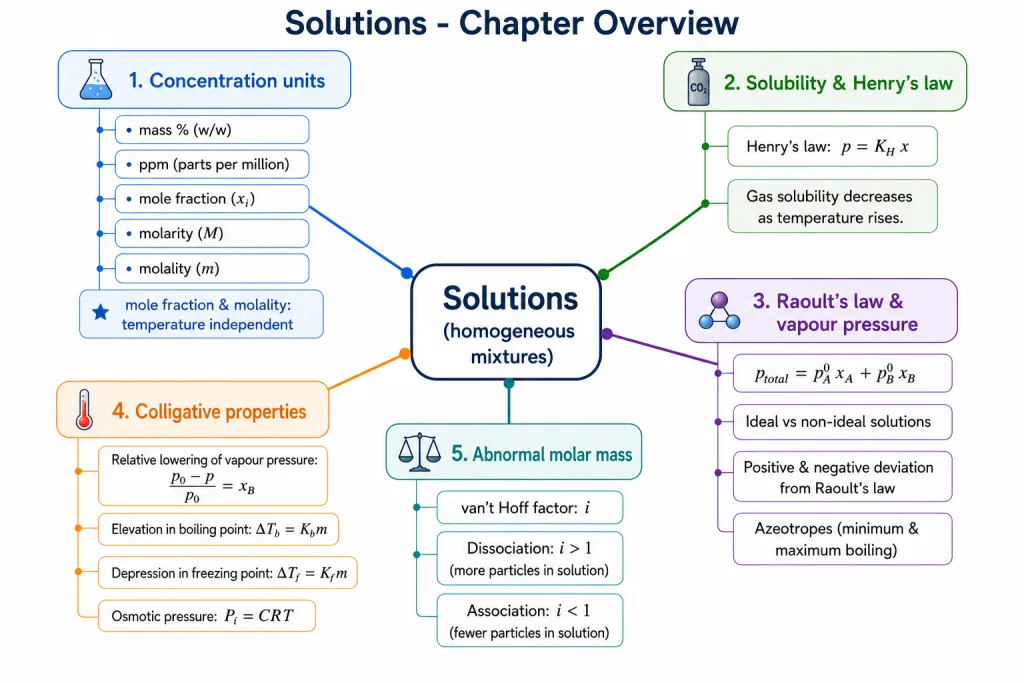
Keep this map in your head; every number and concept slots into one of these five branches.
Master Formula Sheet
Concentration
- Mass %:
- Mole fraction: , with
- Molarity: (temperature-dependent)
- Molality: (temperature-independent)
Henry's law: (higher means lower solubility; increases with temperature)
Raoult's law: ; for two volatile liquids ; vapour composition
Colligative properties
- Relative lowering:
- Boiling-point elevation:
- Freezing-point depression:
- Osmotic pressure:
With van't Hoff factor (multiply each): , , , relative lowering
- Dissociation: ()
- Association: ()
Constants: (water) , (water) K kg mol; L atm K mol L bar K mol.
Quick Comparison Tables
Ideal vs Non-ideal solutions
| Feature | Ideal | Positive deviation | Negative deviation |
|---|---|---|---|
| Raoult's law | obeyed throughout | not obeyed (p higher) | not obeyed (p lower) |
| A-B forces vs A-A, B-B | equal | weaker | stronger |
| 0 | > 0 (endothermic) | < 0 (exothermic) | |
| 0 | > 0 | < 0 | |
| Example | benzene + toluene | ethanol + acetone | chloroform + acetone |
| Azeotrope | none | minimum-boiling | maximum-boiling |
van't Hoff factor at a glance
| Solute behaviour | Example | Effect on observed molar mass | |
|---|---|---|---|
| No change | glucose, urea | normal | |
| Dissociation | NaCl (2), CaCl (3), Al(SO) (5) | lower than true | |
| Association | benzoic acid in benzene (0.5) | higher than true |
Temperature dependence of concentration units
| Unit | Temperature-dependent? |
|---|---|
| Mass %, mole fraction, molality | No |
| Molarity, normality, w/v % | Yes |
Last-Minute Memory Hooks
- MolaRity → litRe of solution → changes with R (temperature). MolaLity → kiLogram of solvent → constant.
- Henry: big means low solubility. Warm drink = flat drink (gas less soluble when hot).
- Positive deviation = weaker forces = escape easier = higher vapour pressure = minimum-boiling azeotrope. (Ethanol-acetone.)
- Negative deviation = stronger forces (new H-bond) = lower vapour pressure = maximum-boiling azeotrope. (Chloroform-acetone, HNO-water.)
- Colligative properties count particles. Same moles of glucose and urea → same effect. NaCl → about double particles; CaCl → about triple.
- Osmotic pressure is especially useful for very large molecules (proteins, polymers); , measured at a fixed temperature.
- for water (1.86 vs 0.52) → freezing-point method is more sensitive.
- : dissociation pushes it above 1, association below 1, no change keeps it at 1.
One-line revision flow for the exam hall: Concentration → Henry (gases) → Raoult (liquids) → ideal/non-ideal & azeotropes → four colligative properties → van't Hoff correction. If you can recite that chain and the boxed formulas above, you have the chapter.