
Osmosis — The Fourth Colligative Property
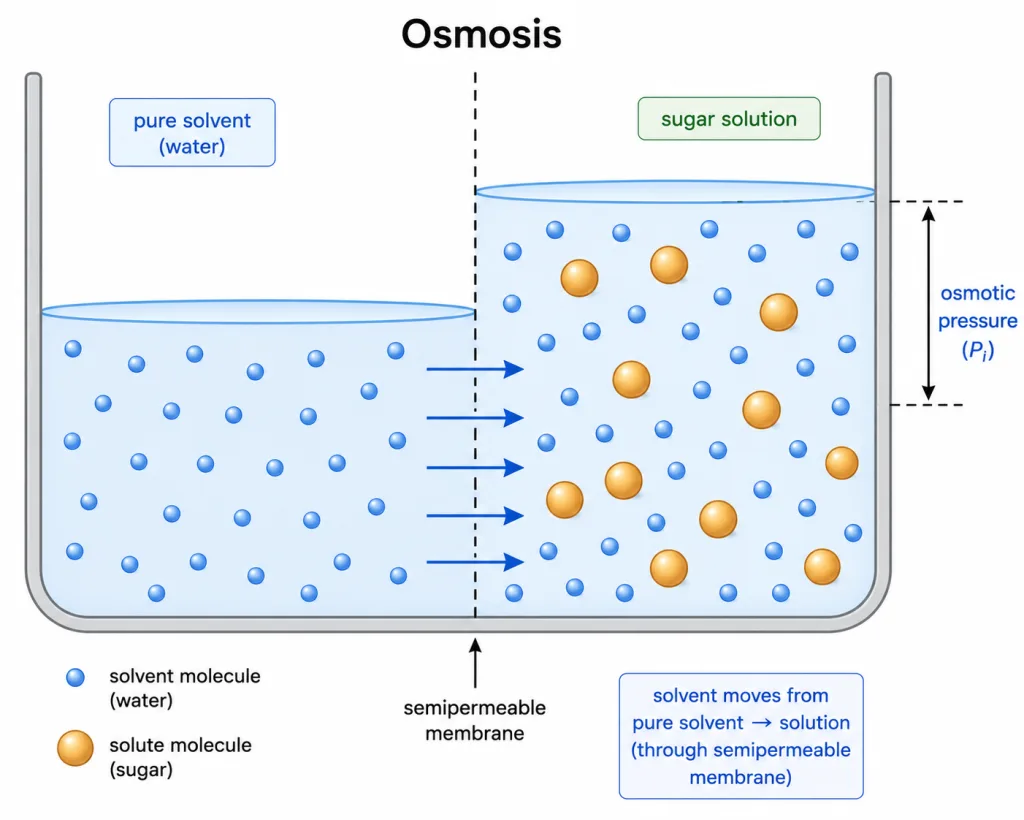
Picture a container split by a special wall that lets solvent molecules through but blocks solute molecules. This is a semipermeable membrane (SPM) — think of a cell membrane, or pig's bladder, or cellophane.
Put pure water on one side and a sugar solution on the other. Water spontaneously flows into the solution through the membrane, trying to dilute it. This net flow of solvent through a semipermeable membrane, from a region of lower solute concentration to higher solute concentration, is osmosis.
Osmosis: the spontaneous flow of solvent molecules through a semipermeable membrane from pure solvent (or dilute solution) into a more concentrated solution.
The flow raises the liquid level on the solution side. The extra pressure that builds up — and which, if applied externally, would just stop the inflow — is the osmotic pressure (). It is this measurable pressure that makes osmosis the fourth, and often most useful, colligative property.
The Osmotic Pressure Equation
For a dilute solution, osmotic pressure follows an equation that looks remarkably like the ideal gas law:
- = osmotic pressure.
- = molar concentration (molarity) .
- = gas constant ( L atm K mol, or L bar K mol).
- = absolute temperature in kelvin.
Since , we can solve for molar mass:
Key Point — why osmotic pressure is the champion for big molecules: osmotic pressure is large and easily measured even for very dilute solutions of high-molar-mass solutes (proteins, polymers), where and are far too small to detect. It's also measured at room temperature, avoiding heat damage to biological samples.
[JEE Tip] Match your to your pressure units: use for in atm, and for in bar. Temperature must be in kelvin ().
Isotonic, Hypertonic, Hypotonic
Two solutions are compared by their osmotic pressures:
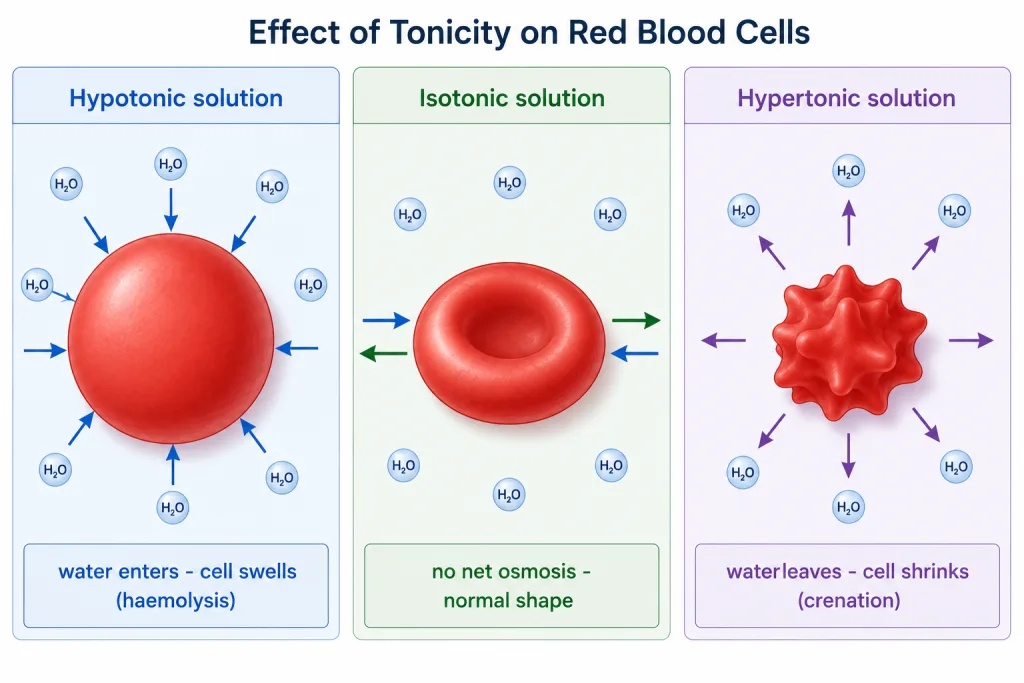
- Isotonic — same osmotic pressure; no net osmosis between them. (A 0.9% w/v NaCl "normal saline" is isotonic with blood — that's why IV fluids use it.)
- Hypertonic — higher osmotic pressure (more concentrated). A cell placed in a hypertonic solution loses water and shrinks (crenation / plasmolysis).
- Hypotonic — lower osmotic pressure (more dilute). A cell placed in a hypotonic solution gains water and swells (may burst / haemolysis).
This biology is exam-favourite: red blood cells in pure water swell and burst; in concentrated salt they shrivel. Putting salt on food or sugar on fruit draws water out of microbes by osmosis — which is how salting and candying preserve food.
Reverse Osmosis and Water Purification
Osmosis runs solvent into the concentrated solution. But if you apply an external pressure on the solution side greater than its osmotic pressure, you reverse the flow — solvent is squeezed out of the solution, through the membrane, leaving the solute behind. This is reverse osmosis (RO).
Its biggest use: desalination of seawater. Pushing seawater against a suitable membrane at high pressure produces pure water on the other side, while salts stay behind. Home RO water purifiers work the same way.
Osmotic pressure as a colligative property: like the other three, depends on the number of solute particles (), not their nature. For electrolytes it is multiplied by the van't Hoff factor: (Section 9).
[NEET Important] Remember the directions: osmosis = solvent flows into the solution (spontaneous); reverse osmosis = external pressure > forces solvent out of the solution. Desalination uses reverse osmosis.
Solved Examples
Example 1: Osmotic pressure, direct
Calculate the osmotic pressure of a 0.1 M solution at 300 K. ( L atm K mol)
Solution:
- Formula: .
- atm.
Answer: atm.
Example 2: Molar mass from osmotic pressure
A solution containing 6.0 g of a solute in 1.0 L of solution has an osmotic pressure of 1.0 atm at 300 K. Find the molar mass. ()
Solution:
- Formula: .
- g mol.
Answer: g mol.
Example 3: Protein molar mass (why osmosis wins)
1.0 g of a protein in 100 mL of solution shows an osmotic pressure of atm at 300 K. Find the protein's molar mass. ()
Solution:
- mL L.
- .
- Numerator ; denominator .
- g mol.
Answer: g mol. Such a huge molar mass could never be found from — this is why osmosis is used for macromolecules.
Example 4: Isotonic solutions
A solution of urea () is isotonic with a 0.05 M glucose solution at the same temperature. Find the concentration of the urea solution.
Solution: Isotonic means equal osmotic pressure, so (at equal ) equal molar concentration: M. (Both are non-electrolytes, .)
Answer: M.
Example 5: Osmotic pressure in bar
Find the osmotic pressure of a 0.2 M cane-sugar solution at 27 °C. ( L bar K mol)
Solution:
- K.
- bar.
Answer: bar.
Example 6: Concentration from osmotic pressure
An aqueous solution exerts an osmotic pressure of 3.0 atm at 300 K. What is its molar concentration? ()
Solution:
- M.
Answer: M.
Example 7: Hypertonic / hypotonic prediction
A red blood cell is placed in distilled water. What happens, and why?
Solution: Distilled water is hypotonic relative to the cell's contents (lower osmotic pressure outside). Water flows into the cell by osmosis; the cell swells and may burst (haemolysis).
Answer: the cell swells and can burst.
Example 8: Why normal saline for IV drips?
Why are intravenous fluids prepared as 0.9% (w/v) NaCl rather than pure water?
Solution: 0.9% NaCl ("normal saline") is isotonic with blood plasma — equal osmotic pressure — so there is no net osmosis into or out of blood cells, keeping them intact. Pure water would be hypotonic and burst the cells; concentrated salt would shrivel them.
Example 9: Reverse osmosis pressure
Seawater has an osmotic pressure of about 30 atm. What minimum pressure must be applied to desalinate it by reverse osmosis, and in which direction does water then flow?
Solution: To reverse the natural osmosis, the applied pressure must exceed the osmotic pressure, i.e. greater than 30 atm. Under that pressure, water flows out of the seawater through the membrane, leaving salts behind and yielding pure water.
Answer: more than 30 atm; water leaves the salt solution (reverse osmosis).
Example 10: Comparing osmotic pressures
Two solutions at the same temperature have concentrations 0.1 M and 0.3 M (both non-electrolytes). Which is hypertonic, and what happens if they are separated by a semipermeable membrane?
Solution: , so the 0.3 M solution has the higher osmotic pressure — it is hypertonic; the 0.1 M is hypotonic. Solvent flows from the 0.1 M side into the 0.3 M side until the pressures balance.
Answer: 0.3 M is hypertonic; water moves from the 0.1 M to the 0.3 M solution.