
What Makes a Property "Colligative"?
We've arrived at the heart of the chapter. When you dissolve a non-volatile solute in a solvent, four properties of the solution change in a very special way:
- Relative lowering of vapour pressure
- Elevation of boiling point
- Depression of freezing point
- Osmotic pressure
These are the colligative properties.
A colligative property depends only on the number of solute particles in solution, not on their chemical nature.
Think of it this way: to the solvent, it doesn't matter whether the dissolved particles are sugar molecules or urea molecules or sodium ions — what matters is how many particles are getting in the way. One mole of dissolved particles produces the same effect regardless of identity. That's why colligative properties are such a powerful tool for finding molar masses: count the effect, work back to the number of particles, and you get the molar mass.
This section covers the first one: relative lowering of vapour pressure.
Deriving Relative Lowering of Vapour Pressure
From Section 4, a non-volatile solute lowers the solvent's vapour pressure to . The lowering of vapour pressure is:
Since , we have . So:
The left side is the relative lowering of vapour pressure. This elegant result says it equals the mole fraction of the solute — a pure count of particles, exactly as a colligative property should be. [NEET Important] This is the equation examiners ask you to derive; know every step.
The working formula for molar mass
For a dilute solution, . Writing moles as mass/molar-mass:
Rearranged to find the solute's molar mass :
where are masses of solute and solvent, and is the solvent's molar mass.
Using the Method
The relative-lowering method was historically one of the first ways to measure molar masses of non-volatile, non-electrolyte solutes.
A typical experiment measures the vapour pressure of the pure solvent () and of the solution (), knows the masses dissolved, and solves for .
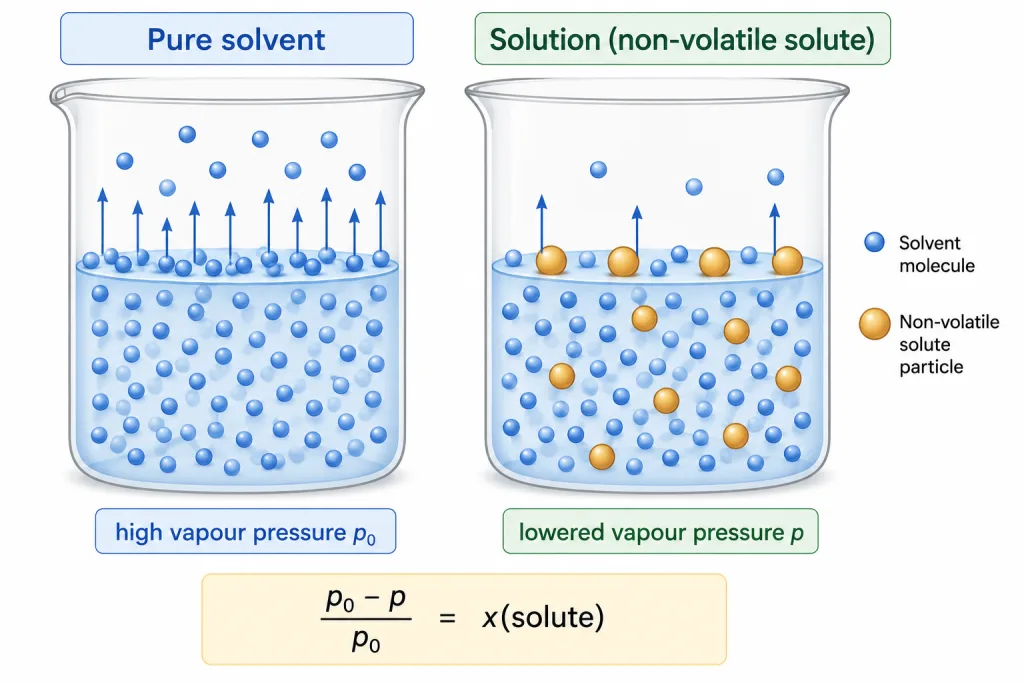
Key Point: The relative lowering depends only on the mole fraction of solute — double the number of solute particles and you double the lowering, regardless of what those particles are. (For electrolytes that dissociate into ions, the number of particles rises — handled by the van't Hoff factor in Section 9.)
[JEE Tip] Watch the wording: "lowering of vapour pressure" is (has units), while "relative lowering" is the dimensionless ratio . Mixing these up is the most common slip in this section.
Solved Examples
Example 1: Relative lowering from data
The vapour pressure of pure benzene is 0.850 bar. On dissolving a non-volatile solute, it falls to 0.845 bar. Find the relative lowering and the mole fraction of solute.
Solution:
- Relative lowering .
- By the formula, this equals the mole fraction of solute: .
Answer: relative lowering .
Example 2: Molar mass from vapour-pressure lowering
The vapour pressure of pure benzene (M = 78 g mol) is 0.850 bar. When 0.5 g of a non-volatile solute is dissolved in 39 g of benzene, the vapour pressure becomes 0.845 bar. Find the molar mass of the solute.
Solution:
- Formula: (dilute).
- Numbers: .
- Left side . Right side .
- So g mol.
Answer: g mol.
Example 3: Vapour pressure of solution given solute molar mass
Find the vapour pressure of a solution containing 0.1 mol of a non-volatile solute in 0.9 mol of solvent whose pure vapour pressure is 200 mm Hg.
Solution:
- Mole fraction of solvent .
- Vapour pressure mm Hg.
Answer: 180 mm Hg (lowered by 20 mm Hg).
Example 4: Find solute mole fraction from lowering
Pure water's vapour pressure at 298 K is 23.8 mm Hg. A solution's vapour pressure is 23.4 mm Hg. Find the mole fraction of the solute.
Solution: .
Answer: .
Example 5: Molar mass with water as solvent
50 g of a non-volatile solute is dissolved in 850 g of water. The vapour pressure falls from 23.8 mm Hg (pure) to 23.5 mm Hg. Find the molar mass of the solute. (M of water = 18)
Solution:
- Relative lowering .
- Dilute formula: .
- mol.
- g mol.
Answer: g mol.
Example 6: Effect of doubling the solute
If the amount of non-volatile solute in a dilute solution is doubled (solvent unchanged), what happens to the relative lowering of vapour pressure?
Solution: Relative lowering . Doubling doubles the relative lowering. (Colligative properties scale with the number of solute particles.)
Answer: it doubles.
Example 7: Lowering vs relative lowering
For a solution, mm Hg and mm Hg. State (a) the lowering of vapour pressure and (b) the relative lowering.
Solution: (a) Lowering mm Hg. (b) Relative lowering (dimensionless).
Takeaway: "Lowering" carries units; "relative lowering" is a pure ratio equal to .
Example 8: Number of moles of solute from lowering
A solution made with 100 g water (M = 18) shows a relative lowering of 0.01. Estimate the moles of solute (dilute approximation).
Solution:
- mol.
- Relative lowering mol.
Answer: ≈ 0.056 mol of solute.
Example 9: Predicting vapour pressure for a given molar mass
18 g of a non-volatile, non-electrolyte solute (M = 60 g mol) is dissolved in 360 g of water (M = 18). Pure water vapour pressure is 24.0 mm Hg. Find the vapour pressure of the solution.
Solution:
- Moles: solute ; water .
- Mole fraction of water .
- Vapour pressure mm Hg.
Answer: ≈ 23.65 mm Hg.
Example 10: Why relative lowering identifies particle number, not identity
Two solutions are prepared with the same number of moles of solute in equal amounts of the same solvent — one solute is glucose, the other urea. Compare their relative lowering of vapour pressure.
Solution: Relative lowering depends only on the mole fraction (number) of solute particles, not their chemical identity. With equal moles in equal solvent, both give the same relative lowering. (This is the defining feature of a colligative property.)