
Vapour Pressure — The Starting Point
Before we can understand colligative properties, we need one key idea: vapour pressure.
Put a liquid in a closed container. Some fast-moving molecules escape into the space above as vapour; some vapour molecules fall back in. When the two rates balance, the vapour exerts a constant pressure called the vapour pressure of the liquid at that temperature.
Vapour pressure is the pressure exerted by the vapour of a liquid in equilibrium with the liquid at a given temperature.
A liquid with high vapour pressure (like ether) evaporates easily — it is volatile. A liquid with low vapour pressure (like glycerol) is non-volatile. Vapour pressure always increases with temperature (more molecules have enough energy to escape).
This section asks: what happens to vapour pressure when we make a solution of two liquids, or dissolve a solid in a liquid? The answer is Raoult's law.
Raoult's Law for Two Volatile Liquids
Consider a binary solution of two volatile liquids A and B (both can evaporate). Raoult's law states:
For each volatile component, its partial vapour pressure is proportional to its mole fraction in the solution.
where are the vapour pressures of the pure liquids, and their mole fractions in solution.
By Dalton's law of partial pressures, the total vapour pressure is the sum:
Since , we can write and get a neat linear form:
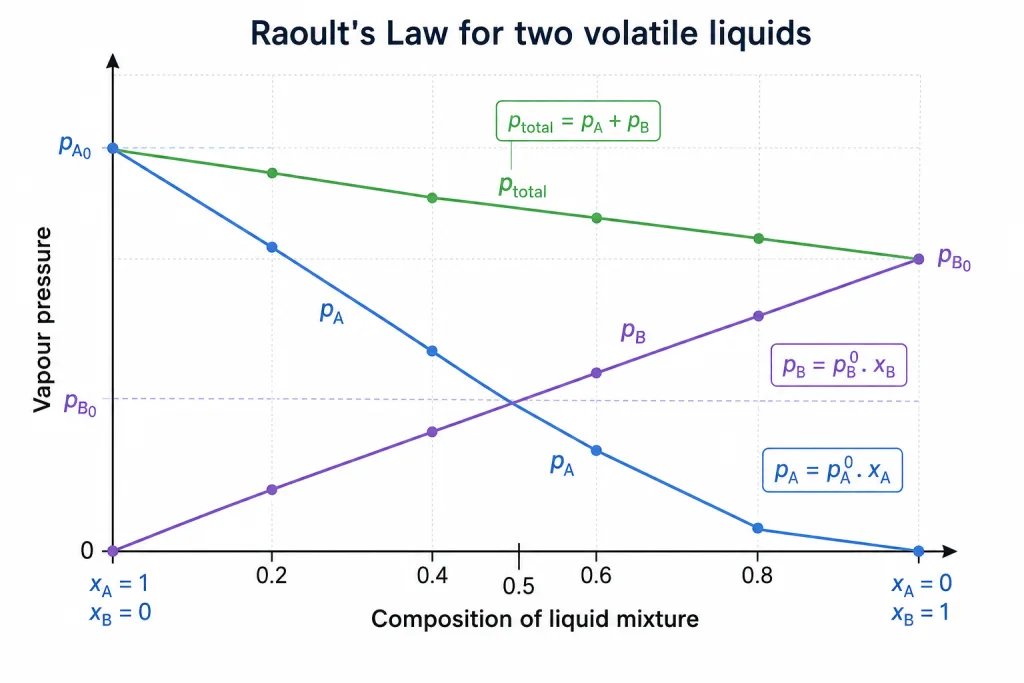
[JEE Tip] A plot of against is a straight line for an ideal solution. The partial pressures and are also straight lines. Spotting a straight-line -vs- plot is the fastest way to recognise Raoult's-law (ideal) behaviour.
Composition of the Vapour Phase
The vapour above the solution is richer in the more volatile component. Using Dalton's law, the mole fraction of A in the vapour () is:
Because the component with the higher contributes a larger share of the vapour, the vapour is enriched in the more volatile liquid relative to the solution. This is the basis of fractional distillation — repeated condensation and re-vaporisation to separate the components.
Key Point: Liquid-phase composition uses ; vapour-phase composition uses . Don't mix the symbols. .
Raoult's Law for a Non-volatile Solute in a Volatile Solvent
Now dissolve a non-volatile solute (like sugar or urea) in a volatile solvent (water). The solute contributes no vapour, so only the solvent evaporates. Raoult's law reduces to:
where A is the solvent. Since whenever solute is present, the vapour pressure of the solution is always lower than that of the pure solvent. The solute particles occupy part of the surface, so fewer solvent molecules escape.
This lowering of vapour pressure is the root cause of all four colligative properties in the sections ahead. Rearranging gives the relative lowering of vapour pressure:
[NEET Important] Connect the dots: Raoult's law for a volatile solute () is the limiting case of Henry's law () where . Same straight-line form; only the constant differs.
Solved Examples
Example 1: Total vapour pressure of an ideal binary solution
At 300 K, two volatile liquids A and B have pure vapour pressures mm Hg and mm Hg. A solution contains 2 mol of A and 3 mol of B. Find the total vapour pressure.
Solution:
- Mole fractions: , .
- Partial pressures: mm Hg; mm Hg.
- Total: mm Hg.
Answer: 220 mm Hg.
Example 2: Composition of the vapour
For the solution in Example 1, find the mole fraction of B in the vapour phase.
Solution: .
Answer: . The vapour (0.82) is richer in the more volatile B than the liquid (0.60) — exactly as expected.
Example 3: Vapour pressure lowering by a non-volatile solute
The vapour pressure of pure water at 298 K is 23.8 mm Hg. What is the vapour pressure of a solution in which the mole fraction of water is 0.98?
Solution:
- Formula: .
- Compute: mm Hg.
Answer: 23.32 mm Hg — lower than pure water, as Raoult's law predicts.
Example 4: Finding pure-component vapour pressures from two data points
The vapour pressures of pure liquids A and B are unknown. For , mm Hg; for , mm Hg. Find and .
Solution:
- Linear form: .
- Equation 1: . Equation 2: .
- Subtract: .
- Back-substitute in Eq 2: mm Hg.
- Then mm Hg.
Answer: mm Hg, mm Hg.
Example 5: Heptane-octane solution
Heptane and octane form an ideal solution. At 373 K, kPa and kPa. A solution has 0.25 mol heptane and 0.35 mol octane. Find the total vapour pressure.
Solution:
- Mole fractions: total = 0.60 mol; , .
- Partials: kPa; kPa.
- Total: kPa.
Answer: ≈ 71.1 kPa.
Example 6: Why vapour is richer in the volatile component
For the heptane-octane solution above, compare the heptane mole fraction in the liquid and in the vapour.
Solution:
- Liquid: .
- Vapour: . The vapour (0.616) is much richer in heptane (the more volatile, higher- component) than the liquid (0.417). This is the principle behind fractional distillation.
Example 7: Mole fraction of solute from vapour-pressure lowering
A non-volatile solute lowers the vapour pressure of a solvent from 100 mm Hg (pure) to 80 mm Hg. Find the mole fraction of the solute.
Solution:
- Relative lowering: .
- Compute: .
Answer: .
Example 8: Raoult's law as a special case of Henry's law
State the connection between Raoult's law and Henry's law.
Solution: Henry's law: . Raoult's law: . For a volatile component, Raoult's law is the special case in which the Henry constant equals the pure-component vapour pressure (). Both give a straight-line -vs- relationship through the origin.
Example 9: Predicting total pressure across composition
For two liquids with kPa and kPa, write as a function of and find at , and .
Solution:
- Linear form: .
- At : kPa (pure B). At : kPa. At : kPa (pure A).
Answer: A straight line from 60 kPa (pure B) to 80 kPa (pure A) — the signature of an ideal solution.
Example 10: Vapour pressure of solution from masses
18 g of glucose (M = 180 g mol, non-volatile) is dissolved in 178.2 g of water (M = 18) at 298 K, where pure water's vapour pressure is 23.8 mm Hg. Find the solution's vapour pressure.
Solution:
- Moles: glucose ; water .
- Mole fraction of water: .
- Vapour pressure: mm Hg.
Answer: 23.56 mm Hg.