
Boiling and Freezing Points Shift Too
A non-volatile solute lowers vapour pressure (Section 6). That single change has two more consequences: it raises the boiling point and lowers the freezing point of the solvent. These are the second and third colligative properties.
Let's see why intuitively. A liquid boils when its vapour pressure equals the atmospheric pressure. Adding solute lowers the vapour pressure at every temperature, so you have to heat the solution hotter to push its vapour pressure back up to 1 atm — the boiling point rises. Likewise, the solute interferes with the solvent freezing into a solid, so it must be cooled colder before it freezes — the freezing point falls.
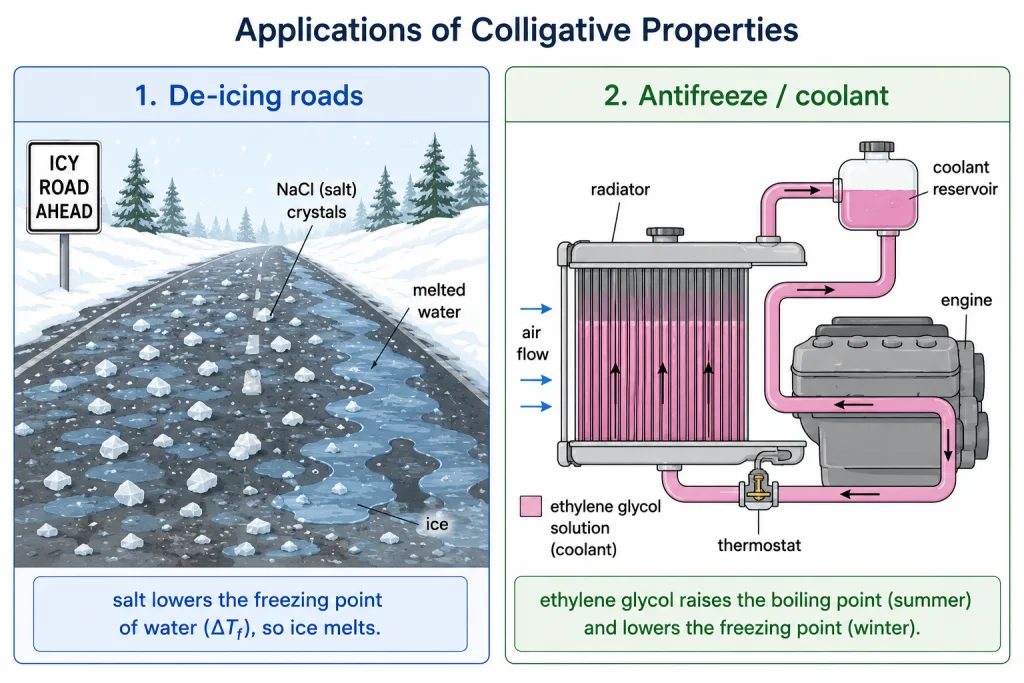
This is exactly why we put salt on icy roads (lowers water's freezing point so ice melts) and ethylene glycol antifreeze in car radiators (lowers the freezing point and helps prevent the coolant from boiling too soon in summer).
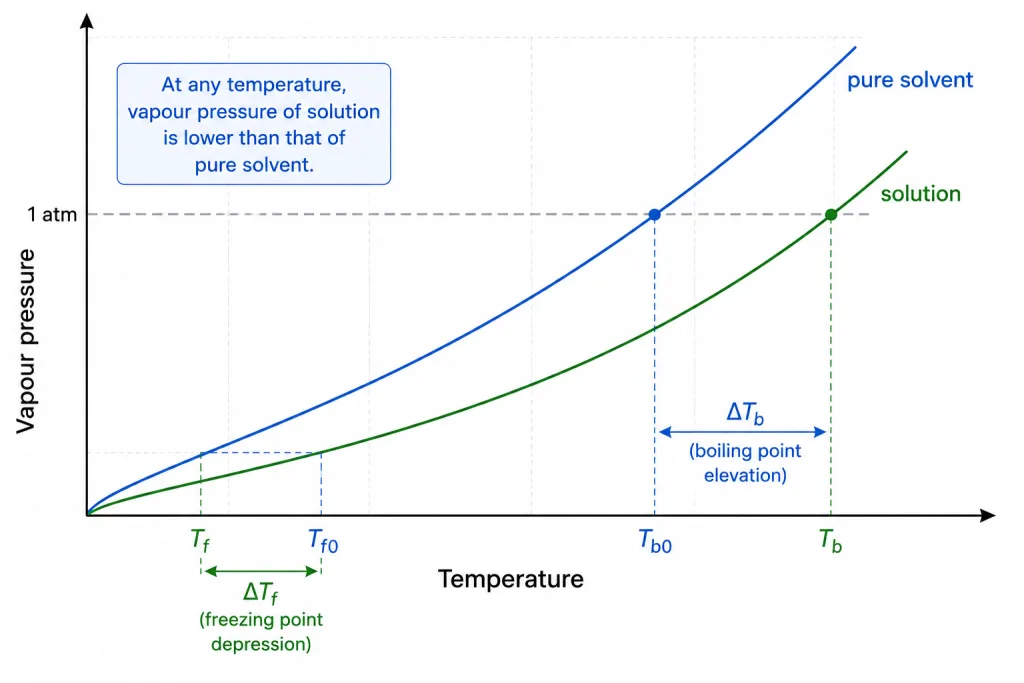
Elevation of Boiling Point
The increase in boiling point is directly proportional to the molality of the solution:
- = elevation of boiling point.
- = molal elevation constant (or ebullioscopic constant), units K kg mol. It is the boiling-point elevation produced by a 1 molal solution. For water, K kg mol.
- = molality.
To find a solute's molar mass, expand :
(with in grams; the 1000 converts to kg).
Key Point: is a property of the solvent only, not the solute. The same solvent gives the same no matter what you dissolve in it.
Depression of Freezing Point
The decrease in freezing point is also directly proportional to molality:
- = depression of freezing point.
- = molal depression constant (or cryoscopic constant), units K kg mol. For water, K kg mol.
- = molality.
The molar-mass form, exactly parallel to boiling-point elevation:
[JEE Tip] Both and depend only on the solvent. Their values for water (0.52 and 1.86 K kg mol) are worth memorising — they appear constantly in numericals. Note for water, so freezing-point depression is the more sensitive (and historically preferred) method.
Which Method, and Watch the Units
All colligative methods can find molar masses, but each has a sweet spot:
- Freezing-point depression is popular because is usually larger than , giving a bigger, easier-to-measure temperature change.
- For very large molar masses (polymers, proteins), even is too tiny to measure — there, osmotic pressure (Section 8) wins.
Common pitfall: molality uses kg of solvent, but the masses in problems are usually given in grams. The factor of 1000 in the molar-mass formula handles that conversion. Forgetting it throws your answer off by exactly 1000×.
[NEET Important] For electrolytes (NaCl, CaCl, etc.) the measured or is larger than these formulas predict, because the solute splits into multiple ions — more particles. The correction is the van't Hoff factor , introduced in Section 9: and .
Solved Examples
Example 1: Boiling point elevation, direct
What is the boiling point of a 0.5 molal aqueous solution? ( for water = 0.52 K kg mol, normal b.p. = 373.15 K)
Solution:
- K.
- New boiling point K.
Answer: 373.41 K (100.26 °C).
Example 2: Molar mass from boiling-point elevation
18 g of a non-volatile solute dissolved in 100 g of water raises the boiling point by 0.52 K. Find the molar mass. ( K kg mol)
Solution:
- Formula: .
- Plug in: g mol.
Answer: 180 g mol (it's glucose).
Example 3: Freezing point depression, direct
Calculate the freezing point of a solution of 1.0 molal in water. ( K kg mol, normal f.p. = 273.15 K)
Solution:
- K.
- New freezing point K.
Answer: 271.29 K (−1.86 °C).
Example 4: Molar mass from freezing-point depression
45 g of a non-electrolyte solute in 600 g of water lowers the freezing point by 0.93 K. Find the molar mass. ( K kg mol)
Solution:
- Formula: .
- g mol.
Answer: 150 g mol.
Example 5: Find the molality from freezing point
A solution freezes at −0.62 °C. What is its molality? ( water = 1.86 K kg mol)
Solution:
- K.
- mol kg.
Answer: 0.333 m.
Example 6: Mass of solute needed for a target boiling point
How much glucose (M = 180 g mol) must be dissolved in 250 g of water to raise the boiling point by 0.10 K? ( K kg mol)
Solution:
- Molality needed: mol kg.
- Moles of glucose: mol.
- Mass: g.
Answer: ≈ 8.65 g of glucose.
Example 7: Compare Kb and Kf reasoning
Why is freezing-point depression generally preferred over boiling-point elevation for measuring molar masses in water?
Solution: For water K kg mol is much larger than K kg mol. A larger constant produces a bigger temperature change for the same molality, which is easier and more accurate to measure. Also, freezing avoids heating that might decompose delicate solutes.
Example 8: Boiling point of a known solution
Calculate the boiling point of a solution containing 6.0 g of urea (M = 60) in 200 g of water. (, b.p. of water = 100 °C)
Solution:
- Molality: mol kg.
- K.
- Boiling point °C.
Answer: 100.26 °C.
Example 9: Molar mass of camphor solute via Kf
1.0 g of a non-electrolyte solute dissolved in 50 g of benzene lowered the freezing point of benzene by 0.40 K. The freezing-point depression constant of benzene is 5.12 K kg mol. Find the molar mass.
Solution:
- Formula: .
- g mol.
Answer: 256 g mol.
Example 10: Effect of dissociation (preview of van't Hoff)
A 0.1 molal solution of NaCl lowers the freezing point of water by about 0.37 K instead of the 0.186 K expected. Why?
Solution: NaCl dissociates into Na and Cl, producing about twice as many particles. Since colligative properties depend on particle number, the observed is roughly doubled. The correction factor is the van't Hoff factor , so K. (Full treatment in Section 9).