
Why "Dilute" and "Concentrated" Aren't Enough
In Section 1 we ended on a warning: calling a solution "dilute" or "concentrated" is hopelessly vague. A chemist needs a number. This section is your complete toolkit of those numbers — the units of concentration.
Let's break this down. There are several ways to express the composition of a solution, and each one answers the question "how much solute, relative to what?" in a slightly different way. Some compare masses, some compare moles, some compare to volume. Your job in this chapter — and in every numerical that follows — is to pick the right one and convert fluently between them.
Here's the master list we'll build:
- Mass percentage (w/w) and volume percentage (v/v)
- Mass by volume percentage (w/v)
- Parts per million (ppm)
- Mole fraction ()
- Molarity ()
- Molality ()
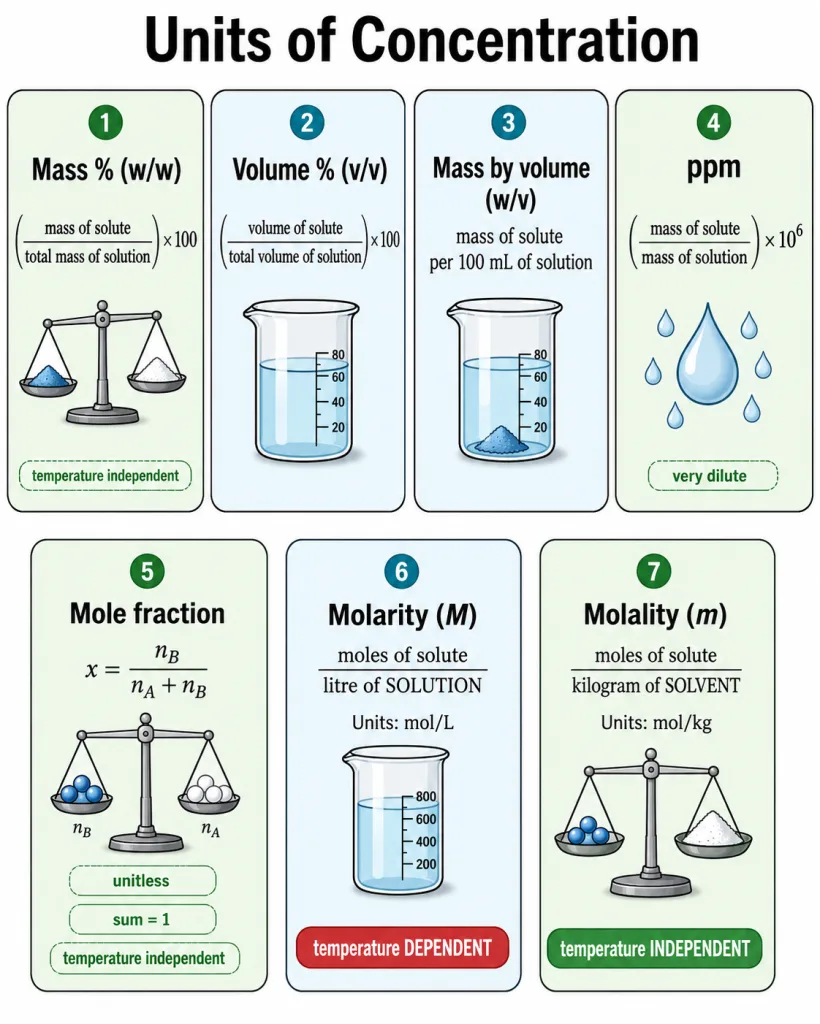
Key Point: Two of these — mole fraction and molality — are independent of temperature. The rest involve volume or are tied to it, and since volume changes with temperature, they are temperature-dependent. This single fact is the most tested conceptual point in the section.
Percentage and ppm
Mass percentage (w/w) — mass of solute per 100 g of solution:
A "10% glucose solution by mass" means 10 g glucose in 100 g of solution (i.e. 10 g glucose + 90 g water).
Volume percentage (v/v) — used for liquid-liquid solutions:
A 35% (v/v) ethylene glycol antifreeze means 35 mL glycol per 100 mL solution.
Mass by volume percentage (w/v) — mass of solute per 100 mL of solution. Common in medicine and pharmacy (e.g. normal saline is 0.9% w/v NaCl).
Parts per million (ppm) — for very dilute solutions (pollutants, trace ions):
[JEE Tip] ppm can be expressed mass-to-mass, volume-to-volume or mass-to-volume — always read which one the problem wants. For dilute aqueous solutions, 1 ppm ≈ 1 mg of solute per litre of water (since 1 L water ≈ 10 mg).
Mole Fraction
Mole fraction () compares the moles of one component to the total moles of all components. For a binary solution of solute (B) in solvent (A):
where .
The defining property — and the reason mole fraction dominates the colligative-property chapters ahead — is that all the mole fractions add up to 1:
Because it's a ratio of moles to moles, mole fraction has no units and is independent of temperature.
[NEET Important] Mole fraction is the natural language of Raoult's law and vapour-pressure problems (Sections 4–6). Get comfortable computing it now and those sections become much easier.
Molarity and Molality — Don't Mix Them Up
These two sound almost identical and are the single biggest source of careless errors in the chapter. Learn the difference cold.
Molarity (M) — moles of solute per litre of solution:
Units: mol L (also written M). Because it depends on the volume of solution, and volume expands when heated, molarity decreases as temperature rises — it is temperature-dependent.
Molality (m) — moles of solute per kilogram of solvent:
Units: mol kg (also written m). It uses mass of solvent, and mass never changes with temperature, so molality is temperature-independent.
Key Point — the one-line memory hook:
- MolaRity → "R" for Litre of solution (volume) → temperature-dependent.
- MolaLity → "L" for kiLogram of solvent (mass) → temperature-independent.
[JEE Tip] For dilute aqueous solutions near room temperature, molarity ≈ molality (because 1 L of dilute solution ≈ 1 kg of water). But never assume this in a calculation unless the problem is explicitly dilute and aqueous.
Interconverting the Units (the Density Bridge)
Exam problems love asking you to convert between molarity, molality, mole fraction and mass %. The bridge that connects mass-based units (molality, mass %, mole fraction) to volume-based ones (molarity) is density:
A reliable recipe that never fails:
- Assume a convenient basis. For a "X% by mass" problem, assume 100 g of solution (so solute = X g, solvent = (100 − X) g).
- Convert masses to moles using molar masses.
- For molality: divide moles of solute by kg of solvent.
- For molarity: find the solution volume using density (), then divide moles of solute by litres of solution.
- For mole fraction: divide moles of each component by total moles.
[NEET Important] The single most common mistake: using the mass (or volume) of the solution where you needed the solvent, or vice versa. Molality uses solvent; molarity uses solution. Underline which one the formula demands before plugging in.
Solved Examples
Example 1: Mass percentage
A solution is prepared by dissolving 22 g of benzene in 122 g of carbon tetrachloride. Calculate the mass percentage of benzene and of .
Solution:
- Total mass of solution g.
- Mass % of benzene .
- Mass % of CCl .
Answer: benzene 15.28%, CCl 84.72%.
Example 2: Mole fraction from mass %
Calculate the mole fraction of benzene (, M = 78 g mol) in a solution containing 30% benzene by mass in carbon tetrachloride (, M = 154 g mol).
Solution:
- Basis: take 100 g of solution → benzene = 30 g, CCl = 70 g.
- Moles: mol; mol.
- Mole fraction: .
Answer: .
Example 3: Molarity, straightforward
Calculate the molarity of a solution containing 5 g of NaOH in 450 mL of solution. (M of NaOH = 40 g mol)
Solution:
- Moles of NaOH mol.
- Volume L.
- Molarity mol L.
Answer: 0.278 M.
Example 4: Molarity by dilution
30 mL of 0.5 M is diluted to 500 mL. Find the new molarity.
Solution:
- Use (moles conserved on dilution).
- .
- mol L.
Answer: 0.03 M.
Takeaway: On dilution the number of moles of solute is unchanged — only the volume grows. is your fastest tool.
Example 5: Molality from mass of solute and solvent
Calculate the molality of a solution containing 20 g of NaOH in 500 g of water. (M of NaOH = 40 g mol)
Solution:
- Moles of NaOH mol.
- Mass of solvent kg.
- Molality mol kg.
Answer: 1.0 m.
Example 6: Mass of solute for a target molality
Calculate the mass of urea (, M = 60 g mol) required to make 2.5 kg of a 0.25 molal aqueous solution.
Solution:
- Molality . Since no density is given, interpret this as a dilute aqueous solution and take 2.5 kg as the mass of solvent.
- Moles of urea mol.
- Mass of urea g.
Answer: 37.5 g of urea.
Example 7: The full interconversion — molality, molarity and mole fraction together
The density of a 20% (by mass) aqueous KI solution is 1.202 g mL. Calculate (a) molality, (b) molarity and (c) mole fraction of KI. (M of KI = 166 g mol, M of HO = 18 g mol)
Solution: Basis: 100 g of solution → KI = 20 g, water = 80 g.
- Moles of KI mol.
- Moles of water mol.
(a) Molality m.
(b) Molarity: volume of solution mL L.
(c) Mole fraction of KI .
Answer: molality ≈ 1.51 m, molarity ≈ 1.45 M, .
[JEE Tip] Notice molarity (1.45) < molality (1.51) here. Because density > 1 and KI is heavy, the solution volume packs in fewer moles per litre than per kg of solvent. Always sanity-check the relative sizes.
Example 8: ppm of a trace pollutant
A sample of drinking water was found to be severely contaminated with chloroform (). The level of contamination was 15 ppm (by mass). Express this in mass percentage.
Solution:
- 15 ppm means 15 parts of CHCl per parts of solution by mass.
- Mass % .
Answer: % by mass.
Takeaway: ppm and mass % differ by a factor of ( vs ). Dividing ppm by gives mass %.
Example 9: Mole fraction must sum to 1
In a binary solution the mole fraction of the solute is 0.2. What is the mole fraction of the solvent?
Solution: Since , we get .
Answer: 0.8. (A one-line problem — but examiners use it to check you know mole fractions are normalised to 1.)
Example 10: Molarity from mass percent and density
Concentrated nitric acid used in the laboratory is 68% HNO by mass in aqueous solution, with density 1.504 g mL. Calculate its molarity. (M of HNO = 63 g mol)
Solution: Basis: 100 g of solution → HNO = 68 g, solution mass = 100 g.
- Moles of HNO mol.
- Volume of solution mL L.
- Molarity mol L.
Answer: ≈ 16.2 M.
Example 11: Which is temperature-independent?
A student prepares a solution at 25 °C and then warms it to 60 °C. State, with reason, which of its molarity and molality changes.
Solution:
- Molarity changes (decreases) — it is defined per litre of solution, and the solution's volume expands on heating, so the same moles now occupy more litres.
- Molality stays constant — it is defined per kilogram of solvent, and mass is unaffected by temperature.
Answer: molarity decreases; molality is unchanged.
Example 12: Mixing two solutions of the same solute
300 g of a 25% (by mass) solution is mixed with 400 g of a 40% (by mass) solution of the same solute. Calculate the mass percentage of the solute in the final mixture.
Solution:
- Solute from first solution g.
- Solute from second solution g.
- Total solute g.
- Total mass of mixture g.
- Mass % .
Answer: ≈ 33.57% by mass.
Takeaway: When mixing solutions of the same solute, add up grams of solute and grams of total solution separately, then take the ratio. Never average the percentages directly.