
Ideal Solutions — The Perfect Mixture
Section 4 assumed every solution obeys Raoult's law perfectly. Reality is messier. Solutions are classified by how well they obey Raoult's law.
An ideal solution obeys Raoult's law over the entire range of composition for both components.
An ideal solution has three defining signatures:
- and — Raoult's law holds throughout.
- Enthalpy of mixing is zero: (no heat absorbed or released).
- Volume of mixing is zero: (final volume = sum of the parts).
The molecular reason: in an ideal solution, the A-B interactions are essentially the same as the A-A and B-B interactions. Each molecule "feels" the same forces it did in the pure liquid, so nothing changes energetically or volumetrically.
Examples of (nearly) ideal solutions: benzene + toluene, n-hexane + n-heptane, chlorobenzene + bromobenzene — all pairs of structurally similar molecules with similar intermolecular forces.
Non-ideal Solutions and Deviations
A non-ideal solution does not obey Raoult's law over the whole composition range. Its vapour pressure is either higher or lower than Raoult's law predicts.
These deviations come in two flavours, decided by how the new A-B forces compare to the original A-A and B-B forces.
Positive deviation (vapour pressure HIGHER than predicted)
- Cause: A-B attractions are weaker than A-A and B-B. Molecules escape more easily, so vapour pressure is raised.
- Consequences: (endothermic; absorbs heat) and (slight expansion).
- Examples: ethanol + water, ethanol + acetone, acetone + CS, carbon disulphide + acetone.
Negative deviation (vapour pressure LOWER than predicted)
- Cause: A-B attractions are stronger than A-A and B-B (often new hydrogen bonds). Molecules are held back, so vapour pressure is lowered.
- Consequences: (exothermic; releases heat) and (slight contraction).
- Examples: phenol + aniline, chloroform + acetone, HNO + water, chloroform + benzene.
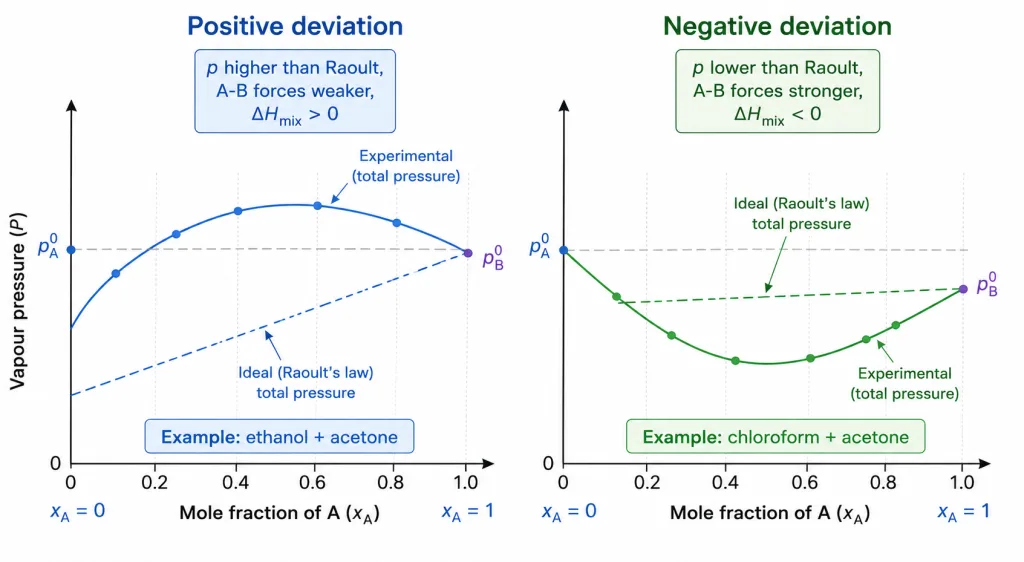
[JEE Tip] Memory hook — positive deviation = weaker forces = molecules escape more = higher P. The acetone-chloroform pair (H-bonding between them) is the classic negative deviation; ethanol-acetone (breaking ethanol's H-bonds) is the classic positive deviation.
Azeotropes — When Distillation Fails
Some non-ideal solutions form azeotropes — constant-boiling mixtures whose vapour has the same composition as the liquid. Because boiling produces vapour identical to the liquid, fractional distillation cannot separate them.
Minimum-boiling azeotropes
- Formed by solutions showing large positive deviation.
- At a particular composition the vapour pressure is maximum, so the boiling point is minimum.
- Example: ethanol + water (~95% ethanol by volume) boils at 78.1 °C — this is why you can't get 100% pure ethanol by simple distillation.
Maximum-boiling azeotropes
- Formed by solutions showing large negative deviation.
- At a particular composition the vapour pressure is minimum, so the boiling point is maximum.
- Example: nitric acid + water (~68% HNO) boils at ~393.5 K.
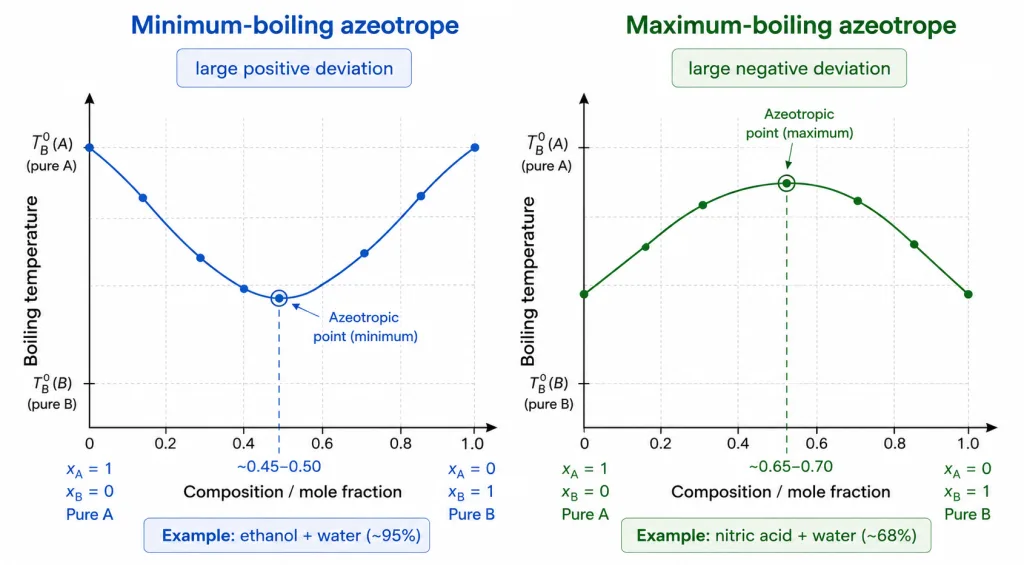
[NEET Important] Link them up: positive deviation → minimum-boiling azeotrope; negative deviation → maximum-boiling azeotrope. Both vapour and liquid have the same composition at the azeotropic point, defeating fractional distillation.
Solved Examples
Example 1: Identify ideal vs non-ideal
Which of these is expected to be nearly ideal: (a) benzene + toluene, (b) ethanol + water? Justify.
Solution: (a) Benzene and toluene are structurally similar non-polar aromatics; their A-B forces ≈ A-A ≈ B-B, so the solution is nearly ideal (). (b) Ethanol + water involves disruption/formation of hydrogen bonds, giving non-ideal behaviour (positive deviation).
Answer: (a) is nearly ideal.
Example 2: Sign of enthalpy of mixing
A solution shows positive deviation from Raoult's law. State the signs of and .
Solution: Positive deviation means weaker A-B forces, so mixing absorbs heat: , and the volume increases slightly: .
Answer: both positive.
Example 3: Acetone + chloroform
A mixture of acetone and chloroform shows a vapour pressure lower than predicted by Raoult's law. Explain the deviation type and cause.
Solution: This is negative deviation. Acetone and chloroform form a new hydrogen-bonded interaction between the chloroform H and the acetone carbonyl oxygen, and this unlike-molecule interaction is stronger than the forces in either pure liquid. The molecules are held back, lowering vapour pressure. (exothermic), .
Example 4: Ethanol + acetone
Why does adding acetone to ethanol cause a positive deviation from Raoult's law?
Solution: Pure ethanol is extensively hydrogen-bonded. Acetone molecules get between ethanol molecules and break some of those H-bonds, so the A-B attractions are weaker than the original A-A attractions. Molecules escape more easily → vapour pressure rises above Raoult's prediction (positive deviation), .
Example 5: Why can't we get 100% ethanol by distillation?
Explain using azeotropes.
Solution: Ethanol-water shows large positive deviation and forms a minimum-boiling azeotrope at ~95% ethanol (b.p. 78.1 °C). At this composition the vapour has the same composition as the liquid, so further distillation yields the same 95% mixture — you cannot enrich beyond it by simple distillation.
Answer: the minimum-boiling azeotrope blocks separation beyond ~95% ethanol.
Example 6: Classify the azeotrope
Nitric acid and water form a constant-boiling mixture at ~68% HNO boiling at 393.5 K, higher than either pure component. What kind of azeotrope is this, and what deviation produces it?
Solution: A boiling point higher than both pure components means a maximum-boiling azeotrope, produced by large negative deviation from Raoult's law (strong A-B attraction).
Example 7: Predicting deviation from heat of mixing
On mixing two liquids the beaker becomes noticeably warm. Predict the deviation type.
Solution: Warming means heat is released → (exothermic) → stronger A-B forces → negative deviation from Raoult's law.
Answer: negative deviation.
Example 8: Volume change clue
Mixing equal volumes of two liquids gives a final volume slightly greater than the sum. What deviation is expected?
Solution: (expansion) accompanies weaker A-B forces, i.e. positive deviation from Raoult's law (also ).
Example 9: Match the example to the behaviour
Classify each as ideal, positive deviation, or negative deviation: (i) n-hexane + n-heptane, (ii) phenol + aniline, (iii) carbon disulphide + acetone.
Solution:
- (i) n-hexane + n-heptane → similar non-polar molecules → ideal.
- (ii) phenol + aniline → strong intermolecular H-bond between unlike molecules → negative deviation.
- (iii) CS + acetone → weaker A-B forces → positive deviation.
Example 10: Reasoning about an ideal solution's properties
For a perfectly ideal solution, what are , , and the shape of the -vs- plot?
Solution:
- , .
- Raoult's law holds throughout, so varies linearly with composition (a straight line between and ).
Answer: zero enthalpy and volume change; straight-line vapour-pressure plot.