
What Does "Soluble" Really Mean?
Drop sugar into water and it disappears; drop sand into water and it just sits there. Why? This section is about solubility — the maximum amount of a solute that dissolves in a given amount of solvent at a given temperature.
Definition: The solubility of a substance is the maximum amount of it that can be dissolved in a specified amount of solvent at a specified temperature.
Solubility depends on three things: the nature of solute and solvent, the temperature, and (for gases) the pressure.
The golden rule of dissolution is "like dissolves like":
- Polar solutes (NaCl, sugar, urea) dissolve in polar solvents (water).
- Non-polar solutes (naphthalene, fats, iodine) dissolve in non-polar solvents (benzene, CCl).
This is because dissolution requires the solute-solvent attractions to be comparable to the solute-solute and solvent-solvent attractions they replace. A polar solvent can pull apart a polar/ionic lattice; a non-polar solvent cannot.
Solubility of a Solid in a Liquid
When a solid is added to a liquid, two opposite processes begin:
- Dissolution — solute particles leave the solid and enter solution.
- Crystallisation — dissolved particles collide with the solid and re-deposit.
When the two rates become equal, the system reaches dynamic equilibrium:
At this point the solution is saturated — it holds the maximum solute possible at that temperature. The concentration of a saturated solution is the solubility.
- Unsaturated: can still dissolve more solute.
- Saturated: at the dissolving limit (dynamic equilibrium).
- Supersaturated: holds more than the equilibrium amount (unstable; excess crystallises out on disturbance).
Effect of temperature
Apply Le Chatelier's principle to the dissolution equilibrium:
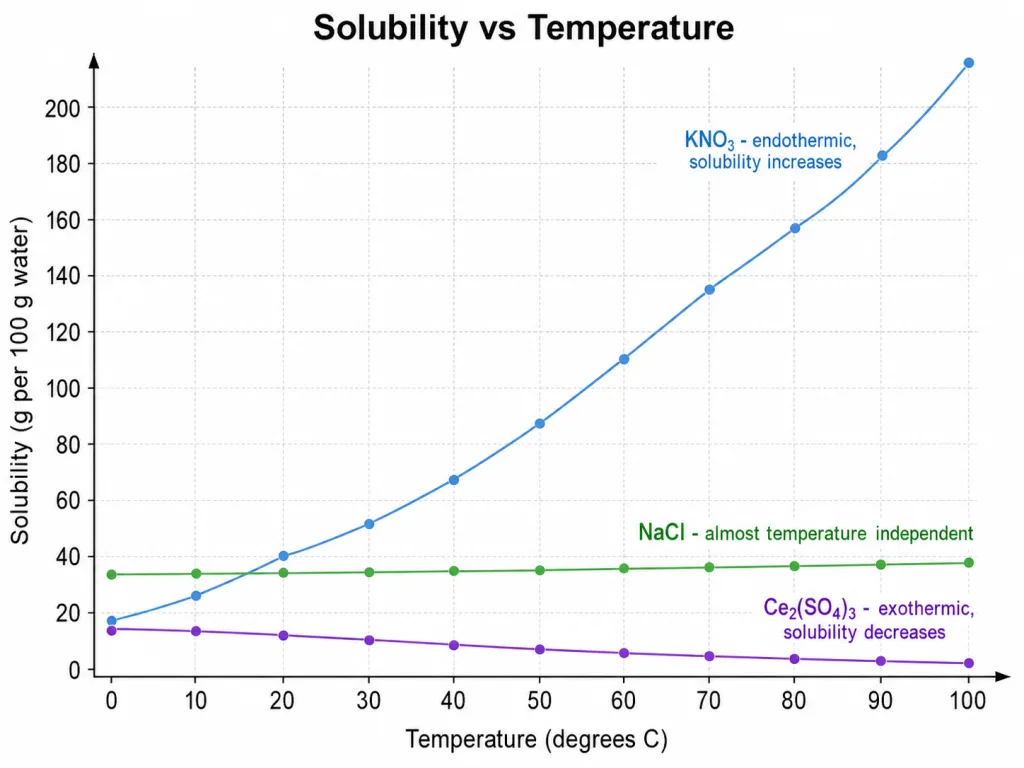
- If dissolution is endothermic (, e.g. KNO, NHCl), heating increases solubility.
- If dissolution is exothermic (, e.g. anhydrous NaSO, Ce(SO)), heating decreases solubility.
[JEE Tip] Pressure has almost no effect on the solubility of solids and liquids (they are nearly incompressible). Pressure only matters for gases.
Solubility of a Gas in a Liquid — Henry's Law
Gases dissolve in liquids too: oxygen in water keeps fish alive; CO dissolved under pressure makes soda fizzy. The amount that dissolves is governed by pressure and temperature.
Henry's law quantifies the pressure effect:
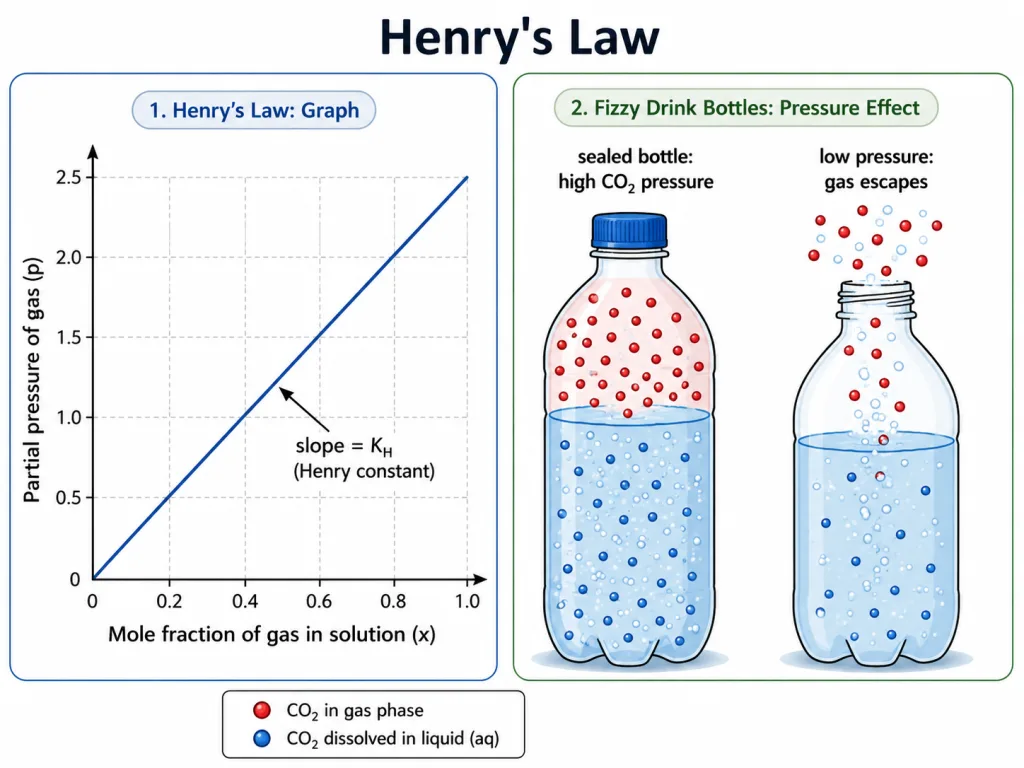
The partial pressure of a gas in the vapour phase () is proportional to the mole fraction of the gas () in the solution.
where is the Henry's law constant (units of pressure, e.g. kbar or Pa).
Reading the constant correctly is everything:
- Higher → lower solubility of the gas (the gas "wants" to escape, so a high pressure is needed to keep even a small mole fraction dissolved).
- is characteristic of the gas-solvent pair and increases with temperature — so gases become less soluble as temperature rises (warm soda goes flat; warm water holds less dissolved O).
Applications of Henry's Law
This law shows up everywhere — and these applications are favourite exam questions:
- Soda water and soft drinks are bottled under high CO pressure to force more gas into solution. Opening the bottle drops the pressure, so dissolved CO escapes as fizz.
- Scuba diving and "the bends": at depth, high pressure dissolves more N in a diver's blood. Rising too fast lets that N bubble out in the tissues, causing the painful, dangerous decompression sickness. Divers use air diluted with helium (less soluble) to reduce this.
- High-altitude anoxia: low atmospheric pressure means low partial pressure of O, so less O dissolves in the blood of climbers — leading to weakness and impaired thinking ("anoxia").
- Aquatic life in cold water: cold water holds more dissolved O (lower temperature → gas more soluble), which is why cold mountain streams are oxygen-rich.
A note on limitations
Henry's law holds when: the pressure is not too high, the temperature is not too low, and the gas does not react with or dissociate in the solvent. (Gases like NH and CO react with water, so they deviate.)
[NEET Important] Raoult's law (next section) is actually a special case of Henry's law where the solute is volatile and (the vapour pressure of the pure component). Keep this link in mind — examiners test it directly.
Solved Examples
Example 1: Reading the Henry constant
Two gases A and B have Henry's law constants kbar and kbar at the same temperature. Which gas is more soluble in water at a given partial pressure?
Solution: From , at fixed we have . The smaller gives the larger mole fraction. Since , gas A is more soluble.
Takeaway: Higher Henry constant → lower solubility. Memorise this inverse relationship.
Example 2: Effect of temperature on dissolved gas
Explain why a warm bottle of soda goes flat faster than a cold one.
Solution: increases with temperature, so gas solubility decreases as temperature rises. In a warm bottle, less CO stays dissolved and more escapes as gas — the drink loses its fizz faster. This is also why fish struggle in warm, oxygen-poor water.
Example 3: Henry's law — finding solubility
If gas is bubbled through water at 293 K at a partial pressure of 0.987 bar, and for at 293 K is kbar, find the mole fraction of in water.
Solution:
- Formula: .
- Convert units: kbar bar.
- Compute: .
Answer: (extremely small — N is barely soluble).
Example 4: Henry constant from data
HS, a toxic gas, has a solubility (mole fraction) in water of at 0.10 bar partial pressure and 298 K. Calculate .
Solution:
- Formula: .
- Compute: bar.
Answer: bar kbar.
Example 5: 'Like dissolves like'
Predict whether naphthalene is more soluble in water or in benzene, and justify.
Solution: Naphthalene is a non-polar aromatic solid. By "like dissolves like", it dissolves in non-polar solvents. Benzene is non-polar; water is polar. Answer: Naphthalene is far more soluble in benzene.
Example 6: Endothermic vs exothermic dissolution
The solubility of KNO rises sharply on heating, while that of anhydrous NaSO falls. What does this tell you about the sign of for each?
Solution: By Le Chatelier's principle:
- KNO solubility increases with temperature → dissolution is endothermic (); heat favours dissolving.
- NaSO (anhydrous) solubility decreases with temperature → dissolution is exothermic ().
Example 7: Pressure and solid solubility
A student claims that increasing pressure greatly increases the amount of sugar that dissolves in water. Is this correct?
Solution: No. Solids and liquids are nearly incompressible, so pressure has a negligible effect on their solubility. Pressure significantly affects only gas solubility (Henry's law). The claim is incorrect.
Example 8: Why divers use helium-diluted air
Explain, using Henry's law, why deep-sea divers breathe air in which nitrogen is partly replaced by helium.
Solution: At depth, the high pressure raises the partial pressure of breathing gases, dissolving more of them in blood (Henry's law). Dissolved N can bubble out during ascent, causing the bends. Helium has a lower solubility (higher ) in blood than nitrogen, so replacing some N with He reduces the amount of dissolved gas and lowers the risk.
Example 9: Calculating dissolved gas mass via Henry's law
The partial pressure of CO over a soft drink is 2.5 atm at 298 K. If for CO in water is atm (mole-fraction basis), find the mole fraction of CO dissolved.
Solution:
- .
Answer: .
Takeaway: The high CO pressure inside a sealed bottle keeps this (already small) mole fraction dissolved; release the pressure and most of it escapes.
Example 10: High-altitude anoxia
Why do mountaineers often feel weak and unable to think clearly at very high altitudes?
Solution: At high altitude the atmospheric pressure — and therefore the partial pressure of oxygen — is low. By Henry's law, less O dissolves in the blood. Low blood-oxygen ("anoxia") causes weakness and impaired thinking.