
Welcome to Solutions
Let's start with a confession the NCERT makes in its very first line: in normal life we rarely come across pure substances. The air you're breathing, the sea, your blood, the brass handle on a door, the soda in a bottle — every one of them is a mixture of two or more pure substances blended so intimately that you can't see the boundary between them.
This chapter is all about one special kind of mixture: the solution — a mixture so uniform that even under a microscope it looks like a single substance.
Think of it this way: if you stir a spoon of sugar into water and keep stirring, the sugar vanishes. Every sip tastes equally sweet — the top, the middle, the bottom. There are no sugar lumps hiding anywhere. That uniformity is the whole idea of a solution.
Definition: A solution is a homogeneous mixture of two or more chemically non-reacting substances whose composition is the same throughout.
The word that earns the marks here is homogeneous — same properties and same composition in every part of the mixture. Contrast this with a heterogeneous mixture like sand in water, where you can clearly see two separate phases.
Solute and Solvent — Who's Who?
A solution is built from two kinds of ingredient:
- Solvent — the component present in the larger amount. It usually decides the physical state of the solution. (In sugar-water, water is the solvent.)
- Solute — the component(s) present in the smaller amount, dissolved in the solvent. (In sugar-water, sugar is the solute.)
A solution with just one solute dissolved in one solvent is called a binary solution — two components in total. Most of this chapter deals with binary solutions, so keep that word handy.
[JEE Tip] "Solute" and "solvent" are about relative amount, not about which is "more important". When two liquids are mixed, the one in excess is called the solvent. So in a solution of 80% water and 20% ethanol, water is the solvent; flip the ratio and ethanol becomes the solvent.
When water is the solvent, the solution is called aqueous (e.g. salt water). When the solvent is something other than water — like benzene, ether or alcohol — it's a non-aqueous solution.
Key Point: A solution is not a compound. The components keep their own chemical identities and can be separated by physical means (evaporation, distillation). Mixing them releases no new compound — only, sometimes, a little heat.
The Nine Types of Solutions
Here's the part examiners love. Since both the solute and the solvent can each be a gas, a liquid, or a solid, there are possible combinations. NCERT lists all nine with a standard example for each — and these examples are worth memorising verbatim.
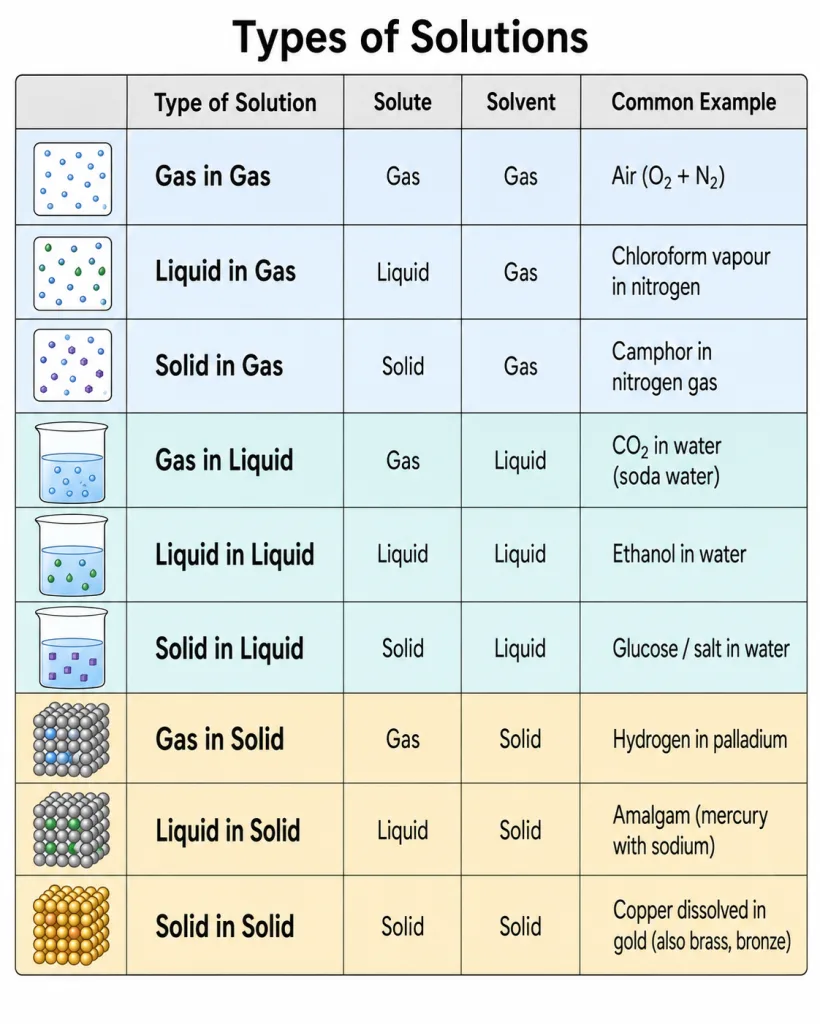
| Type | Solute | Solvent | Common Example |
|---|---|---|---|
| Gaseous | Gas | Gas | Air (mixture of and ) |
| Liquid | Gas | Chloroform vapour in nitrogen gas | |
| Solid | Gas | Camphor in nitrogen gas | |
| Liquid | Gas | Liquid | Oxygen / in water (soda water) |
| Liquid | Liquid | Ethanol in water | |
| Solid | Liquid | Glucose or salt in water | |
| Solid | Gas | Solid | Hydrogen in palladium |
| Liquid | Solid | Amalgam (mercury in sodium) | |
| Solid | Solid | Copper dissolved in gold (also brass, bronze) |
[NEET Important] Three rows trip students up every year:
- Camphor in nitrogen → solid solute, gaseous solvent.
- Hydrogen in palladium → gaseous solute, solid solvent.
- Amalgam → a solution of a metal in mercury; sodium amalgam is a liquid-solute, solid-solvent example in NCERT's table, so read the option wording carefully.
Aqueous vs Non-aqueous, Dilute vs Concentrated
A couple more labels you'll meet throughout the chapter:
- Aqueous solution — solvent is water.
- Non-aqueous solution — solvent is anything but water (benzene, CCl, ether…).
- Dilute solution — relatively small amount of solute.
- Concentrated solution — relatively large amount of solute.
"Dilute" and "concentrated" are vague, comparative words — they tell you roughly how much solute is present but not exactly. For real chemistry we need precise numbers, which is why the next section is devoted entirely to expressing concentration (mass %, mole fraction, molarity, molality and friends).
Why this matters: The amount of solute in a solution is rarely a cosmetic detail. NCERT's own examples make the point sharply — 1 ppm of fluoride in drinking water prevents tooth decay, 1.5 ppm mottles the teeth, and a high concentration is poisonous (sodium fluoride is rat poison). Same substance, wildly different outcomes — all decided by concentration.
[JEE Tip] Don't confuse a solution (homogeneous, particle size < 1 nm, never settles, can't be filtered) with a colloid (1–1000 nm) or a suspension (> 1000 nm, settles on standing, filterable). Only the truly homogeneous, single-phase mixture is a solution. This particle-size hierarchy is a favourite one-mark distractor.
Solved Examples
Example 1: Spot the solute and the solvent
In a solution prepared by dissolving 5 g of common salt in 95 g of water, identify the solute and the solvent.
Solution:
- Rule: The component present in the larger amount is the solvent; the smaller is the solute.
- Compare: Water = 95 g, salt = 5 g. Water is in excess.
- Conclusion: Water is the solvent, common salt (NaCl) is the solute.
Takeaway: Solute/solvent is decided purely by relative quantity — there is nothing special about being "the dissolved one".
Example 2: How many components?
A binary solution contains how many components, and what does "binary" mean here?
Solution: "Binary" = two. A binary solution has exactly two components — one solute and one solvent. (A solution of sugar and salt in water would be a ternary solution: three components.)
Example 3: Classify the type of solution — soda water
Soda water is carbon dioxide dissolved in water. Classify it by the physical states of solute and solvent.
Solution:
- Solute: — a gas.
- Solvent: water — a liquid.
- Type: gas in liquid → a liquid solution.
Takeaway: Always name the state of the solute first, solvent second. "Gas in liquid", not "liquid in gas".
Example 4: Classify the type of solution — brass
Brass is an alloy of copper and zinc, with copper in excess. What type of solution is it?
Solution:
- Solvent (excess): copper — a solid.
- Solute: zinc — a solid.
- Type: solid in solid → a solid solution (an alloy).
[JEE Tip] All common alloys (brass, bronze, German silver, steel) are solid-in-solid solutions.
Example 5: The tricky ones — camphor in nitrogen
A solution of camphor in nitrogen gas belongs to which type?
Solution:
- Solute: camphor — a solid (it sublimes, but it is a solid).
- Solvent: nitrogen — a gas.
- Type: solid in gas → a gaseous solution.
[NEET Important] This exact example is NCERT's textbook entry for the "solid solute in gaseous solvent" row. Memorise: camphor in N = solid in gas.
Example 6: Hydrogen in palladium
Hydrogen gas absorbed into palladium metal is an example of which type of solution?
Solution:
- Solute: hydrogen — a gas.
- Solvent: palladium — a solid.
- Type: gas in solid → a solid solution.
Takeaway: Compare with Example 5 — the states are reversed. Camphor-in-N is solid-in-gas; H-in-Pd is gas-in-solid. Examiners pair these two precisely to catch a careless swap.
Example 7: Give an example of a solid solution in which the solute is a gas
This is a direct NCERT intext question. Provide an example.
Solution: A solid solution with a gaseous solute is a solution of hydrogen in palladium (H gas dissolved in solid Pd). Palladium can absorb large volumes of hydrogen, making it the standard textbook example.
Example 8: Is air a solution?
Explain whether ordinary air qualifies as a solution, and if so, of what type.
Solution: Air is a homogeneous mixture of nitrogen (~78%), oxygen (~21%) and traces of other gases, uniform in composition over a room. Since both solute and solvent are gases (N as solvent, O etc. as solute), air is a gas-in-gas solution — a gaseous solution.
Takeaway: All gases mix in all proportions, so every gaseous mixture is automatically a solution.
Example 9: Amalgam
What is an amalgam, and to which type of solution does sodium amalgam belong?
Solution: An amalgam is a solution (alloy) of a metal dissolved in mercury. In sodium amalgam, mercury is the solvent and sodium is the solute. NCERT classifies the "amalgam of sodium with mercury" under liquid solute in solid solvent (the row "Liquid–Solid"). The key fact to remember: amalgam = metal in mercury.
Example 10: Why a solution but not a colloid?
A salt solution and milk both look uniform to the naked eye. Why is salt water a true solution while milk is not?
Solution:
- Particle size test: In salt water the dissolved Na and Cl ions are smaller than 1 nm — true solution.
- Milk: fat globules are 1–1000 nm — that's the colloidal range. Milk scatters light (Tyndall effect) and is heterogeneous at the microscopic level.
- Conclusion: Salt water is a genuine homogeneous solution; milk is a colloid.
[JEE Tip] The deciding criterion between solution, colloid and suspension is particle size (<1 nm, 1–1000 nm, >1000 nm respectively), not just appearance.