
Setting Up — Two Parallel Wires
We have already learnt two big facts in this chapter:
- A current-carrying wire produces a magnetic field around it (Sections 5, 7).
- A current-carrying wire experiences a force when placed in a magnetic field (Section 3).
Now put these two together. If wire 1 produces a field, and wire 2 sits in that field, wire 2 must feel a force. And by Newton's third law, wire 1 feels an equal and opposite force back. This mutual force is the subject of Section 9.
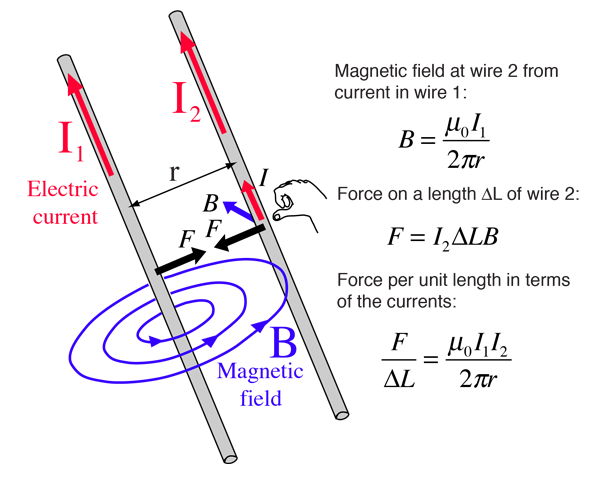
The geometry
Place two infinitely long, thin, straight wires parallel to each other, separated by a perpendicular distance . Wire 1 carries current , wire 2 carries current , both in the same direction (say upward).
Field of wire 1 at wire 2’s location
From Section 5 (or directly from Ampère’s law in Section 7), the magnitude of the magnetic field produced by an infinite straight wire carrying at perpendicular distance is
By the right-hand thumb rule, at wire 2’s location is perpendicular to the plane of the two wires — it points into the page on the side of wire 2 (assuming wire 1 is on the left and current is up).
Force per Unit Length — The Master Formula
Wire 2 sits in the field produced by wire 1 and carries current . From Section 3, the force on a length of wire 2 is
Since (along the current , upward) and (into the page) are mutually perpendicular, the magnitude of the force is
Force per unit length (magnitude):
Direction: Use the right-hand rule on :
- Parallel currents: attract.
- Antiparallel currents: repel.
A handy mnemonic: Like currents attract, unlike currents repel.
SI Definition of the Ampere
Until the 2019 redefinition, the ampere was operationally defined by the force between parallel currents:
One ampere is the steady current which, flowing in two infinitely long, straight, parallel conductors of negligible cross-section placed 1 m apart in vacuum, produces a force of N per metre of length between them.
Plug A, m, T·m/A into to verify N/m.
Note: After 2019, the ampere is defined by fixing the elementary charge ; is then measured. For all Class 12 problems we continue to use T·m/A.
Real-World Applications
Railgun (parallel-current accelerator): Two rails carry large currents in opposite directions. The rails repel each other and produce a magnetic field that acts on the current through the sliding projectile. By , the projectile is accelerated along the rails at km/s.
Pinch effect in plasma: Currents in the plasma flow in the same direction and attract, squeezing the plasma into a narrow column. This confinement is used in Z-pinch and tokamak fusion devices.
Magnetic confinement: Plasma currents interact with external coil currents via the same current–current forces to hold hot plasma away from reactor walls.
Cable engineering: High-current power cables are made of parallel conductors that can attract or repel. Engineers clamp them to withstand short-circuit surges.
Memory Capsule
Master formula:
Key points:
- : magnitude of force per unit length on each wire
- Direction: parallel currents attract, antiparallel repel
- Pre-2019 ampere: steady current giving N/m between wires 1 m apart
Quick reference list:
- Symbol guide: • : currents in the two wires • : separation (m) • T·m/A
- Numerical check: for A, cm, N/m
- Applications: railgun, plasma pinch, cable bracing
Solved Examples
Example 1: Force per metre between two wires
Two wires carry A, A in the same direction, separated by cm. Find and its nature.
Solution: and since currents are parallel, the force is attractive.
Example 2: Antiparallel currents
Same as Example 1, but reversed.
Solution: Magnitude unchanged at N/m; direction is repulsive.
Example 3: SI definition of the ampere — verification
Two wires 1 m apart each carry 1 A in the same direction. which matches the pre-2019 definition of the ampere.
Example 4: Equilibrium of a third wire
Wires A, B carry A, A, separated by 20 cm. A third wire C is between them, carrying . Find from A such that net force on C is zero.
Solution: Fields from A and B at C are opposite. Equate magnitudes: C is 8 cm from A (and 12 cm from B).
Example 5: Force on a finite length
Wires 5 cm apart each carry 20 A. Find force on a 50 cm length.
Solution: so N, attractive.
Example 6: Three wires in a row
Wires P, Q, R carry 2 A, 4 A, and 6 A, 10 cm apart. Find net on Q.
Solution: Attraction toward P: toward R: Net N/m toward R.
Example 7: Currents that balance gravity
Two vertical wires of mass per length g/m hang on 50 cm strings, carrying equal currents in opposite directions. They settle 5 cm apart; estimate .
Solution: Horizontal force per length: and from the string angle :
Example 8: Force on a square loop from a long wire
Square loop side cm, carrying A. Nearest side is cm from a long wire with A, same direction on the near side.
Solution: Near side (attractive): Far side (repulsive, at cm): Net N, toward the long wire.