
Defining the Magnetic Field
In Chapter 1, we defined the electric field through the force it exerts on a test charge: . We need a similar operational definition for the magnetic field — but here's the twist: a magnetic field exerts no force on a stationary charge. It only acts on charges that are moving.
So how do we define ? Through the force experienced by a moving test charge.
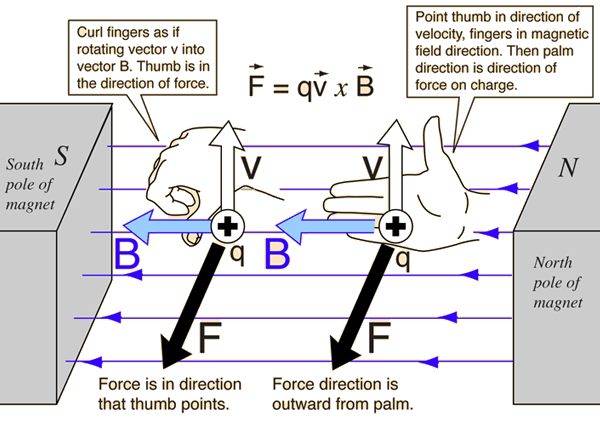
Experiments show that the force on a charge moving with velocity in a magnetic field obeys these three properties:
- The magnitude is proportional to , to , and to .
- The force is perpendicular to both and .
- The force vanishes when is parallel to , and is maximum when is perpendicular to .
All three observations are captured beautifully by a single vector equation:
This relation defines — both its magnitude and direction — through the way it pushes on moving charges.
The Lorentz Force
In a region where both an electric field and a magnetic field are present, the total electromagnetic force on a charge moving with velocity is the sum of the electric and magnetic forces:
This is the Lorentz force law — one of the cornerstone equations of classical electromagnetism, named after Dutch physicist Hendrik Lorentz.
Magnitude
The magnitude of the magnetic part is
where is the angle between and .
Units of
From , the SI unit of magnetic field is:
A non-SI unit you'll see in older texts is the gauss: G T. (Earth's magnetic field is about G T.)
Direction — Right-hand rule for
Point the fingers of your right hand along ; curl them toward ; your thumb points along . For a positive charge, is along the thumb; for a negative charge, is opposite.
[JEE Tip] Don't memorise rules blindly — practise turning your right hand for 2D problems where is into or out of the page. That dexterity is worth 1-2 marks in any JEE numerical.
Key Properties of the Magnetic Force
Three facts make the magnetic force qualitatively different from the electric force. Let's lock them in.
1. It is always perpendicular to
Because , the force is by definition perpendicular to the velocity at every instant.
2. The magnetic force does NO WORK
This is the consequence that catches many students by surprise. Work done in a small displacement is
since the cross product is perpendicular to . So:
A purely magnetic force can change the direction of a charged particle's velocity, but never its speed (and therefore never its kinetic energy).
3. Magnitude depends on the angle between and
- or : — particle moves in a straight line (Section 4, Case 1).
- : , maximum — particle moves in a circle (Section 4, Case 2).
- General : helical path (Section 4, Case 3).
[NEET Important] "Magnetic force does no work" is a favourite single-mark NEET conceptual. The trap option will say "magnetic force changes KE of the particle" — that's false.
Velocity Selector — Crossed and Fields
Suppose we want to filter out particles of one specific speed from a beam containing many speeds. We can do that elegantly using crossed electric and magnetic fields.
Setup
Send a positive charge moving along with speed . Apply:
- Uniform pointing along (so the electric force is directed along ).
- Uniform pointing along .
The magnetic force on the moving charge is
Now the electric force is , so the two forces can oppose each other.
Balance condition
The two forces cancel exactly when
Particles with this special speed pass straight through undeflected. Faster ones are bent one way; slower ones the other way. Only one speed survives — hence the name velocity selector.
[JEE Tip] The condition is independent of the charge and the mass . It works for electrons, protons, ions of any species — the velocity selector is a universal speed filter. This idea is the heart of J.J. Thomson's experiment and every modern mass spectrometer.
Memory Capsule
A compact recap before we tackle currents in Section 3.
The two field–force equations side by side
| Source | Force law | Acts on |
|---|---|---|
| Electric field | Any charge, moving or stationary | |
| Magnetic field | Only moving charges |
The Lorentz force (memorise verbatim)
Three iron-clad facts about
- Direction: perpendicular to both and (right-hand rule).
- Magnitude: .
- Work done: zero, always. KE and speed are conserved by magnetic forces.
Units
- SI: tesla N/(A·m).
- Non-SI: gauss T.
- Earth's field G T.
Velocity selector
- Crossed , both perpendicular to the beam.
- Undeflected speed: — independent of and .
One-line takeaway The magnetic force steers a charge but never speeds it up — it is a perfect compass needle for kinetic energy.
Solved Examples
Example 1: Force on a moving electron
An electron moves with velocity m/s in a magnetic field T. Find the magnitude and direction of the magnetic force on it. ( C.)
Solution. Use .
Compute the cross product (dropping units in the vector form):
Then
Magnitude: N. Direction: along (the minus sign comes from the electron's negative charge).
Example 2: Force when
A proton moves with speed m/s in a direction parallel to a uniform magnetic field of T. What force does it experience?
Solution. When , the angle and .
The proton experiences no magnetic force and continues in a straight line with unchanged speed.
Example 3: Velocity selector numerical
A velocity selector has V/m and T (in mutually perpendicular directions). What is the speed of particles that pass through undeflected?
Solution. The selector condition is
All particles with m/s pass through the selector regardless of their charge or mass. Faster or slower particles are deflected and removed by a slit.
Example 4: Direction by right-hand rule
A positive charge moves vertically downward in a region where points horizontally toward the north. Find the direction of the magnetic force on the charge.
Solution. Take east = , north = , up = . Then (downward) and (north).
For positive , the force points east. (Right-hand check: point fingers down, curl toward north — thumb points east.)
Example 5: Magnitude with arbitrary angle
A charge C moves with speed m/s at an angle of to a magnetic field of T. Find the magnitude of the magnetic force.
Solution. Use .
Example 6: Lorentz force with both and
A charge C moves with m/s in a region where V/m and T. Find the net Lorentz force.
Solution. .
So
The net force is 10 N along .
Example 7: Work done by a magnetic force
A proton enters a magnetic field of T at speed m/s, moves through the field for s, and exits. Find the work done by the magnetic force during this time.
Solution. The magnetic force is always perpendicular to , so
at every instant. Hence .
Example 8: Mass spectrometer feed
In a mass spectrometer, an ion source produces ions of various speeds. A velocity selector with V/m and T is placed at the entrance.
(a) What speed do the ions emerging from the selector have?
(b) If the magnetic field is doubled (with unchanged), how does the selected speed change?
Solution.
(a) From :
(b) If , then m/s. The selected speed is halved.