
The Solenoid — Construction
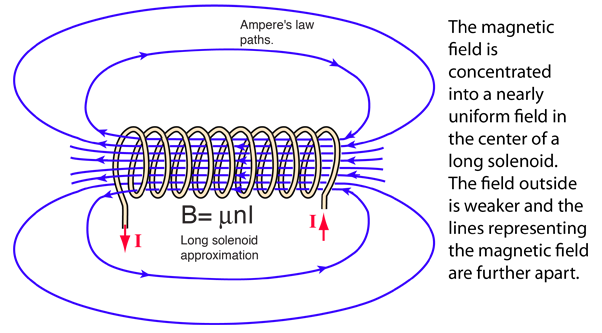
A solenoid is a long cylindrical coil produced by winding a single insulated wire in the shape of a tight helix. Two important parameters:
- = number of turns per unit length (units: turns·m⁻¹).
- = current through the wire.
We say a solenoid is ideal when:
- Its length is much greater than its diameter (so the central region behaves as if the wire-wrappings were infinitely long).
- The winding is tight (adjacent turns close together — almost a continuous current sheet on a cylinder).
For an ideal solenoid:
- The magnetic field inside is uniform, parallel to the axis, and strong. Its direction is given by the right-hand thumb rule: if you curl your fingers in the direction of current, the thumb points along the axis in the direction of .
- The magnetic field outside is essentially zero.
You can visualise the solenoid as a stack of many circular loops, each producing its own on-axis field; at any interior point, contributions from all loops add up to produce a strong uniform field, while at any exterior point they partly cancel.
[NEET Important] "Long solenoid" ideal solenoid approximation uniform inside, zero outside. This is a standard idealisation in JEE/NEET problems.
Applying Ampère's Law to the Solenoid
To find inside an ideal solenoid, we apply Ampère's circuital law to a rectangular Amperian loop straddling the wall of the solenoid.
Choosing the loop
Take a rectangle where:
- Side of length lies inside the solenoid, parallel to the axis.
- Side of length lies outside, parallel to the axis.
- Sides and are short segments perpendicular to the axis, crossing the wall of the solenoid.
Evaluating
Split the integral into four parts:
- (inside, along axis): is along the axis (parallel to if you traverse along ). Contribution: .
- (outside, opposite direction): outside an ideal solenoid. Contribution: .
- and (perpendicular crossings): inside, , so contribution is zero on the inside parts; outside, . Contribution: .
So .
Enclosed current
The rectangle of length along the axis encloses turns, each carrying . So .
Putting it together
The field inside an ideal solenoid is uniform and depends only on and — not on the radius of the solenoid or on the position inside it. Outside: .
At the end of a long solenoid
By a careful argument (or by superposing the contributions of two semi-infinite solenoids), the field on the axis at one end of a long but finite solenoid is half the interior value:
This is a 1-mark JEE recall — make sure you know which factor (½) applies.
[JEE Tip] A "long" solenoid is ideal only in its central region. The end correction matters whenever the question asks about the field at the mouth.
The Toroid — Solenoid Bent into a Donut
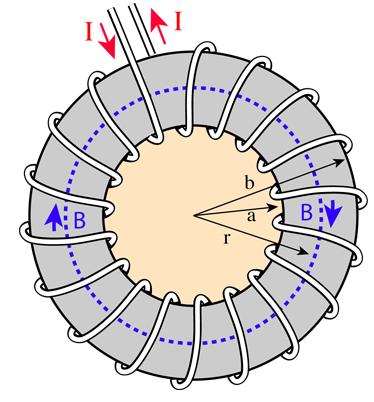
A toroid is what you get if you bend a long solenoid into a circle and join its ends — essentially a "donut-shaped solenoid". It has total turns around a central radius (the radius of the circle running through the centre of the tube).
The toroid has one big advantage over a straight solenoid: its field is entirely confined inside the tube, with no end effects. There's no "outside the ends" because the toroid has no ends.
Applying Ampère's law
Choose an Amperian loop that is a circle of radius concentric with the torus. By symmetry, is tangent to this loop, constant in magnitude, and its direction follows the right-hand grip rule (curl your fingers along the current; the thumb points along ).
Each of the turns of wire passes through this loop once, all carrying current in the same direction. So .
Connection to the solenoid formula
If we let — the number of turns per unit circumferential length of the toroid — then , exactly the same form as the solenoid.
Field outside the toroid
An Amperian loop drawn entirely outside the toroid encloses no net current. So
The toroid is the most "magnetically clean" device in elementary electromagnetism — no leakage field at all, in the ideal limit.
[JEE Tip] Toroid: inside depends on as — the field is not uniform across the toroid's cross-section (unlike the solenoid). For thin toroids, the variation is small; for fat ones, it matters.
Solenoid vs Toroid — A Comparison & Applications
| Feature | Solenoid | Toroid |
|---|---|---|
| Shape | Long straight cylinder | Donut (closed ring) |
| Field formula | ||
| Field uniform? | Yes (central region) | No — varies as across cross-section |
| Field outside | Approx. zero (ideal limit) | Exactly zero (no end effects) |
| End correction | Yes, | None |
| Best for | Strong uniform fields | Confined magnetic fields |
Practical applications
- Solenoid valves: small solenoid pulls an iron plunger when energised — used in washing machines, automatic doors, hydraulic systems, and car starters.
- Electromagnets: a solenoid wrapped around an iron core can lift cars in scrapyards (core multiplies by hundreds).
- MRI machines: superconducting solenoids generate fields of several tesla over a region big enough for a human body.
- Loudspeakers: a solenoid attached to the speaker cone — current oscillations push it, producing sound.
- Toroidal transformers: power-supply transformers with toroidal cores have lower leakage flux and are quieter than open-core transformers.
- Tokamak fusion reactors: enormous toroidal magnets confine plasma at million K.
Memory Capsule
Solenoid — the must-remember formulas
| Location | Field |
|---|---|
| Inside (central) | |
| Outside (ideal) | |
| At one end (on axis) |
= turns·m⁻¹. Uniform interior field; direction by right-hand rule.
Toroid — the must-remember formula
= total turns. Field varies as . Outside (and in the central hole): .
Key conceptual points
- Both follow Ampère's law: solenoid uses a rectangular loop; toroid uses a circular loop.
- A toroid is essentially a solenoid bent into a circle.
- A solenoid has end-effects; a toroid does not.
One-line takeaway
Solenoid: stores a uniform inside; toroid: keeps the field entirely confined.
Exam Tips
- For solenoids, choose a rectangular Amperian loop with one long side inside (parallel to ) and the opposite side outside (where ). Perpendicular sides contribute zero.
- For toroids, choose a circular Amperian loop at the mean radius , concentric with the torus. The symmetry makes tangent and constant.
- Always apply the right-hand rule (thumb along , fingers in direction of current) to fix the field direction.
Solved Examples
Example 1: Field inside a solenoid
A solenoid has turns wound over a length of cm. It carries a current of A. Find the magnetic field inside the solenoid.
Solution. First compute :
Then apply :
Example 2: Field at the end of a solenoid
For the same solenoid as Example 1 ( turns·m, A), find the magnetic field at one end (on the axis).
Solution. The end-correction formula gives Alternatively, use directly.
Example 3: Designing a solenoid for a given
A solenoid is to produce a field of T inside it, using a current of A. How many turns per metre are needed?
Solution. From :
That's about turns per millimetre — achievable with fine wire wound tightly.
Example 4: Toroid — basic numerical
A toroid has 2000 turns and a mean radius of 0.20 m. It carries a current of 4 A. Find the magnetic field along the central circle inside the toroid.
Solution.
Example 5: Solenoid vs toroid with same
A solenoid has turns·m, A. A toroid is made by joining the ends of the same length of coil into a donut of mean radius 0.25 m.
(a) T.
(b) For the toroid, turns, Same as the solenoid.
Example 6: Effect of doubling current and halving turns
A solenoid currently produces T. The current is doubled while the turn density is halved. What is the new field?
Solution.
Example 7: Toroid field across its cross-section
A toroid has , A, inner radius m, outer radius m. Find at and .
Example 8: Solenoid in an MRI-style application
A superconducting solenoid has turns·m and must produce 1.5 T.
(a)
(b) In copper this current would generate enormous heat. MRI solenoids use superconducting wire cooled by liquid helium to carry hundreds of amperes with zero resistance.