When a charge q moves with velocity v in a uniform magnetic field B, it experiences a magnetic force of magnitude
F=qvBsinθ
where θ is the angle between v and B. This force is always perpendicular to both v and B (given by the right-hand rule). The particle’s trajectory then depends entirely on θ.
Case 1 — v parallel (or anti-parallel) to B
F=qvBsin0°=0
No force acts, so the particle moves in a straight line at constant velocity. The magnetic field is invisible to a charge moving exactly along its direction.
Case 2 — v perpendicular to B
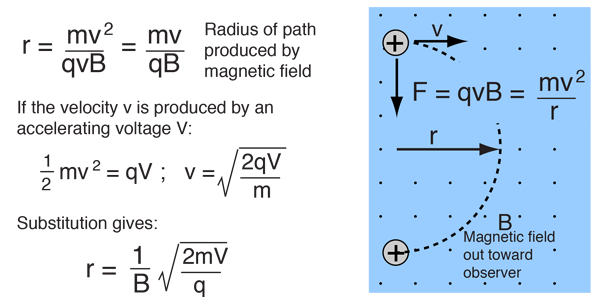
The force F=qv×B has constant magnitude qvB and is always perpendicular to v. This serves as a centripetal force, producing uniform circular motion.
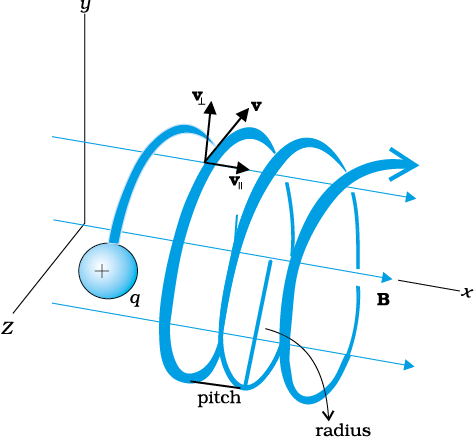
Case 3 — v at an angle θ to B
Decompose v into parallel and perpendicular components:
v∥=vcosθ feels no force → uniform motion along B.
v⊥=vsinθ feels a perpendicular force → circular motion in the plane normal to B.
The combination is a helical path along the field direction.
Case 2 in Detail — Circular Motion
When v⊥B, the magnetic force qvB provides the centripetal force:
qvB=rmv2
Solving for the radius of the circle:
r=qBmv=qBp
where p=mv is the particle’s momentum. Larger p → wider circle; stronger B → tighter circle.
Time period, frequency, and angular frequency
The particle travels 2πr in one revolution at speed v, so:
A charged particle moves in a circle of radius r in a magnetic field B. If B is doubled (keeping speed and charge the same), what is the new radius?
Solution. Since r=mv/(qB), r∝1/B. So doubling Bhalves the radius:
r′=r/2
Time period T=2πm/(qB) also halves: T′=T/2. Speed is unchanged (no work done).
Example 7: Two particles in the same field
A proton and an alpha particle (qα=2e, mα=4mp) enter the same magnetic field with the same speed, perpendicular to the field. Compare (a) their radii (b) their time periods.
Solution.
(a) r=mv/(qB). With same v, B:
rprα=mp/qpmα/qα=mp/e4mp/(2e)=2
The alpha particle traces a circle with twice the radius of the proton.
(b) T=2πm/(qB):
TpTα=mp/qpmα/qα=1/14/2=2
The alpha takes twice as long to complete one revolution.
Example 8: Why electrons cannot be accelerated in a standard cyclotron
An electron is to be accelerated in a hypothetical cyclotron. Estimate its speed classically after it gains a kinetic energy of 0.5 MeV, and explain why this result indicates a breakdown of the classical framework.
Solution. Using the non-relativistic formula for kinetic energy, K=21mev2⇒v=me2K.
Converting kinetic energy from MeV to Joules:
K=0.5×106×1.6×10−19J=8.0×10⁻¹⁴J
Substituting the values:
v=9.1×10−312×8.0×10−14=9.1×10−311.6×10⁻¹³
v≈1.76×1017=17.6×10¹⁶≈4.19×10⁸m/s
This calculated value exceeds the universal speed limit—the speed of light (c=3×10⁸m/s)—which is physically impossible.
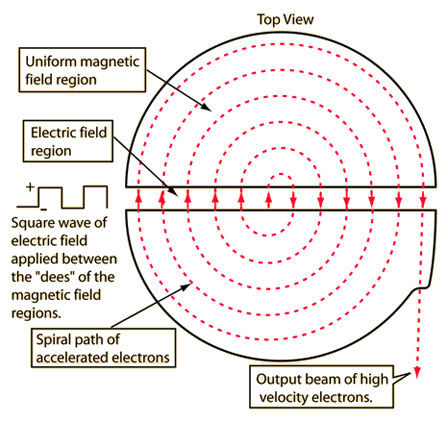
Conclusion: The classical estimate breaks down completely at this energy level. In reality, as the electron's speed approaches c, its relativistic mass (m) increases significantly. Since the cyclotron frequency depends inversely on mass (fcyc=2πmqB), the frequency drops, causing the electron to quickly fall out of step with the fixed frequency of the oscillating electric field. This is why cyclotrons are used for heavy particles like protons or alpha particles, but not electrons.
Example 9: Helical motion — full picture
A proton with KE =5×10⁻¹³ J enters a region of B=0.1 T at 30° to B. (mp=1.67×10⁻²⁷ kg, q=1.6×10⁻¹⁹ C.) Find (a) speed (b) radius of helix (c) pitch.