
Why This Chapter Matters
You've already met electric fields (Chapter 1) and electric currents (Chapter 3). This chapter is where those two ideas merge — and one of the most beautiful unifications in all of physics happens: electric currents produce magnetic fields, and magnetic fields exert forces on moving charges.
In exam terms:
- CBSE Boards typically asks 8–12 marks from this chapter — usually a 3-mark derivation, a 3-mark numerical, and a 5-mark long answer on the galvanometer or the cyclotron.
- JEE Main / Advanced: 2–3 questions every year — almost always numericals involving Biot-Savart, Ampère’s law, or motion in a magnetic field.
- NEET: 2–4 questions every year, mostly conceptual with one quick numerical.
The chapter has a clear story arc. We’ll start with one accidental observation from 1820 and end with a beautiful instrument (the moving coil galvanometer) that turns physics into measurement.
Oersted's Accidental Discovery (1820)
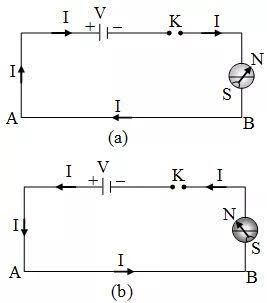
Imagine a routine physics demonstration at the University of Copenhagen in July 1820. Professor Hans Christian Oersted is showing his students how a current flowing through a wire heats it up. By chance, a magnetic compass happens to be lying on the table near the wire.
As Oersted closes the circuit, the compass needle twitches. Open the circuit — it springs back. Reverse the current — it flips the other way.
That tiny twitch shattered a 2000-year-old wall: until that moment, electricity and magnetism had been treated as two unrelated phenomena. Oersted's experiment was the first direct evidence that moving electric charges produce a magnetic field.
One-line statement (memorise): A current-carrying conductor produces a magnetic field around it.
Within a decade, this single observation triggered the work of Ampère, Biot, Savart, Faraday, and eventually Maxwell — leading to the unified theory of electromagnetism that drives every motor, generator, transformer, and wireless device in the modern world.
The Right-Hand Thumb Rule
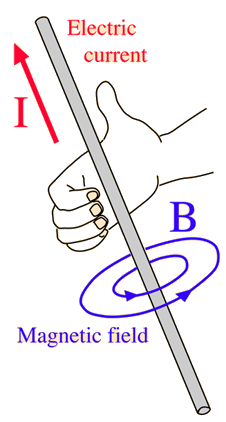
To know the direction of the magnetic field produced by a straight current-carrying wire, use the right-hand thumb rule:
Hold the wire in your right hand with the thumb pointing in the direction of the conventional current . The curl of your fingers then gives the direction of the magnetic field lines around the wire.
Key facts about the field of an infinite straight wire (we will derive these later):
- Field lines are concentric circles in planes perpendicular to the wire.
- Field strength follows , so it weakens with distance.
- The field is tangent to those circles and has no component along the wire.
A reverse-fact also holds: a magnetic field exerts a force on a current-carrying conductor. We will explore this in Section 3 — it is the principle behind every electric motor.
Memory Capsule
Key historical fact
- 1820, Hans Christian Oersted, Copenhagen: a current-carrying wire deflects a compass needle. First experimental link between electricity and magnetism.
Core statement
A current-carrying conductor produces a magnetic field around it.
Direction rule — Right-hand thumb rule
- Point right thumb along the direction of the conventional current.
- Curl your fingers around the wire.
- The curl gives the direction of the magnetic field lines.
Field lines of a straight current-carrying wire
- Shape: concentric circles perpendicular to the wire.
- Strength: decreases as (we’ll prove this in Section 5).
- Direction: tangent to each circle; given by the right-hand thumb rule.
One-line takeaway
Moving charges are the source of magnetic fields, and magnetic fields exert forces only on moving charges — magnetism is the kinetic side of electricity.
Solved Examples
Example 1: What Oersted’s compass tells us
A compass needle is placed below a horizontal wire pointing east–west. When current flows from west to east, the north-pole of the compass deflects toward the south. Without the current, the needle points north. What does this tell you about the magnetic field of the wire at that point?
Solution. Directly below the wire, the north pole points toward the south, so the magnetic field there must point south. By the right-hand thumb rule (thumb east, fingers curling), the field below the wire is indeed toward the south. Conclusion: B points south under the wire.
Example 2: Direction of from right-hand rule
A long straight wire carries current vertically upward. What is the direction of the magnetic field at a point (a) directly east of the wire? (b) directly west of the wire?
Solution. Thumb up, fingers curl counter-clockwise when viewed from above:
- East of the wire: field points north.
- West of the wire: field points south.
Example 3: A historical perspective
State the broad significance of Oersted’s discovery.
Solution. Until 1820, electricity (charges, currents, batteries) and magnetism (lodestones, compasses) were considered unrelated. Oersted’s experiment showed that an electric current creates a magnetic field — establishing the unity of electric and magnetic phenomena. This led to Biot-Savart, Ampère, Faraday’s induction law, and finally Maxwell’s unified electromagnetism.
Example 4: Comparing two compasses
Two compasses are placed on opposite sides of a long current-carrying wire (one north of the wire, one south). The current is flowing east. In which direction does each compass needle deflect?
Solution. Using the right-hand thumb rule (thumb east):
- Above the wire (north side): the magnetic field points into the page, so the north-pole of the needle is deflected into the page.
- Below the wire (south side): the magnetic field points out of the page, so the north-pole of the needle deflects out of the page.
Thus the two compasses show opposite deflections, confirming the circular field lines around the wire.
Example 5: Reversing the current
In an Oersted-type setup, a compass needle deflects 30° east when the switch is closed. What will happen if (a) the current is reversed (b) the current is doubled?
Solution.
- (a) Reversing the current reverses the direction of at the compass; the needle now deflects 30° west.
- (b) Doubling the current doubles the magnitude of at the compass (). The needle deflects through a larger angle (roughly doubling the tangent of the angle).
Example 6: Conceptual: why does the deflection matter?
Why is the deflection of the compass needle — rather than any other effect — the real proof that the wire produces a magnetic field?
Solution. A compass needle responds only to magnetic torques. The fact that the deflection (i) reverses with current direction, (ii) scales with current magnitude, and (iii) follows the right-hand rule — proves unambiguously that the source is a magnetic field generated by the current.
Example 7: Field strength scaling
If you place a compass 5 cm from a wire carrying A, it deflects by angle . Move it to 10 cm. How does the deflection change qualitatively?
Solution. For an infinite straight wire, . Doubling the distance halves , so the deflection angle (for small angles, ) roughly halves.
Example 8: Earth's magnetic field as a reference
Earth’s field T. At 1 m from a 10 A wire, T. Compare.
Solution. The wire’s field at 1 m is only 4% of Earth’s, so the compass must be placed very close to the wire to see the deflection.