
Light as Rays, Mirrors as Geometry
Light is an electromagnetic wave (Chapter 8) — but when it travels around objects much larger than its wavelength (a few hundred nanometres), it behaves as if moving in straight lines: rays. Ray optics is the geometry of light.
The laws of reflection hold at every point of any surface, plane or curved:
- Angle of reflection = angle of incidence (both measured from the normal).
- Incident ray, reflected ray and normal lie in one plane.
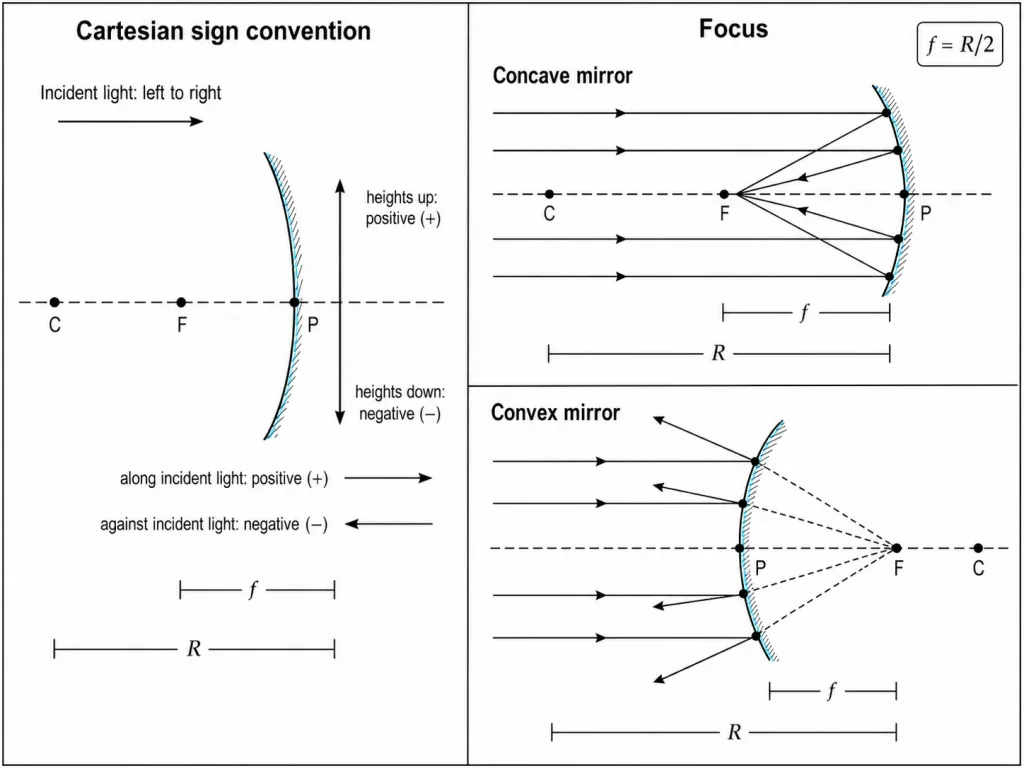
For a spherical mirror, the normal at any point runs along the radius — the line from the centre of curvature C to the point. The geometric centre of the mirror is its pole P; the line joining P and C is the principal axis.
The Cartesian Sign Convention (Learn It Once, Use It Everywhere)
Every formula in this chapter assumes the Cartesian sign convention:
- All distances are measured from the pole of the mirror (or the optical centre of a lens).
- Distances along the direction of incident light are positive; distances against it are negative.
- Heights above the principal axis are positive; below, negative.
With this one convention, a single mirror formula and a single lens formula handle every case — concave or convex, real or virtual.
Immediate consequences (with light incident from the left):
- Object distance u is negative (object sits left of the pole).
- Concave mirror: f and R negative; convex mirror: f and R positive.
- A real image (left of a mirror) has v negative; a virtual image (behind the mirror) has v positive.
[NEET Important] Most lost marks in ray optics are sign errors. Write u, v, f, R with signs before substituting — every time.
The Principal Focus and f = R/2
Send a paraxial beam (rays close to the pole, making small angles with the axis) parallel to the principal axis:
- Concave mirror: reflected rays converge to a point F on the axis.
- Convex mirror: reflected rays appear to diverge from a point F behind the mirror.
F is the principal focus; the pole-to-focus distance is the focal length f. (A parallel beam at a small angle to the axis converges in the focal plane through F.)
Why : consider a parallel ray hitting the mirror at M. The radius CM is the normal, so the ray reflects making equal angles with CM. Geometry gives MCP and MFP ; for small angles, and , so — for paraxial rays D approaches P, hence
Key Point: holds for both mirror types (with signs: concave ; convex ) and only for paraxial rays — wide beams suffer blurring (spherical aberration, the reason for parabolic mirrors in telescopes).
Solved Examples
Example 1: Focal lengths with signs [NEET Numerical]
Write the focal lengths (with signs) of (a) a concave mirror of R = 20 cm, (b) a convex mirror of R = 32 cm.
Solution:
- in magnitude; signs from the convention.
- (a) Concave: cm.
- (b) Convex: cm.
Example 2: The side-view mirror's focus [NEET Numerical]
A car's side-view (convex) mirror has R = 2 m. Where is its focus, and can sunlight be concentrated by it?
Solution:
- m — the focus lies 1 m behind the mirror.
- Reflected sunlight only appears to diverge from this virtual focus; it is never actually concentrated.
- A concave mirror (real focus) is what burns paper in sunlight.
Example 3: Normal along the radius
Why is the normal to a spherical mirror at any point taken along the radius through that point?
Solution:
- The normal must be perpendicular to the tangent plane of the surface at the point of incidence.
- For a sphere, every radius is perpendicular to the surface where it meets it.
- So the line from the centre of curvature C to the incidence point is the normal — which is why C anchors all mirror geometry.
Example 4: Paraxial means… [JEE pattern]
State the paraxial approximation and why mirror formulas need it.
Solution:
- Rays incident close to the pole, making small angles with the principal axis (so ).
- Only such rays reflect through a single sharp focus; marginal (wide) rays cross the axis at slightly different points.
- All formulas of this chapter — , the mirror and lens equations — are paraxial results.
Example 5: Sign-convention drill [NEET Numerical]
An object stands 25 cm in front of a concave mirror of focal length 10 cm. Write u and f with correct signs (do not solve yet).
Solution:
- Light travels from the object towards the mirror; distances against the incident light are negative.
- cm (object on the incident side).
- cm (concave focus on the incident side). The actual image hunt happens in Section 2.
Example 6: Focal plane in action [JEE Numerical]
A parallel beam strikes a concave mirror ( cm) at a small angle of 0.1 rad to the principal axis. Where does it converge?
Solution:
- A tilted parallel beam converges in the focal plane — the plane through F perpendicular to the axis.
- Distance from the axis: cm.
- Answer: 20 cm in front of the mirror, 2 cm off the axis.
Example 7: Concave vs convex at a glance
List the sign pattern (u, f, R) for the two mirror types with a real object.
Solution:
- Always: for a real object (it sits against the incident direction).
- Concave: , — real focus in front.
- Convex: , — virtual focus behind. Memorise the pattern; it removes half the errors of this chapter.
Example 8: Why curved surfaces still obey plane laws
Justify using the plane-mirror laws of reflection for spherical mirrors.
Solution:
- The laws of reflection are local — they hold at each point of any reflecting surface.
- At each point, the curved mirror behaves like the tiny tangent plane there, with the normal along the radius.
- The curvature only changes the normal's direction from point to point — which is exactly what focuses the beam.
Example 9: R from f [NEET Numerical]
A shaving (concave) mirror must have its focus 25 cm from the pole. What radius of curvature should the maker grind?
Solution:
- cm.
- With signs: cm, cm.
- The centre of curvature sits 50 cm in front of the mirror — twice as far as the focus, always.
Example 10: One convention, all cases
What does NCERT mean by 'a single formula handles all cases'?
Solution:
- With the Cartesian convention, (Section 2) works for concave AND convex mirrors, real AND virtual images.
- You never memorise case-wise rules; the signs carry the geometry.
- The same economy repeats for lenses with .