
The Simple Microscope (Magnifier)
A converging lens of small focal length, held close to the eye with the object within one focal length. The lens makes an erect, magnified, virtual image, comfortably viewable at the near point cm or beyond.
Image at the near point (maximum magnification, slight eye strain):
Image at infinity (object exactly at f — relaxed-eye viewing):
(one less, but more comfortable — NCERT adopts the at-infinity case for instruments). With cm: (near point) or 5 (infinity). What the magnifier really does: it lets you bring the object closer than D while the eye still sees a comfortable, distant image — more subtended angle, more detail.
Realistic single lenses top out at . For more, compound the effect.
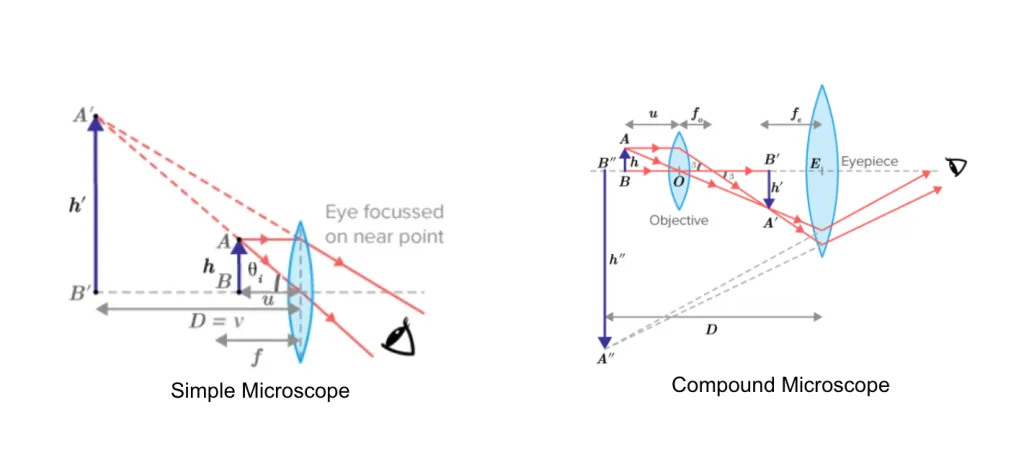
The Compound Microscope
Two lenses, each multiplying the other's work:
- The objective (focal length , nearest the object): forms a real, inverted, magnified image of a close object. Linear magnification where L, the tube length, is the distance between the objective's second focus and the eyepiece's first focus.
- The eyepiece (): used as a simple magnifier on that first image — angular magnification (near point) or (infinity).
Total magnification (final image at infinity):
NCERT's example: cm, cm, L = 20 cm gives .
Design logic: both focal lengths small (in practice not much below 1 cm) and L large. The final image is inverted with respect to the object. Modern microscopes use multi-element objectives/eyepieces to tame aberrations.
[NEET Important] Objective: REAL image (it must be, to serve as the eyepiece's object). Eyepiece: VIRTUAL final image. Mixing these up costs the easiest mark on the paper.
Solved Examples
Example 1: The 5 cm magnifier [NEET Numerical]
Find the magnification of a simple microscope of f = 5 cm for image (a) at the near point, (b) at infinity (D = 25 cm).
Solution:
- (a) .
- (b) .
- One unit less, far less strain — NCERT's own pair of numbers.
Example 2: NCERT's 250x microscope [NEET Numerical]
Compute the magnification of a compound microscope with cm, cm, tube length 20 cm (image at infinity).
Solution:
- .
- .
- — the textbook's flagship number.
Example 3: Near-point boost [JEE Numerical]
For the same microscope, what is the total magnification if the final image is formed at the near point instead?
Solution:
- .
- .
- Eight percent more magnification, bought with eye strain — why 'at infinity' is the default.
Example 4: Choosing f for a target magnification [NEET Numerical]
What focal length must a magnifier have for a near-point magnification of 11?
Solution:
- .
- cm.
- Single lenses this short exist, but aberrations bite — beyond m of about 9-10, builders switch to compound designs.
Example 5: What the magnifier actually does
A stamp 1 mm tall is examined. Explain, via angles, why the magnifier helps although the image may be no closer than D.
Solution:
- Unaided, the closest comfortable view is at D: the stamp subtends .
- The lens lets the stamp sit at while presenting its image far away: the eye now receives angle .
- Angular gain — the magnifier's true job is letting the object come close while keeping the view comfortable.
Example 6: Objective magnification check [JEE Numerical]
In a compound microscope, the objective ( cm) forms its image 20 cm from its second focus (L = 20 cm). Confirm from first principles for a near-focus object.
Solution:
- The object sits just beyond ; the image height ratio is (NCERT's construction).
- So .
- The tube-length formula is geometry, not magic — angle equality at the focus.
Example 7: Both lenses small — why? [NEET pattern]
Justify NCERT's design rule: objective and eyepiece of a microscope should both have small focal lengths.
Solution:
- — both focal lengths sit in denominators.
- Halve either and the magnification doubles; large L multiplies further.
- Practical floor: about 1 cm (lens making and aberrations), hence the 250x scale of student microscopes.
Example 8: Image orientations through the chain
Track erect/inverted through a compound microscope.
Solution:
- Objective: real, inverted, magnified first image.
- Eyepiece (simple magnifier): keeps orientation — virtual, magnified, still inverted.
- Final image: inverted with respect to the object (fine for cells, fatal for reading — hence erecting prisms in field instruments).
Example 9: A microscope on paper [JEE Numerical]
Design check: cm, cm, L = 18 cm. Find m (image at infinity) and comment.
Solution:
- ; .
- .
- Comparable to NCERT's 250x with slightly different trade-offs — real designs juggle , L and aberration control.
Example 10: Why not one strong lens?
A single 0.1 cm lens would nominally give . Why do we not build such magnifiers?
Solution:
- NCERT: realistic single-lens magnification is at most about 9 — ultra-short lenses suffer crushing aberrations and impossible working distances (object 1 mm from glass!).
- The compound microscope splits the labour: moderate times moderate achieves what no single lens can.
- 'Compounding the effect of one lens by another' — the instrument's name is its principle.