
The Geometry of a Prism
A ray crosses a triangular prism (angle A): refraction at face AB (angles i, ) and at face AC (angles , e). The angle between the emergent and incident rays is the angle of deviation d.
Two lines of pure geometry:
- In the quadrilateral formed by the faces and normals, ; the triangle of normals gives . Hence
- Total deviation = the two bends summed: , so
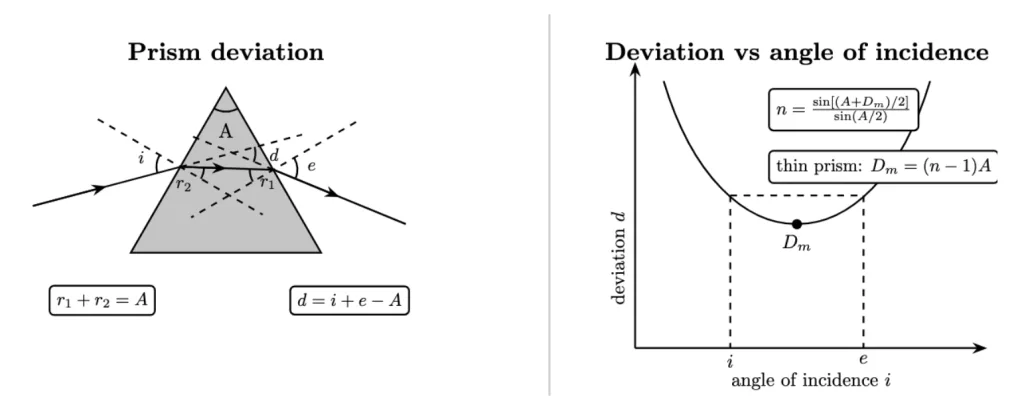
Plot d against i: a U-shaped curve with a single minimum. Every deviation except the minimum corresponds to two incidence angles (i and e swap — the path is reversible); at the bottom of the U they coincide.
Minimum Deviation: The Prism's Sweet Spot
At minimum deviation : and — the ray runs parallel to the base inside the prism. Then and , and Snell's law at either face delivers the jewel:
Measure A and on a spectrometer table and the refractive index follows — the standard laboratory method.
Thin (small-angle) prisms: sines become angles, and
— thin prisms deviate little, and the deviation is independent of i (for small i).
[NEET Important] The two prism facts asked every year: at minimum deviation the internal ray is parallel to the base, and i = e. [JEE Tip] A favourite special case: A = 60 degrees and degrees give — memorise the trio (60, 30, ).
Solved Examples
Example 1: The classic 60-30 prism [NEET Numerical]
A prism of angle 60 degrees shows minimum deviation 30 degrees. Find its refractive index.
Solution:
- .
- .
- The (60, 30, ) trio — the most reused prism numbers in exam history.
Example 2: Deviation from the angles [NEET Numerical]
Light enters a 60-degree prism at i = 45 degrees and emerges at e = 35 degrees. Find the deviation.
Solution:
- .
- .
- No Snell's law needed — the relation is pure geometry.
Example 3: Inside the prism [JEE Numerical]
Light strikes a 60-degree prism (n = 1.5) at . Find and hence .
Solution:
- Snell at entry: .
- .
- The pair always sums to A — use it instead of re-running Snell inside.
Example 4: Thin-prism deviation [NEET Numerical]
A thin prism of angle 6 degrees (n = 1.5) deviates light by how much?
Solution:
- .
- — small prisms, small bends, independent of incidence angle.
- (Two such prisms opposed make a 'prism pair' deflecting without dispersion tricks — instrument-makers' staple.)
Example 5: At minimum deviation, find i [JEE Numerical]
For the 60-degree, -index prism at minimum deviation, what is the angle of incidence?
Solution:
- .
- (= e, by symmetry).
- And inside, with the ray parallel to the base — the full minimum-deviation portrait.
Example 6: Index from the lab [JEE Numerical]
A spectrometer measures A = 60.0 degrees and degrees for a glass prism. Find n.
Solution:
- .
- — crown glass.
- This is exactly how Table 9.1's indices are measured.
Example 7: Two angles, one deviation
Why does each deviation (except ) correspond to two incidence angles?
Solution:
- is symmetric in i and e: swapping them leaves d unchanged.
- Physically, light paths are reversible — run the ray backwards and i, e exchange roles with the same d.
- Only at the minimum do the two solutions merge (): the U-curve's single bottom.
Example 8: Grazing the limit [JEE Numerical]
Under what condition does a ray fail to emerge from the prism's second face AC?
Solution:
- The ray fails to emerge when it hits AC beyond the critical angle: .
- Since , small i (small ) pushes up — too-shallow entry causes TIR at the second face.
- Emergence requires , i.e. : a prism with transmits nothing at any incidence — a neat JEE trap.
Example 9: Parallel to the base — why it matters
State two practical consequences of the minimum-deviation symmetry.
Solution:
- Measurement: at the geometry is unique and stable (d changes only second-order with i), so spectrometer readings are sharpest there — ideal for measuring n.
- Alignment: the internal ray parallel to the base means symmetric entry/exit — rotating the prism slightly barely changes d near the minimum (the turning point).
- Exams reward the phrase: 'at minimum deviation the refracted ray inside the prism is parallel to the base; i = e and .'
Example 10: Building the n-formula
Derive in three lines.
Solution:
- At minimum: , and gives .
- (from with ) gives .
- Snell at the first face: . Done — and examiners award each line.