
Snell's Law
When light meets a transparent medium obliquely, part reflects and part refracts — changes direction as it enters. Snell's experimental laws:
- Incident ray, refracted ray and the normal at the point of incidence lie in one plane.
- — a constant for the medium pair, the refractive index of medium 2 with respect to medium 1 (it also depends on wavelength, but never on the angle of incidence).
Reading :
- : — ray bends towards the normal; medium 2 is optically denser.
- : — bends away from the normal; medium 2 is rarer.
Key Point (NCERT's warning): optical density is NOT mass density. Turpentine is lighter than water by mass yet optically denser — optical density compares light speeds, nothing else.
Relative Indices and Two Classic Geometries
Index algebra (pure bookkeeping, endlessly examined):
With vacuum/air as medium 1, — the absolute refractive index: glass 1.5 means light at m/s inside.
The parallel-sided slab: refraction at entry and exit faces gives — the emergent ray is parallel to the incident ray (zero net deviation) but laterally shifted. The thicker the slab or the larger the angle, the bigger the shift.
The raised pool floor: light from the bottom bends away from the normal on exiting water, so the bottom appears raised. For near-normal viewing,
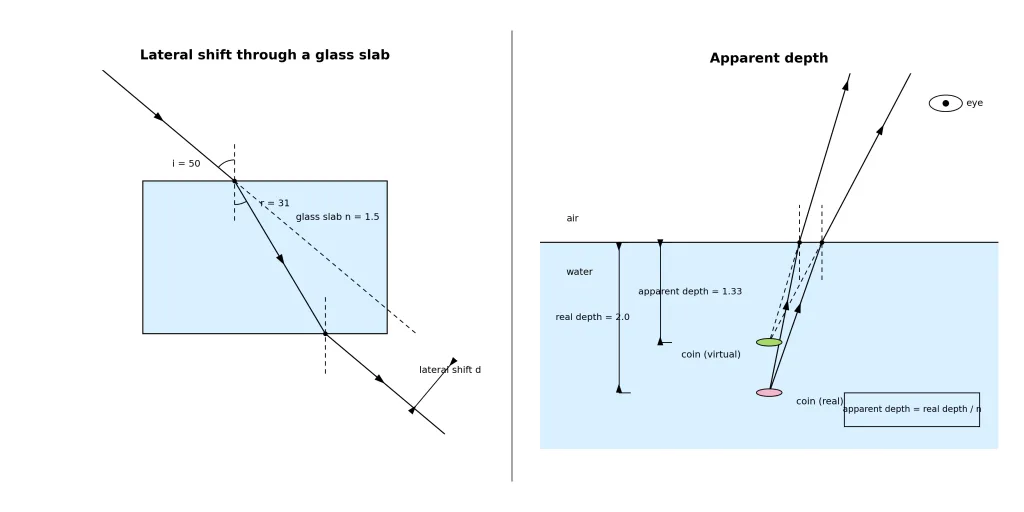
[NEET Important] Water's : a pool always looks three-quarters of its real depth. Divers and exam-setters both exploit this.
Solved Examples
Example 1: Bending at a glass surface [NEET Numerical]
Light strikes a glass surface (n = 1.5) at 60 degrees from the normal. Find the angle of refraction.
Solution:
- .
- .
- Towards the normal, as expected entering a denser medium.
Example 2: Speed inside glass [NEET Numerical]
What is light's speed in glass of refractive index 1.5? And in water (n = 1.33)?
Solution:
- .
- Glass: m/s.
- Water: m/s — light is slower where the medium is optically denser.
Example 3: Water-to-glass index [JEE Numerical]
Find the refractive index of glass (n = 1.5) with respect to water (n = 1.33).
Solution:
- .
- .
- Light entering glass from water bends towards the normal, but far more gently than from air — the relative index is what Snell's law sees.
Example 4: The 4-metre pool [NEET Numerical]
A pool is really 4.0 m deep. How deep does it look to someone peering straight down? (n of water = 4/3.)
Solution:
- Apparent depth .
- m.
- A swimmer misjudging this by a metre is the classic real-world (and exam) consequence.
Example 5: Index chain [JEE Numerical]
Given (water w.r.t. air) and (glass w.r.t. air), find (glass w.r.t. water) and .
Solution:
- .
- .
- Light from glass into water bends away from the normal ().
Example 6: Slab in, slab out
A ray passes through a thick parallel-sided glass slab. Compare the emergent ray with the incident ray.
Solution:
- Refraction at entry (towards normal) is exactly undone at exit (away from normal): .
- The emergent ray is parallel to the incident ray — zero net deviation.
- It is, however, laterally shifted; the shift grows with slab thickness and angle of incidence. (A slab displaces; it never deviates.)
Example 7: A coin under glass [JEE Numerical]
A coin lies under a 6 cm thick glass slab (n = 1.5). By how much does it appear raised?
Solution:
- Apparent depth cm.
- Raised by cm — in general .
- Check: cm. The coin floats a third of the way up.
Example 8: Why does the index ignore the incidence angle?
A student doubles the angle of incidence and finds sin i/sin r unchanged. Why?
Solution:
- is a property of the pair of media (and the light's wavelength) — it encodes the speed ratio .
- Changing i changes r in exact proportion of sines; their ratio cannot move.
- What DOES change : switching media or switching colour (dispersion — violet bends more than red).
Example 9: Turpentine vs water
Turpentine has lower mass density than water but higher optical density. Reconcile.
Solution:
- Mass density: mass per volume. Optical density: how much the medium slows light (ratio of speeds).
- The two are set by different physics — molecular polarisability vs packing — and need not order the same way.
- NCERT's example: light travels slower in turpentine than in water, so turpentine is optically denser despite floating on water.
Example 10: Apparent depth, oblique warning
The formula apparent depth = real depth/n carries a caveat. What is it?
Solution:
- The derivation assumes near-normal viewing (small angles).
- Viewed obliquely, the apparent position shifts further and the simple formula fails.
- NCERT's Fig. 9.10 shows both cases — quote 'for viewing near the normal direction' when stating the result.