
One Curved Interface, One Master Formula
Let light cross a single spherical surface of radius R from a medium of index into (object O on the axis, image I). For paraxial rays, the small-angle geometry plus Snell's law ( for small angles) gives, after applying the Cartesian convention (OM , MI , MC ):
Reading the formula:
- It connects object and image across one refracting surface — the atomic unit from which the lens formulas are assembled (Section 6 applies it twice).
- R carries a sign: convex towards the incident light (centre beyond the surface) means .
- Set (flat interface) and it reduces to — the apparent-depth result in disguise.
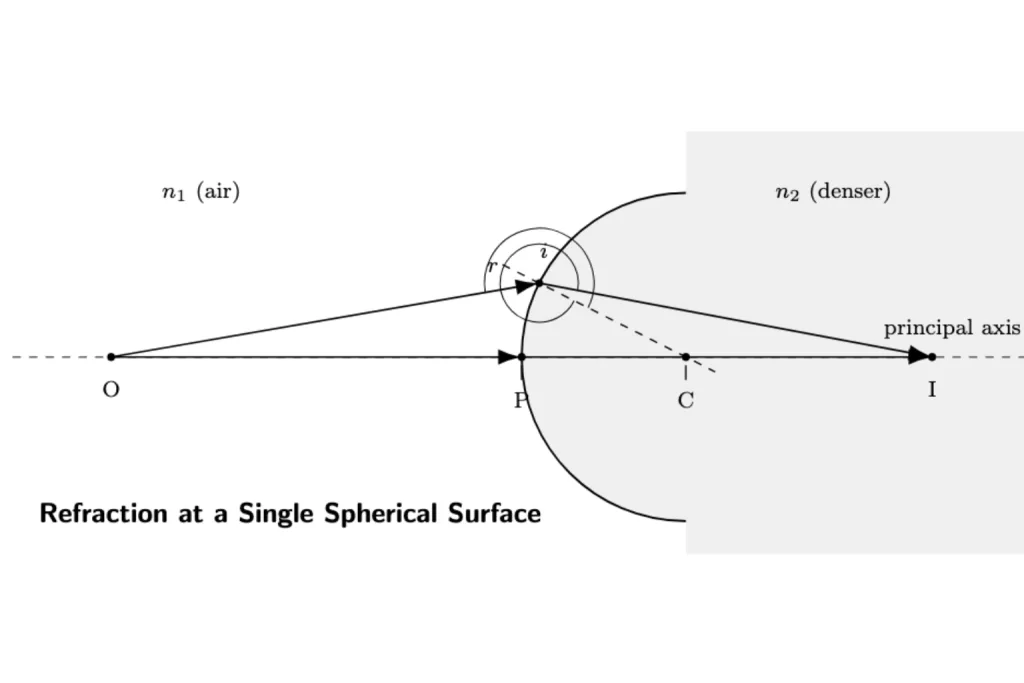
The Template Problem
Light from a point source in air falls on a glass surface (n = 1.5, R = 20 cm) from 100 cm away. Where is the image?
Setup: , , cm, cm.
The image forms 100 cm inside the glass, in the direction of the incident light.
Problem-solving drill:
- Identify (where light starts) and (where it goes) — the formula is direction-sensitive!
- Sign u (almost always negative), sign R by where C lies.
- Solve for v; positive v = image downstream (real, inside medium 2 here).
[JEE Tip] Curved-interface problems love two disguises: a fish under a curved bowl wall, and an air bubble inside a glass sphere (light then travels glass-to-air: , — swap roles!). Direction of travel decides which index is which.
Solved Examples
Example 1: The NCERT template (Example 9.5)
A point source in air sits 100 cm from a convex glass surface (n = 1.5, R = 20 cm). Locate the image.
Solution:
- .
- .
- cm — a real image 100 cm beyond the surface, inside the glass.
Example 2: Same surface, nearer object [JEE Numerical]
Move the source to 25 cm from the same surface. Now where is the image?
Solution:
- .
- cm.
- Negative v: a virtual image 100 cm on the incident side — close objects beat the surface's converging power.
Example 3: Flat-interface limit [NEET Numerical]
Use the master formula with for a fish 90 cm under water (n = 4/3), viewed from straight above. Where does it appear?
Solution:
- with (water, where light starts), , .
- cm.
- The fish appears 67.5 cm deep — the apparent-depth rule, straight from the master formula.
Example 4: Glass-to-air crossing [JEE Numerical]
An object inside glass (n = 1.5) sits 30 cm from a surface separating glass from air; the surface is concave as seen from inside the glass, with signed radius R = -10 cm. Find the image. (Light goes glass to air: , .)
Solution:
- .
- .
- : the rays emerge parallel — this object happens to sit at the surface's first focus.
Example 5: Sign the radius [NEET pattern]
State the sign of R when light strikes (a) a surface bulging towards it (convex), (b) a surface curving away (concave).
Solution:
- R runs from the surface's pole to its centre of curvature C, signed along the incident light.
- (a) Convex towards the light: C lies downstream — .
- (b) Concave towards the light: C lies upstream — .
Example 6: The formula's direction-sensitivity
Why must always be the medium the light comes FROM?
Solution:
- The derivation applies Snell's law at the crossing — with i in the first medium.
- Swapping the labels flips the sign of and misplaces the image.
- In bubble-in-glass problems light starts in glass: , . Read the ray, then label.
Example 7: Landing on the second focus [JEE Numerical]
For the air-glass surface (n = 1.5, R = +20 cm), find the object distance for which the image forms at cm.
Solution:
- .
- But exactly, so , i.e. .
- A parallel beam (object at infinity) focuses at 60 cm — incidentally the surface's second focal distance: cm.
Example 8: First and second foci of one surface [JEE Numerical]
For the same surface, find the first focal distance (object position giving parallel emergent rays).
Solution:
- Set : .
- cm.
- Note (40 vs 60 cm) — single surfaces have unequal foci, in the ratio .
Example 9: A drop as a surface [NEET Numerical]
A tiny insect sits at the centre of curvature of a hemispherical dew drop (n = 4/3, R = 3 mm) and is viewed from above through the curved surface. Where does it appear?
Solution:
- An object at the centre of curvature sends every ray along a radius — each meets the surface normally and passes undeviated.
- The formula agrees: with the signed radius (C lies on the incident side) and : , so .
- The insect appears exactly where it is — rays through C never bend. A favourite shortcut.
Example 10: Building towards the lens
How does this section's formula become a lens formula?
Solution:
- A thin lens is two spherical surfaces back-to-back.
- Apply at the first surface; its image becomes the object for the second application.
- Add the two equations, let the thickness vanish — out drops the lens maker's formula (Section 6). One brick, used twice.