
A Lens Is Two Surfaces (The Lens Maker's Formula)
A thin lens = two spherical refracting surfaces back-to-back. Apply Section 5's formula at each:
- Surface 1 (radius ): forms image of object O.
- Surface 2 (radius ): treats as its (possibly virtual) object and forms the final image I.
Adding the two surface equations for a thin lens (thickness ), and putting the object at infinity (so the image lands at the focus f), gives the lens maker's formula:
- = lens material's index relative to the surroundings — a lens behaves differently in water than in air!
- Signs: a double-convex lens has , , giving (converging). A double-concave lens reverses both: (diverging).
- The formula designs lenses: choose radii to manufacture any desired f.
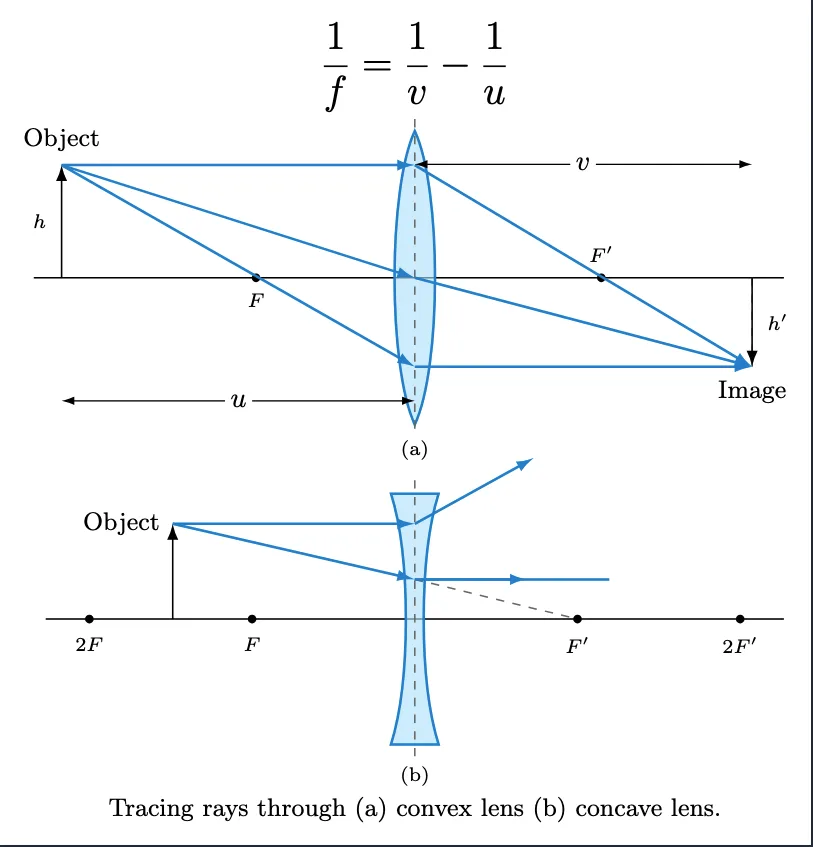
The Thin-Lens Equation and Image Tracing
Keeping the object finite, the same two-surface addition yields the thin lens formula:
(note the minus, unlike the mirror's plus!) — valid for convex and concave lenses, real and virtual images. A lens has two foci F and F', equidistant from the optical centre.
The three standard rays (any two locate the image):
- Parallel to the axis → emerges through F' (convex) or appears to come from F (concave).
- Through the optical centre → passes undeviated.
- Through the first focus F (convex) → emerges parallel to the axis.
Magnification: (no minus sign in the lens version!). : real and inverted; : virtual and erect.
The case map (convex lens): beyond 2F → image between F' and 2F' (real, inverted, diminished); at 2F → at 2F' (same size); between 2F and F → beyond 2F' (magnified); inside F → virtual, erect, magnified (the magnifying glass!). Concave lens: always virtual, erect, diminished, on the object's side.
[NEET Important] Mirror: , equation with +. Lens: , equation with −. Examiners live in this asymmetry.
Solved Examples
Example 1: The vanishing lens
A magician makes a glass lens (n = 1.47) disappear in a trough of liquid. What is the liquid's refractive index? Could it be water?
Solution:
- The lens vanishes when it stops bending light: requires , i.e. liquid index = 1.47.
- Then : the lens acts as a plain glass sheet — invisible in the liquid.
- Water (n = 1.33) won't do; glycerine (n about 1.47) would.
Example 2: Designing a lens [JEE Numerical]
A double-convex lens (n = 1.5) has radii 10 cm and 15 cm. Find its focal length.
Solution:
- cm, cm.
- .
- cm — converging, as the shape promised.
Example 3: Image hunt, convex lens [NEET Numerical]
An object stands 30 cm from a convex lens of f = +10 cm. Locate and describe the image.
Solution:
- .
- cm (real, beyond F' on the far side).
- : real, inverted, half-size — the object is beyond 2F.
Example 4: Image hunt, concave lens [NEET Numerical]
The same object (30 cm away) faces a concave lens of f = -10 cm.
Solution:
- .
- cm: on the object's side.
- : virtual, erect, quarter-size — the invariable concave-lens verdict.
Example 5: The magnifying-glass position [JEE Numerical]
Where must a stamp sit before a convex lens (f = +10 cm) to appear erect and 5x enlarged?
Solution:
- Erect and magnified: virtual image, .
- cm.
- Inside the focus (8 < 10) — exactly the case map's magnifier slot. Image at cm.
Example 6: Plano-convex design [JEE Numerical]
What radius must the curved face of a plano-convex lens (n = 1.5) have for f = +20 cm?
Solution:
- Flat face: . .
- cm.
- One curved face does all the work; for n = 1.5, R is always half… rather, . Equivalently an equiconvex lens (|R| both sides) with n = 1.5 has .
Example 7: The lens in water [JEE Numerical]
A convex lens of f = +20 cm in air (n_glass = 1.5) is dipped in water (). Find its new focal length.
Solution:
- In air: , so .
- In water the relative index is : .
- cm — the lens converges nearly four times more weakly under water. (Why swimmers see blurry: their eye-lenses lose power the same way.)
Example 8: Same lens, both faces swapped
Does turning a lens around change its focal length?
Solution:
- Reversing the lens swaps (each radius flips sign and role).
- is unchanged by that swap.
- No — focal length (and power) is the same from either side; the two foci stay equidistant from the optical centre.
Example 9: Finding f from one conjugate pair [NEET Numerical]
A lens forms a real image at 60 cm of an object 20 cm away (on the other side). Find f and the lens type.
Solution:
- Real image opposite side: cm, cm.
- , so cm.
- Positive f: convex lens; — inverted, tripled.
Example 10: Why m has no minus for lenses
Reconcile with .
Solution:
- Both come from the same similar-triangles construction; the sign difference is bookkeeping from the conventions (reflection folds distances back; refraction continues forward).
- The decoder is identical: negative m = inverted (real), positive m = erect (virtual).
- Trust the formulas with signed u, v — never re-derive signs midway through an exam.