
Power: A Lens's Bending Ability
A shorter focal length bends light more sharply. The power of a lens quantifies this: it is the tangent of the angle by which the lens deflects a ray arriving parallel at unit height (; with ):
- SI unit: dioptre (D) — the power of a 1 m focal-length lens. f must be in metres!
- P positive for converging (convex), negative for diverging (concave) lenses.
- The optician's language: a prescription of +2.5 D means a convex lens of m; −4.0 D means a concave lens of cm.
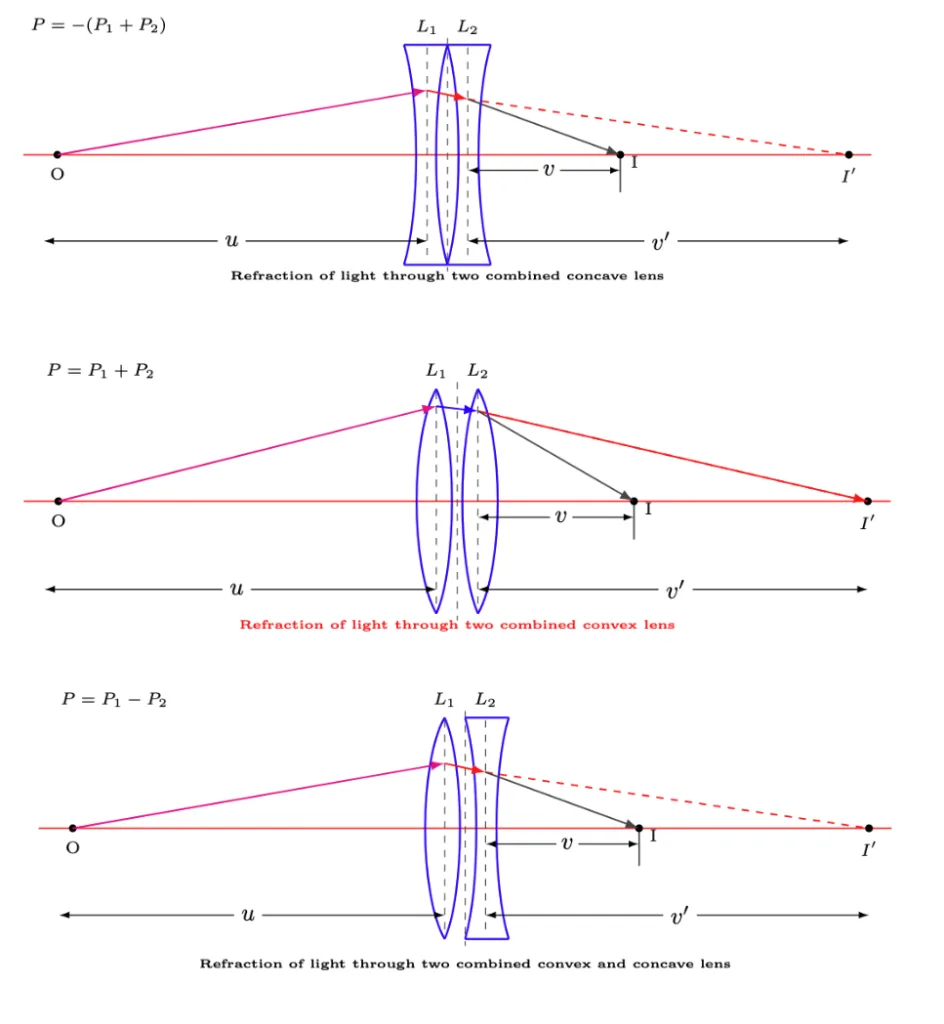
Lenses in Contact: Powers Simply Add
Place two thin lenses () in contact. The first forms an image at (), which acts as the object for the second (). Adding:
So for any number of thin lenses in contact:
Powers add algebraically (signs included!) — the reason opticians work in dioptres rather than focal lengths. Combinations let designers tune power and sharpen images (multi-element camera lenses, instrument eyepieces).
[JEE Tip] For lenses separated by distance d (not in contact), process them sequentially: image of lens 1 (shifted by d) becomes the object of lens 2 — exactly NCERT Example 9.8's three-lens chain. A real image that lands beyond the next lens acts as that lens's virtual object (positive u). The chain method never fails; memorised 'd-formulas' often do.
Solved Examples
Example 1: Power of a half-metre lens (NCERT Example 9.7i) [NEET Numerical]
Find the power of a glass lens of focal length 0.5 m.
Solution:
- .
- dioptre — converging.
Example 2: Reading a prescription [NEET Numerical]
What lens does a −4.0 D prescription specify? And +2.5 D?
Solution:
- : D gives m — a concave lens of 25 cm focal length.
- D gives m — a convex lens of 40 cm.
- Dioptres are just reciprocal metres with the lens type encoded in the sign.
Example 3: Two lenses in contact [NEET Numerical]
A convex lens ( cm) is in contact with a concave lens ( cm). Find the combination's focal length and power.
Solution:
- .
- cm: the pair diverges.
- D. (Equivalently D ✓.)
Example 4: Power bookkeeping [JEE Numerical]
Three thin lenses of powers +2 D, +3 D and −5 D are in contact. Describe the combination.
Solution:
- D.
- : the stack behaves as a plane glass sheet — light passes undeviated (in direction).
- Zero-power combinations are how instrument makers cancel aberrations while keeping geometry.
Example 5: NCERT's three-lens chain (Example 9.8) [JEE Numerical]
Lenses of cm, cm, cm stand 5 cm apart in sequence. An object sits 30 cm before the first lens. Find the final image.
Solution:
- Lens 1: cm. This image sits cm beyond lens 2: a virtual object, cm.
- Lens 2: — parallel rays emerge.
- Lens 3: parallel input focuses at its focus: cm.
- Final image: 30 cm beyond the third lens. The chain method, step by step.
Example 6: Equivalent power of the eye-plus-spectacle [NEET Numerical]
An eye of power +60 D wears a −2 D spectacle lens (treat as in contact). What is the corrected power and focal length?
Solution:
- D.
- m cm.
- Spectacles work by adding power — dioptres make eyewear arithmetic trivial.
Example 7: From radii to dioptres [JEE Numerical]
Find the power of a double-convex lens (n = 1.5, radii 10 cm and 15 cm).
Solution:
- From Section 6: cm m.
- D.
- Small focal lengths mean big dioptres — instrument objectives run to tens of D.
Example 8: What does 1 dioptre mean physically?
Interpret P = 1 D via the bending-angle definition.
Solution:
- for a ray arriving parallel at unit height (1 m) from the axis.
- A 1 D lens deflects such a ray by per metre of height — i.e. it converges it to cross the axis 1 m downstream.
- Power literally measures deflection per unit ray height — bending ability, not 'strength of glass'.
Example 9: Cancelling a lens [NEET Numerical]
What lens, placed in contact with a +5 D lens, makes the pair behave like a plain sheet? Its focal length?
Solution:
- Need : D.
- m cm — a concave lens.
- Equal and opposite powers in contact annul each other — the principle behind achromatic doublets (different materials, cancelling dispersions).
Example 10: Magnification through a chain
Two lenses in contact produce magnifications and in sequence. What is the overall magnification and image character?
Solution:
- .
- The final image is inverted, same size as the object.
- Multiplying magnifications (with signs) is general for any lens train — microscopes (Section 9) live on this rule.