
The Mirror Equation
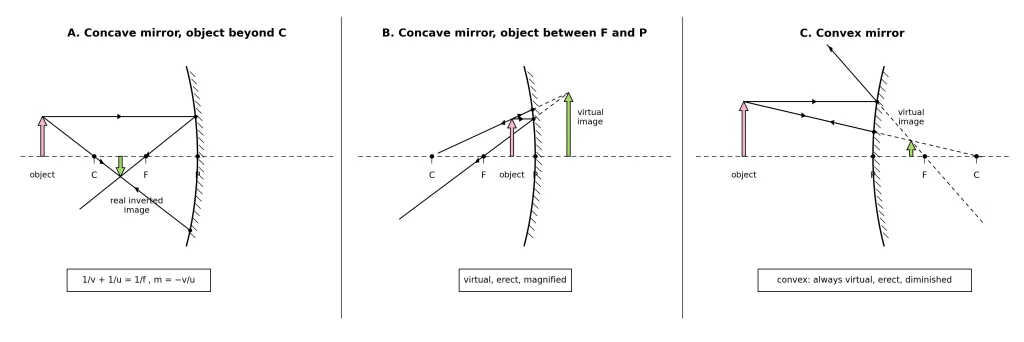
For an object on the principal axis of a spherical mirror, the image position follows from similar triangles in the ray diagram (object ray through C, ray to the pole). For paraxial rays the result is the mirror equation:
Derived for a real, inverted image in a concave mirror — but valid for every case (concave or convex, real or virtual image) once the Cartesian signs are used.
Lateral magnification:
Sign decoding: — image inverted (and real, for mirrors); — image erect (and virtual). : magnified; : diminished.
The Case Map (Concave) and the One-Line Convex Story
Concave mirror (f negative), object moving in from infinity:
| Object position | Image | Nature |
|---|---|---|
| Beyond C | between F and C | real, inverted, diminished |
| At C | at C | real, inverted, same size |
| Between C and F | beyond C | real, inverted, magnified |
| At F | at infinity | — |
| Between F and P | behind the mirror | virtual, erect, magnified (the make-up mirror!) |
Convex mirror: for every real object position, the image is virtual, erect, diminished, located between P and F behind the mirror — which is why it gives a wide field of view (vehicle side-view mirrors), at the price of 'objects are closer than they appear'.
[JEE Tip] For numericals, skip the case map: substitute signed values in and read the nature from the signs of v and m. The map is for ray-diagram questions and quick checks.
Solved Examples
Example 1: The half-covered mirror
The lower half of a concave mirror is covered with opaque material. What happens to the image of an object in front of it?
Solution:
- Every point of the remaining half still obeys the laws of reflection, and rays from every object point still reach it.
- The image remains complete — of the whole object.
- But the reflecting area is halved, so the image intensity drops (here to half). Covering a mirror (or lens) never crops the image; it only dims it.
Example 2: The phone along the axis
A mobile phone lies along the principal axis of a concave mirror. Why is its image distorted?
Solution:
- Different parts of the phone sit at different object distances u.
- Magnification varies with u — each slice of the phone is magnified differently (the part on the plane perpendicular to the axis through C images at C, same size).
- Hence the image is distorted, and yes, the distortion depends on where the phone lies relative to the mirror.
Example 3: Two positions, two natures [NEET Numerical]
An object is placed at (i) 10 cm, (ii) 5 cm in front of a concave mirror of R = 15 cm. Find the image position, nature and magnification.
Solution:
- cm.
- (i) : cm; . Real, inverted, magnified 3x, 30 cm in front.
- (ii) : cm; . Virtual, erect, magnified 3x, 15 cm behind — the object is inside F.
Example 4: The jogger in the mirror [JEE Numerical]
A jogger approaches a convex side-view mirror (R = 2 m) at 5 m/s. How fast does the image move when the jogger is 39 m, 29 m, 19 m and 9 m away?
Solution:
- m. For : m. One second later (): m.
- Image shift in that second: m — average speed m/s.
- Repeating: at 29 m → m/s; at 19 m → m/s; at 9 m → m/s.
- The image crawls when far and speeds up sharply as the jogger nears — exactly what you observe in a parked car.
Example 5: Convex mirror image hunt [NEET Numerical]
An object stands 10 cm in front of a convex mirror of f = +7.5 cm. Locate and describe the image.
Solution:
- .
- cm — behind the mirror.
- : virtual, erect, diminished — as always for a convex mirror.
Example 6: Where is the image the same size? [JEE Numerical]
For a concave mirror of f = -12 cm, where must the object stand for a real image of equal size?
Solution:
- Equal-size real image means , i.e. .
- The mirror equation: cm.
- At the centre of curvature (24 cm in front) — object at C, image at C.
Example 7: Finding f from one image [JEE Numerical]
A concave mirror forms a real image 24 cm in front of it when the object stands 40 cm away (so cm, cm). Find f and m.
Solution:
- .
- cm ( cm).
- : real, inverted, diminished.
Example 8: Virtual-image magnification [NEET Numerical]
A make-up (concave) mirror of f = -15 cm shows your face erect and doubled in size. How far is your face?
Solution:
- Erect, doubled: .
- Mirror equation: .
- cm — hold the mirror 7.5 cm away (inside F, as the case map demands).
Example 9: Why side-view mirrors are convex
Give the optical trade-off behind convex vehicle mirrors.
Solution:
- A convex mirror images the whole wide world as erect, diminished, virtual pictures between P and F — an enormous field of view in a small glass.
- The price: diminished images look farther than they are ('objects in mirror are closer than they appear').
- A plane mirror would show true distances but a far narrower field.
Example 10: One equation, every case
Verify the convex-mirror result of Example 5 satisfies the case map.
Solution:
- Computed: cm (behind, between P and F since cm), .
- Case map for convex mirrors: image always virtual, erect, diminished, between P and F — all four boxes ticked.
- The algebra and the geometry always agree; use each to check the other in exams.