
The Refracting Telescope
A telescope gives angular magnification of distant objects. Like the microscope it has an objective and an eyepiece — but with opposite design rules: the objective has a LARGE focal length and a much larger aperture than the eyepiece.
Light from the distant object forms a real image at the objective's second focus, inside the tube; the eyepiece magnifies it like a simple microscope. The magnifying power is the ratio of the angle the final image subtends at the eye () to the angle the object itself subtends ():
NCERT's example: cm, cm gives (tube about 101 cm). The final image is inverted — irrelevant for stars, awkward on land: terrestrial telescopes add a pair of inverting lenses to erect the view.
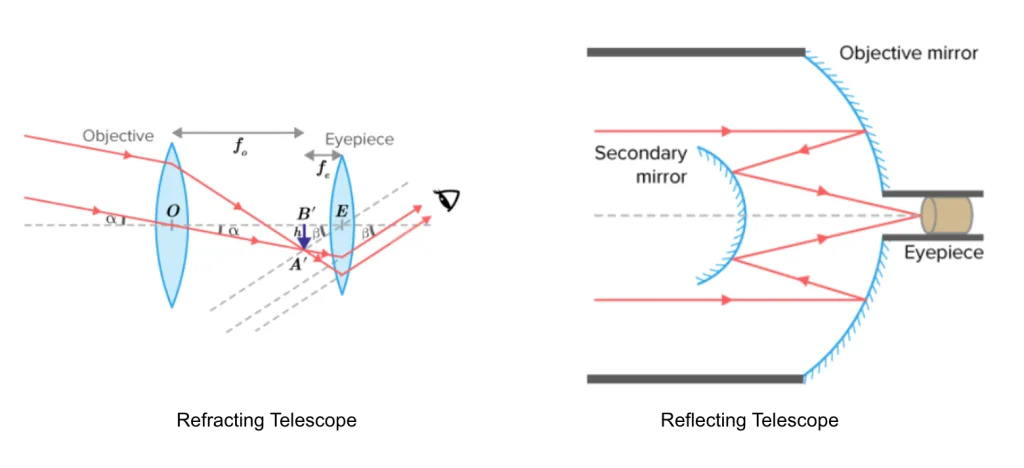
Why the Big Ones Are Mirrors (Reflecting Telescopes)
For astronomy, two performance currencies matter: light-gathering power (proportional to the objective's area — faint galaxies need big collectors) and resolution (better with larger aperture). Scaling a LENS up runs into trouble; a mirror objective wins on every count (NCERT's list):
- No chromatic aberration — reflection treats all colours identically; a big lens smears colours.
- Spherical aberration removable — use a parabolic mirror.
- Mechanical support is far easier: a mirror weighs less than a lens of equivalent quality and can be supported over its entire back (a lens can only be held at the rim, and a huge lens sags under its own weight).
The Cassegrain arrangement: a large concave (parabolic) primary with a hole at its centre; a small convex secondary mirror reflects the converging beam back through the hole to the eyepiece/detector. Compact tube, big effective focal length.
[NEET Important] 'Give two reasons why reflecting telescopes are preferred' — chromatic-aberration freedom and full-back mechanical support are the expected pair; the parabolic cure of spherical aberration earns the third mark.
Solved Examples
Example 1: NCERT's 100x telescope [NEET Numerical]
A telescope has cm and cm. Find its magnifying power and tube length.
Solution:
- .
- Tube length cm.
- Long objective, short eyepiece — the exact opposite of a microscope's recipe.
Example 2: Design from constraints [JEE Numerical]
You must build a 50x telescope in a 102 cm tube (normal adjustment). Find the focal lengths.
Solution:
- and cm.
- cm; cm.
- Two equations, two unknowns — the standard telescope design problem.
Example 3: The moon through it [JEE Numerical]
The moon subtends about 0.5 degrees to the naked eye. Through the 100x telescope, what angle does its image subtend?
Solution:
- : degrees.
- The moon fills most of your visual field — angular magnification in action.
- Telescopes do not make distant things 'bigger'; they make them subtend more angle.
Example 4: Objective image size [JEE Numerical]
For the same telescope, how large is the moon's REAL image at the objective's focus? (Moon's angle 0.5 degrees = 8.7 mrad.)
Solution:
- Image height at the focus (small angles).
- cm.
- A centimetre-scale moon inside the tube, which the eyepiece then magnifies angularly.
Example 5: Why a LARGE objective aperture? [NEET pattern]
Give the two NCERT reasons telescope objectives are made as large as possible.
Solution:
- Light gathering: collected light grows with aperture area — faint stars become visible.
- Resolution: larger apertures separate closer star pairs (sharper detail).
- Magnification is the cheap part; aperture is the expensive, precious one.
Example 6: Mirror vs lens objective
List NCERT's reasons the world's largest telescopes are reflectors.
Solution:
- No chromatic aberration in a mirror (all colours reflect alike).
- Spherical aberration eliminated by a parabolic figure.
- Support: a mirror is lighter and can be held across its entire back; a giant lens must hang by its edges and deforms. Hence Cassegrain reflectors rule the mountaintops.
Example 7: The Cassegrain trick
Describe the Cassegrain telescope's geometry and its advantage.
Solution:
- A large concave parabolic primary with a central hole; a small convex secondary faces it.
- The primary's converging beam reflects off the secondary back through the hole to the focus behind the primary.
- Folding the path makes the tube short while keeping a long effective focal length — big telescope, compact body.
Example 8: Terrestrial vs astronomical
Why do terrestrial telescopes carry extra lenses?
Solution:
- The two-lens astronomical telescope yields an inverted final image — harmless for stars.
- Watching ships or birds upside-down is absurd, so a pair of inverting (erecting) lenses is added in the tube.
- Same optics otherwise; the erecting stage just flips the image upright.
Example 9: Swap test [NEET Numerical]
What happens if you look through the 100 cm/1 cm telescope the wrong way round?
Solution:
- The roles swap: .
- Objects shrink to a hundredth of their angular size — the world recedes.
- (Doorpeep viewers exploit exactly this minifying geometry.)
Example 10: Comparing the two instruments
Contrast microscope and telescope in one table-worth of facts.
Solution:
- Object: microscope — tiny and near (just outside ); telescope — huge and far (at infinity).
- Objective: microscope — small , small aperture; telescope — large , large aperture.
- Magnification: vs ; both invert, both use a magnifier eyepiece, both prefer the image at infinity. One pair of formulas, two opposite philosophies.