
From Internal Reflection to TOTAL Internal Reflection
When light travels from a denser to a rarer medium, the interface partly reflects it back (internal reflection) and partly refracts it away from the normal ().
Increase the angle of incidence and the refracted ray bends ever further — until at the critical angle the refraction grazes the surface (). Snell's law at this limit:
For , Snell's law has no solution ( would exceed 1): refraction is impossible and the ray is totally reflected — total internal reflection (TIR).
Key Point: ordinary reflection always loses some light to transmission; TIR transmits nothing — it is the only perfect mirror nature offers. Hence its technological glamour.
NCERT Table 9.1 (with respect to air):
| Medium | n | |
|---|---|---|
| Water | 1.33 | 48.75 degrees |
| Crown glass | 1.52 | 41.14 degrees |
| Dense flint glass | 1.62 | 37.31 degrees |
| Diamond | 2.42 | 24.41 degrees |
(Values as printed in NCERT. Small print discrepancies exist between editions — e.g. degrees; the 37.31-degree entry corresponds to n = 1.65.)
TIR's Two Conditions and Its Famous Applications
TIR happens only if BOTH hold:
- Light travels from denser to rarer medium;
- The angle of incidence exceeds the critical angle.
Applications (NCERT 9.4.1):
- Right-angled prisms bend light by 90 or 180 degrees, or invert images without size change. The prism material needs — true for crown and dense flint glass, whose hypotenuse face then totally reflects light hitting at 45 degrees. Used in binoculars and periscope-quality optics: brighter than any silvered mirror.
- Diamonds sparkle because is a tiny 24.4 degrees — almost any ray entering gets trapped into repeated TIR before bursting out of a deliberately cut face.
- Optical fibres: a high-index core clad in lower-index cladding. Light entering suitably steep undergoes thousands of total internal reflections, following the fibre around bends with no appreciable intensity loss — the backbone of modern audio/video/data transmission (and medical endoscopes).
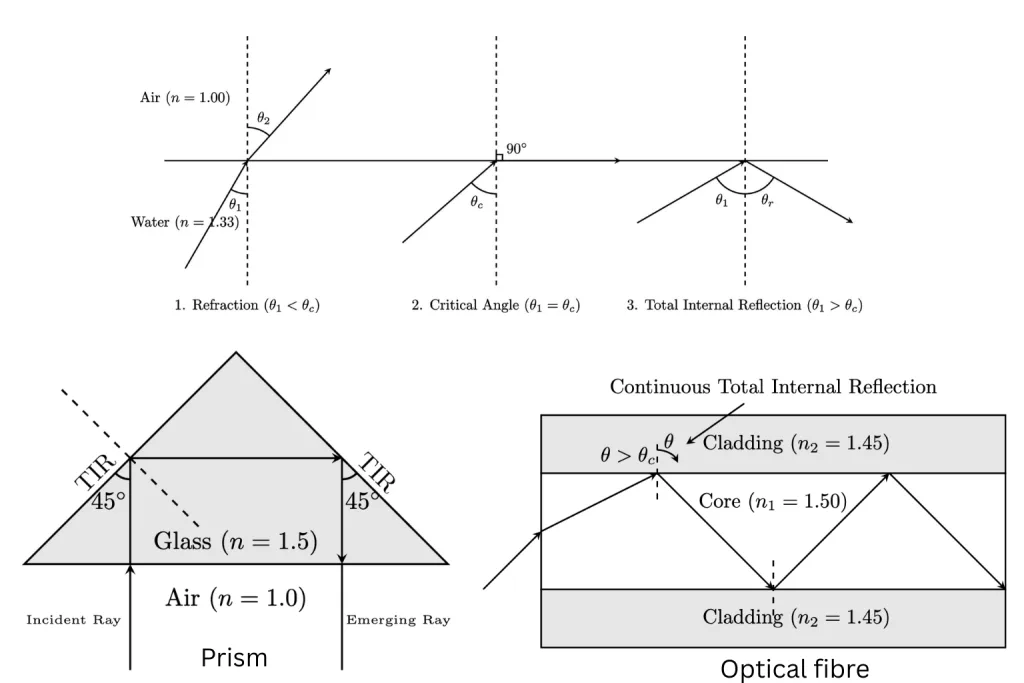
[NEET Important] The laser-in-turbid-water demonstration: shine a laser up through water at increasing obliqueness; beyond 48.75 degrees the refracted spot on the ceiling vanishes and the beam reflects wholly back — TIR made visible with a beaker.
Solved Examples
Example 1: Critical angle of glass [NEET Numerical]
Find the critical angle for glass of n = 1.5 in air.
Solution:
- .
- .
- Any ray inside the glass striking the surface beyond 41.8 degrees stays in.
Example 2: Index from the critical angle [JEE Numerical]
A medium's critical angle (against air) is measured as 30 degrees. Find its refractive index and the light speed inside.
Solution:
- .
- m/s.
- A very dense medium — denser than diamond would not be far off ().
Example 3: Verifying Table 9.1 [NEET Numerical]
Check NCERT's critical angle for water (n = 1.33).
Solution:
- .
- — exactly Table 9.1's entry.
- The laser-beaker demonstration flips from refraction to TIR at precisely this angle.
Example 4: Why diamonds sparkle
Explain the diamond's brilliance using degrees.
Solution:
- n = 2.42 gives a critically small : a ray inside hits most faces beyond 24.4 degrees.
- Light entering the stone suffers repeated total internal reflections — trapped, bouncing among the facets.
- Skilled cutting ensures it finally exits only through intended faces — concentrated, flashing brilliance. Same glass shape: dull; the index makes the gem.
Example 5: The 45-degree prism condition [JEE Numerical]
Why must a totally-reflecting right-angled prism's material have degrees? Check crown glass.
Solution:
- In the 90-degree bender, light strikes the hypotenuse internally at 45 degrees; TIR demands .
- Crown glass: ✓ — TIR occurs; the prism reflects totally.
- Water () would fail — a 'water prism' transmits at 45 degrees instead of reflecting.
Example 6: Fibre geometry [JEE Numerical]
An optical fibre core has n = 1.5 with cladding n = 1.4. Find the critical angle at the core-cladding wall.
Solution:
- Relative index (cladding w.r.t. core) .
- .
- Rays hitting the wall beyond 69 degrees (i.e. travelling nearly along the fibre) are trapped — which is why entry must be at a suitably shallow launch angle.
Example 7: Both conditions, not one
Light in air strikes a glass surface at 60 degrees (> the glass's 41.8-degree critical angle). Does TIR occur?
Solution:
- No. TIR's first condition fails: the light travels from rarer (air) to denser (glass).
- The critical angle concept applies only inside the denser medium.
- Here the ray simply refracts into the glass at 35.3 degrees (Section 3's Example 1). Both conditions or nothing.
Example 8: Mirror vs TIR
Why are totally-reflecting prisms preferred over silvered mirrors in fine instruments?
Solution:
- A metal-coated mirror always transmits/absorbs a few percent — every reflection dims the image.
- TIR reflects 100 percent of the light — no coating to tarnish, no loss at each bounce.
- Binoculars route light through several reflections; prisms keep the view bright where mirrors would dull it.
Example 9: 180-degree turn and inversion
How does a right-angled isosceles prism (a) turn light by 180 degrees, (b) invert an image?
Solution:
- (a) Light entering normally through the hypotenuse strikes BOTH perpendicular faces at 45 degrees — two TIRs send it straight back: a perfect retroreflector (binocular prism pairs).
- (b) Oriented for a single TIR at the hypotenuse, the prism swaps top and bottom rays — inverting the image without changing its size (NCERT Fig. 9.13c).
- All from one rule: 45 degrees > for glass.
Example 10: The fibre's gentle bends
Why does light follow an optical fibre even around curves, and what limits sharp bending?
Solution:
- Each wall strike beyond reflects totally; the fibre is drawn so successive strikes keep exceeding — light ricochets along, loss-free, kilometre after kilometre.
- Bend too sharply and a strike falls below the critical angle: light leaks into the cladding.
- The core-cladding index pair sets how tight a curve the signal survives — fibre design in one sentence.