
Circle Words You Must Know
A circle is every point at one fixed distance from a fixed point. The fixed point is the centre (we call it ) and the fixed distance is the radius . Circle questions lean on a handful of words, so get these straight first.
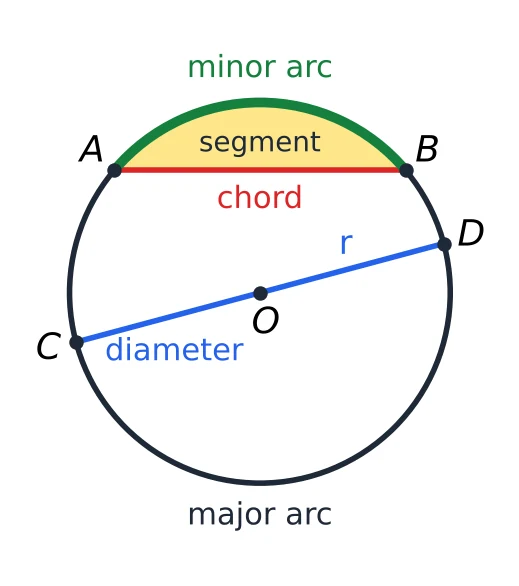
- Chord: a segment joining two points of the circle, like . A chord through the centre is a diameter, . The diameter is the longest chord a circle has.
- Arc: a piece of the circle between two points. A chord splits the circle into a minor arc (the shorter one) and a major arc. A diameter splits it into two semicircles.
- Segment: the region between a chord and one of its arcs, so every chord makes a minor segment and a major segment. This word comes back in "angles in the same segment".
- Sector: the region between two radii and the arc they cut off.
- Secant: a line that cuts the circle at two points. A tangent touches it at exactly one point; tangents have their own section, Circles: Tangents, Secants and Two Circles.
- Concentric circles share a centre, congruent circles have equal radii, and points that lie on one circle are concyclic.
Arcs in degrees. The degree measure of an arc is the angle it makes at the centre. If , the minor arc is 100° and the major arc is 360° − 100° = 260°. Every angle rule in this section is really a statement about arcs, so keep this idea handy.
How many circles? Through one point, or through two points, you can draw infinitely many circles (for two points, any centre on the perpendicular bisector of the segment works). Through three points not on one line there is exactly one circle, and through three points on one line there is none. Two different circles meet in at most two points. SSC turns these into one-mark "which statement is true" questions.
Finding the centre. The perpendicular bisector of every chord passes through the centre, so the perpendicular bisectors of two chords that are not parallel meet exactly at .
[SSC Tip] "Longest chord" always means the diameter. In a circle of radius 7 cm no chord can be longer than 14 cm, so an option of 15 cm for a chord is wrong straight away.
The Perpendicular from the Centre Bisects a Chord
This is the fact behind almost every chord question. The perpendicular from the centre to a chord cuts the chord into two equal halves. It works the other way too: the line from the centre to the midpoint of a chord is perpendicular to the chord.
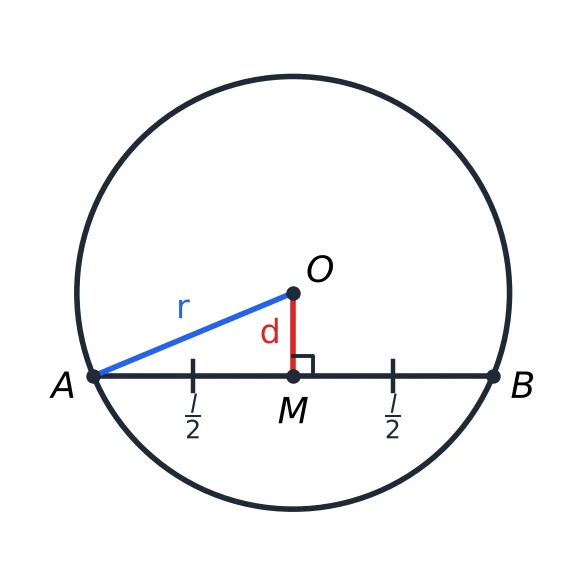
Why: in triangles and , (both radii), is common and both angles at are 90°. So the triangles are congruent (RHS) and .
Now look at triangle , right-angled at . With the radius, the distance of the chord from the centre and the length of the chord,
Any one of , and comes from the other two.
- Radius 13 cm, chord 24 cm: the half-chord is 12, so cm.
- Radius 10 cm, chord 6 cm from the centre: the half-chord is , so the chord is 16 cm.
- Chord 70 cm, 12 cm from the centre: the half-chord is 35, so cm.
- Radius 7 cm, distance 3 cm: cm. Answers need not be whole numbers.
Longest and shortest chord through a point. Take a point inside the circle. The longest chord through is the diameter through it, . The shortest is the chord at right angles to , because no chord through can be farther from the centre than . Its length is . For cm and cm, the chords through run from 8 cm up to 10 cm.
[SSC Tip] Half the chord goes into Pythagoras, and a chord found from it must be doubled at the end. The wrong options to expect are the half-chord itself (12 instead of 24) and a value worked out with the whole chord in the formula.
Equal Chords, Equal Distances and Equal Angles
From you can read off three facts at once.
- Equal chords are equally far from the centre, and chords at the same distance from the centre are equal.
- The chord nearer the centre is the longer one. As grows, shrinks, and so does the chord.
- Equal chords make equal angles at the centre and cut off equal arcs. This works backwards too: equal angles at the centre, or equal arcs, mean equal chords.
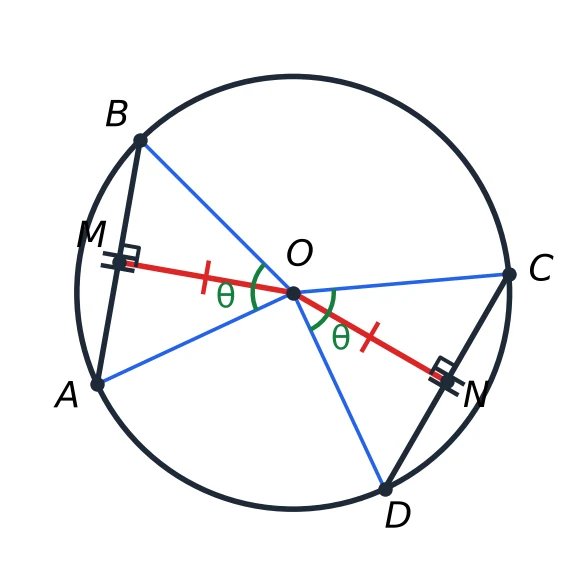
Fact 3 comes from congruent triangles: if , triangles and have all three sides equal (SSS), so .
Chords for special angles. Triangle is isosceles with two sides equal to , so the angle at the centre fixes the chord completely.
| Angle at the centre | Chord | Distance from the centre |
|---|---|---|
| 60° | ||
| 90° | ||
| 120° | ||
| 180° | 0 |
The first row is the one SSC loves: a chord equal to the radius makes 60° at the centre, because triangle is then equilateral. The 90° row is half a square, with the chord as the hypotenuse of an isosceles right triangle. The 120° row splits into two 30°-60°-90° triangles: the distance is the side opposite 30°, half of .
So in a circle of radius 9 cm, a chord that makes 120° at the centre is cm long and sits 4.5 cm from the centre. And a chord of cm in a circle of radius 6 cm makes a right angle at the centre, because .
[SSC Tip] Read "a chord equal to the radius" as "60° at the centre". The angle it makes at a point on the major arc is then 30°, and at a point on the minor arc 150° (the parts below show why). This pair comes up often in CGL papers.
Two Parallel Chords
When two chords are parallel, the perpendicular from to one of them is also perpendicular to the other. So both distances are measured along the same line through the centre, and the gap between the chords is either a difference or a sum.
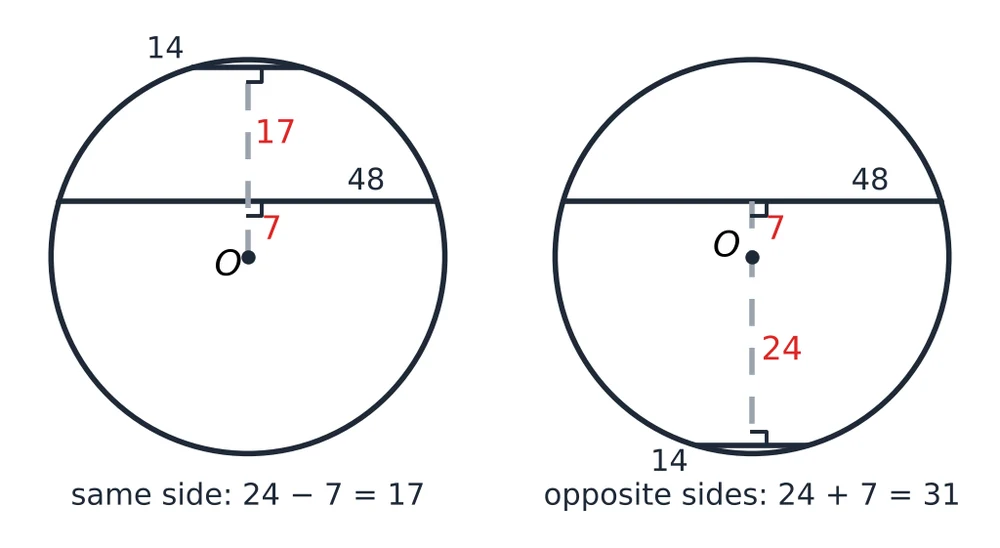
Here is the larger distance, which belongs to the shorter chord.
Forward. In a circle of radius 25 cm, chords of 48 cm and 14 cm are parallel. Their distances from the centre are cm and cm. On the same side of the centre they are 24 − 7 = 17 cm apart; on opposite sides they are 24 + 7 = 31 cm apart.
Backward: finding the radius. Chords of 10 cm and 24 cm lie on opposite sides of the centre, 17 cm apart. Say the 10 cm chord is cm from ; then the other one is cm away. Each chord gives , so set them equal:
So and cm. Check: the 24 cm chord is cm from , and 12 + 5 = 17.
If the chords are on the same side, use and instead, with the shorter chord farther away. A negative distance in the answer means the chords cannot sit that way; switch to the other case.
When a question says "parallel chords" without saying which side, work out both gaps; usually only one of them is among the options. If both are, read the question again for "same side" or "opposite sides". A quick check: the longer chord is always the nearer one.
Common Chord of Two Intersecting Circles
When two circles cut each other at and , the segment is their common chord. The key fact: the line joining the centres is the perpendicular bisector of the common chord. Each centre is equally far from and , and the points equally far from and are exactly the points of the perpendicular bisector of . So both centres sit on that line.
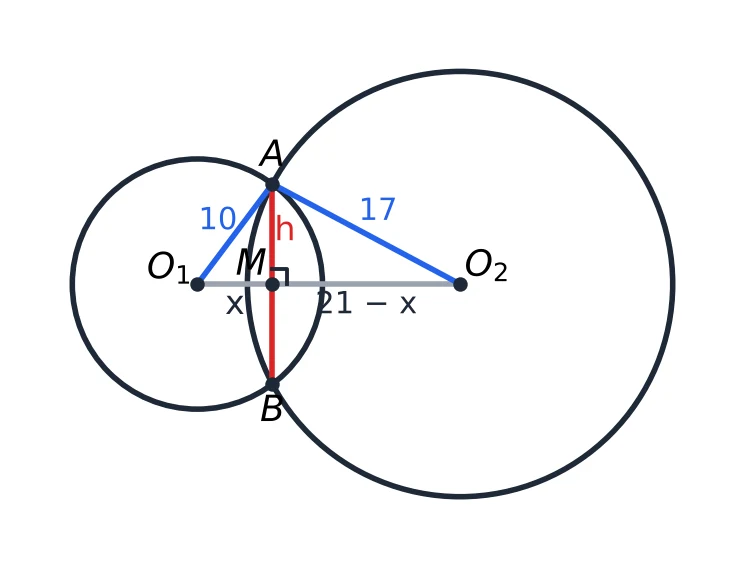
So the line of centres cuts the common chord at its midpoint , at right angles. The half-chord is then a side of two right triangles at once:
Usually lies between the two centres, so .
Finding the common chord. Radii 10 cm and 17 cm, centres 21 cm apart. Put , so . Both triangles give :
Then and the common chord is 16 cm. Check from the other side: and .
Finding the distance between the centres. This direction is quicker. Knowing the common chord and both radii, find and by Pythagoras and add them. If the question puts both centres on the same side of the chord, subtract instead.
Two equal circles through each other's centres. Then , so triangle is equilateral, , and the common chord is .
If the two radii and the distance between the centres form a Pythagorean triple, like 6, 8 and 10, the radii meet at a right angle at . Then is just the altitude of that right triangle: , and the common chord is 9.6.
The Angle at the Centre Is Twice the Angle on the Circle
The angle an arc makes at the centre is twice the angle it makes at any point on the rest of the circle. For a chord and a point on the major arc, .
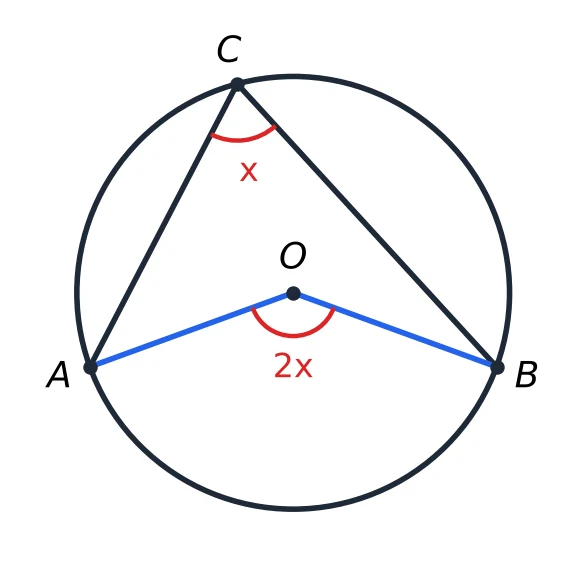
Why: join and extend it. Triangles and are isosceles (two radii each), so the exterior angle each one makes at is twice its base angle. Adding the two parts gives .
So gives , and gives .
A point on the minor arc. If is on the minor arc, it looks at the major arc, and the major arc makes the reflex angle at the centre. Half of that is
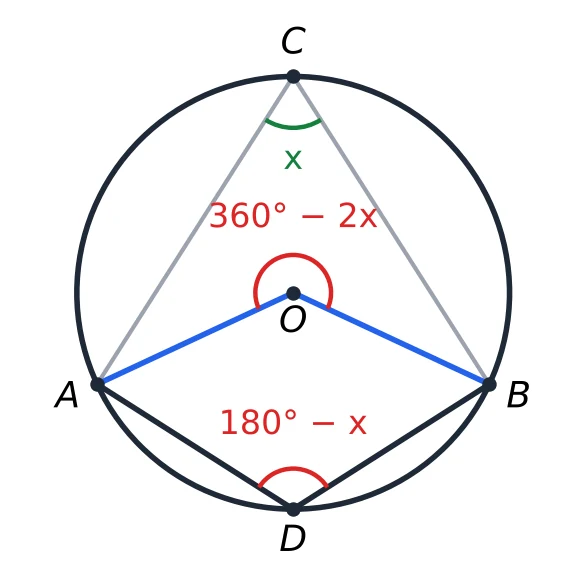
With , . Backwards: if on the minor arc gives , the reflex angle at the centre is 230°, so .
The radii make an isosceles triangle. In triangle , , so
If , then and . Keep this link between a base angle at the chord and the angle on the circle ready; it shortens many angle chases.
[SSC Tip] Before halving, check which arc the point stands on. On the major arc (the same side of the chord as the centre), take half of . On the minor arc, take 180° minus that. The wrong one of the two is always among the options.
Angles in the Same Segment and in a Semicircle
Angles in the same segment are equal. If and are both on the major arc of chord , then , because each is half of . Two points on the minor arc also see at equal angles. However many points you take on one arc, they all see the chord at the same angle.
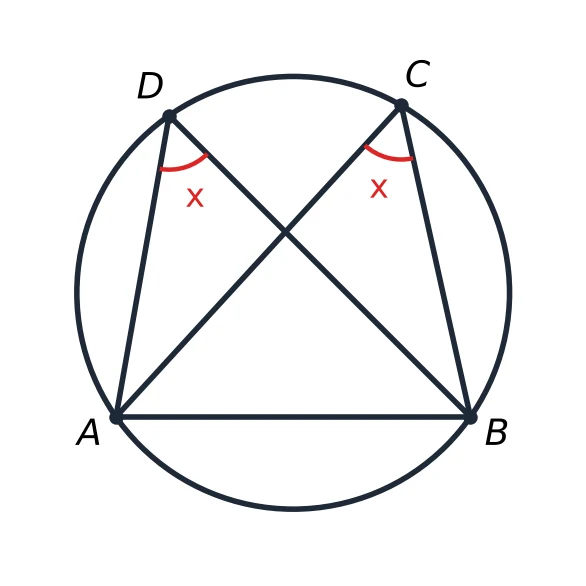
Angles in opposite segments add to 180°. One point on each arc gives and , as shown above. This is the cyclic quadrilateral rule in another form.
The angle in a semicircle is a right angle. When is a diameter, is a straight angle of 180°, so every point on the circle gives .
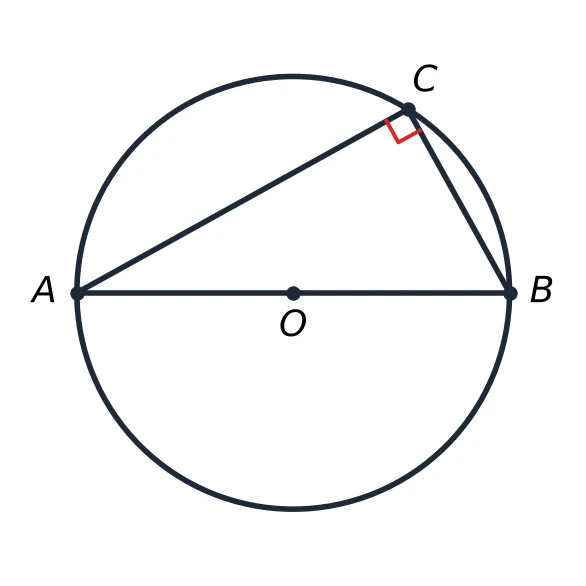
The reverse is just as useful: if with on the circle, then is a diameter. So the hypotenuse of a right triangle drawn in a circle is a diameter, and the radius is half the hypotenuse.
- is a diameter, cm and cm: cm, so the radius is 7.5 cm.
- is a diameter and : then .
Equal chords, equal angles on the circle. Equal chords make equal angles at the centre, so they also make equal angles at points on the circle (half of equal angles). If and is on the arc that does not contain , then : the line cuts in half.
The moment you see a diameter, mark a 90° at every point of the circle joined to both its ends. Most semicircle questions are one Pythagoras step or one angle-sum step after that.
Cyclic Quadrilaterals
A quadrilateral whose four corners all lie on one circle is cyclic. Its main property: opposite angles add up to 180°.
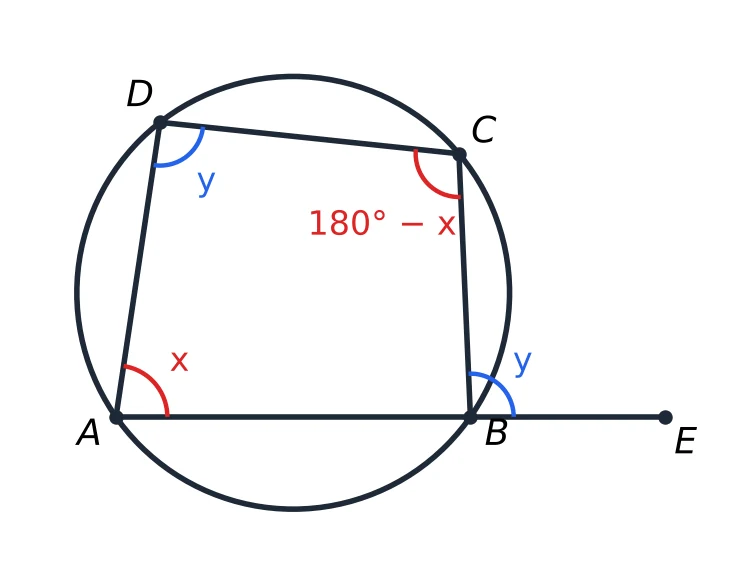
Why: is half the arc and is half the arc . Those two arcs make up the whole circle, 360°, so the two angles add to 180°. The reverse is also true: if the opposite angles of a quadrilateral add to 180°, its corners lie on a circle.
Exterior angle. Produce beyond to . Then . The exterior angle of a cyclic quadrilateral equals the interior opposite angle.
Typical lines.
- : then , so and .
- With the centre: if is on the major arc and , then and .
Which shapes can be cyclic?
- A rectangle and a square always are.
- A parallelogram only when it is a rectangle: its opposite angles are equal and must add to 180°, so each is 90°.
- A rhombus only when it is a square.
- A trapezium only when it is isosceles (non-parallel sides equal). So a cyclic trapezium has equal base angles and equal diagonals.
- A kite only when its two equal angles are right angles.
[Tier 2] Ptolemy's theorem. In a cyclic quadrilateral, the product of the diagonals equals the sum of the products of the opposite sides: . In a 3 cm by 4 cm rectangle: .
As soon as four points on a circle form a quadrilateral, write both 180° equations before anything else. Many "find the angle" questions are just these two lines plus the exterior-angle rule.
Angle Chasing in a Circle
Most angle questions combine three or four of these moves:
- Radii are equal, so any triangle with two radii as sides is isosceles.
- Angle at the centre = 2 × angle on the circle (on the same arc).
- Angles in the same segment are equal.
- The angle in a semicircle is 90°.
- Opposite angles of a cyclic quadrilateral add to 180°.
- The angles of a triangle add to 180°, and an exterior angle equals the two far interior angles.
A worked chase. is a diameter of a circle with centre . is on the circle with , and is on the arc that does not contain . Find .
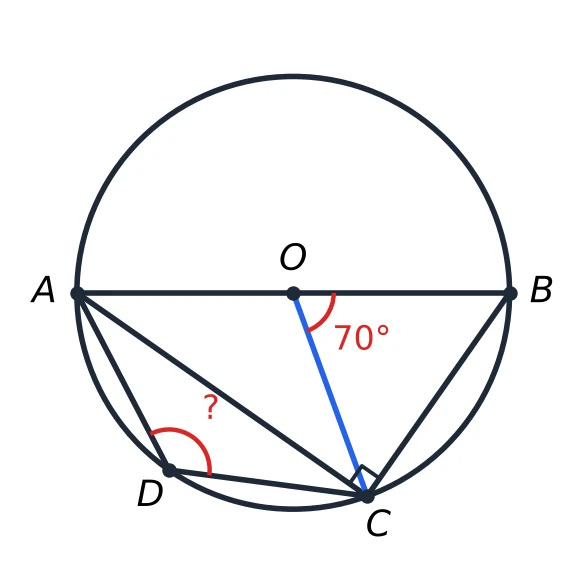
- (move 2).
- (move 4), so (move 6).
- is cyclic, so (move 5).
The same answer comes another way: triangle is isosceles (move 1), so , and then move 5. Two routes agreeing is a good check.
Arcs given as a ratio. If , and cut the circle into arcs in the ratio 1 : 2 : 3, the arcs are 60°, 120° and 180°. Each angle of triangle is half the arc opposite it (the arc that does not contain that vertex), so the angles are 30°, 60° and 90°. Notice the angles come out in the same ratio as the arcs, which is a handy check.
Spotting the isosceles triangles. Any time two segments from end on the circle, mark the two equal base angles straight away. In a figure with three or four radii drawn, there are usually two or three such triangles, and the answer drops out of their angle sums.
Mark every given angle on a rough figure, then write each new angle on it as you find it. Before using "half the central angle", check that the point and the centre are on the same side of the chord.
Chords Cutting Inside:
When two chords and cross at a point inside the circle, the products of the two pieces are equal:
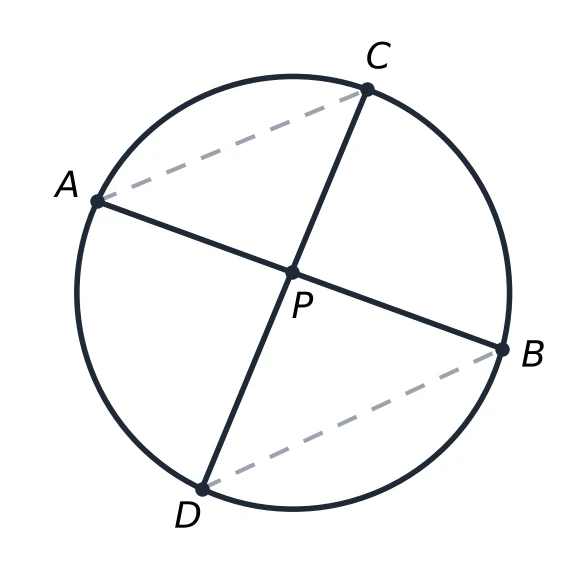
Why: join and . In triangles and , the angles at are vertically opposite, and (same segment, both standing on chord ). So the triangles are similar, , and cross-multiplying gives the rule.
- , and : then , so .
- If the whole chord is given instead of , you get a sum and a product. With and , the pieces of are two numbers with product 18 and sum 11, namely 2 and 9.
A diameter at right angles to a chord. If diameter cuts chord at right angles at , then is the midpoint of , so and
With and : , the chord is 6 and the radius is .
The product in one line. For every chord through , the product of its two pieces is . (Use the diameter through : its pieces are and .) In a circle of radius 10 with , every chord through is split into two pieces whose product is 64.
[Tier 2] Chords at right angles. If at , then
With , , and (and , so they fit one circle): the sum is 125, so and .
When the chords are extended and meet outside the circle, a similar product rule holds along each line; that case, with secants and tangents, is in Circles: Tangents, Secants and Two Circles.
Always pair the pieces of the same chord: with , and with . A wrong option is usually built by multiplying by mistake.
[Tier 2] Angle Between Two Chords: Inside and Outside
Here arcs are measured in degrees, that is, by the angle they make at the centre.
Chords meeting inside. If chords and cross at inside the circle, then
Arc is the arc the angle opens onto, and arc is the one its vertically opposite angle opens onto.
Why: is the exterior angle of triangle at , so it equals . These two angles on the circle are half of arc and half of arc .
Chords meeting outside. If chords and are extended to meet at outside the circle, with and the points nearer to , then
that is, half of the far arc minus the near arc.
Why: in triangle , the exterior angle at is . So , which is half of arc minus half of arc .
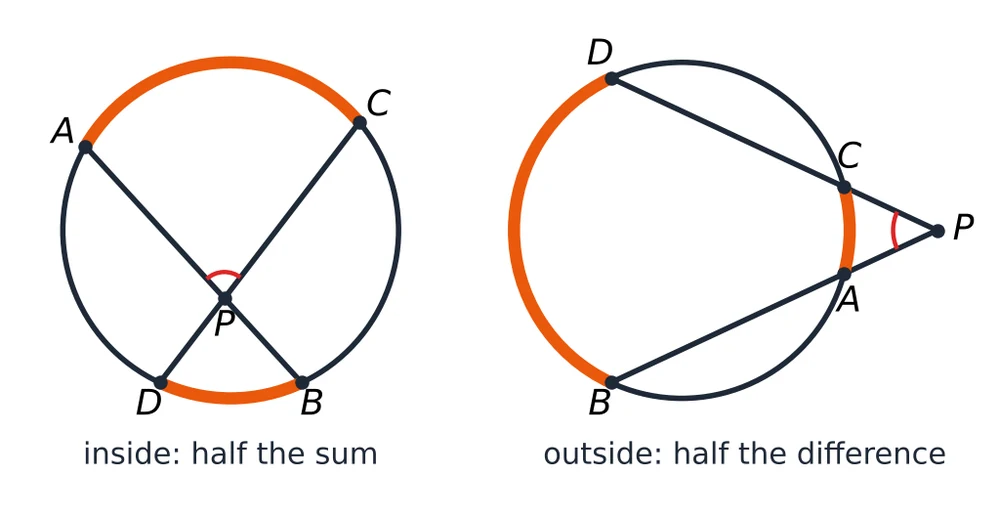
- Inside: arc and arc give . The other angle at , , is .
- Outside: a far arc of and a near arc of give .
These settle "find the angle between the chords" questions without any extra construction. The same half-the-difference idea gives the angle between two tangents, or between a tangent and a secant, which comes up in the next section.
Inside means add, outside means subtract, and both get halved. An option equal to the full sum or the full difference is the trap for anyone who forgets to halve.
Triangles Inscribed in a Circle
Every triangle fits in exactly one circle through its three corners, its circumcircle. Its centre and the formula are in Centres of a Triangle; here are the circle-side shortcuts that SSC uses.
Right triangle. The hypotenuse is a diameter (angle in a semicircle), so .
Equilateral triangle. Each side makes 120° at the centre, so from the chord table, side , that is , and each side is from the centre. A circle of radius 6 cm holds an equilateral triangle of side cm.
Isosceles triangle. Let and let be the height to the base . This height is the perpendicular bisector of the chord , so it passes through the centre. Extend it to the diameter . Then (semicircle), and in the right triangle with we get , that is :
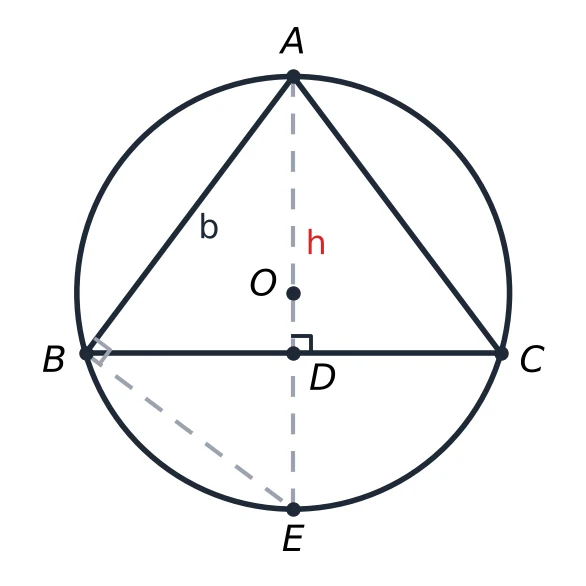
With cm and cm: , so cm. The general formula agrees: .
Going the other way. Given and the base , first find the distance of from the centre, . If the apex is on the major arc, ; if it is on the minor arc, . Then . For and : , so and , or and .
An apex on the major arc gives an acute triangle with the centre inside it; an apex on the minor arc gives an obtuse triangle with the centre outside. If the question says "acute", use , and expect the other value among the options.
Solved Examples
Question 1
A chord of a circle is 48 cm long and is 10 cm away from the centre. What is the radius of the circle? (a) 24 cm (b) 26 cm (c) cm (d) 34 cm
Answer. The perpendicular from the centre cuts the chord in half, so half the chord is 24 cm. The radius is the hypotenuse of a right triangle with sides 24 and 10: = (b) 26 cm. cm is what you get by putting the whole 48 into Pythagoras.
Question 2
In a circle of radius 29 cm, a chord is drawn 20 cm away from the centre. What is the length of the chord? (a) 21 cm (b) cm (c) 18 cm (d) 42 cm
Answer. Half the chord is cm. The chord is double that: (d) 42 cm.
Question 3
Two parallel chords of a circle of radius 17 cm are 30 cm and 16 cm long, and they lie on opposite sides of the centre. What is the distance between them? (a) 23 cm (b) 7 cm (c) 14 cm (d) 46 cm
Answer. Find each chord's distance from the centre. For the 30 cm chord, cm. For the 16 cm chord, cm. On opposite sides of the centre the two distances add: 8 + 15 = (a) 23 cm.
Question 4
Two parallel chords of a circle are 12 cm and 16 cm long. They are on the same side of the centre and 2 cm apart. What is the radius of the circle? (a) 8 cm (b) cm (c) 10 cm (d) 13 cm
Answer. The longer chord is nearer the centre. Say the 16 cm chord is cm from the centre; then the 12 cm chord is cm away. Both chords give , so . That is , so and . Then , so the radius is (c) 10 cm. Check with the other chord: it is 8 cm away, and again.
Question 5
Two circles of radii 15 cm and 13 cm cut each other, and their common chord is 24 cm long. The centres lie on opposite sides of the common chord. How far apart are the centres? (a) 4 cm (b) 14 cm (c) 28 cm (d) 10 cm
Answer. The line joining the centres cuts the common chord in half at right angles, so each half is 12 cm. From the first centre to the chord: cm. From the second: cm. The centres are on opposite sides, so the distance is 9 + 5 = (b) 14 cm. 4 cm would be the answer if both centres were on the same side of the chord.
Question 6
In a circle of radius 12 cm, a chord makes an angle of 120° at the centre. What are the length of the chord and its distance from the centre? (a) cm and cm (b) cm and 6 cm (c) 12 cm and cm (d) cm and 6 cm
Answer. Drop the perpendicular from the centre to the chord. It splits the 120° into two 60° angles and the chord into two halves, so each half is a 30°-60°-90° triangle with hypotenuse 12. The side opposite 30° is the distance: half of 12, so 6 cm. The side opposite 60° is half the chord: cm. So the chord is cm, and the answer is (d) cm and 6 cm.
Question 7
is the centre of a circle and , , are points on it, with on the major arc . If , what is ? (a) 62° (b) 56° (c) 124° (d) 28°
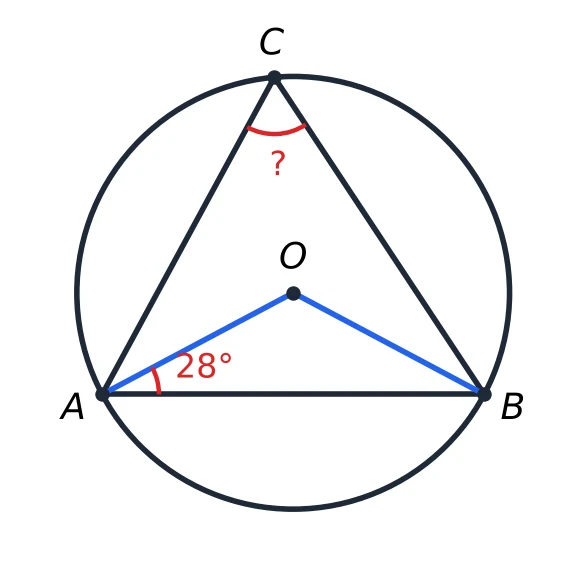
Answer. Triangle has two radii as sides, so it is isosceles and too. That leaves . is on the major arc, so is half of the angle at the centre: (a) 62°. Shortcut: .
Question 8
and are points on a circle with centre , and . is a point on the minor arc . What is ? (a) 55° (b) 110° (c) 125° (d) 70°
Answer. sits on the minor arc, so it looks at the major arc. The major arc makes the reflex angle at the centre, and half of that is (c) 125°. Another way: a point on the major arc would see 55°, and a point on the minor arc sees . 55° is the trap for anyone who does not check which arc is on.
Question 9
, and lie on a circle with centre , and is on the minor arc . If , what is (the angle less than 180°)? (a) 224° (b) 136° (c) 56° (d) 68°
Answer. is on the minor arc, so it looks at the major arc, and the angle at the centre on that side is the reflex one: . The ordinary angle is what is left of the full turn: = (b) 136°.
Question 10
is a diameter of a circle. and are points on the circle on opposite sides of . If , what is ? (a) 34° (b) 124° (c) 90° (d) 56°
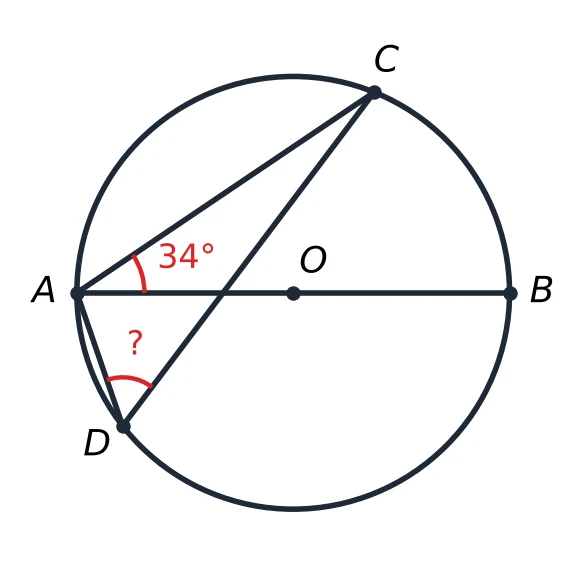
Answer. is a diameter, so , and in triangle , . Now and are on the same arc cut off by the chord , so they see at the same angle: = (d) 56°.
Question 11
is a diameter of a circle of radius 6.5 cm, and is a point on the circle with cm. What is the length of ? (a) 12 cm (b) cm (c) 8 cm (d) 6.5 cm
Answer. The diameter is cm, and the angle in a semicircle is a right angle, so triangle is right-angled at with hypotenuse . Then = (a) 12 cm.
Question 12
Three points , , on a circle divide it into arcs , and in the ratio 2 : 3 : 7. What is the largest angle of triangle ? (a) 210° (b) 75° (c) 105° (d) 150°
Answer. The arcs add up to 360°, so they are , 90° and 210°. Each angle of the triangle is half the arc opposite it, so the angles are 30°, 45° and 105°. The largest is (c) 105°.
Question 13
In a cyclic quadrilateral , , and . What is ? (a) 80° (b) 100° (c) 110° (d) 70°
Answer. Opposite angles add to 180°: , so and . Then , and = (b) 100°. 80° is itself, so read what the question asks.
Question 14
is a cyclic quadrilateral in a circle with centre , and lies inside it. Side is produced to , and . What is ? (a) 76° (b) 104° (c) 208° (d) 152°
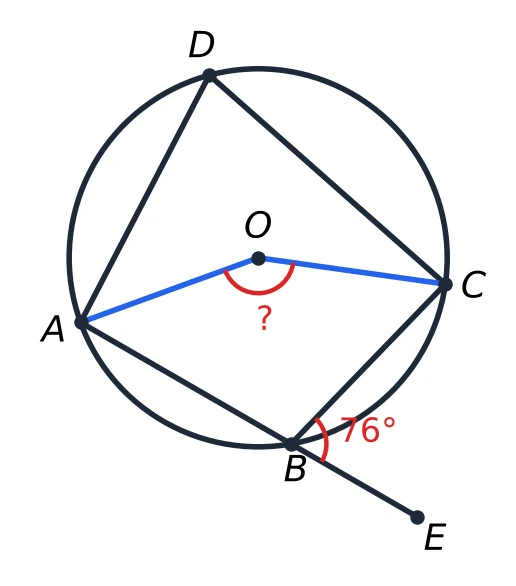
Answer. The exterior angle of a cyclic quadrilateral equals the interior opposite angle, so . stands on the arc , and the angle at the centre on the same arc is double: = (d) 152°.
Question 15
is a cyclic quadrilateral in which is a diameter of the circle. If , what is ? (a) 42° (b) 48° (c) 66° (d) 38°
Answer. and are opposite, so . is a diameter, so . In triangle : = (a) 42°.
Question 16
A chord of a circle is equal to the radius. What angle does the chord make at a point on the minor arc? (a) 30° (b) 60° (c) 150° (d) 120°
Answer. The chord and the two radii to its ends make an equilateral triangle, so the chord makes 60° at the centre. A point on the major arc sees half of that, 30°. A point on the minor arc sees the rest: = (c) 150°.
Question 17
and are equal chords of a circle with centre . If , what is ? (a) 52° (b) 76° (c) 104° (d) 38°
Answer. Triangle has two radii as sides, so as well, and . Equal chords make equal angles at the centre, so = (b) 76°.
Question 18
In a cyclic quadrilateral , and . What is ? (a) 35° (b) 70° (c) 55° (d) 110°
Answer. Opposite angles: . Triangle has , so its other two angles are equal: = (a) 35°. Another way to see it: the equal chords and make equal angles at , so each is 35°, and (same segment).
Question 19
Chords and of a circle cut each other at . cm, cm and cm, with shorter than . What is ? (a) 20 cm (b) 4 cm (c) 5 cm (d) 3 cm
Answer. The pieces of one chord multiply to the same number as the pieces of the other: . Also . Two numbers with sum 23 and product 60 are 3 and 20 (check: ). is the shorter piece, so = (d) 3 cm.
Question 20
is a diameter of a circle and is a chord at right angles to , cutting it at . If cm and cm, what is the length of ? (a) 6 cm (b) 13 cm (c) 12 cm (d) 6.5 cm
Answer. A diameter at right angles to a chord cuts it in half, so . The chord rule gives , that is . So cm and = (c) 12 cm.
Question 21
[Tier 2] Chords and of a circle cut each other at right angles at . If cm, cm, cm and cm, what is the radius of the circle? (a) cm (b) cm (c) cm (d) cm
Answer. First a check: , so these pieces really fit one circle. For chords at right angles, : , so and the radius is (b) cm.
Question 22
[Tier 2] In the figure, is the centre, and . Chords and are produced to meet at outside the circle. What is ? (a) 35° (b) 75° (c) 70° (d) 55°
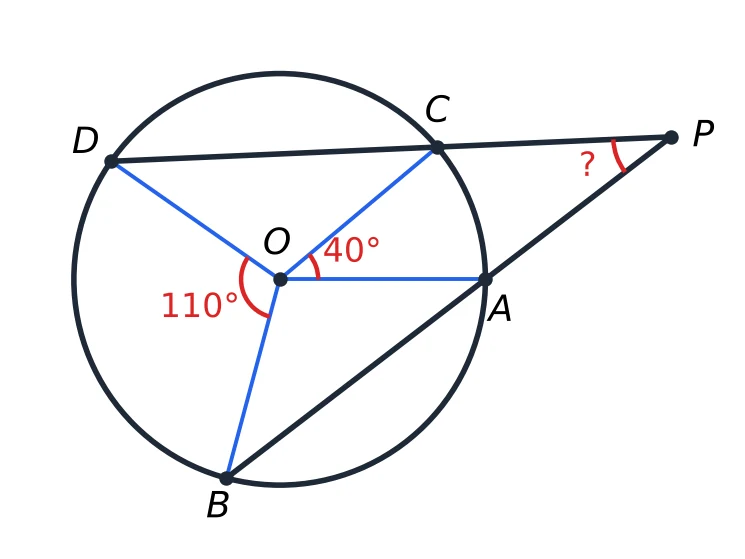
Answer. For chords meeting outside, the angle is half of the far arc minus the near arc. The arcs in degrees are the angles at the centre: the far arc is 110° and the near arc is 40°. So = (a) 35°. 75° adds the arcs, which is the rule for chords crossing inside.
Question 23
A triangle with cm and cm is drawn with all three vertices on a circle. What is the radius of the circle? (a) cm (b) cm (c) cm (d) cm
Answer. The height from to is cm, and it passes through the centre. For an isosceles triangle, = (c) cm. Check with : the area is , and .
Question 24
is a chord of length 24 cm in a circle of radius 13 cm. is a point on the major arc with . What is the length of ? (a) cm (b) 18 cm (c) cm (d) cm
Answer. The chord is cm from the centre. means is on the perpendicular bisector of , which passes through the centre. is on the major arc, so the height from to is cm. Then = (d) cm. cm is the answer for a point on the minor arc, where the height is .