
Tangent to a Circle
A tangent is a line that touches a circle at exactly one point, called the point of contact. A secant cuts the circle at two points. You can picture a tangent as a secant whose two cutting points have slid together into one.
How many tangents from a point?
- From a point inside the circle: none, because every line through it cuts the circle twice.
- From a point on the circle: exactly one.
- From a point outside the circle: exactly two.
The tangent is perpendicular to the radius at the point of contact. If is the point of contact, then is at 90° to the tangent. Every other point of the tangent lies outside the circle, so it is farther from than is. The shortest segment from to a line is the perpendicular, so must be it. This works backwards too: a line drawn at right angles to a radius, through its outer end, is a tangent.
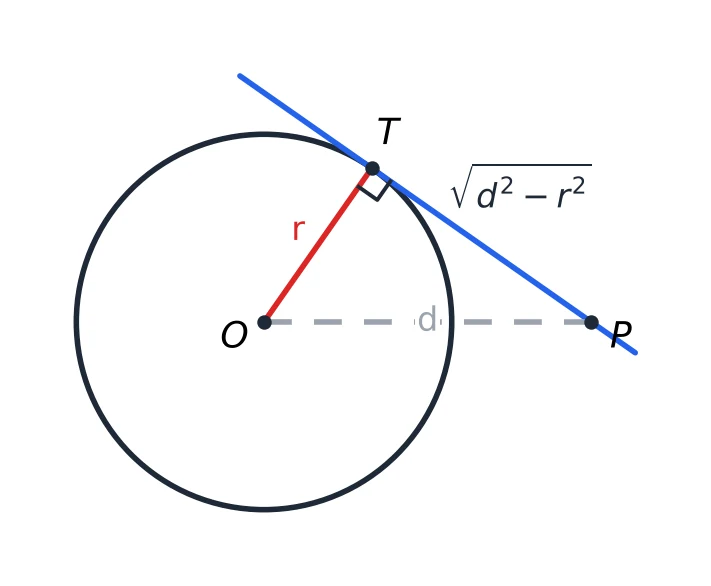
Tangent length. From an outside point at distance from the centre, the tangent is a side of the right triangle , with the right angle at and as the hypotenuse:
- cm and cm: cm.
- cm and cm: cm.
- cm and cm: cm.
Parallel tangents. The tangents at the two ends of a diameter are both perpendicular to that diameter, so they are parallel, and the gap between them is the diameter . So a circle that fits between two parallel lines 12 cm apart, touching both, has radius 6 cm.
[SSC Tip] The right angle sits at the point of contact, not at the centre, so in the distance is the hypotenuse. A wrong option usually adds the two squares instead of subtracting.
Two Tangents from an Outside Point
From a point outside the circle you can draw two tangents, touching the circle at and .
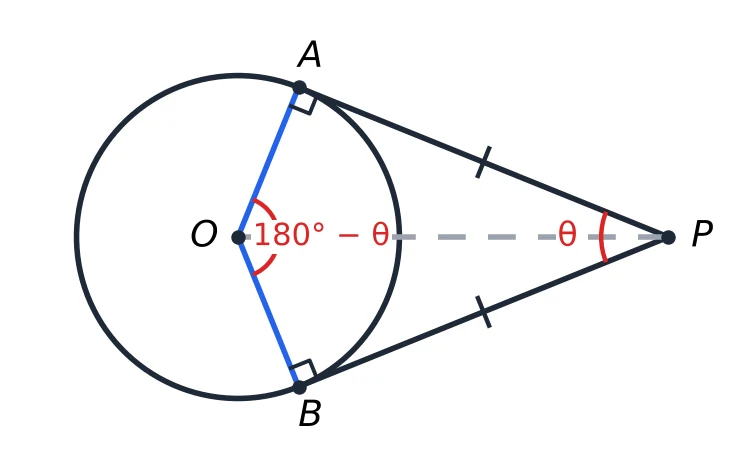
The two tangents are equal: . Triangles and are right-angled at and , share the hypotenuse , and have , so they are congruent (RHS). The same congruence gives two more facts:
- bisects , and it bisects too.
- is the perpendicular bisector of the chord , which is called the chord of contact.
Angle at + angle at = 180°. In the quadrilateral , the angles at and are 90° each, so
If the tangents meet at 50°, the radii to the points of contact meet at 130°. Since the angles at and add to 180°, is a cyclic quadrilateral, with as a diameter of its circle.
Two angles worth remembering.
- : then , so in the 30°-60°-90° triangle , and . With cm: cm and cm.
- : then has four right angles and , so it is a square, with and . With cm, cm.
[Tier 2] Length of the chord of contact. Half of is the altitude from to the hypotenuse in the right triangle , so
With and : and .
"Tangents from an outside point are equal" settles a surprising number of questions by itself, especially perimeter questions. Mark the equal pieces with ticks on your rough figure as soon as you see two tangents from one point.
Angles Made by Tangents
Take two tangents and with . Every other angle in the picture follows from .
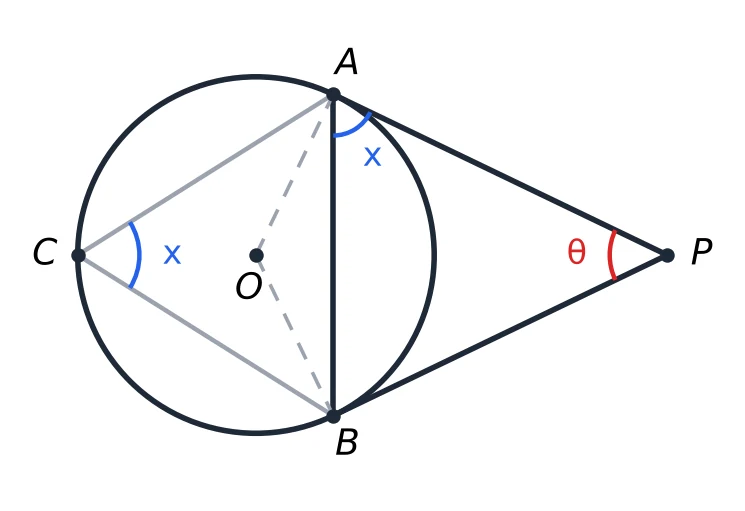
- .
- Triangle is isosceles (), so .
- . So the angle between a radius and the chord of contact is half the angle between the tangents.
- For on the major arc: , the same as .
- For on the minor arc: .
Take : , , , and . Going backwards is just as quick. If for on the major arc, then and the tangents meet at .
is no accident: it is the alternate segment theorem, which has its own part below.
[Tier 2] Through the arcs. Like two chords meeting outside the circle, the angle between two tangents is half the difference of the two arcs between the points of contact: . With the arcs are 220° and 140°, and .
[SSC Tip] Three numbers keep coming back: , and . In most tangent-angle questions the answer is one of them and the other two are usually among the options, so name the angle you want before you calculate.
Concentric Circles and Parallel Tangents
A chord of the bigger circle that touches the smaller one. Take two circles with the same centre , with radii (bigger) and . Let a chord of the bigger circle touch the smaller circle at . Then (radius and tangent), and a perpendicular from the centre bisects a chord, so is the midpoint of and
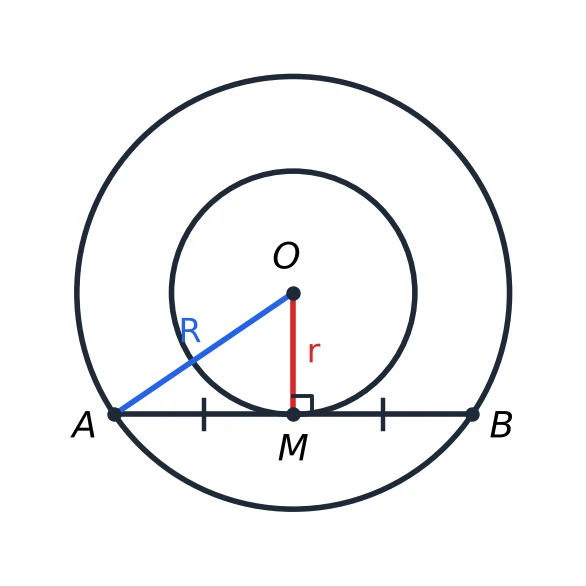
- cm and cm: cm.
- A chord of 72 cm in a circle of radius 39 cm touches a smaller circle with the same centre. Half the chord is 36, so cm.
Every such chord has the same length, because each one is exactly from the centre. The area of the ring between the two circles is a Chapter 13 question, and this half-chord is the piece it needs.
Two parallel tangents and a third. The tangents at the ends of a diameter are parallel. Let a third tangent, touching the circle at , cut them at and .
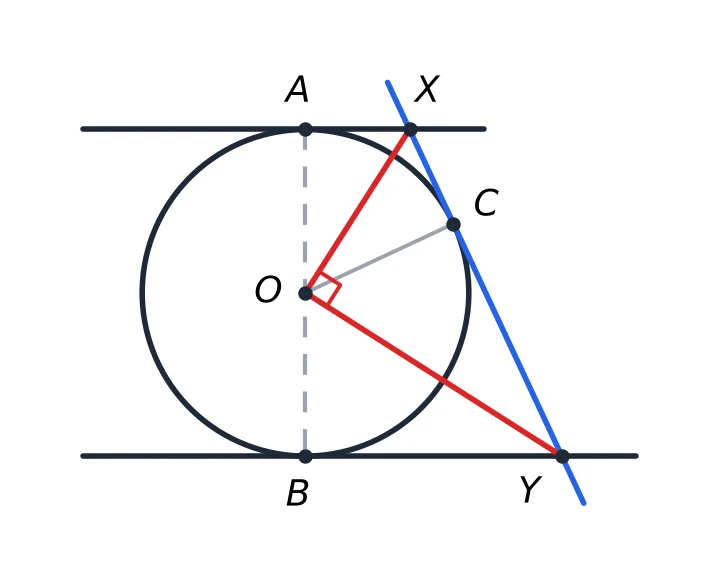
Then and (tangents from one point), so bisects and bisects . Those two angles together make the straight angle , so
wherever is. Also , and since is the altitude of the right triangle , .
"Tangents at the ends of a diameter" means "parallel tangents, apart". And a tangent cutting across two parallel tangents always makes a right angle at the centre; SSC asks this as a one-line question.
Tangent and Secant from One Point
From an outside point , draw a tangent and a secant that cuts the circle at (nearer) and (farther). Then
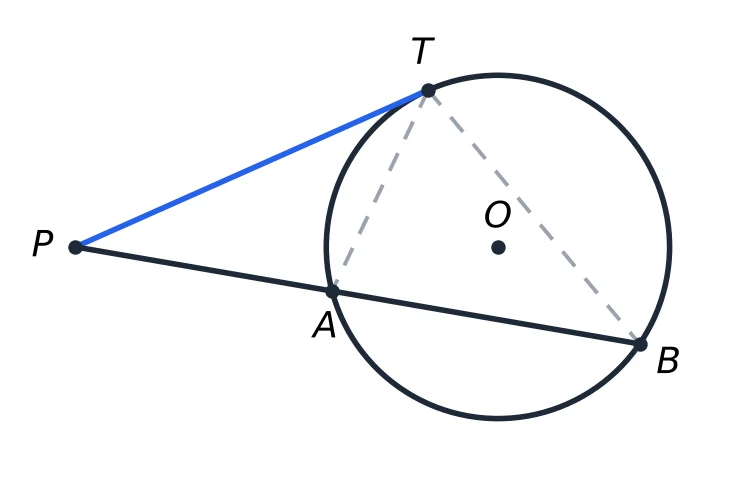
Why: triangles and share the angle at , and by the alternate segment theorem (further down this section). So the triangles are similar, , and cross-multiplying gives the rule.
- cm and cm: cm, so cm.
- cm and cm: cm, so the chord cm.
Two secants from one point. If two secants from cut the circle at , and at , (with and the nearer points), both products equal , so
With , and : , so the chord .
This is the same rule as for chords crossing inside the circle (in Circles: Chords, Arcs and Angles), now with outside. For an outside point, every such product equals , which is by Pythagoras.
[SSC Tip] Multiply whole lengths measured from : , never . If the question gives the chord , add to it first. Using in place of is the standard wrong option.
The Alternate Segment Theorem
The angle between a tangent and a chord, at the point of contact, equals the angle that the chord makes at any point of the circle on the other side of the chord (the alternate segment).
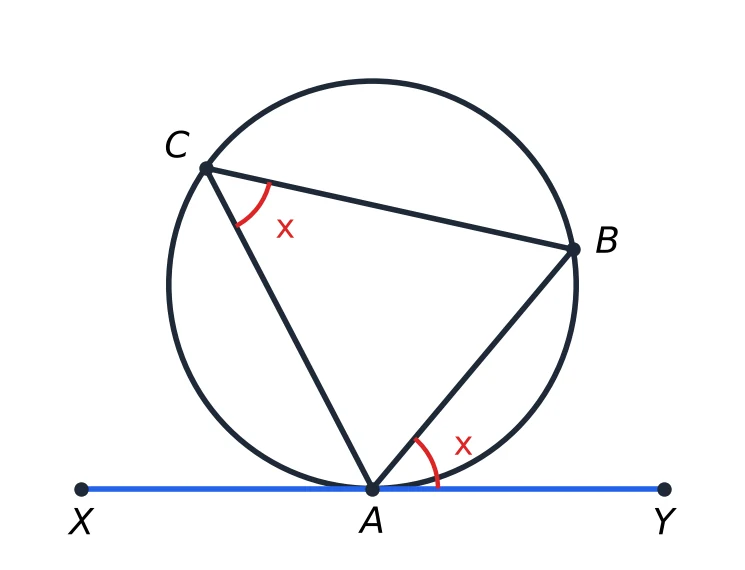
In the figure, the tangent at and the chord make . The alternate segment is the part of the circle on the far side of from , so for there, .
Why: the radius is at 90° to the tangent, so . Triangle is isosceles, so , and a point on the major arc sees half of that, which is .
So the angle between a tangent and a chord is also half the angle the chord makes at the centre. A point on the near arc (on the same side as the angle ) sees the chord at .
- The tangent at makes 55° with chord . Then the angle in the alternate segment is 55°, , and a point on the other arc sees at 125°.
- Triangle sits in a circle, and the tangent at makes 50° with on one side and 60° with on the other. Then , and . The three angles at along the tangent add to 180°, as they should.
With a diameter. Let be a diameter, and let the tangent at a point meet produced beyond at . By this theorem , and . Since is the exterior angle of triangle ,
For , .
Match the angle to the correct segment: the angle on one side of the chord at the tangent equals the angle in the segment on the other side. Pick the wrong side and you get , which is always among the options.
Quadrilateral Circumscribing a Circle
When all four sides of touch a circle, the quadrilateral circumscribes the circle, and the circle is inscribed in it. Each corner sends two equal tangents to the circle.
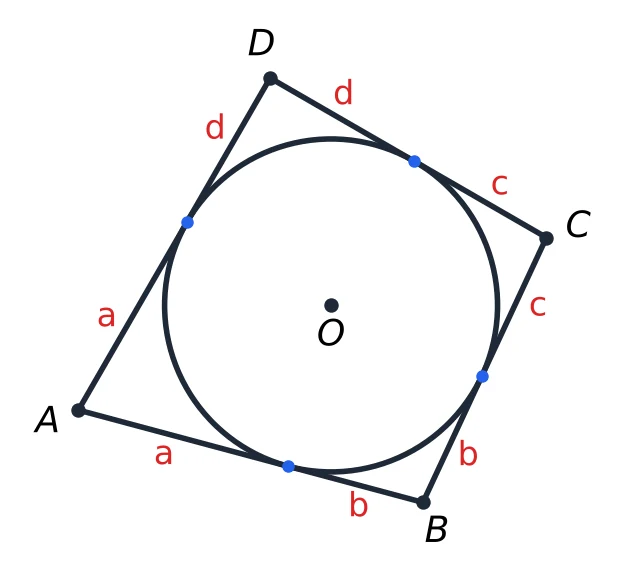
Call the tangent lengths from , , , by , , , . Then , , and , so
The two pairs of opposite sides have equal sums, and the perimeter is .
- cm, cm and cm: cm, and the perimeter is cm.
Shapes that can hold a circle. A parallelogram circumscribing a circle has and , so the rule gives and all four sides are equal: it must be a rhombus. In the same way a rectangle circumscribing a circle is a square. In a trapezium circumscribing a circle, both parallel sides are tangents, so the height equals the diameter.
[Tier 2] Angles at the centre. The lines from the centre to the four corners bisect the four angles, and opposite sides make supplementary angles at the centre: . (Each of these angles is minus half of two corner angles, and the four corner angles add to 360°.)
You rarely need the separate tangent lengths; the opposite-sides rule does the work in one line. Watch the wording: a circle "inscribed in a quadrilateral" uses this rule, while a quadrilateral "inscribed in a circle" is cyclic and uses opposite angles adding to 180°.
A Circle Inside a Triangle: Tangent Lengths
The incircle of triangle touches , and at , and . Equal tangents from each corner split every side into two tangent lengths.
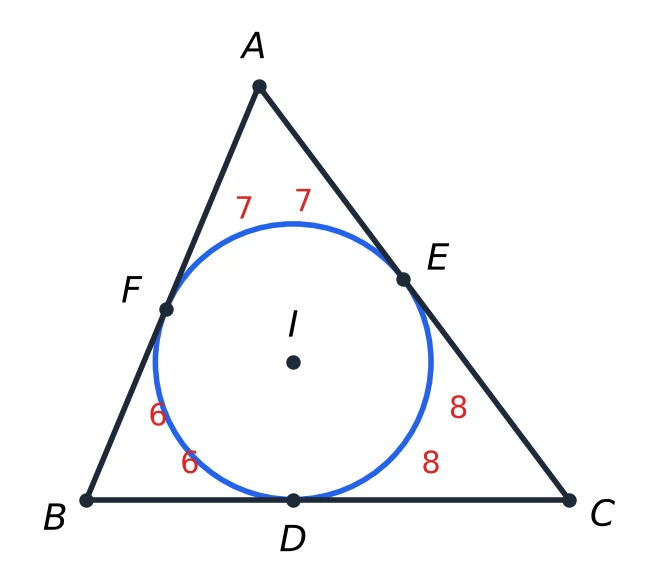
With , , and the semi-perimeter :
Each corner's tangent length is minus the side opposite that corner. For , and : , so , and . Check: .
Right triangle. At the right angle , the two tangents and two radii form a square, so the tangents from are each . The tangents from and are then and , and together they make the hypotenuse: . So
Legs 8 and 15 with hypotenuse 17: . The general formula is in Centres of a Triangle.
The third tangent. Tangents and touch a circle. A third tangent, at a point on the minor arc, cuts at and at . Then and , so
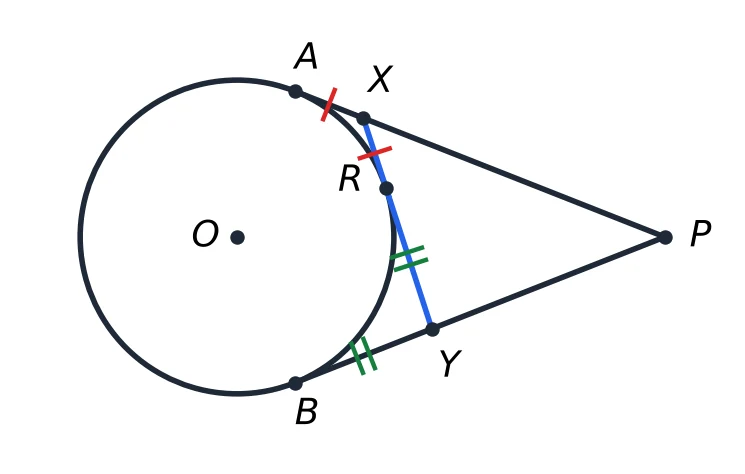
The perimeter of triangle is twice the tangent length, wherever sits. With cm, the perimeter is 18 cm. ([Tier 2] The circle here is the excircle of triangle , so equals the semi-perimeter of that triangle.)
" minus the opposite side" is easy to mix up: the tangent from uses , the side that does not touch . Check by adding two tangent lengths to get a side.
Two Circles: Touching, Cutting and Common Tangents
Take two circles with radii and centres apart. Comparing with and tells you how they sit, and how many lines touch both of them (their common tangents).
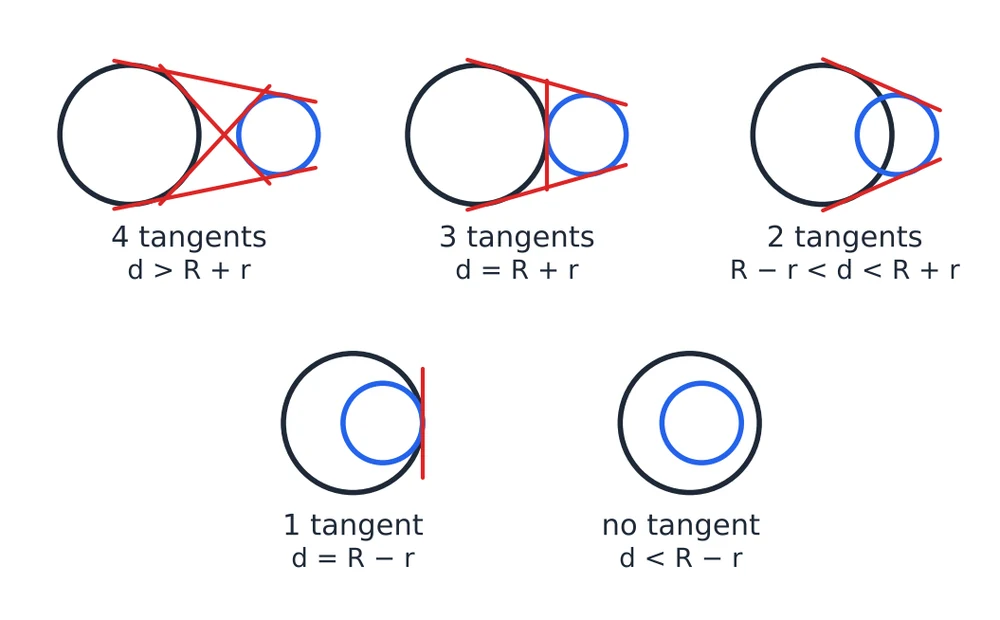
| Position | Condition | Common tangents |
|---|---|---|
| Apart, each outside the other | 4 (2 direct, 2 transverse) | |
| Touching externally | 3 | |
| Cutting at two points | 2 | |
| Touching internally | 1 | |
| One inside the other | 0 |
Circles with the same centre () fall in the last row.
When two circles touch, the point of contact lies on the line joining the centres, and the common tangent at that point is perpendicular to this line.
Take cm and cm. If cm they touch externally (3 common tangents); cm, they touch internally (1); cm, they cut each other (2); cm, they are apart (4); and cm, the small circle sits inside without touching (0).
Direct and transverse. A direct common tangent has both circles on the same side of it. A transverse one passes between them and crosses the line of centres. Transverse tangents need the circles to be apart (then there are two) or touching externally (then they merge into the single tangent at the point of contact).
The touching cases get asked both ways. "Two circles of radii 9 cm and 5 cm touch internally; find the distance between their centres" is 9 − 5 = 4 cm, not 14 cm. Internal means subtract.
Direct and Transverse Common Tangents
For circles with radii and whose centres are apart, the length of a common tangent is measured between its two points of contact:
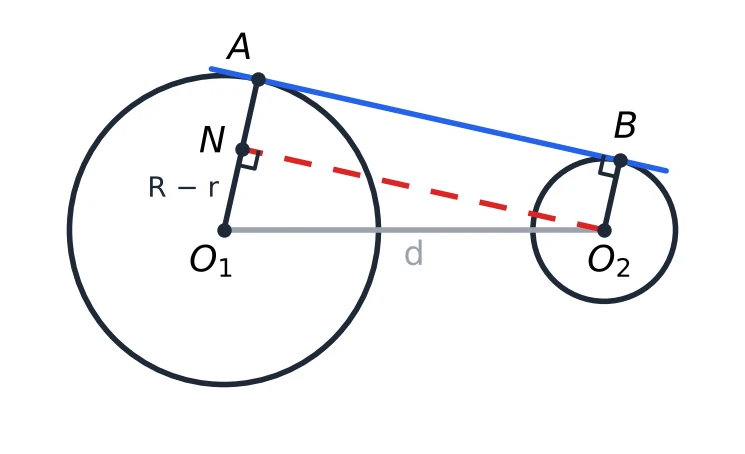
Why the direct formula: the radii and are both perpendicular to the tangent . Draw a line from parallel to , meeting at . Then is a rectangle, so and . Pythagoras in triangle gives .
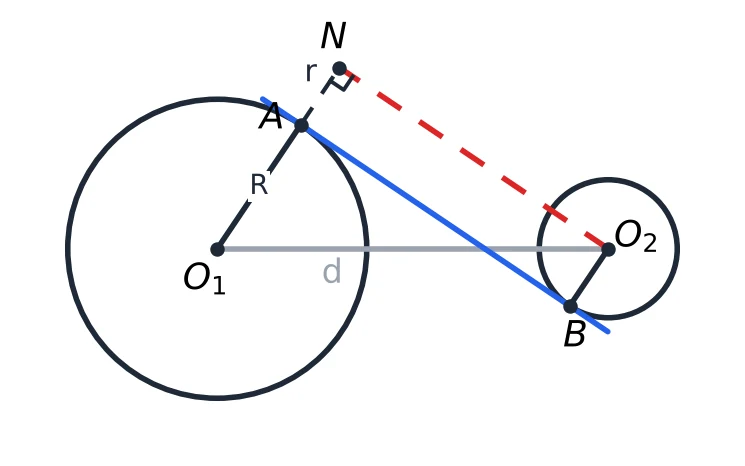
For a transverse tangent the two radii point opposite ways, so the same construction meets extended, and .
Take cm, cm and cm: the direct tangent is cm and the transverse one is cm. The direct tangent is always the longer of the two.
Where the tangents cross the line of centres. A transverse tangent cuts at a point that divides it in the ratio . Here cm and cm. The two direct tangents meet on extended beyond the smaller circle, at a point with . Since , cm. Both facts come from similar right triangles (radius to tangent at each circle).
[SSC Tip] Direct goes with , transverse with . The standard trap swaps them. A quick check: the transverse tangent is the shorter one, and it exists only when (or is zero when the circles touch).
Touching Circles and Three Circles
Two circles touching externally. When , the direct common tangent becomes
For radii 8 cm and 2 cm, cm.
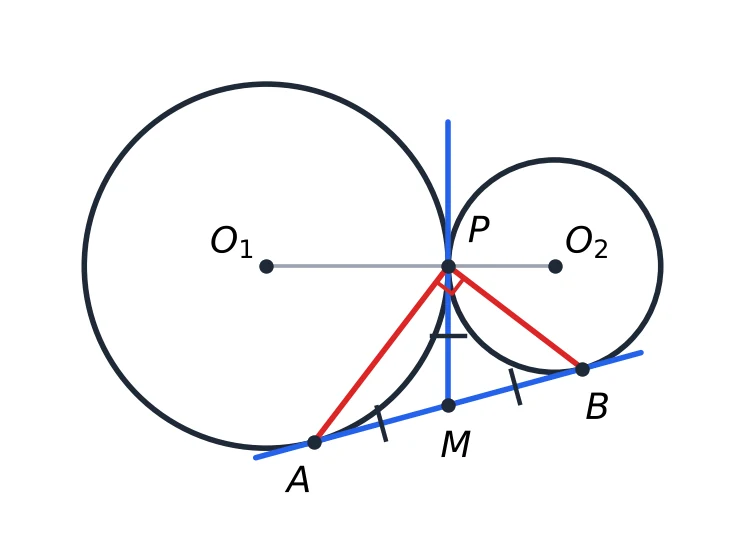
Now let the circles touch at , and let the common tangent at meet at . From there are two tangents to each circle: and . So is the midpoint of , , and lies on the circle with diameter . That gives
for any two circles touching externally. In the same way and bisect the two angles at , which add to 180°, so as well.
Three circles touching each other externally. The centres form a triangle whose sides are the sums of pairs of radii. So the perimeter of that triangle is . Going back, each radius is the semi-perimeter minus the side opposite its centre, just like tangent lengths in a triangle.
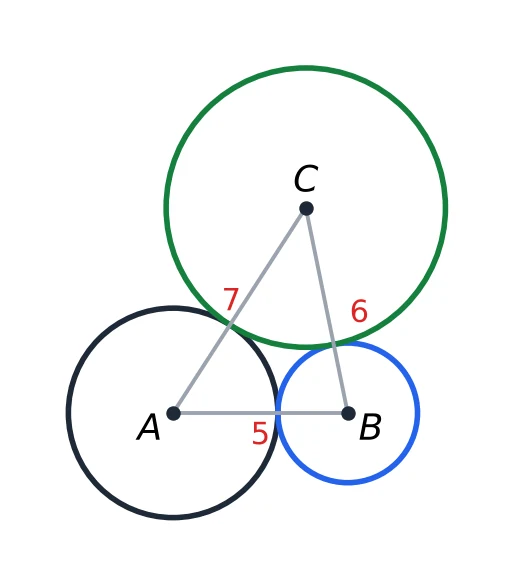
Let the centres be , , with , and . Then , and the radii are at , at and at . Check: , and . Three equal circles of radius touching one another have centres forming an equilateral triangle of side .
[Tier 2] A small circle in the gap. Two circles of radii and touch each other and a straight line. A smaller circle in the gap, touching both of them and the same line, has radius with
This follows from the touching-circle tangent measured three times along the line: . For two circles of radius 4: , so .
For touching circles, is faster than the full formula. And "" is a favourite one-mark question whose options include 60° and "cannot be found".
Circles in Squares, Triangles and Other Circles
These "fit one shape inside another" questions only need the distance from the centre to a side or to a corner.
Square of side . The circle inside touches all four sides, so its diameter is and . The circle outside passes through the corners, so its diameter is the diagonal and . So . For a square of side 10 cm, cm and cm. Turned around, the biggest square that fits in a circle of radius has side .
Triangles. In a right triangle, and (the hypotenuse is a diameter). In an equilateral triangle of side , and . The other centres are in Centres of a Triangle.
Largest circle in a semicircle. In a semicircle of radius , the largest circle touches the diameter at its midpoint and the arc at the top, so its diameter is and its radius is .
[Tier 2] Largest circle in a quadrant. In a quarter circle of radius , the circle touching both straight edges and the arc has its centre on the line that bisects the corner, at distance from the corner. Adding reaches the arc:
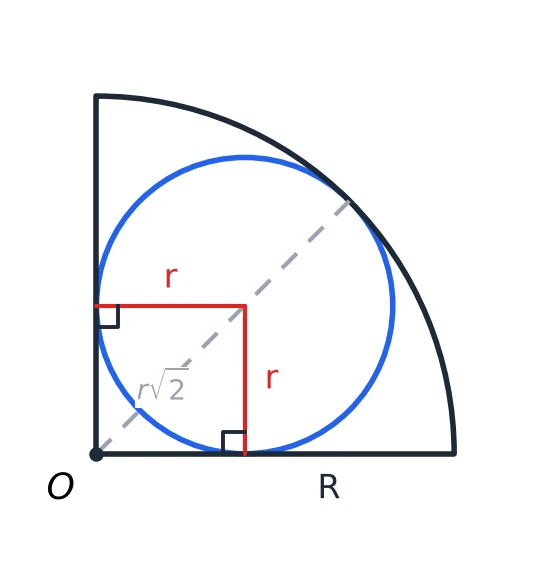
For cm, , about 4.14 cm.
Circles inside a circle. Two equal circles inside a circle of radius , touching each other and the big circle, each have radius : their two diameters fill one diameter of the big circle. [Tier 2] For three equal circles touching one another and the big circle, the centres form an equilateral triangle of side , whose centre is from each corner. Adding gives , so .
Whenever a circle sits in a right-angled corner touching both sides, its centre is from the corner. That single fact solves the quadrant and most other "circle in a corner" questions.
Solved Examples
Question 1
A point is 61 cm from the centre of a circle of radius 11 cm. What is the length of the tangent drawn from to the circle? (a) 50 cm (b) cm (c) 60 cm (d) 72 cm
Answer. The radius meets the tangent at a right angle, so is the hypotenuse of the right triangle. Tangent = (c) 60 cm.
Question 2
The tangent from a point to a circle is 20 cm long, and is 29 cm from the centre. What is the radius of the circle? (a) 21 cm (b) 9 cm (c) cm (d) 49 cm
Answer. The triangle made by the radius, the tangent and is right-angled at the point of contact, with hypotenuse . So = (a) 21 cm.
Question 3
and are tangents from to a circle with centre . If , what is ? (a) 58° (b) 116° (c) 64° (d) 32°
Answer. The angle at and the angle at add up to 180°, so . Triangle has , so = (d) 32°. That is half of , as expected. 58° is , the angle between the tangent and the chord.
Question 4
Two tangents drawn from a point to a circle of radius 9 cm make an angle of 60° with each other. What is the length of each tangent? (a) 18 cm (b) cm (c) 9 cm (d) cm
Answer. cuts the 60° in half, so , and triangle has its right angle at . In a 30°-60°-90° triangle the side opposite 30° is half the hypotenuse: , so cm, and the side opposite 60° is times the short side: = (b) cm.
Question 5
and are tangents to a circle with centre , and . is a point on the major arc . What is ? (a) 36° (b) 108° (c) 54° (d) 126°
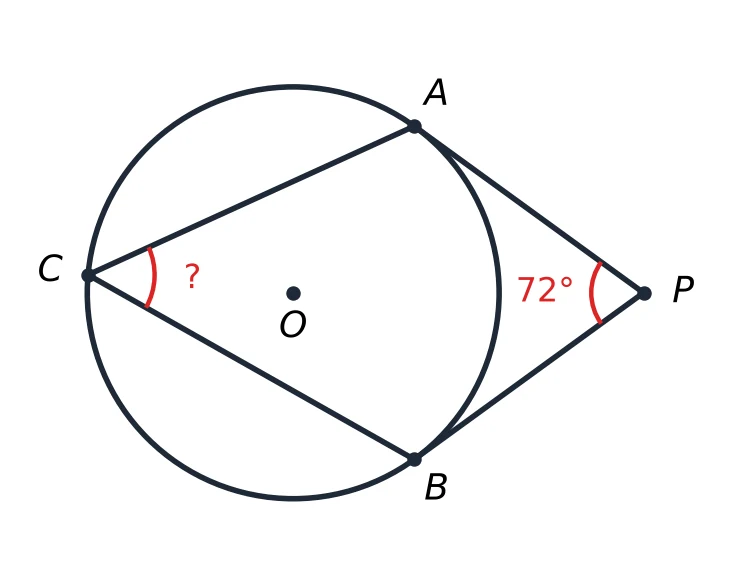
Answer. First the centre: . is on the major arc, so it sees half of that: = (c) 54°. Quick form: . 126° is what a point on the minor arc would see.
Question 6
Two circles with the same centre have radii 50 cm and 14 cm. What is the length of a chord of the larger circle that touches the smaller circle? (a) 96 cm (b) 48 cm (c) 72 cm (d) cm
Answer. The chord touches the small circle, so the small circle's radius meets it at right angles, and that perpendicular from the centre cuts the chord in half. Half the chord is cm, so the chord is (a) 96 cm.
Question 7
From a point , a tangent and a secant are drawn to a circle. If cm and cm, what is the length of ? (a) cm (b) 3 cm (c) 4.5 cm (d) 6 cm
Answer. The whole secant is cm. Then , so = (d) 6 cm. Using gives cm, the usual slip.
Question 8
Two secants and are drawn to a circle from an outside point . If cm, cm and cm, what is the length of ? (a) 10 cm (b) 4 cm (c) cm (d) 6 cm
Answer. Use whole lengths from : cm. Then , so cm and = (b) 4 cm.
Question 9
A tangent and a secant are drawn from a point to a circle. If cm and cm, what is the length of the chord ? (a) 21 cm (b) 28 cm (c) 14 cm (d) 7 cm
Answer. , so and cm. The chord is the part inside the circle: = (a) 21 cm.
Question 10
The tangent at a point of a circle makes an angle of 58° with the chord . What angle does make at a point on the minor arc ? (a) 58° (b) 116° (c) 122° (d) 32°
Answer. By the alternate segment theorem, a point on the major arc (the far side of the chord) sees at 58°. is on the minor arc, the other side of the chord, so it sees = (c) 122°.
Question 11
is a diameter of a circle, and the tangent at a point on the circle meets produced at , beyond . If , what is ? (a) 32° (b) 58° (c) 64° (d) 26°
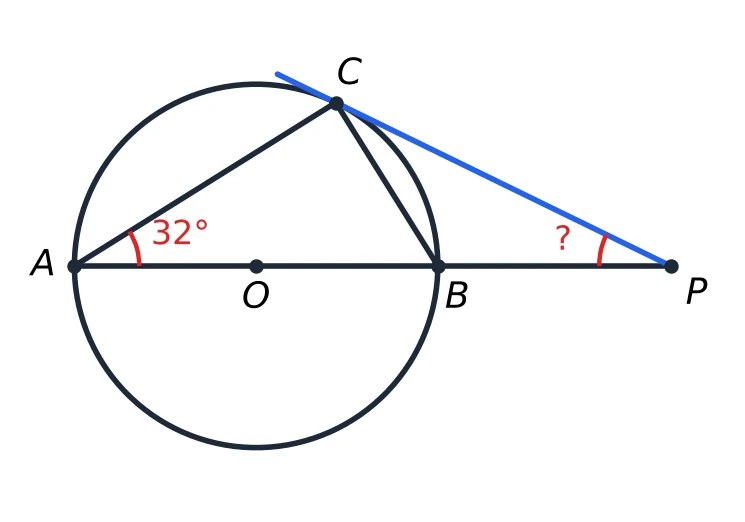
Answer. By the alternate segment theorem, . is a diameter, so and . Now is the exterior angle of triangle at , so , which gives = (d) 26°. Shortcut: .
Question 12
Triangle is drawn in a circle. The tangent at makes an angle of 70° with on one side and 48° with on the other side. What is ? (a) 70° (b) 62° (c) 48° (d) 118°
Answer. The three angles at along the straight tangent add up to 180°: , so = (b) 62°. As a check, the alternate segment theorem gives and , and .
Question 13
A quadrilateral is drawn around a circle so that all four sides touch it. If cm, cm and cm, what is the length of ? (a) 7 cm (b) 13 cm (c) 9 cm (d) 29 cm
Answer. For a quadrilateral around a circle, the opposite sides have equal sums: . So , and = (a) 7 cm.
Question 14
The incircle of triangle touches at . If cm, cm and cm, what is ? (a) 7 cm (b) 5.5 cm (c) 4 cm (d) 5 cm
Answer. Half the perimeter is cm. The tangent from is minus the side opposite , which is : = (c) 4 cm. Check: , and .
Question 15
and are tangents from to a circle, each 12 cm long. A third tangent touches the circle at a point of the minor arc and cuts at and at . What is the perimeter of triangle ? (a) 12 cm (b) 36 cm (c) 18 cm (d) 24 cm
Answer. Tangents from one point are equal, so and . The perimeter of is . Both tangents are 12 cm, so the perimeter is (d) 24 cm, wherever sits on the arc.
Question 16
A right-angled triangle has legs 28 cm and 45 cm. What is the radius of the circle that touches all three of its sides? (a) 20 cm (b) 10 cm (c) 26.5 cm (d) 7 cm
Answer. The hypotenuse is cm. For a right triangle, = (b) 10 cm.
Question 17
The hypotenuse of a right-angled triangle is 26 cm and the radius of its incircle is 4 cm. What is the perimeter of the triangle? (a) 60 cm (b) 34 cm (c) 52 cm (d) 68 cm
Answer. gives cm. The perimeter is = (a) 60 cm. (The legs are 10 cm and 24 cm, and .)
Question 18
A circle of radius 7 cm is drawn inside a square, touching all four sides. Another circle passes through all four corners of the square. What is the radius of the second circle? (a) 14 cm (b) cm (c) cm (d) cm
Answer. The inner circle touches opposite sides, so the side of the square is its diameter, 14 cm. The outer circle passes through opposite corners, so its diameter is the diagonal, cm, and its radius is (c) cm. cm is the diameter, not the radius.
Question 19
Two circles of radii 27 cm and 12 cm touch each other externally. What is the length of their direct common tangent? (a) 39 cm (b) 18 cm (c) 15 cm (d) 36 cm
Answer. Touching externally means the centres are cm apart. The direct common tangent is = (d) 36 cm. Shortcut for touching circles: .
Question 20
Two circles of radii 7 cm and 2 cm have their centres 15 cm apart. What is the length of a transverse common tangent? (a) cm (b) 12 cm (c) 9 cm (d) cm
Answer. A transverse tangent uses the sum of the radii: = (b) 12 cm. cm is the direct common tangent, which uses .
Question 21
Two circles touch each other internally. The radius of the bigger circle is 15 cm and the distance between the centres is 6 cm. What are the radius of the smaller circle and the number of common tangents? (a) 9 cm and 3 (b) 21 cm and 2 (c) 9 cm and 1 (d) 21 cm and 1
Answer. Touching internally means , so and cm. Circles touching internally have just one common tangent, the line through the point of contact. So the answer is (c) 9 cm and 1.
Question 22
The direct common tangent of two circles of radii 11 cm and 4 cm is 24 cm long. How far apart are their centres? (a) 25 cm (b) cm (c) 24 cm (d) 15 cm
Answer. , so and = (a) 25 cm.
Question 23
Two circles touch each other externally at . A direct common tangent touches them at and . What is ? (a) 60° (b) 90° (c) 120° (d) It depends on the radii
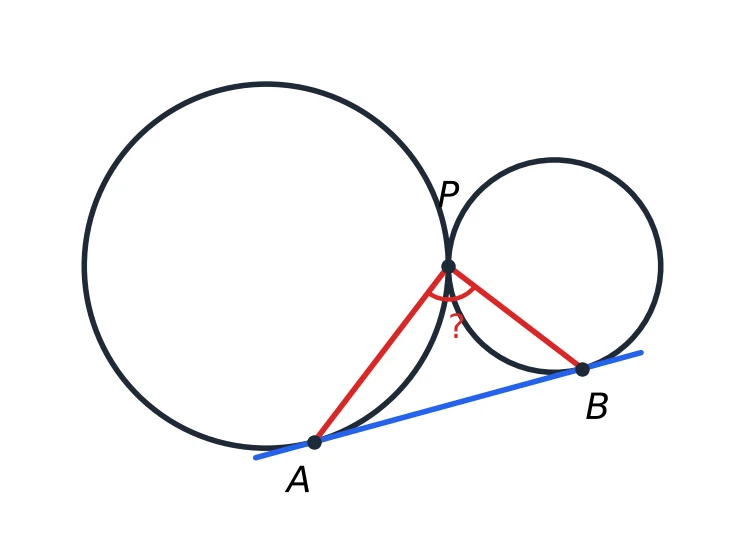
Answer. Let the common tangent at meet at . From , and are tangents to the first circle, so ; and and are tangents to the second, so . So is the midpoint of with , which puts on the circle with diameter . The angle in a semicircle gives = (b) 90°, whatever the radii are.
Question 24
Three circles touch one another externally. The distances between their centres are 10 cm, 13 cm and 15 cm. What is the radius of the largest circle? (a) 6 cm (b) 7.5 cm (c) 19 cm (d) 9 cm
Answer. Call the radii , and . Touching externally means , and . Adding all three, , so . Take away each pair in turn: the radii are , and . The largest is (d) 9 cm.
Question 25
[Tier 2] From a point that is 50 cm from the centre of a circle of radius 40 cm, tangents and are drawn. What is the length of the chord ? (a) 24 cm (b) 48 cm (c) 30 cm (d) 60 cm
Answer. The tangent length is cm. is the perpendicular bisector of , so half of is the altitude from in the right triangle : cm. So = (b) 48 cm.