
Kinds of Angles, Complements and Supplements
An angle is made by two rays that start from the same point, called the vertex. Its size tells you how far one arm must turn to reach the other, and one full turn is 360°.
| Name | Size |
|---|---|
| Acute | more than 0° and less than 90° |
| Right | exactly 90° |
| Obtuse | more than 90° and less than 180° |
| Straight | exactly 180° |
| Reflex | more than 180° and less than 360° |
| Complete | exactly 360° |
Every angle has a reflex partner that completes the turn. The reflex angle that goes with 72° is 360° − 72° = 288°.
Complementary angles add up to 90°. Supplementary angles add up to 180°. So for an angle ,
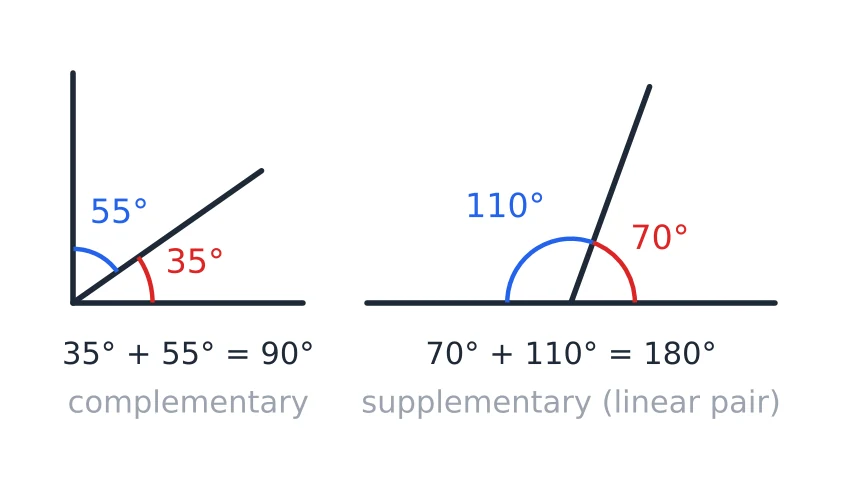
Two facts settle most questions:
- Only an acute angle has a complement. A right angle or anything bigger has none.
- The supplement is always 90° more than the complement, because . If the supplement of an angle is 128°, its complement is 38°, and you never needed the angle itself.
Angles in a ratio. Two supplementary angles are in the ratio 4 : 5. Together they are 9 parts and 180°, so one part is 20° and the angles are 80° and 100°. Two complementary angles in the ratio 4 : 11 are 15 parts of 6° each: 24° and 66°.
Angles described in words. Turn the sentence into an equation in .
- "An angle is 24° more than its complement": , so and . Check: the complement is 33°, and 57 − 33 = 24.
- "The supplement of an angle is three times its complement": , so and .
Chains are read from the inside out. "The supplement of the complement of 30°" is the supplement of 60°, which is 120°. In general the supplement of the complement of is .
After solving, look at your answer again. If the question talks about a complement and you got 96°, the equation was set up the wrong way round, because an angle that has a complement must be less than 90°.
Linear Pairs, Vertically Opposite Angles and Angles at a Point
Linear pair. When a ray stands on a straight line, it makes two angles side by side, and together they fill the straight angle. So the two angles of a linear pair add up to 180°. The 70° and 110° drawn under Kinds of Angles above are a linear pair. It works the other way too: if two angles side by side add up to 180°, their outer arms lie on one straight line.
Vertically opposite angles. Two crossing lines make four angles. The two angles that face each other across the crossing point are called vertically opposite, and they are always equal.
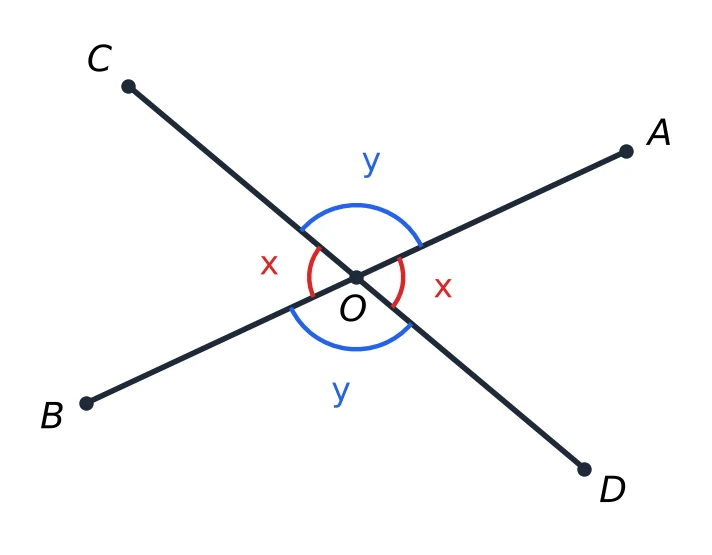
The reason takes one line. and lie along the straight line AB, so . and lie along the straight line CD, so they also add to 180°. Both and are therefore , so they are equal. The four angles go round as , , , with : know one of them and you know all four.
Angles at a point add up to 360°. If four rays from O make angles , , and all the way round, then and the angles are 36°, 72°, 108° and 144°.
Angles on one side of a line add up to 180°, however many rays there are. Three lines through one point make six angles. The three on one side of any of these lines add to 180°, and the other three are their vertically opposite copies. If the three on one side are , and , then , , and the six angles are 40°, 60°, 80°, 40°, 60°, 80°.
Bisectors. The bisectors of the two angles of a linear pair are perpendicular, since half of plus half of is 90°. The bisectors of two vertically opposite angles lie along one straight line.
Before any calculation in a figure, mark the straight lines (angles along them add to 180°) and the crossing points (opposite angles are equal). Most "find " figures need nothing more.
Parallel Lines and a Transversal
Two lines in a plane that never meet are parallel; we write . A line that cuts both of them is a transversal. It makes four angles at each crossing, so eight in all.
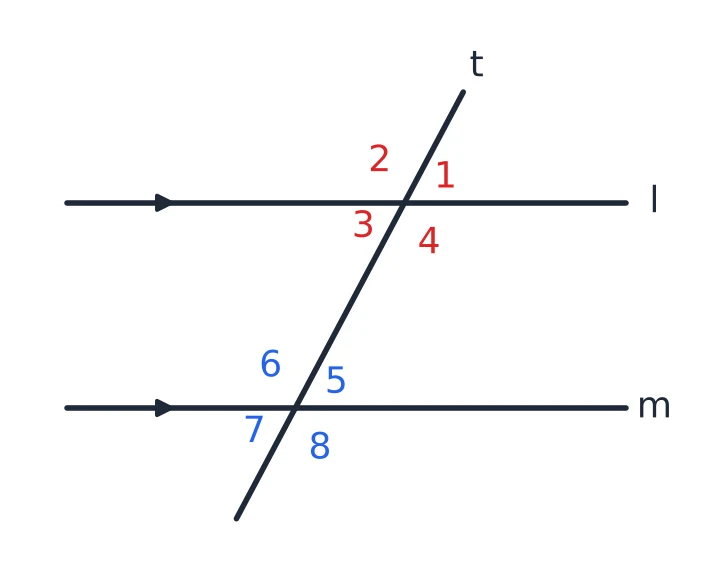
With , the eight angles come in matched pairs:
| Pair | In the figure | Rule |
|---|---|---|
| Corresponding (same position at each crossing) | 1 and 5, 2 and 6, 3 and 7, 4 and 8 | equal |
| Alternate interior (between the lines, opposite sides of the transversal) | 3 and 5, 4 and 6 | equal |
| Alternate exterior (outside the lines, opposite sides of the transversal) | 1 and 7, 2 and 8 | equal |
| Co-interior (between the lines, same side of the transversal) | 3 and 6, 4 and 5 | add up to 180° |
| Vertically opposite (same crossing) | 1 and 3, 2 and 4, 5 and 7, 6 and 8 | equal |
A quicker way to hold all of this: a transversal across two parallel lines makes only two different angles, one acute and one obtuse, and they add to 180°. In the figure the odd-numbered angles are all the acute one and the even-numbered angles are all the obtuse one. Any two angles from the same group are equal, and an angle from one group plus an angle from the other gives 180°.
The rules work backwards too. If a pair of corresponding angles is equal, or a pair of alternate angles is equal, or two co-interior angles add to 180°, then the two lines are parallel. That is how a "for what value of is " question is settled.
Angles given as expressions. Say angles 3 and 5 are and . They are alternate interior angles, so they are equal: , which gives and an angle of 60°. If the question had named angles 3 and 6 instead, they would be co-interior, and you would set their sum to 180°: , so and the angles are 80° and 100°. So check which pair the question names before you write the equation.
[SSC Tip] Remember the letter shapes. Corresponding angles sit in an F, alternate angles in a Z, and co-interior angles in a C (or U). If a Z runs through the two angles, they are equal; if a C does, they add up to 180°.
The Bend Rule: An Angle Between Two Parallel Lines
A common SSC figure has two parallel lines with a bent arm between them: a point E lies between the lines and is joined to A on the top line and to C on the bottom line. Two of the angles are given and the third is asked.
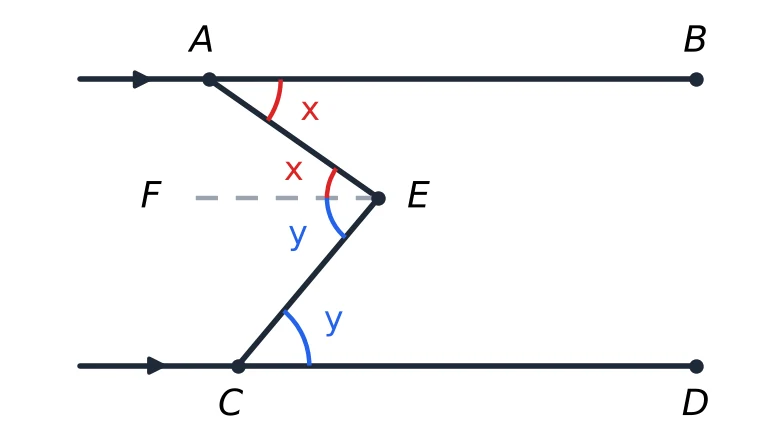
The rule. The angle at the bend equals the sum of the angles that the two arms make with the parallel lines, both measured on the side the bend points to:
Why. Draw a helper line EF through E, parallel to AB (dashed in the figure). Since EF AB, (alternate angles, with AE as the transversal). Since EF CD as well, (alternate angles, with CE as the transversal). The two parts together make .
With and , the bend is 85°. The rule also runs backwards: if the bend is 100° and the top angle is 42°, the bottom angle is 58°.
Angles on the far side: the 360° rule. Sometimes the figure marks the angles on the other side of each arm, away from the bend.
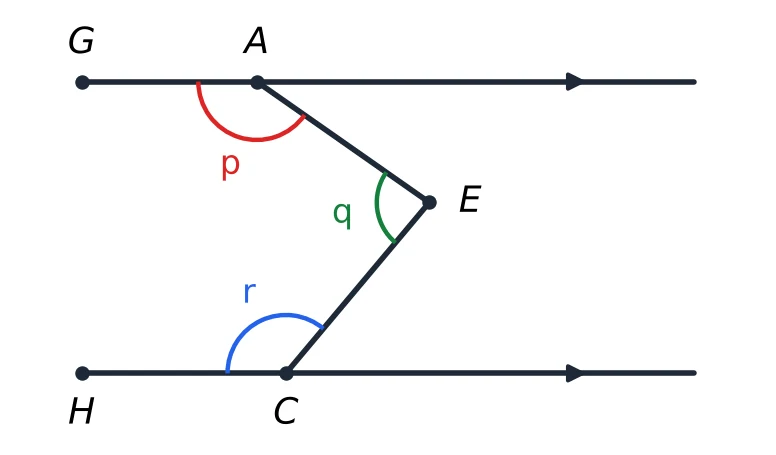
Here and , while the bend is . Adding them,
So with and , the bend is .
A point outside the two lines. When E lies beyond both lines, the angle at E is the difference of the two angles, not the sum.
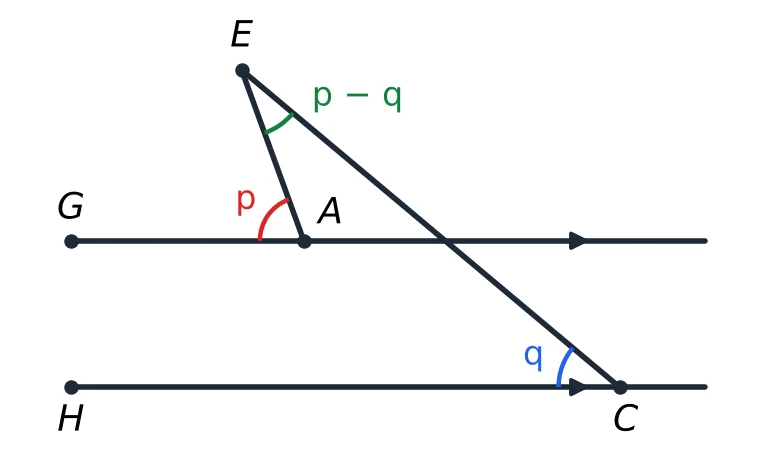
The line EC crosses the top line and makes the angle there too (corresponding angles). That gives a small triangle with E and A, and is its exterior angle at A. An exterior angle equals the two opposite interior angles (see Triangles: Angles, Sides, Congruence and Pythagoras), so and . With and , the angle at E is 30°.
If you forget which version applies, draw the helper line through the point parallel to the given lines and use alternate or co-interior angles on each part. It takes ten seconds and never fails.
Bisectors and Angle Ratios with Parallel Lines
Bisectors of co-interior angles meet at 90°. A transversal cuts AB at P and CD at Q, with AB CD. The co-interior angles and add up to 180°. Let their bisectors meet at R. In triangle PQR,
so the third angle, , is 90°, whatever the slope of the transversal.
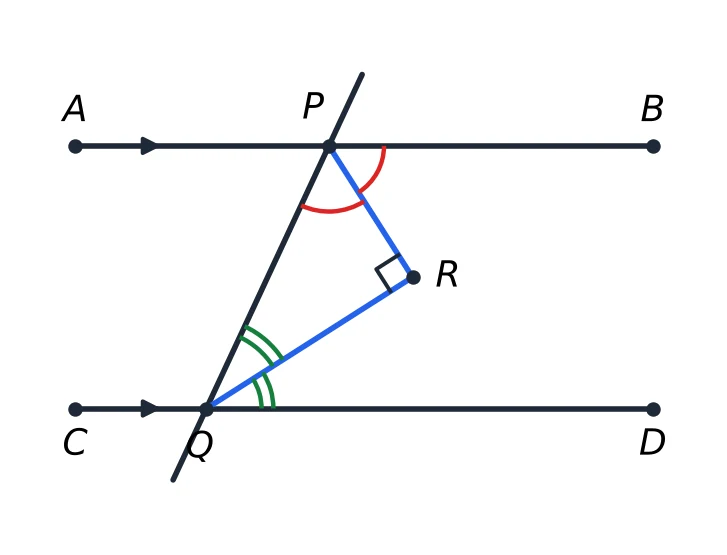
Two related facts. The bisectors of a pair of alternate angles, such as and , are parallel to each other, because they make equal alternate angles with PQ. The bisectors of a pair of corresponding angles are parallel for the same reason. Only co-interior angles (and a linear pair) give bisectors that meet at 90°.
Bisectors at a bend. Go back to the bend figure with . If the bisectors of and meet at F between the lines, F is a bend too, with arms making half the angles. So . A bend of 110° gives .
Co-interior angles in a ratio. Two co-interior angles are in the ratio 2 : 3. They add to 180°, so the 5 parts are 36° each and the angles are 72° and 108°. Every one of the eight angles at the two crossings is then 72° or 108°.
One angle a multiple of another. "One of the angles made by a transversal with two parallel lines is four times another." Two different angles here must be the acute one and the obtuse one (equal angles cannot be four times each other). So , , and the angles are 36° and 144°.
Perpendiculars. A line perpendicular to one of two parallel lines is perpendicular to the other as well, since corresponding angles are equal. Two lines that are both perpendicular to a third line are parallel to each other, and two lines parallel to the same line are parallel to each other.
Polygons: Interior and Exterior Angles
A polygon is a closed figure made of straight sides. It is convex when every interior angle is less than 180°, so no corner is pushed inwards; SSC polygon questions use convex polygons. It is regular when all its sides are equal and all its angles are equal.
Sum of the interior angles. From one vertex of a polygon with sides, draw every diagonal you can. The polygon splits into triangles, and each triangle holds 180°.
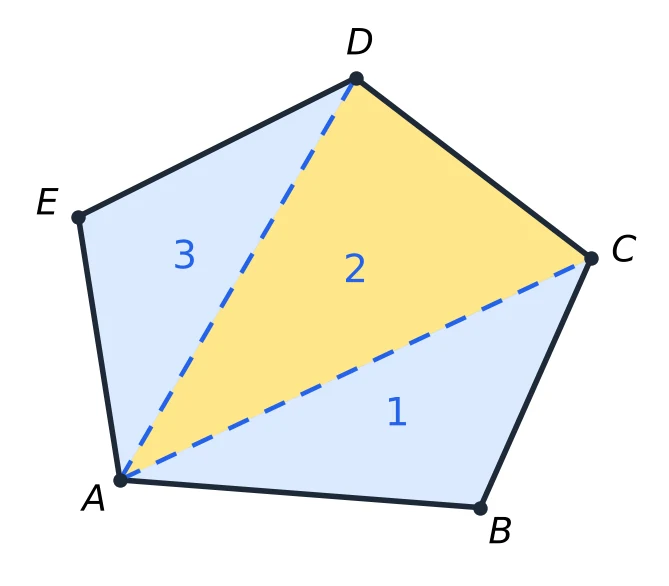
A pentagon gives , a hexagon 720° and an octagon 1080°.
Sum of the exterior angles. Extend each side in turn, always going the same way round. The angle between the extension and the next side is the exterior angle at that vertex, and at every vertex
because the two form a linear pair. Now walk once round the polygon. At each corner you turn through its exterior angle, and you finish facing the way you started, so the turns make one full turn.
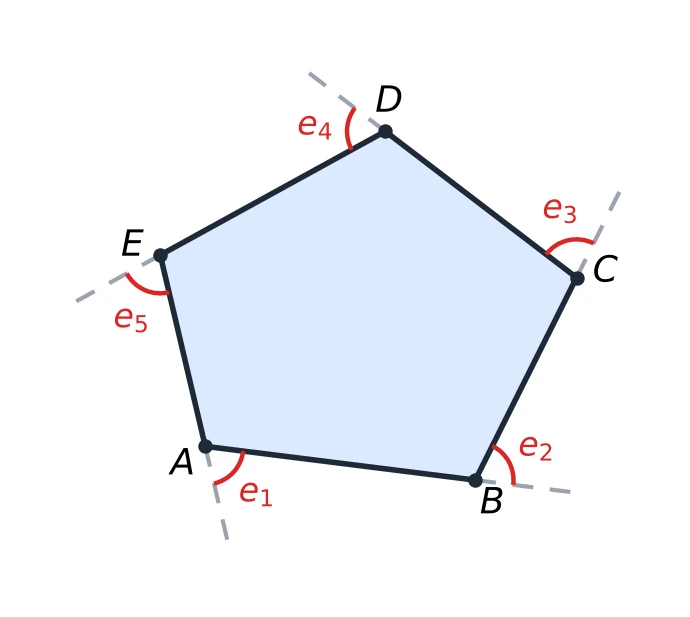
Regular polygons. All exterior angles are equal, so
| Sides | Name | Interior sum | Each exterior | Each interior |
|---|---|---|---|---|
| 3 | Equilateral triangle | 180° | 120° | 60° |
| 4 | Square | 360° | 90° | 90° |
| 5 | Pentagon | 540° | 72° | 108° |
| 6 | Hexagon | 720° | 60° | 120° |
| 8 | Octagon | 1080° | 45° | 135° |
| 9 | Nonagon | 1260° | 40° | 140° |
| 10 | Decagon | 1440° | 36° | 144° |
| 12 | Dodecagon | 1800° | 30° | 150° |
| 15 | 15-sided | 2340° | 24° | 156° |
| 18 | 18-sided | 2880° | 20° | 160° |
| 20 | 20-sided | 3240° | 18° | 162° |
[SSC Tip] Work through the exterior angle every time. It is one division, , and the interior angle is then 180° minus it. The interior formula with on top is where most slips happen.
Finding the Number of Sides
Every "how many sides" question comes down to one step: find a single exterior angle , then
From the interior angle. Each interior angle is 140°, so and .
Is such a polygon possible? The number of sides must be a whole number, at least 3. Interior angles of 130° give , and , so no regular polygon has interior angles of 130°. The only possible exterior angles are the divisors of 360 up to 120: 120°, 90°, 72°, 60°, 45°, 40°, 36°, 30°, 24°, 20°, 18°, 15°, 12°, 10°, 9°, 8°, 6°, 5°, 4°, 3°, 2° and 1°.
From a ratio of interior to exterior angle. If interior : exterior , the two add up to 180°, so . For 7 : 2, and . When the ratio is there is a shortcut, because
So an interior angle 4 times the exterior angle means , and 144° and 36° check out.
From a difference. If the interior angle exceeds the exterior angle by 108°, then and , so and .
From the interior sum. gives , so . If the interior sum is times the exterior sum, then , so again . Three times gives , and indeed 1080 = 3 × 360.
Two regular polygons. Their numbers of sides are in the ratio 1 : 2 and their interior angles in the ratio 3 : 4. Call the sides and :
So they are a pentagon (108°) and a decagon (144°), and 108 : 144 = 3 : 4.
When the options give the number of sides, test them instead of solving. Work out for each option and see which one fits the data; in a ratio question this takes under a minute.
Diagonals and Triangles from the Vertices
A diagonal joins two vertices that are not next to each other. From one vertex of an -sided polygon you can draw a diagonal to every vertex except itself and its two neighbours, so diagonals start at each vertex. Doing this at all vertices counts every diagonal twice, once from each end:
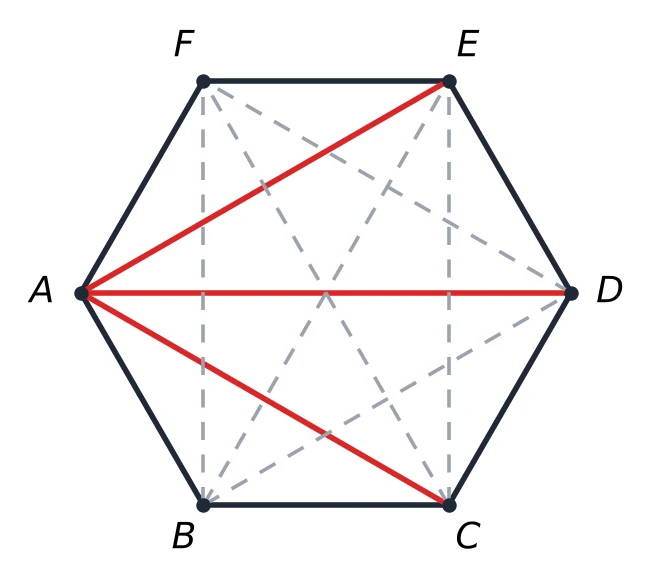
A hexagon has diagonals, three of them from A. An octagon has 20, a decagon 35 and a 12-sided polygon 54. Another way to see the formula: any two of the vertices give a segment, segments in all, and of them are sides. The rest are diagonals.
Going backwards.
- 54 diagonals: , so .
- As many diagonals as sides: gives , so . The pentagon is the only one.
- Diagonals times the sides: , so . Twice the sides gives , with 14 diagonals.
Triangles from the vertices. Any three vertices of a convex polygon make a triangle, since no three of them lie on a line. So the number of triangles is the number of ways to choose 3 vertices:
An octagon gives . Do not mix this up with the triangles made by the diagonals from one vertex, which is the angle-sum picture.
[Tier 2] Triangles that share sides with the polygon. Sort the triangles from the vertices by how many of their sides are sides of the polygon:
| Sides shared | Count | How |
|---|---|---|
| Two | three neighbouring vertices | |
| One | pick a side, then a vertex not touching it | |
| None | whatever is left |
For an octagon these are 8, 32 and 16, and 8 + 32 + 16 = 56.
[SSC Tip] For "how many sides has a polygon with 35 diagonals", double it to 70 and split 70 into two numbers that differ by 3: 10 × 7. The larger one, 10, is the number of sides.
Quadrilaterals: Angle Sum and Angle Bisectors
A diagonal cuts any quadrilateral into two triangles, so its four angles add up to . Angles in the ratio 3 : 4 : 5 : 6 are 18 parts of 20° each: 60°, 80°, 100° and 120°.
Bisectors of two adjacent angles. In quadrilateral ABCD let the bisectors of and meet at O. In triangle AOB,
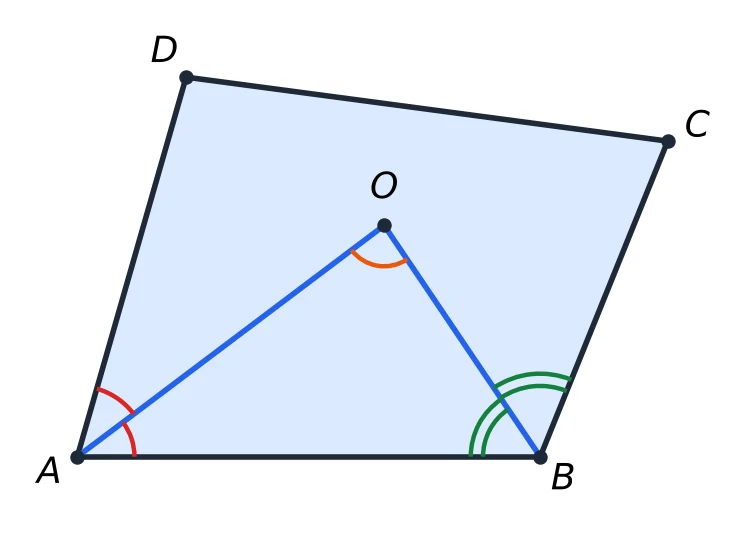
So and are not needed one by one. If and , then .
Bisectors of two exterior angles. The bisectors of the exterior angles at A and B meet (on the side of the quadrilateral) at an angle of , because each exterior bisector makes or with AB.
[Tier 2] Bisectors of two opposite angles. The bisectors of and make an angle of with each other. In a parallelogram , so those two bisectors are parallel.
The mid-point quadrilateral. Join the mid-points of the four sides of any quadrilateral, in order, and you always get a parallelogram. (The reason is the midpoint theorem, in Similar Triangles and Proportionality.) Its sides run parallel to the diagonals of the original and are half as long, so its shape depends on those diagonals:
| Original quadrilateral | Mid-point quadrilateral |
|---|---|
| Any quadrilateral | Parallelogram |
| Rectangle (equal diagonals) | Rhombus |
| Rhombus (perpendicular diagonals) | Rectangle |
| Square | Square |
For the bisector question, add the two angles that were not bisected and halve the sum: . The supplement of the right answer, , is almost always one of the options, so check which angle the question really asks for.
Parallelogram, Rectangle and Square
A parallelogram has both pairs of opposite sides parallel. That one fact gives all the others:
- opposite sides are equal and opposite angles are equal;
- adjacent angles add up to 180°, since they are co-interior angles between parallel sides;
- the diagonals bisect each other, so each cuts the other into two equal halves;
- each diagonal splits it into two congruent triangles.
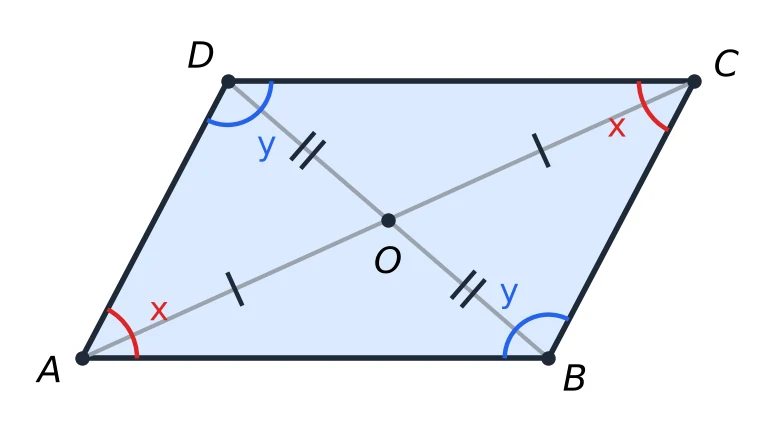
The diagonals of a general parallelogram are neither equal nor perpendicular.
Tests for a parallelogram. A quadrilateral is a parallelogram if any one of these holds: both pairs of opposite sides are equal; both pairs of opposite angles are equal; the diagonals bisect each other; one pair of opposite sides is both equal and parallel.
Bisectors of adjacent angles meet at 90°. Since , half of each adds up to 90°, and the bisectors meet at a right angle. It is the co-interior fact again, with AD BC. Draw all four bisectors and they enclose a rectangle.
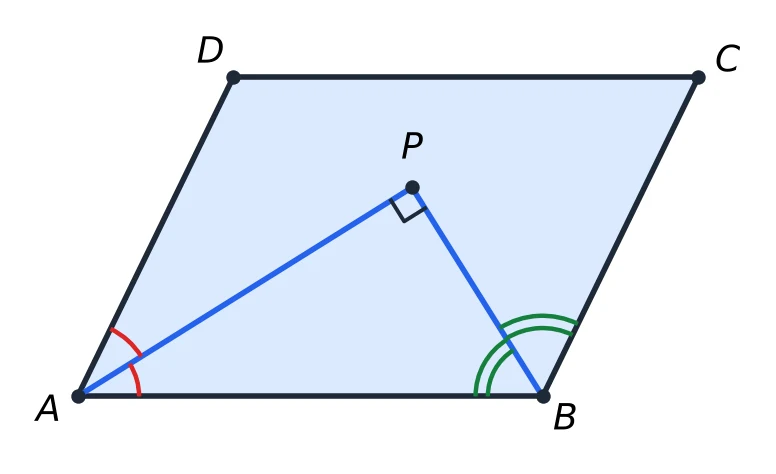
Sum of the squares of the diagonals. In any parallelogram ABCD,
With sides 9 cm and 8 cm and one diagonal 11 cm: , so and the other diagonal is 13 cm.
Rectangle. A parallelogram with one right angle, and so four. Its diagonals are equal as well as bisecting each other, so all four half-diagonals are equal. By Pythagoras the diagonal is : a 15 cm by 8 cm rectangle has diagonals of 17 cm.
Square. A rectangle with equal sides, and also a rhombus. Its diagonals are equal, bisect each other at 90° and cut the corner angles into 45° each. The diagonal of a square of side is .
| Diagonals | Parallelogram | Rectangle | Rhombus | Square |
|---|---|---|---|---|
| Bisect each other | Yes | Yes | Yes | Yes |
| Equal | No | Yes | No | Yes |
| Perpendicular | No | No | Yes | Yes |
| Bisect the vertex angles | No | No | Yes | Yes |
Every square is both a rectangle and a rhombus, and every rectangle and rhombus is a parallelogram. None of these works the other way round.
"Which statement is true" questions on these shapes are settled by the table. Two traps to watch: the diagonals of a rectangle are not perpendicular, and the diagonals of a rhombus are not equal.
Rhombus, Trapezium and Kite
Rhombus. All four sides are equal. It is a parallelogram, so opposite angles are equal and adjacent angles add up to 180°. Its diagonals bisect each other at right angles and bisect the vertex angles. They cut the rhombus into four congruent right triangles, each with legs and and hypotenuse :
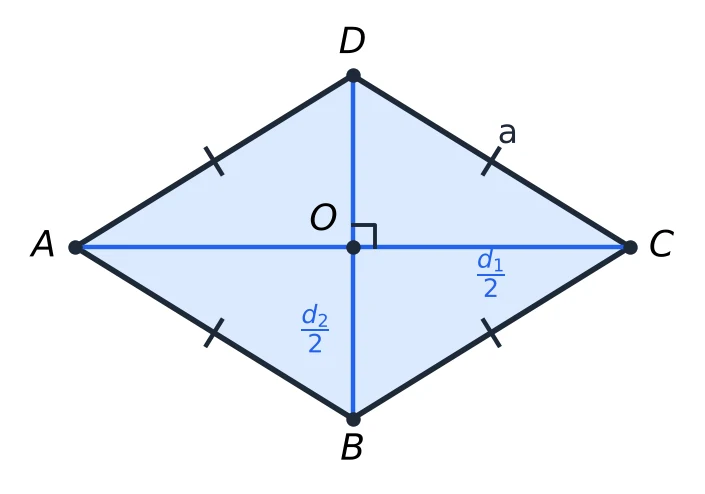
Diagonals of 24 cm and 10 cm have halves 12 and 5, so the side is 13 cm. A side of 10 cm with one diagonal of 12 cm gives , so the other diagonal is 16 cm. If one angle of a rhombus is 60°, the shorter diagonal makes an equilateral triangle with two sides, so it equals the side.
Trapezium. Exactly one pair of parallel sides. In trapezium ABCD with AB DC:
- the two angles along each slanting side add up to 180°: ;
- the segment MN joining the mid-points of the slanting sides is parallel to the two bases and equals half their sum;
- the diagonals cut each other in the ratio of the parallel sides.
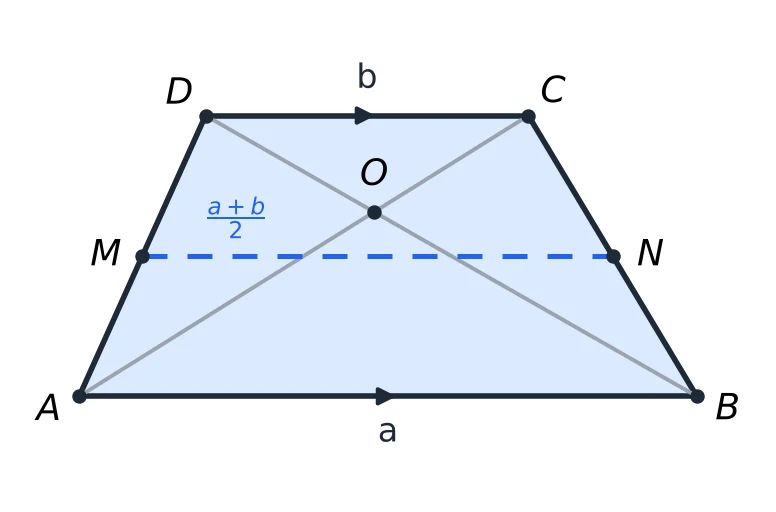
With AB = 18 cm and DC = 12 cm the mid-segment is 15 cm, and a diagonal AC of 20 cm is cut in the ratio 3 : 2, into AO = 12 cm and OC = 8 cm. The diagonal ratio comes from the similar triangles AOB and COD (Similar Triangles and Proportionality). In an isosceles trapezium the slanting sides are equal, the base angles are equal in pairs and the diagonals are equal.
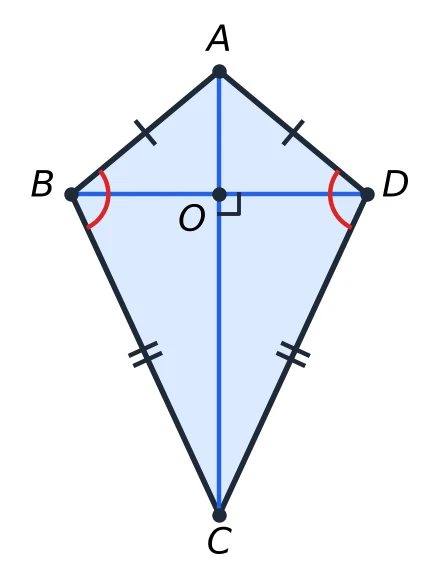
Kite. Two pairs of equal sides next to each other: AB = AD and CB = CD. The diagonal AC, through the corners where the equal sides meet, is a line of symmetry. It bisects and and is the perpendicular bisector of the other diagonal BD. The angles at B and D, between unequal sides, are equal.
[SSC Tip] For a rhombus, halve both diagonals first and look for a Pythagorean triple: halves of 5 and 12 give a side of 13, 8 and 15 give 17, 9 and 12 give 15. Forgetting to halve gives a side twice too long, and that wrong value is always in the options.
Solved Examples
Question 1
Two supplementary angles are in the ratio 7 : 11. What is the smaller angle? (a) 110° (b) 35° (c) 70° (d) 100°
Answer. Supplementary means they add up to 180°. There are 7 + 11 = 18 parts, so one part is 10°, and the smaller angle is 7 parts, which is (c) 70°.
Question 2
The complement of an angle is one-fourth of its supplement. What is the angle? (a) 30° (b) 60° (c) 45° (d) 72°
Answer. Write it as an equation: . Multiply both sides by 4: , so and the angle is (b) 60°. Check: the complement is 30°, the supplement is 120°, and 30 is a quarter of 120. 30° is the complement, not the angle.
Question 3
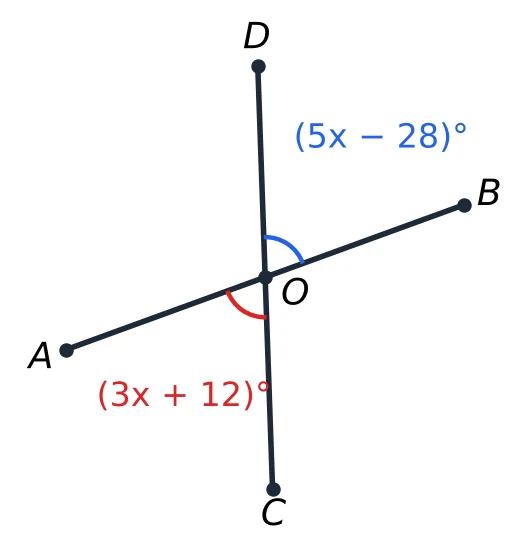
In the figure, the lines AB and CD cross at O. If and , what is ?
(a) 72° (b) 20° (c) 128° (d) 108°
Answer. and are vertically opposite, so they are equal: , which gives and . So . sits next to along the straight line AB, so , which is (d) 108°.
Question 4
Two parallel lines are cut by a transversal. Two alternate interior angles are and . What is the size of each obtuse angle formed? (a) 95° (b) 85° (c) 25° (d) 105°
Answer. Alternate interior angles are equal: , so and . Each of these angles is , which is the acute angle. The obtuse angles are its supplement, 180° − 85° = (a) 95°. 85° is the acute angle, so it answers a different question.
Question 5
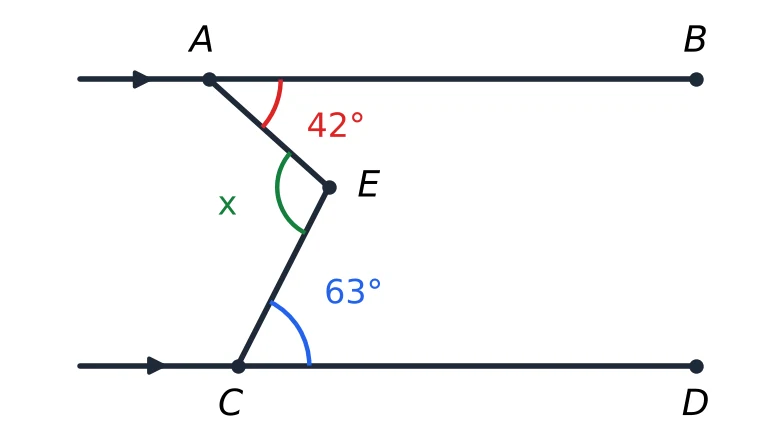
In the figure, AB CD, and . What is ?
(a) 75° (b) 105° (c) 21° (d) 255°
Answer. E is a bend between the two parallel lines, and both given angles are on the side the bend points to. So the bend is their sum: , which is (b) 105°. If you want to see why, draw a line through E parallel to AB; it splits into 42° and 63° (alternate angles).
Question 6
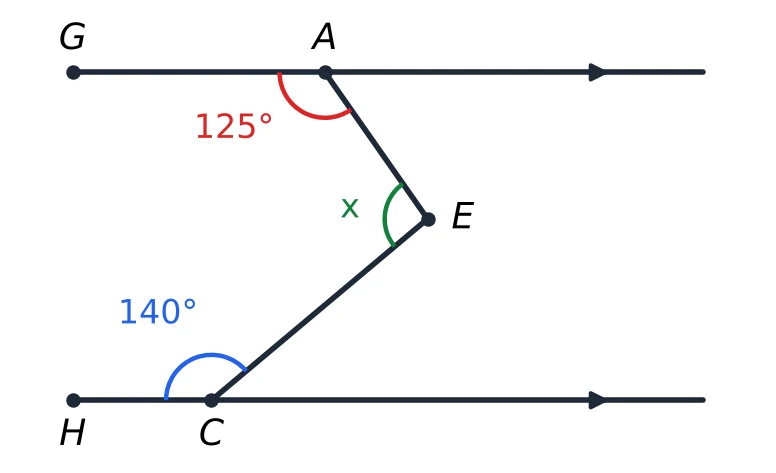
In the figure, the two horizontal lines are parallel, and . What is ?
(a) 265° (b) 85° (c) 15° (d) 95°
Answer. This time the marked angles are on the side away from the bend, so the 360° rule applies: , giving (d) 95°. You can also turn the angles round first: and are the angles on the bend's side, and .
Question 7
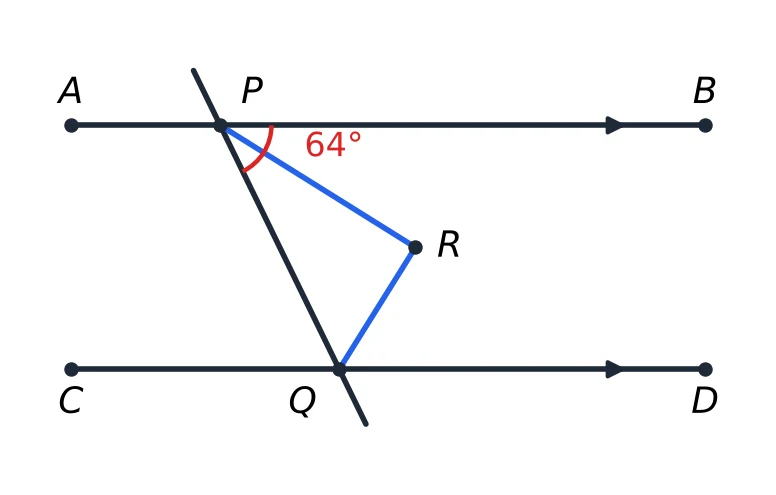
In the figure, AB CD and a transversal cuts them at P and Q. The bisectors of and meet at R. If , what is ?
(a) 32° (b) 26° (c) 58° (d) 90°
Answer. and are co-interior angles, so . QR cuts it in half, so is (c) 58°. Check with triangle PQR: , (bisectors of co-interior angles always meet at a right angle), and .
Question 8
Each interior angle of a regular polygon is 162°. How many sides does it have? (a) 20 (b) 18 (c) 9 (d) 12
Answer. The exterior angle is , so the number of sides is , which is (a) 20. 18 is the exterior angle, not the number of sides.
Question 9
Each interior angle of a regular polygon is 108° more than each exterior angle. How many diagonals does the polygon have? (a) 10 (b) 45 (c) 70 (d) 35
Answer. Interior plus exterior is 180° and interior minus exterior is 108°, so twice the exterior angle is and the exterior angle is 36°. That gives sides, and the diagonals number , which is (d) 35.
Question 10
The ratio of each interior angle to each exterior angle of a regular polygon is 5 : 1. How many sides does it have? (a) 10 (b) 12 (c) 6 (d) 11
Answer. The two angles add to 180° and are 6 parts, so the exterior angle is and the polygon has sides, which is (b) 12. The shortcut with gives the same.
Question 11
The sum of the interior angles of a polygon is 2160°. How many sides does it have? (a) 12 (b) 13 (c) 14 (d) 16
Answer. , so and is (c) 14. 12 is only , so add 2 back to get .
Question 12
The numbers of sides of two regular polygons are in the ratio 2 : 3, and their interior angles are in the ratio 9 : 10. How many sides do they have? (a) 8 and 12 (b) 6 and 9 (c) 4 and 6 (d) 10 and 15
Answer. Testing the options is quickest. With 8 and 12 sides the exterior angles are 45° and 30°, so the interior angles are 135° and 150°, and 135 : 150 = 9 : 10. That is (a) 8 and 12. The others fail: 6 and 9 give 120° and 140° (6 : 7), 4 and 6 give 90° and 120° (3 : 4), and 10 and 15 give 144° and 156° (12 : 13).
Question 13
A polygon has 44 diagonals. How many sides does it have? (a) 8 (b) 12 (c) 11 (d) 9
Answer. , so . Two numbers that differ by 3 and multiply to 88 are 11 and 8, so the polygon has (c) 11 sides.
Question 14
How many triangles can be formed by joining the vertices of a nonagon (a polygon with 9 sides)? (a) 7 (b) 84 (c) 27 (d) 504
Answer. Any three of the 9 vertices make a triangle, so the count is , which is (b) 84.
Question 15
The angles of a quadrilateral are in the ratio 2 : 3 : 4 : 6. What is the largest angle? (a) 120° (b) 96° (c) 216° (d) 144°
Answer. The four angles make 360° and parts, so one part is 24°. The angles are 48°, 72°, 96° and 144°, and the largest is (d) 144°.
Question 16
In the quadrilateral ABCD shown, and . The bisectors of and meet at O. What is ?
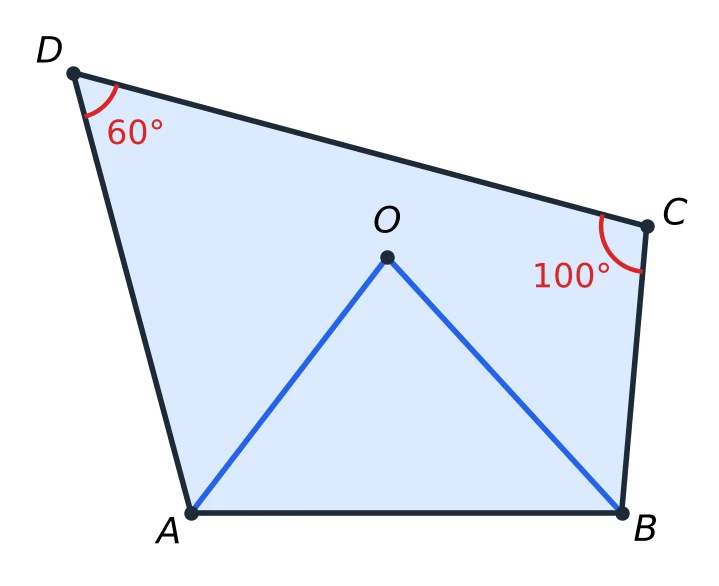
(a) 80° (b) 100° (c) 160° (d) 40°
Answer. , so the halves at A and B add up to 100°. In triangle AOB that leaves , which is (a) 80°. The shortcut says the same thing: . 100° is the sum of the halves, not the angle at O.
Question 17
In a parallelogram, one angle is 24° less than twice its adjacent angle. What is the larger angle? (a) 68° (b) 112° (c) 136° (d) 78°
Answer. Adjacent angles of a parallelogram add up to 180°. If the smaller one is , then , so and . The larger angle is , which is (b) 112°.
Question 18
In parallelogram ABCD, the bisectors of and meet at a point P on the side CD. If AD = 7 cm, what is AB?
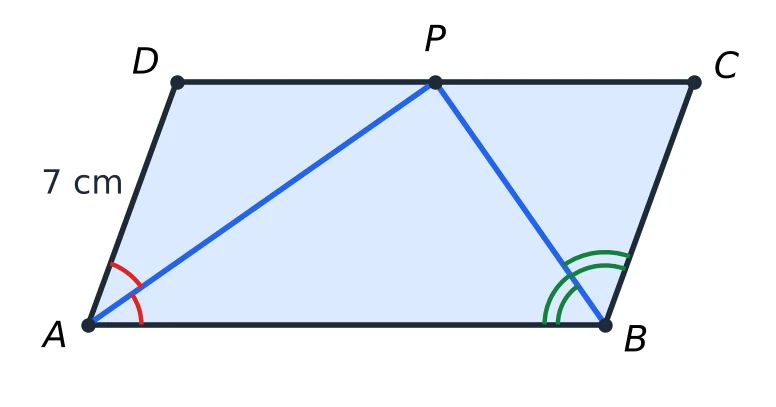
(a) 7 cm (b) cm (c) 14 cm (d) 21 cm
Answer. AP bisects , so . Because AB DC, (alternate angles). So in triangle ADP the angles at A and P are equal, which makes it isosceles with DP = AD = 7 cm. In the same way triangle BCP gives CP = BC = 7 cm. So AB = DC = DP + PC, which is (c) 14 cm. In other words, AB is twice AD whenever the two bisectors meet on CD.
Question 19
The sides of a parallelogram are 6 cm and 7 cm, and one of its diagonals is 7 cm. What is the other diagonal? (a) 6 cm (b) cm (c) cm (d) 11 cm
Answer. In a parallelogram the squares of the diagonals add up to twice the sum of the squares of the sides: . So and the other diagonal is (d) 11 cm. If you skip taking away the known diagonal, you get cm.
Question 20
The diagonals of a rhombus are 42 cm and 56 cm. What is the length of each side? (a) 35 cm (b) 70 cm (c) 49 cm (d) 98 cm
Answer. The diagonals of a rhombus bisect each other at right angles, so each side is the hypotenuse of a right triangle with legs 21 cm and 28 cm. The side is , which is (a) 35 cm.
Question 21
In rhombus ABCD, . What is ? (a) 62° (b) 28° (c) 56° (d) 34°
Answer. Adjacent angles of a rhombus add up to 180°, so . The diagonal AC bisects , so is half of 56°, which is (b) 28°. Another way: triangle ACD has AD = DC and , so each base angle is .
Question 22
In trapezium ABCD, AB DC, AB = 21 cm and DC = 15 cm. The diagonals meet at O, and AC = 24 cm. What are AO and the length of the segment joining the mid-points of AD and BC? (a) 10 cm and 18 cm (b) 14 cm and 36 cm (c) 14 cm and 18 cm (d) 12 cm and 18 cm
Answer. The diagonals cut each other in the ratio of the parallel sides, so AO : OC = 21 : 15 = 7 : 5. AO is 7 of the 12 parts of 24 cm, which is 14 cm. The mid-segment is half the sum of the parallel sides, cm. So the answer is (c) 14 cm and 18 cm. 10 cm is OC, the shorter piece of the diagonal.