
The Bend Rule for Parallel Lines
Most SSC geometry questions turn on one fact: a bend between parallel lines, a centre angle, a chord distance or a tangent length. If you spot that fact in the first few seconds, the sum rarely needs more than three lines. Draw a rough figure for every question, even when one is printed, and mark everything you are given on it.
When to use it: two parallel lines with a bent path between them (an arrowhead or a zigzag), and the angle at the bend is asked.
Fast way: when the bend points towards the same side as A and C, as in the figure, the angle at the bend is the sum of the two angles the arms make with the parallel lines.
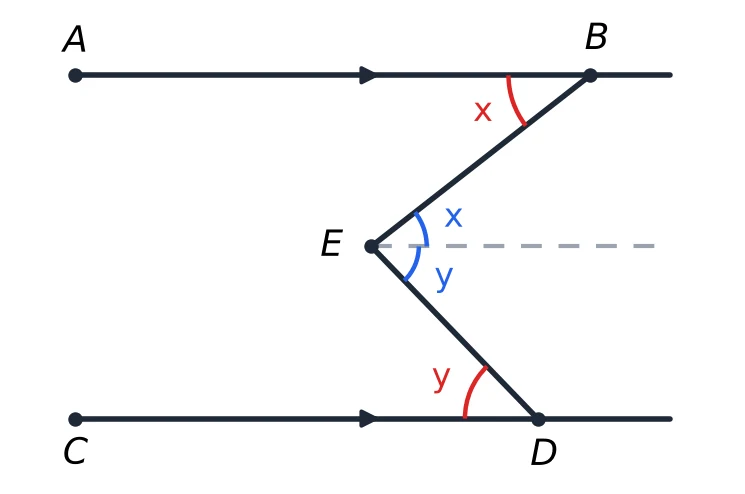
Why it works: draw a line through E parallel to AB (dashed). It cuts angle BED into two parts, and each part is an alternate angle to one of the given angles.
Reverse case: when the bend points the other way (E sits further right than B and D), the three angles add up to , so .
More bends: with a zigzag of several bends between the same two parallel lines, the angles that open to the left add up to the angles that open to the right. In the figure, angles ABE and CDE open to the left and angle BED opens to the right.
Question 1
In the figure, . If and , find .
Answer. The bend points towards A and C, so just add: = 79°.
Time check: about 5 seconds.
When it does not work:
- The two lines must be given as parallel. Lines that only look parallel in a figure don't count.
- The given angles must be the ones between each arm and the part of the line on the side the bend points to. If the question gives the angle on the other side at B, take it away from first.
- If the bend points away from A and C, use the rule. For example, with and on that side, .
[SSC Tip] The bisectors of two co-interior angles (the two angles between the parallel lines on the same side of a transversal) always meet at , because the halves add up to half of .
Polygon Sides from One Angle
When to use it: a regular polygon, with one interior or exterior angle given (or their ratio or difference), and the number of sides, diagonals or the angle sum asked.
Fast way: always go through the exterior angle. It is minus the interior angle, and the exterior angles of any polygon add up to . So .
- Interior angle given: .
- Interior : exterior given: .
- Interior minus exterior given: exterior .
- Sum of interior angles given: .
- Number of diagonals: .
Values worth knowing:
| Sides | Exterior | Interior |
|---|---|---|
| 5 | 72° | 108° |
| 6 | 60° | 120° |
| 8 | 45° | 135° |
| 9 | 40° | 140° |
| 10 | 36° | 144° |
| 12 | 30° | 150° |
| 15 | 24° | 156° |
| 18 | 20° | 160° |
| 20 | 18° | 162° |
| 24 | 15° | 165° |
| 36 | 10° | 170° |
Question 2
The ratio of each interior angle to each exterior angle of a regular polygon is 13 : 2. How many diagonals does it have?
Answer. The two angles add up to , so the exterior angle is and . Diagonals = 90.
Time check: about 15 seconds.
When it does not work:
- If divided by the exterior angle is not a whole number, no regular polygon has that angle. An interior angle of gives an exterior angle of , and , so there is no such polygon.
- The each-angle formulas need a regular polygon. For any other polygon, only the sums hold.
- Diagonals use ; the angle sum uses . Mixing them is the usual slip.
Worth knowing: the only polygon with as many diagonals as sides is the pentagon: gives .
Quadrilateral Facts That Save Time
When to use it: a rhombus, parallelogram, rectangle or trapezium with diagonals, sides or angle bisectors in the question.
Fast way:
- Rhombus. The diagonals cut each other in half at right angles, so each side is the hypotenuse of a right triangle with legs and . In one line, . Look for a triplet in the halves.
- Parallelogram. , where and are two adjacent sides. Adjacent angles add up to , so the bisectors of two adjacent angles meet at .
- Rectangle and square. The diagonals are equal. A square of side has diagonal .
- Any quadrilateral ABCD. The bisectors of angles A and B meet at an angle of .
- Trapezium with . The line joining the midpoints of the slant sides is , and the diagonals cut each other in the ratio .
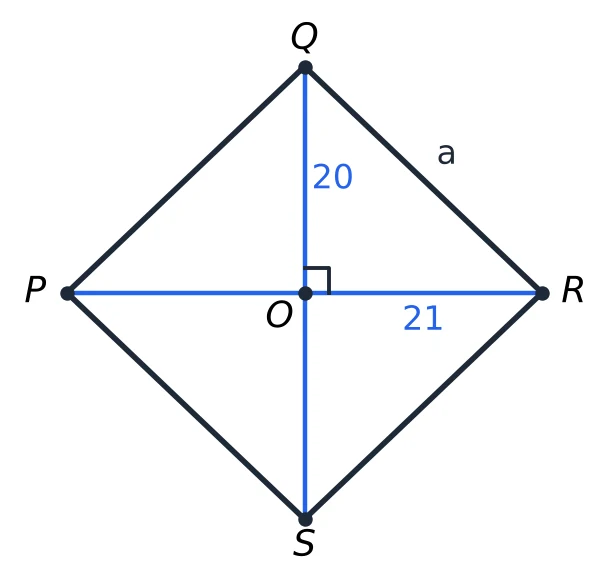
In the rhombus PQRS above, the diagonals are 42 and 40, so the halves are 21 and 20, and the side is 29 (the 20, 21, 29 triplet).
Question 3
The sides of a parallelogram are 6 cm and 13 cm, and one diagonal is 11 cm. Find the other diagonal.
Answer. . So , and the other diagonal is 17 cm.
Time check: about 20 seconds.
When it does not work:
- is only for a rhombus (a square is a rhombus too). For a parallelogram with unequal sides, use .
- Use half of each diagonal for the rhombus side. Forgetting to halve gives a side twice as long.
- The rule is for the internal bisectors of two angles next to each other, A and B.
Isosceles Chains: Push One Angle Along
When to use it: equal sides are marked (AB = AC, AD = BD, BD = BC and so on), there is an extra point on a side, and an angle is asked.
Fast way: call the first unknown angle . Every pair of equal sides gives two equal angles opposite them, and every exterior angle of a triangle equals the sum of the two interior opposite angles. Push round the figure until every angle is written in terms of , then use .
The classic chain is , with D on AC so that .
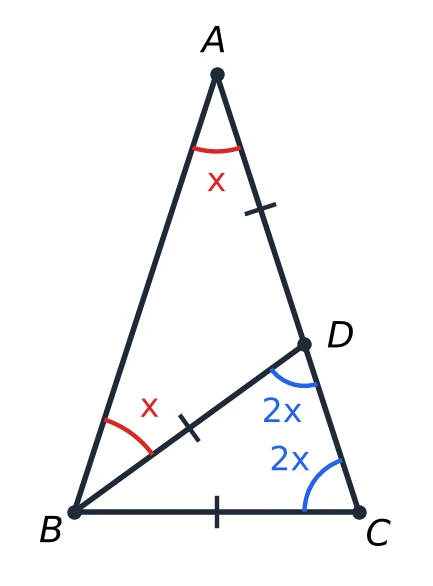
- , so .
- is an exterior angle of triangle ABD, so it is .
- , so .
- , so .
- In triangle ABC, , so .
Question 4
In triangle ABC, and . D is a point on BC such that . Find .
Answer. The base angles are each. Since , . So = 78°. Check in triangle ADC: , and .
Time check: about 20 seconds.
When it does not work:
- Equal sides give equal angles opposite them. makes the angles at A and B of triangle ABD equal, not the angle at D.
- The exterior-angle step needs the extra point to lie on the side itself, not on the side extended. If D is on BC extended, draw it that way and chase again.
A related fact: in an isosceles triangle, the bisector of the angle between the equal sides is also the median and the altitude. The bisector of the exterior angle at that vertex is parallel to the base.
Congruence: Name the Rule in Five Seconds
When to use it: two triangles with some parts equal, and the question asks which rule makes them congruent, which set of conditions is not enough, or which parts must be equal.
Fast way: learn the five rules and the two non-rules.
| Rule | What must match |
|---|---|
| SSS | all three sides |
| SAS | two sides and the angle between them |
| ASA | two angles and the side between them |
| AAS | two angles and a side that is not between them |
| RHS | the right angle, the hypotenuse and one more side |
SSA (the angle is not between the two sides) and AAA (three angles, no side) are not rules. Equal angles only make triangles similar: the same shape, but any size.
Reading the letters. pairs A with P, B with Q and C with R, in that order. So , , , , and so on. Every other matching part then follows by CPCT (corresponding parts of congruent triangles are equal).
Question 5
If , which side is equal to QR, and which angle is equal to ?
Answer. Pair the letters in order: P with Z, Q with X, R with Y. So QR = XY and = .
Time check: about 5 seconds.
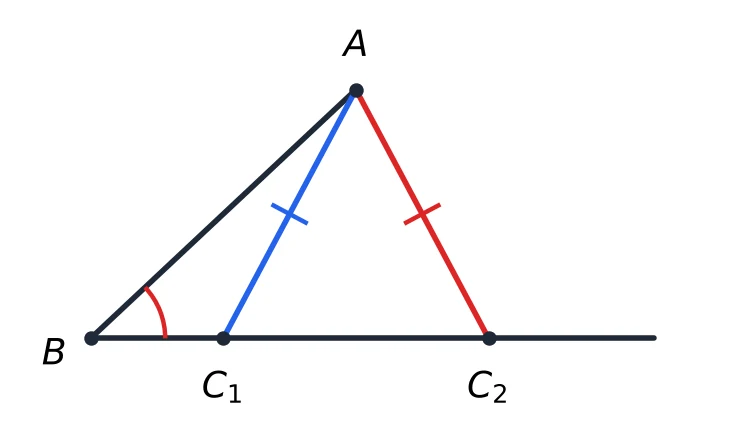
Why SSA fails. In the figure, AB, angle B and the length of the side from A are all fixed, yet that side can end at or at . Two different triangles fit the same data.
When it does not work:
- SSA and AAA prove nothing, as above.
- RHS is the one side-side-angle pattern that works, because the angle is and the side opposite it is the hypotenuse.
- Equal area or equal perimeter does not make two triangles congruent.
When SSC lists four conditions and asks which one is not enough, look for an angle that is not between the two given sides, or for three angles with no side.
Triplets and the 30-60-90 and 45-45-90 Triangles
When to use it: a right triangle with two sides given, or one side and a , or angle.
Fast way: before squaring anything, look for a known pattern.
- Triplets: 3, 4, 5; 5, 12, 13; 8, 15, 17; 7, 24, 25; 20, 21, 29; 9, 40, 41; 12, 35, 37; 11, 60, 61; 28, 45, 53; 33, 56, 65; 16, 63, 65; 13, 84, 85. Any multiple works too: divide the given sides by their HCF first, so 39 and 52 become 3 and 4, and the hypotenuse is .
- Making a triplet: for an odd leg , the others are and (11 gives 60 and 61). For an even leg , they are and (16 gives 63 and 65).
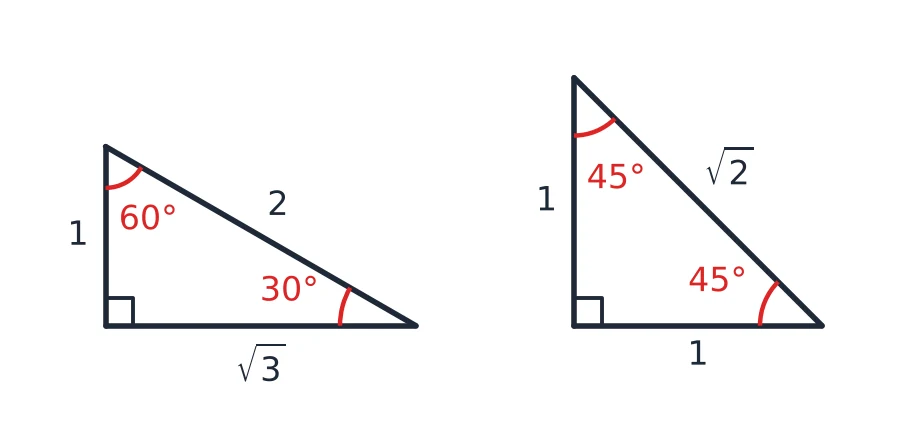
- 30-60-90: the sides opposite , and are in the ratio .
- 45-45-90: the sides are in the ratio .
Acute, right or obtuse. With the longest side: means acute, right, obtuse. Sides 7, 8 and 11 give , so that triangle is obtuse. Sides 36, 77 and 85 give , a right triangle.
Question 6
In triangle ABC, , and cm. Find AB and BC.
Answer. AC is the hypotenuse. AB faces the angle, so it is half the hypotenuse: AB = 7 cm. BC faces the angle, so BC = cm.
Time check: about 10 seconds.
When it does not work:
- A triplet is a shortcut only when the triangle is known to be right-angled. Sides 5, 12 and 14 are not a triplet.
- The hypotenuse is always the longest side. If the two given sides are a leg and the hypotenuse, subtract the squares; don't add them.
- In a 30-60-90 triangle the shortest side faces . Swapping the side and the short side is the usual trap.
The Centre-Angle Table
When to use it: a centre of triangle ABC is named (incentre, excentre, circumcentre or orthocentre), and angle BXC at that centre is asked from angle A, or the other way round.
Fast way: one table.
| Point X | Where lines meet | |
|---|---|---|
| Incentre I | internal angle bisectors | |
| Excentre E (opposite A) | external bisectors of B and C | |
| Circumcentre O | perpendicular bisectors of the sides | |
| Orthocentre H | altitudes | |
| Internal bisector of B meets external bisector of C |
So . Also, is always more than and is always less than .
Question 7
In an acute triangle ABC, O is the circumcentre and . Find and , where I is the incentre and H the orthocentre.
Answer. , so . Then = 116° and = 128°.
Time check: about 15 seconds.
When it does not work:
- Circumcentre, obtuse A. O moves to the other side of BC, as in the figure below, and . For that is , not . If , O is the midpoint of BC.
- Orthocentre, obtuse B or C. H lies outside, beyond the obtuse vertex, and then . If A itself is obtuse, still holds. If , H is the vertex A.
- The incentre and excentre rows always hold. The usual trap is to use for the incentre.
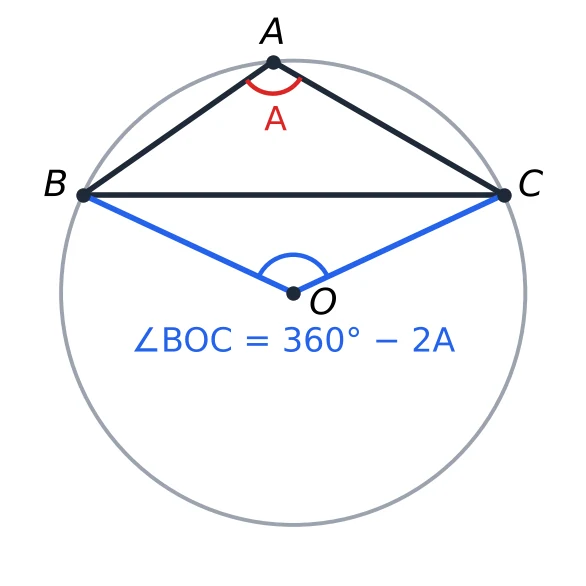
[SSC Tip] Where the centres sit: the incentre is always inside; the circumcentre and orthocentre are inside for an acute triangle, at the midpoint of the hypotenuse and at the right-angle vertex for a right triangle, and outside for an obtuse one.
Centroid and Medians, and the Median to the Hypotenuse
When to use it: medians, the centroid G, lengths like AG or GD, or a right triangle with the midpoint of its hypotenuse.
Fast way:
- G cuts every median in the ratio from the vertex: and .
- The three medians cut the triangle into six small triangles of equal area, so triangle GBC is one third of triangle ABC.
- Median length (Apollonius): .
- Sum of the squares of the medians (sum of the squares of the sides).
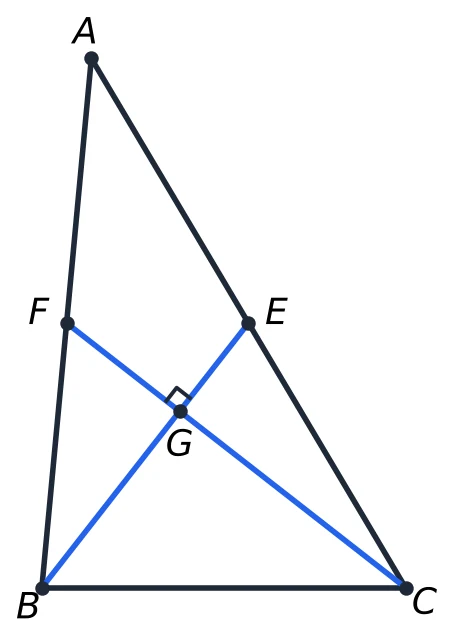
- If medians BE and CF meet at right angles, then .
Question 8
The medians BE and CF of triangle ABC cut each other at right angles. If cm and cm, find BC.
Answer. , so and BC = 13 cm.
Time check: about 15 seconds.
The median to the hypotenuse
In a right triangle, the midpoint M of the hypotenuse is the circumcentre, so = half the hypotenuse. Triangles ABM and ACM are then isosceles, so the angles at the base copy across, and the angle at M is double.
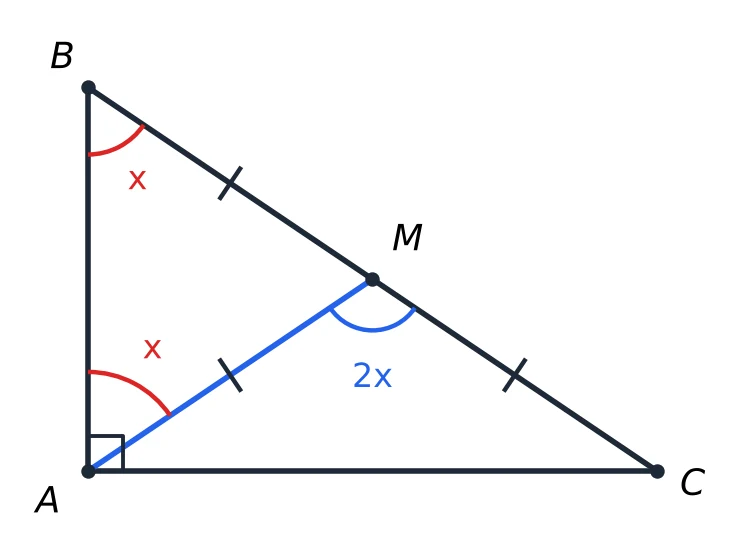
The converse is just as useful: if a median is half the side it meets, the angle at that vertex is .
Question 9
In triangle PQR, and M is the midpoint of PR. If , find .
Answer. , so . Angle QMR is the exterior angle of triangle PMQ, so = 68°.
Time check: about 10 seconds.
When it does not work:
- of the median, not of a side.
- Only the median to the hypotenuse is half of anything. The medians to the legs follow Apollonius.
- The rule needs the two medians from B and C, and BC is the side between those two vertices.
Radii of Equilateral and Right Triangles
When to use it: the inradius or the circumradius of an equilateral triangle or a right triangle is asked.
Fast way:
- Equilateral, side . The height is . All four centres are the same point, which sits two thirds of the way down each height. So , , and . In short, .
- Right triangle, legs and , hypotenuse . , because the midpoint of the hypotenuse is the circumcentre, and .
- Any triangle. and , where is the area and is half the perimeter. (Area formulas are in Chapter 13.)
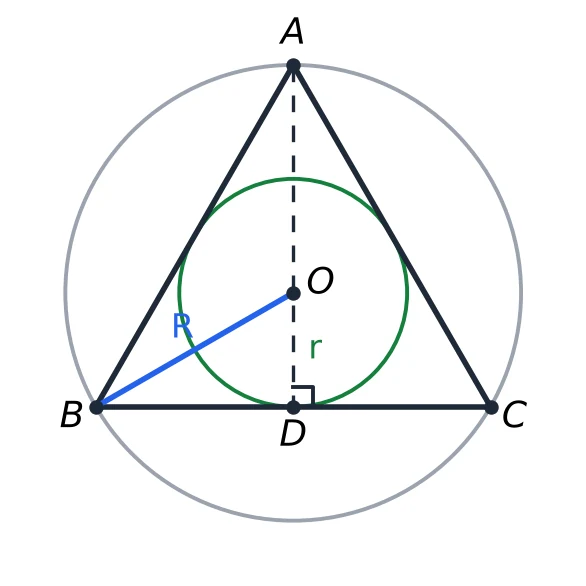
For an equilateral triangle of side 18 cm, , and .
Question 10
The two shorter sides of a right triangle are 20 cm and 21 cm. Find its inradius and circumradius.
Answer. 20, 21, 29 is a triplet, so the hypotenuse is 29 cm. Then = 6 cm and = 14.5 cm.
Time check: about 10 seconds.
When it does not work:
- and work only with a right angle. For other triangles use and .
- In the equilateral formulas, don't put the height in place of the side. If the height is given, and straight away.
For an equilateral triangle, the circumcircle's area is 4 times the incircle's, because .
Incircle Tangent Lengths:
When to use it: a circle inside a triangle (or a quadrilateral) touches all its sides, and a piece of a side is asked.
Fast way: the two tangents from a point to a circle are equal, so each vertex has one tangent length. With , the tangent length from A is , from B is , and from C is , where , and .
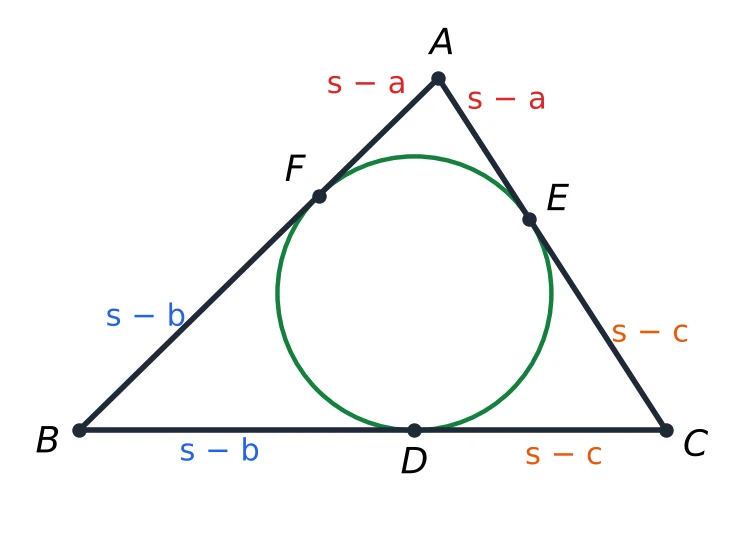
- If the incircle touches BC at D, then and .
- For a right triangle, the tangent length from the right-angle vertex equals .
- Quadrilateral round a circle: . Opposite sides add up to the same total.
Question 11
In triangle ABC, cm, cm and cm. The incircle touches BC at D. Find BD.
Answer. . BD is the tangent length from B, which is = 9 cm. (Then cm, and checks.)
Time check: about 15 seconds.
For a quadrilateral ABCD drawn round a circle with , and , we get .
When it does not work:
- BD is minus the side opposite B, which is CA, not BC. Check by adding: must give BC.
- pairs opposite sides. Adjacent sides need not add up to anything.
BPT and the Area Ratio in One Line
When to use it: a line parallel to one side of a triangle cuts the other two sides, and a length or an area is asked.
Fast way: if and , then triangle ADE is similar to triangle ABC with scale .
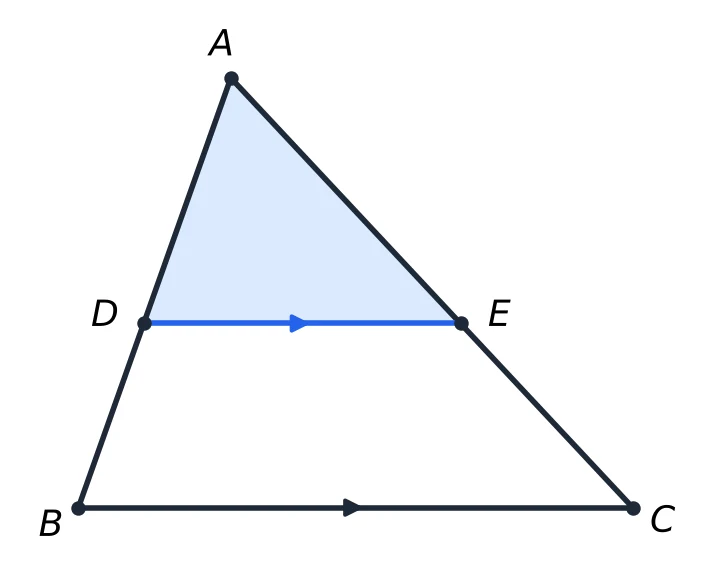
| AD : DB | ADE : ABC | ADE : DBCE |
|---|---|---|
| 1 : 1 | 1 : 4 | 1 : 3 |
| 1 : 2 | 1 : 9 | 1 : 8 |
| 2 : 1 | 4 : 9 | 4 : 5 |
| 2 : 3 | 4 : 25 | 4 : 21 |
| 3 : 2 | 9 : 25 | 9 : 16 |
The first row is the midpoint theorem: the line joining two midpoints is parallel to the third side and half of it.
Question 12
In triangle ABC, with D on AB and E on AC, and . If the area of trapezium DBCE is 99 sq cm, find the area of triangle ADE. Also find BC if cm.
Answer. Area ADE : DBCE , so area ADE = 48 sq cm. And , so BC = 21 cm.
Time check: about 20 seconds.
When it does not work:
- is , not . With , the scale is , not .
- Areas go by the square of the scale. Lengths, perimeters, medians and heights go by the scale itself.
- No parallel line, no ratio. If DE is not parallel to BC, this method does not apply.
A line parallel to BC that cuts the triangle into two equal areas has .
Angle Bisector: Splitting the Side, and the Angle with the Altitude
When to use it: the bisector of angle A meets BC at D, and BD, DC or a side is asked. Or both the bisector and the altitude from A are drawn and the angle between them is asked.
Fast way:
- Side split: . So and .
- Angle between the bisector AD and the altitude AL from the same vertex: .
- [Tier 2] The bisector of the exterior angle at A cuts BC extended at a point P with .
- [Tier 2] Length of the bisector: .
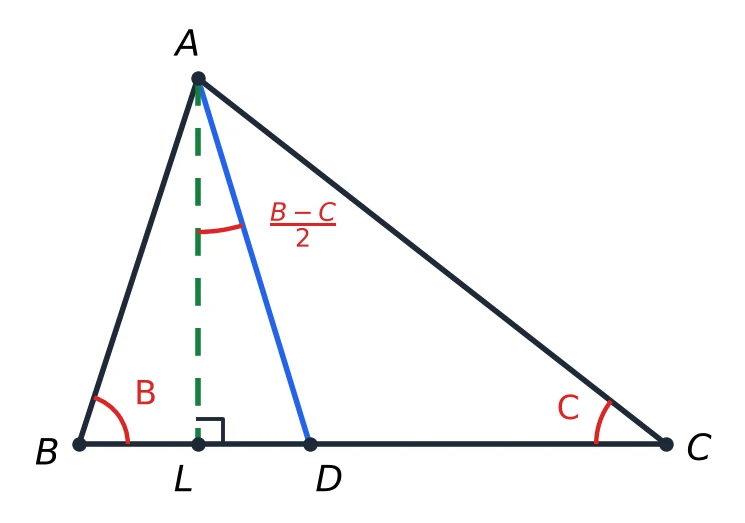
With and , the angle between the bisector and the altitude from A is .
Question 13
In triangle ABC, cm, cm and cm. The bisector of meets BC at D. Find BD.
Answer. BD : DC , so BD = 12 cm (and DC = 9 cm).
Time check: about 10 seconds.
When it does not work:
- The ratio uses the two sides that make the angle, AB and AC. BC is the side being cut.
- is the angle between the bisector and the altitude from the same vertex A. It does not give the angle between the bisector and a median.
The Altitude to the Hypotenuse
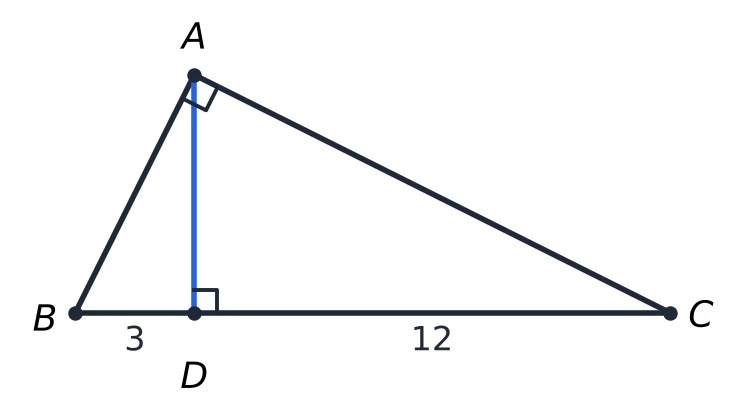
When to use it: and AD is drawn perpendicular to the hypotenuse BC.
Fast way: the altitude splits the triangle into two smaller triangles, both similar to the big one. That gives five one-liners.
- and
Question 14
In triangle ABC, and . If cm and cm, find AD, AB and AC.
Answer. , so AD = 6 cm. BC = 15, so and AB = cm, and , so AC = cm.
Time check: about 20 seconds.
With the legs given instead, say 7 and 24, the hypotenuse is 25 and cm.
When it does not work:
- uses the whole hypotenuse BC, not DC. Each leg goes with the piece next to it.
- The results need the right angle at A and the perpendicular dropped onto the hypotenuse. An altitude onto a leg gives nothing like this.
Chord Distance with Triplets
When to use it: of the radius, a chord's length and its distance from the centre, two are known and the third is asked. Also two parallel chords.
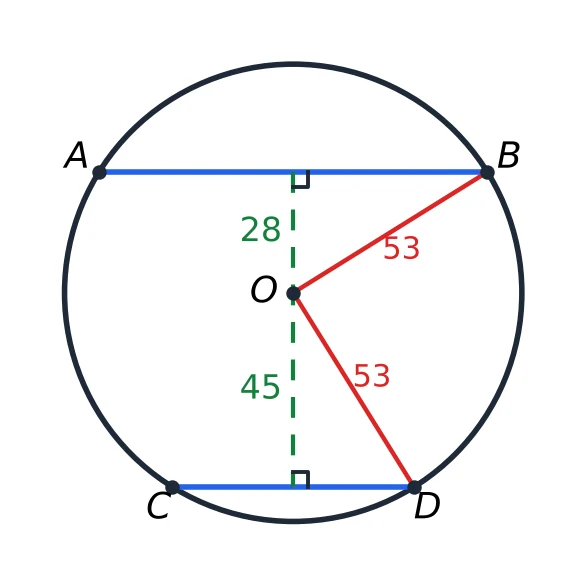
Fast way: the perpendicular from the centre cuts the chord in half, so half the chord, the distance and the radius make a right triangle.
Spot the triplet before squaring: radius 13 with chord 24 (half 12) gives distance 5.
- Equal chords are equally far from the centre, and the nearer chord is the longer one.
- Two parallel chords on the same side of the centre are apart; on opposite sides, apart.
Question 15
In a circle of radius 53 cm, AB and CD are parallel chords of lengths 90 cm and 56 cm. Find the distance between them if they are (i) on opposite sides of the centre, (ii) on the same side.
Answer. For AB, half is 45, so its distance is 28 (the 28, 45, 53 triplet). For CD, half is 28, so its distance is 45. Opposite sides: = 73 cm. Same side: = 17 cm.
Time check: about 15 seconds.
When it does not work:
- The right triangle uses half the chord. Putting in the full chord is the usual slip.
- A chord cannot be longer than the diameter. If your numbers make bigger than , recheck the data.
- If a question with parallel chords does not say which side, both answers are possible. Look at the options to see which one is listed.
[SSC Tip] For two circles that cross, the common chord is perpendicular to the line joining the centres and is cut in half by it. When , as with radii 15 and 20 and centres 25 apart, half the common chord is , so the chord is 24.
Angles in a Circle in One Look
When to use it: points on a circle, often with the centre O, and an angle is asked.
Fast way: first find the arc (or chord) the angle stands on. Then one of these finishes it.
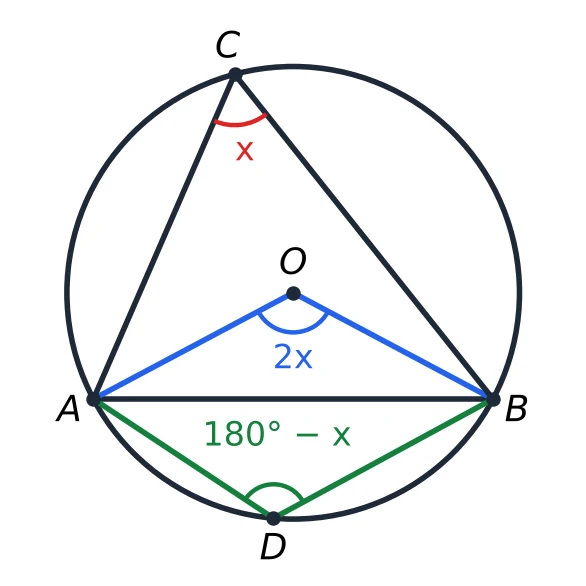
- The angle at the centre is twice the angle at the circumference on the same arc.
- Angles on the same arc, in the same segment, are equal.
- The angle in a semicircle is .
- An angle from the other side of the chord (the minor arc) is minus the angle from the major arc. Together they make a cyclic quadrilateral.
- In a cyclic quadrilateral, opposite angles add to , and each exterior angle equals the interior opposite angle.
- Triangle OAB is isosceles (), so when C is on the major arc.
Question 16
A, B, C and D lie on a circle with centre O, with C on the major arc AB and D on the minor arc AB. If , find and .
Answer. , so and . Then = 62°, and ACBD is cyclic, so = 118°.
Time check: about 15 seconds.
When it does not work:
- The doubling rule needs both angles on the same arc. If C is on the minor arc, .
- A quadrilateral is cyclic only if all four corners lie on the circle. A quadrilateral with O as a corner, like OACB, is not cyclic in general.
- flips to when the angle at C is obtuse.
Tangent Length and the Rule
When to use it: tangents from an outside point P to a circle with centre O.
Fast way:
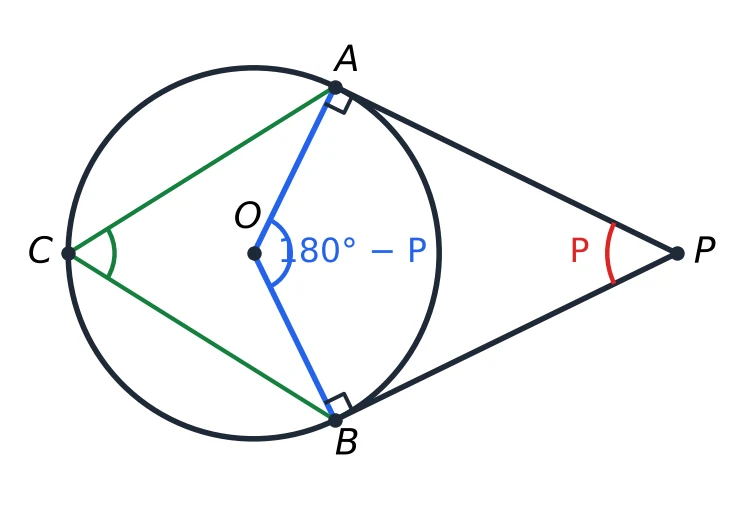
- The radius to the point of contact is perpendicular to the tangent: .
- Tangent length: . Triplets again: and give .
- The two tangents from P are equal, , and OP bisects both and .
- , because OAPB has two right angles.
- The chord AB makes equal angles with the tangents: . This is also the angle ACB at any point C on the major arc (alternate segment theorem).
Question 17
PA and PB are tangents to a circle with centre O, and . Find and , where C is a point on the major arc AB.
Answer. = 128°. The angle at the circumference is half of that, so = 64°. (And too.)
Time check: about 10 seconds.
When it does not work:
- Use the distance from the centre. If P is 8 cm from the nearest point of a circle of radius 5 cm, then and the tangent is cm, not .
- The rule is for two tangents from the same point. For a tangent and a chord, use the alternate segment theorem: the angle between them equals the angle in the other segment.
- For C on the minor arc, .
Tangent-Secant and Crossing Chords
When to use it: a line from an outside point P cuts the circle at A and B, and there is a tangent PT or another line from P. Or two chords cross inside the circle.
Fast way: use the power of a point.
- Tangent and secant from P: , with PA the near part and PB the whole length to the far point.
- Two secants from P: .
- Two chords crossing at E inside: .
- [Tier 2] Angles from arcs: two chords meeting inside make an angle equal to half the sum of the two arcs they cut off; two secants (or tangents) meeting outside make an angle equal to half the difference of the arcs.
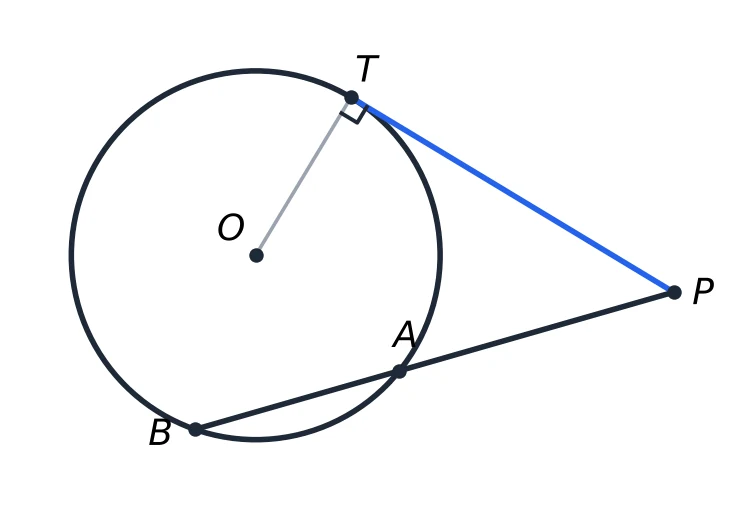
Question 18
From an outside point P, a secant meets a circle at A and B, with cm and cm. Find the tangent PT. Also, chords AB and CD of another circle cross at E with , and . Find ED.
Answer. , so and PT = 8 cm. For the chords, , so ED = 8.
Time check: about 15 seconds.
When it does not work:
- PB is the whole length from P to the far point. Using is the trap.
- For chords crossing inside, multiply the two pieces of the same chord. Don't mix a piece of one chord with a piece of the other on the same side.
- If the outside angle is asked with arcs, take half the difference; half the sum is only for chords crossing inside.
Direct or Transverse Common Tangent
When to use it: two circles with radii and and centres apart, and the length of a common tangent between its two points of contact is asked.
Fast way:
- Direct tangent (both circles on the same side of it): .
- Transverse tangent (it passes between the circles): .
Memory hook: direct goes with the difference, transverse with the total. The transverse one is always the shorter.
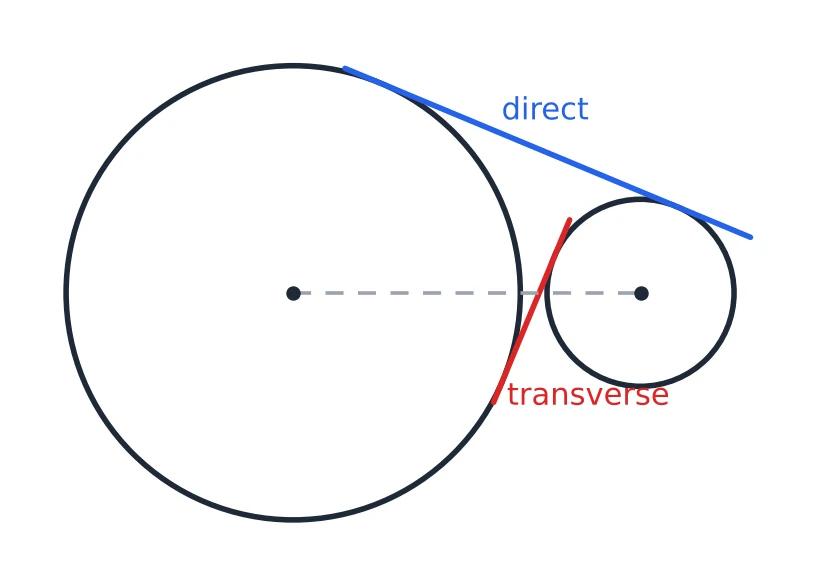
- Circles touching externally: , so the transverse length is 0 and the direct one is .
- A transverse tangent exists only when the circles are clear of each other, .
Question 19
Two circles of radii 17 cm and 7 cm have their centres 26 cm apart. Find the lengths of the direct and the transverse common tangents.
Answer. Direct: = 24 cm. Transverse: = 10 cm.
Time check: about 15 seconds.
When it does not work:
- Mixing the two formulas is the standard trap, and the setters put both answers in the options. Here 24 and 10 would both be there.
- is the distance between the centres, not the gap between the circles. If the gap is given, add both radii to it.
- If a radius is the unknown, use the same formula backwards: a direct tangent of 24 with centres 26 apart gives .
Touching Circles and Counting Common Tangents
When to use it: two or three circles touch each other, or the number of common tangents is asked.
Fast way:
- Touching externally: the distance between the centres is . Touching internally: .
- Number of common tangents:
| Position | compared with the radii | Common tangents |
|---|---|---|
| Apart | 4 | |
| Touching externally | 3 | |
| Cutting at two points | 2 | |
| Touching internally | 1 | |
| One inside the other | 0 |
- Three circles touching each other externally: the centres make a triangle with sides , and . Its perimeter is , and each radius is half that perimeter minus the side across from that circle's centre, the same idea as for incircle tangents.
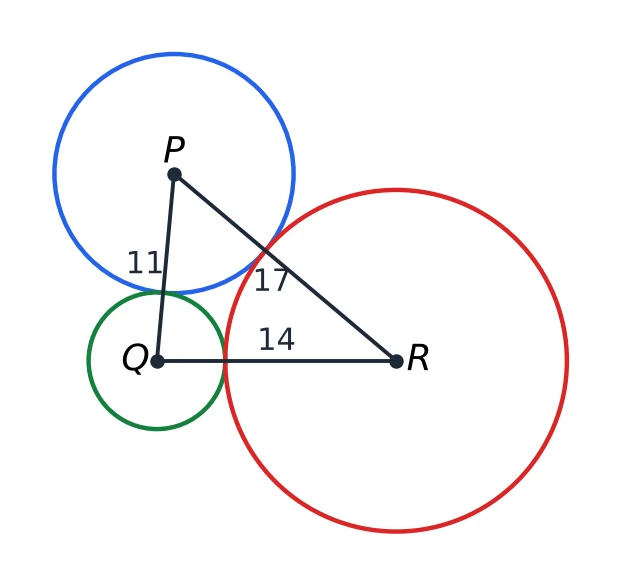
Question 20
Three circles touch each other externally. The distances between their centres P, Q and R are cm, cm and cm. Find the three radii.
Answer. Half the perimeter is . The radius at P is , at Q it is , and at R it is . So the radii are 7 cm, 4 cm and 10 cm. Check: , , .
Time check: about 20 seconds.
When it does not work:
- Internal touching uses the difference of the radii. A small circle touching a big one from inside has its centre from the big centre.
- Concentric circles (same centre) have no common tangent at all.
A Rough Figure, and Elimination by Size
When to use it: every question in words, and every time the options are far apart.
Fast way: spend five seconds on a rough figure that is roughly to scale. Draw a big angle big, keep equal sides equal, and mark every given length and angle. Then run these size checks on the options before any working.
- Triangle inequality: each side is less than the sum of the other two and more than their difference.
- Biggest side, biggest angle: the longest side faces the largest angle. The hypotenuse is the longest side of a right triangle.
- Centres: is always above ; at an excentre is always below ; in an equilateral triangle , with .
- Circles: a chord is at most the diameter; a tangent from P is shorter than OP; the transverse common tangent is shorter than the direct one.
- Right triangles: the altitude to the hypotenuse is shorter than both legs, and the median to the hypotenuse is exactly half of it.
Question 21
In triangle ABC, cm and cm. Which of these can be the length of BC: (a) 4 cm (b) 5 cm (c) 18 cm (d) 20 cm? Also, how many whole-number lengths are possible for BC?
Answer. BC must be more than and less than . So (a), (b) and (d) are out, and the answer is (c) 18 cm. The whole numbers from 6 to 18 work, which is 13 lengths.
Time check: about 10 seconds.
When it does not work:
- If two options pass every check, work the question out in full.
- A printed figure may not be to scale, and SSC figures often are not. Trust the given numbers, never a measurement off the paper.
- The triangle inequality is strict: with sides 5, 7 and 12 the three points lie on one line, so no triangle is formed.
[SSC Tip] Trap options here follow a short list: in place of , for an obtuse angle at the circumcentre, in the direct tangent, the full chord in place of half, in place of , and an area ratio that was not squared. If your answer equals one of these, go back and check that step.