
Lines and Angles
- Complementary angles add to , supplementary to ; angles at a point to .
- Vertically opposite angles are equal; a linear pair adds to .
- Parallel lines and a transversal: corresponding and alternate angles are equal, co-interior angles add to .
- Bend rule: . If the bend points away, the three angles add to .
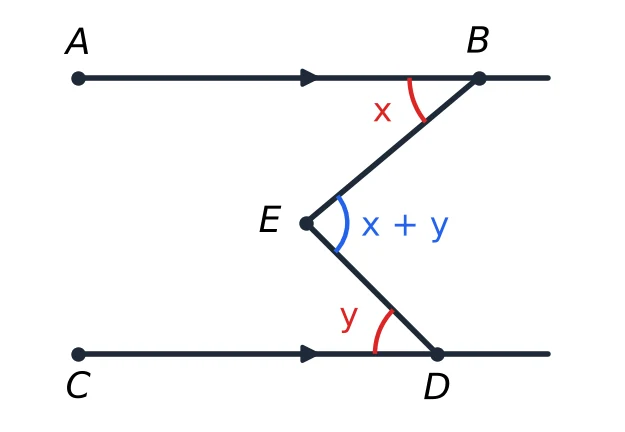
- Bisectors of co-interior angles meet at .
- Trap: use the angles on the side the bend points to.
Polygons
- Interior angles add to ; exterior angles always add to .
- Regular polygon: each exterior angle , each interior angle .
- Sides from an angle: . Interior : exterior gives .
- Diagonals: . A decagon has 35.
- Only the pentagon has as many diagonals as sides.
- Trap: if divided by the exterior angle is not a whole number, no such regular polygon exists.
Quadrilaterals
- Angle sum . Bisectors of and meet at .
- Parallelogram: adjacent angles add to , diagonals bisect each other, .
- Rectangle: equal diagonals. Square: diagonal .
- Rhombus: diagonals are perpendicular bisectors of each other, so .
- Trapezium: mid-segment ; diagonals cut each other in the ratio .
- Kite: diagonals are perpendicular.
- Trap: halve the diagonals before using Pythagoras.
Triangle Angles and Sides
- Angle sum ; an exterior angle equals the sum of the two interior opposite angles.
- The larger side faces the larger angle.
- Triangle inequality: , strictly.
- With the longest side: acute, right, obtuse.
- Isosceles: equal sides face equal angles. Equilateral: each, height .
- [Tier 2] Median: .
- Trap: in isosceles chains, push one angle round using exterior angles.
Congruence
- Rules: SSS, SAS (the angle between the two sides), ASA, AAS, and RHS (right angle, hypotenuse, side).
- Not rules: SSA and AAA. Equal angles alone only give similar triangles.
- pairs A with P, B with Q, C with R, so and .
- CPCT then gives every other matching part.
- The bisector from the top of an isosceles triangle makes two congruent halves, so it is also the median and altitude.
- Trap: equal area or perimeter does not mean congruent.
Pythagoras and Right Triangles
- Triplets: 3, 4, 5; 5, 12, 13; 8, 15, 17; 7, 24, 25; 20, 21, 29; 9, 40, 41; 12, 35, 37; 11, 60, 61; and their multiples.
- Odd leg : the others are and .
- 30-60-90 sides: , shortest side facing .
- 45-45-90 sides: .
- The median to the hypotenuse is half the hypotenuse.
- Trap: when the hypotenuse is given, subtract the squares.
Triangle Centres
- Incentre: . Excentre: .
- Circumcentre: , or if A is obtuse.
- Orthocentre: , or if B or C is obtuse.
- Centroid: . Medians from B and C at give .
- Bisector and altitude from A: apart.
- [Tier 2] Euler line: .
- Trap: swapping the incentre and excentre (common in the PYQ Practice Sets).
Inradius and Circumradius
- Any triangle: and .
- Right triangle: , .
- Equilateral: , , , and .
- Incircle tangent lengths from A, B, C: , , .
- [Tier 2] .
- Trap: the touch point D on BC gives , with .
Similar Triangles
- Tests: AA, SAS, SSS.
- Sides, perimeters, heights, medians and bisectors all follow the scale ; areas follow .
- Altitude AD to the hypotenuse of a right triangle: , , , .
- with D on BC gives .
- Shadows and lamps: match the two similar triangles.
- Trap: from an area ratio, take the square root before finding a length.
Proportionality Theorems
- BPT: gives , and the converse holds.
- Scale ; area ADE : DBCE for .
- Midpoint theorem: the join of two midpoints is half the third side.
- Angle bisector: . [Tier 2] The external bisector splits BC externally in the same ratio.
- Trapezium: , and triangles AOD and BOC have equal areas.
- Trap: , not .
Chords and Arcs
- The perpendicular from the centre bisects a chord: .
- Equal chords are equally far from the centre; the nearer chord is longer.
- Parallel chords: apart on the same side, on opposite sides.
- Common chord of two circles: perpendicular to the line of centres and bisected by it.
- Chords crossing inside: .
- Trap: use half the chord.
Angles in a Circle
- The angle at the centre is twice the angle at the circumference on the same arc.
- Angles in the same segment are equal; the angle in a semicircle is .
- Equal chords subtend equal angles.
- With C on the major arc: .
- [Tier 2] Chords crossing inside: angle half the sum of the arcs; secants meeting outside: half the difference.
- Trap: from the minor arc, the angle is .
Cyclic Quadrilaterals
- Opposite angles add to .
- An exterior angle equals the interior opposite angle.
- If one pair of opposite angles adds to , the quadrilateral is cyclic.
- Rectangles, squares and isosceles trapeziums are cyclic; a parallelogram is cyclic only if it is a rectangle.
- AB and DC produced meet at P, AD and BC at Q, with A the corner away from both: .
- Trap: all four corners must lie on the circle.
Tangents
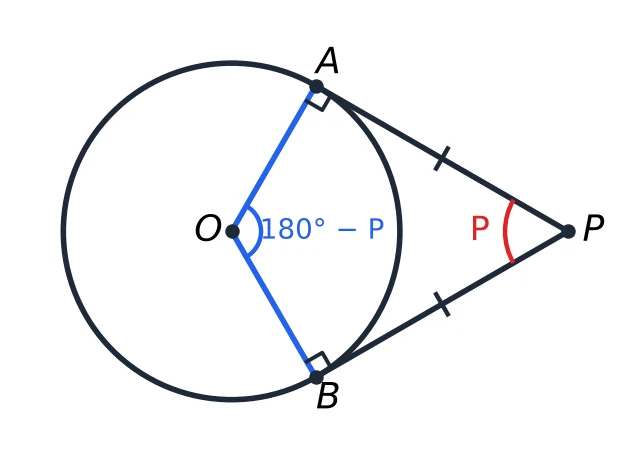
- A tangent is perpendicular to the radius at the point of contact.
- Tangent length from P: .
- The two tangents are equal, and .
- Alternate segment: tangent-chord angle angle in the other segment.
- Tangent and secant: .
- Quadrilateral round a circle: .
- Trap: OP is from the centre, not from the circle.
Two Circles and Common Tangents
- Touching: externally, internally.
- Common tangents: 4 apart, 3 touching externally, 2 cutting, 1 touching internally, 0 one inside the other.
- Direct ; transverse ; touching externally, direct .
- Three touching circles: each radius is half the perimeter of the centre triangle minus the opposite side.
- [Tier 2] Circle under two touching circles on a line: .
- Trap: direct goes with .