
How to Use These Questions
The 35 questions here jump between topics. A chord question can come straight after one on polygons, so the first job each time is to name the result it needs. About a third are on triangles (angles, congruence, Pythagoras, the centres and the two radii), another third on circles (chords, angles, cyclic quadrilaterals, tangents and pairs of circles), and the rest on similar triangles, the proportionality theorems, lines, polygons and quadrilaterals.
SSC usually gives geometry questions in words, so draw your own rough figure for each one and mark the given numbers on it before you start; that sketch does half the work. Try the question on paper first and give a usual Tier 1 question about 45 seconds. If one drags on, find its quick route in Shortcuts & Speed Methods and redo the question the next day.
Questions marked [Tier 2] use the same results in a longer setup, so Tier 1 students should try them too.
Solved Examples
Question 1
A transversal cuts two parallel lines. Two co-interior angles (the interior angles on the same side of the transversal) are and . Find the larger angle.
Answer. Co-interior angles add up to . So , which gives and . The angles are and . The larger one is 119°.
Question 2
In triangle ABC, the bisectors of angles B and C meet at I, and . Find . If the bisectors of the exterior angles at B and C meet at E, find as well.
Answer. At the incentre, . So and = 68°. E is the excentre, where = 56°. A quick check: , as it should be.
Question 3
In a circle of radius 61 cm, AB is a chord of length 120 cm. How far is AB from the centre? Also find the length of a chord that is 60 cm from the centre.
Answer. Half of AB is 60, so the distance is = 11 cm. For the second chord, half its length is , so the chord is 22 cm long. Both parts use the 11, 60, 61 triplet, just the other way round.
Question 4
Triangles ABC and PQR are similar, with areas 64 sq cm and 121 sq cm. If the median from A in triangle ABC is 12 cm, find the matching median in triangle PQR.
Answer. Areas go as the square of the scale, so the scale is . Medians go by the scale itself. So the median in PQR is = 16.5 cm.
Question 5 [Tier 2]
A point P is 50 cm from the centre O of a circle of radius 30 cm. PA and PB are the tangents from P. Find PA and the length of the chord AB.
Answer. , so = 40 cm. OP cuts AB at right angles at its midpoint M. In the right triangle OAP, AM is the altitude to the hypotenuse OP, so . So AB = 48 cm.
Question 6
Each interior angle of a regular polygon is more than each exterior angle. How many sides and how many diagonals does it have?
Answer. The two angles add up to and differ by , so the exterior angle is . Then = 18 sides, and the number of diagonals is = 135.
Question 7
If , with cm, cm, cm and , find PR, QP and .
Answer. Pair the letters in order: A with Q, B with R, C with P. PR matches CB, so PR = 9 cm. QP matches AC, so QP = 11 cm. And matches , so = 48°.
Question 8
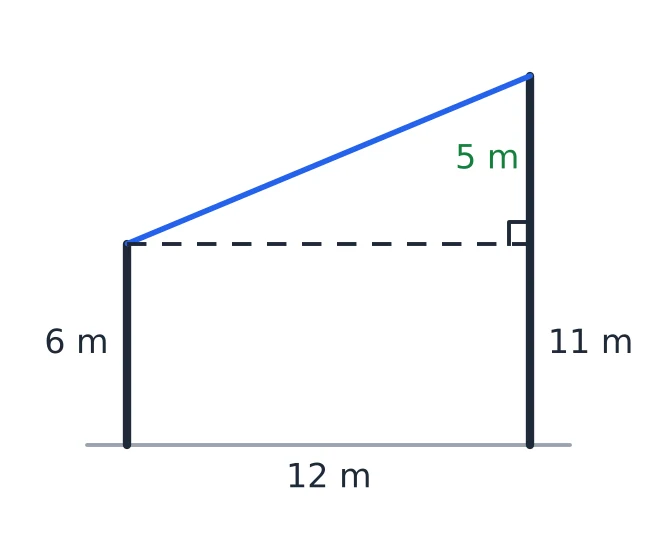
Two vertical poles of heights 6 m and 11 m stand 12 m apart on level ground. Find the distance between their tops.
Answer. Draw a level line from the top of the short pole across to the tall pole, as in the figure. It is 12 m long and meets the tall pole 6 m up, which leaves m above it. The distance between the tops is the hypotenuse: = 13 m.
Question 9
In a cyclic quadrilateral ABCD, , and is more than . Find the smallest angle of the quadrilateral.
Answer. Opposite angles add up to . From in the ratio , and . From with , and . The smallest angle is .
Question 10
Find the inradius and the circumradius of a triangle with sides 20 cm, 20 cm and 24 cm.
Answer. It is isosceles, so the height to the 24 cm side lands on its midpoint: height . Area , and . So = 6 cm and = 12.5 cm.
[Tier 2] Both centres sit on that height. I is 6 cm above the base and O is cm above it, so cm. This matches .
Question 11
In triangle ABC, , with D on AB and E on AC. If , , and , find .
Answer. By the basic proportionality theorem, , so . Cross-multiplying, , so = 4. Check: and .
Question 12
In the figure, AB is a diameter of the circle with centre O, and C and D lie on opposite sides of AB. If , find , and .
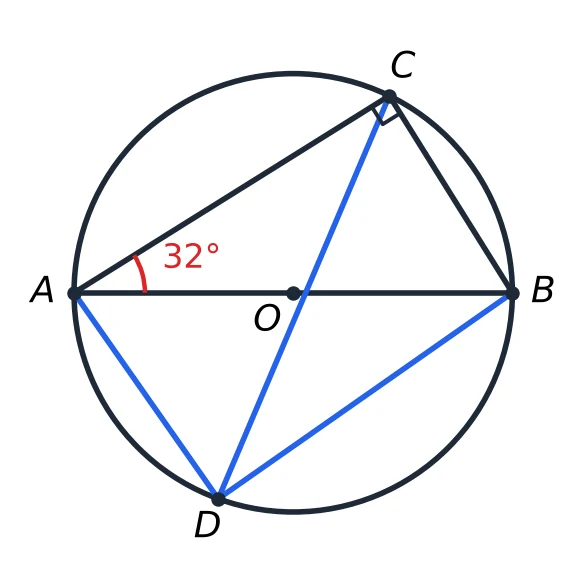
Answer. (angle in a semicircle), so = 58°. stands on the same arc AC as , so = 58° too. stands on arc BC, like , so = 32°. Check: , the angle in a semicircle again.
Question 13
Two circles of radii 12 cm and 3 cm touch each other externally. Find the length of their direct common tangent.
Answer. Touching externally means the centres are cm apart. The direct tangent is = 12 cm. The quick rule for touching circles, , gives the same.
Question 14
The sides of a parallelogram are 7 cm and 9 cm, and one diagonal is 8 cm. Find the other diagonal.
Answer. . So , and the other diagonal is 14 cm.
Question 15
Two sides of a triangle are 6 cm and 11 cm, and the third side is a whole number of centimetres. How many such triangles are possible, and how many of them are obtuse?
Answer. The third side must be more than and less than , so . That is 11 triangles. Now the obtuse test, using the longest side.
- If is the longest side, obtuse needs , so .
- If 11 is the longest side, obtuse needs , so , giving .
So 8 of them are obtuse (and the other three, with = 10, 11 and 12, are acute).
Question 16 [Tier 2]
In a triangle, the distance between the orthocentre H and the centroid G is 10 cm. Find the distance between the circumcentre O and the orthocentre.
Answer. O, G and H lie on one straight line (the Euler line), with G between them and . So cm and = 15 cm.
Question 17 [Tier 2]
Two circles of radii 25 cm and 26 cm cut each other, and their centres are 17 cm apart. Find the length of the common chord.
Answer. The common chord is perpendicular to the line of centres and is cut in half by it. Say it crosses that line at M, cm from the smaller circle's centre. Half the chord, , gives . So , which gives and . Then , and the common chord is 48 cm. Check from the other centre: , and .
Question 18
In the figure, PT touches the circle with centre O at A, and AB is a chord with . C is a point on the major arc AB and D a point on the minor arc AB. Find , and .
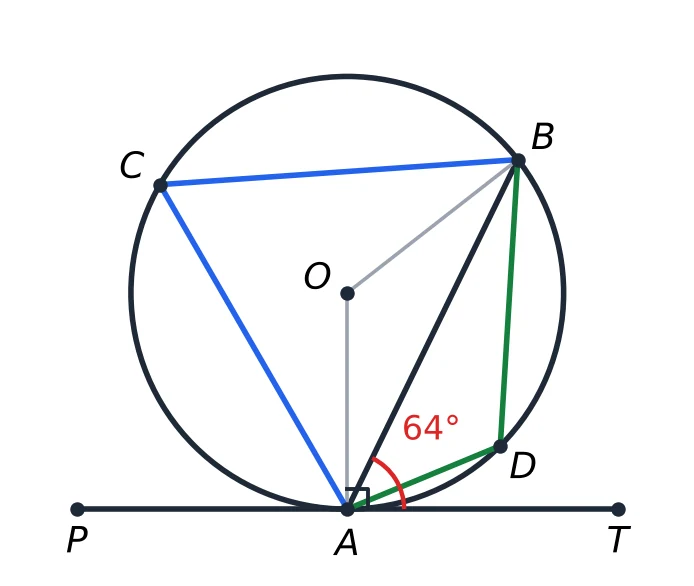
Answer. By the alternate segment theorem, the angle between the tangent and the chord equals the angle in the other segment, so = 64°. The angle at the centre is double: = 128°. ACBD is cyclic, so = 116°. (Also, , so .)
Question 19
A lamp is fixed 6 m above the ground on a pole. A girl 1.5 m tall walks away from the foot of the pole at 1.2 m per second. How long is her shadow after 4 seconds?
Answer. After 4 seconds she is m from the pole. Let her shadow be m. The pole, the ground up to the tip of the shadow and the light ray make a big triangle, similar to the small one made by the girl and her shadow. So . Cross-multiplying, , so and = 1.6 m.
Question 20
ABCD is a trapezium with , cm and cm. Its diagonals meet at O. If the area of triangle AOB is 45 sq cm, find the areas of triangles COD and AOD.
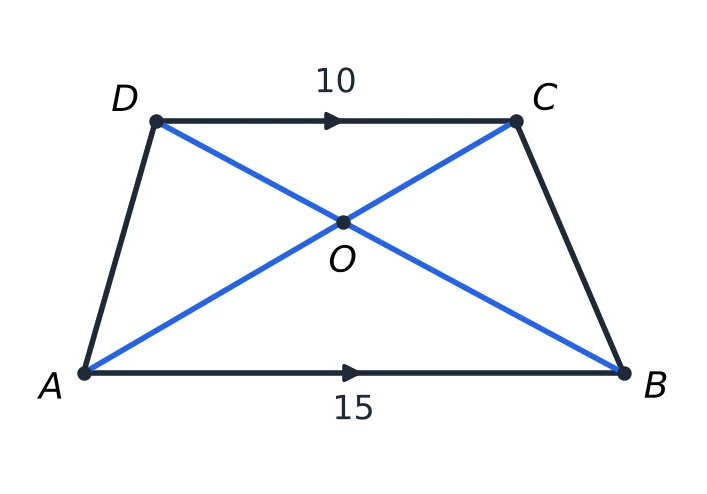
Answer. Triangles AOB and COD are similar (alternate angles), with scale . So area COD = 20 sq cm. The diagonals also cut each other in the ratio , so . Triangles AOB and AOD have the same height from A, so their areas are in the ratio of their bases . Area AOD = 30 sq cm. (Triangle BOC is also 30 sq cm.)
Question 21
The inradius of an equilateral triangle is 6 cm. Find its height, its side and its circumradius.
Answer. In an equilateral triangle , so the height is 18 cm. From , the side is = cm. And = 12 cm.
Question 22 [Tier 2]
ABCD is a cyclic quadrilateral. AB and DC, when extended, meet at P, and AD and BC, when extended, meet at Q, as in the figure. If and , find and .
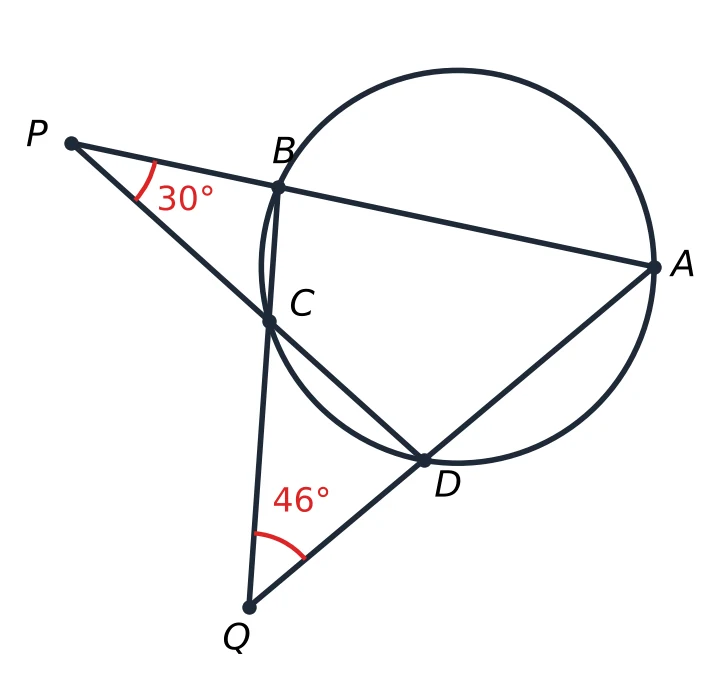
Answer. Call . In triangle APD, the angle at D is , so . In triangle AQB, the angle at B is , so . Adding the two, . ABCD is cyclic, so , which gives and . So = 128° and = 98°. (Then , and checks.)
Question 23
In triangle ABC, and . Find .
Answer. Write everything in terms of : and . Then , so and . So = 86° (and ).
Question 24 [Tier 2]
In triangle ABC, cm, cm and cm. Find the length of the median AD.
Answer. By Apollonius, , with . So , that is , so and AD = 12 cm.
Question 25
The transverse common tangent of two circles is 15 cm long, and their centres are 17 cm apart. If one radius is 5 cm, find the other.
Answer. Transverse goes with the total of the radii: . So and . The other radius is = 3 cm.
Question 26 [Tier 2]
Chords AB and CD of a circle cross at E inside the circle. The arc AC (not containing B or D) is and the arc BD (not containing A or C) is . Find .
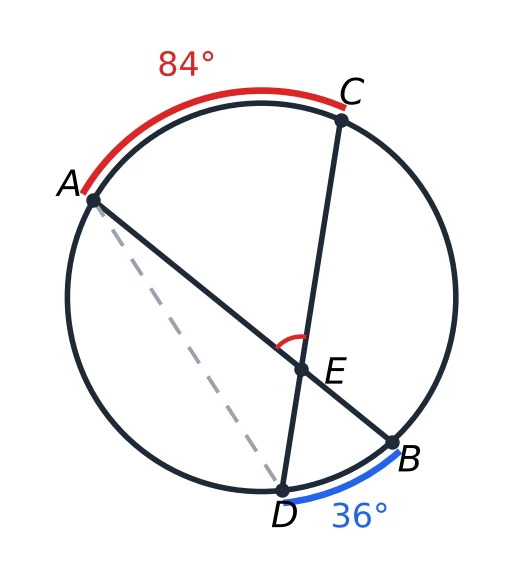
Answer. Join AD. Since C, E and D are on one line, is the exterior angle of triangle AED at E, so . stands on arc BD, so it is , and stands on arc AC, so it is . So = 60°. This is the rule: the angle between two chords crossing inside is half the sum of the two arcs.
Question 27
In triangle ABC, , cm and cm. The incircle touches AC at P. Find the inradius, AP and CP.
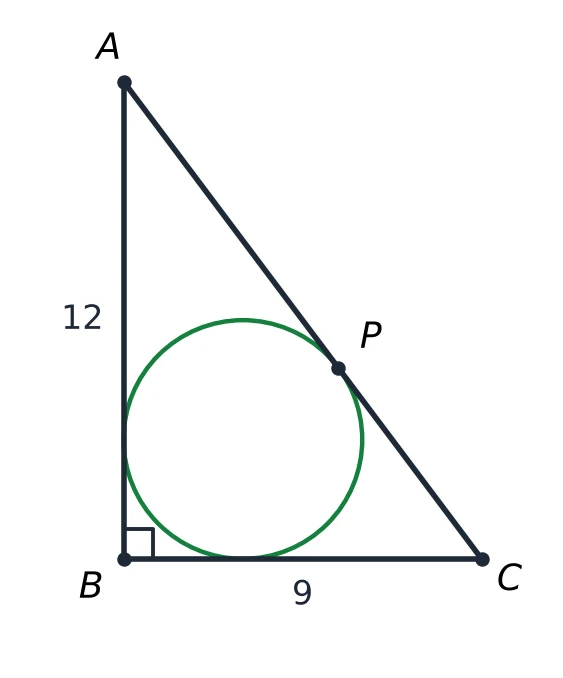
Answer. cm (the 9, 12, 15 triplet, which is three times 3, 4, 5). Then = 3 cm. Half the perimeter is . AP is the tangent length from A, which is = 9 cm, and = 6 cm. Check: .
Question 28
In triangle ABC, cm and cm. The bisector of meets BC at D. Find AD.
Answer. Triangles ABD and ACD are congruent by SAS: , the two angles at A are equal, and AD is common. By CPCT, cm, and . These two add up to , so each is . Then = 40 cm.
Question 29
In triangle ABC, D is a point on BC such that . If cm and cm, find DC.
Answer. Triangles ADC and BAC share , and , so they are similar (AA), with D matching A and A matching B. So , which gives = 4 cm.
Question 30
In the figure, , , and . Find , marked .
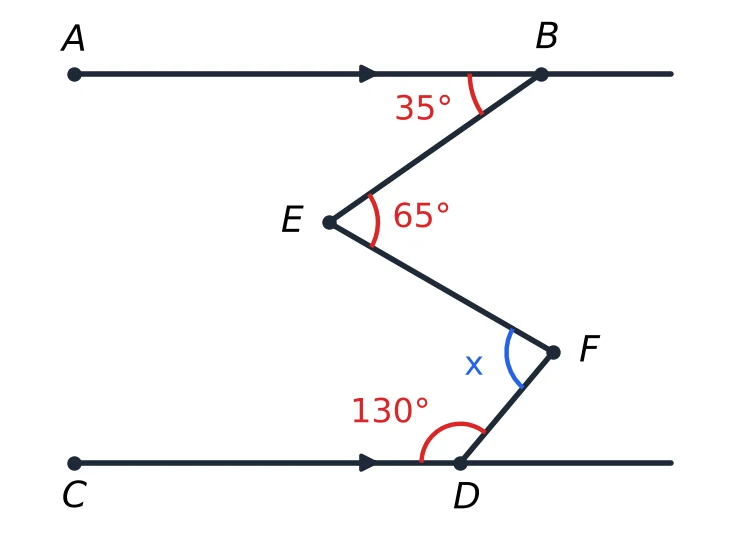
Answer. At D, the angle on the right of DF is . With several bends between two parallel lines, the angles that open to the left add up to the angles that open to the right. Here 35° (at B) and (at F) open to the left, and 65° (at E) and 50° (at D) open to the right. So , and = 80°. (Drawing a parallel line through E and another through F gives the same answer in three steps.)
Question 31
The numbers of sides of two regular polygons are in the ratio , and their interior angles are in the ratio . Find the number of sides of each.
Answer. Say the sides are and . The interior angles are and , and their ratio simplifies to . Setting gives , so . The polygons have 5 and 10 sides. Check: their angles are and , and .
Question 32
In a quadrilateral ABCD, and . The bisectors of and meet at P. Find .
Answer. , so their halves add up to . In triangle APB, = 85°. That is just .
Question 33
ABCD is a cyclic quadrilateral with and . Find .
Answer. Opposite angles add up to , so . In triangle ABD, , so . stands on arc AB, like , so = 55°. (By the same idea, , and checks.)
Question 34
In triangle ABC, and . If cm and cm, find BC and AC.
Answer. , so = 15 cm. Then = 12 cm. (Also , so cm.)
Question 35
In triangle ABC, , and cm. AD is perpendicular to BC. Find BC.
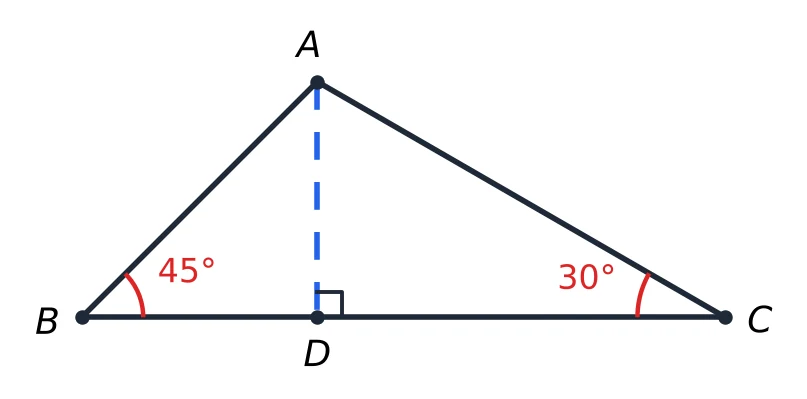
Answer. Triangle ABD is a 45-45-90 triangle, so cm. Triangle ADC is a 30-60-90 triangle with AD facing the angle, so cm and cm. So BC = cm, about 16.4 cm.