
Similar Triangles: Same Shape, Different Size
Two triangles are similar when one is an enlarged or reduced copy of the other. Their angles are equal in pairs, and all their corresponding sides are in the same ratio. We write , and the order of the letters is the matching: A goes with P, B with Q and C with R. So
The common ratio is the scale factor. Congruent triangles are the special case (the congruence rules are in Triangles: Angles, Sides, Congruence and Pythagoras).
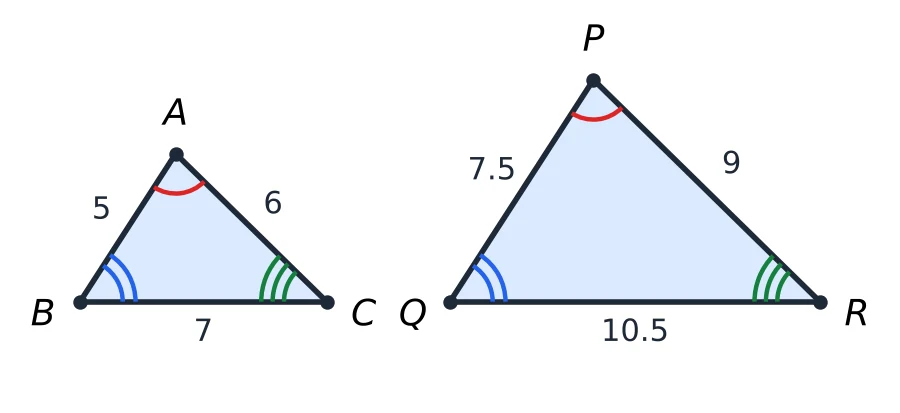
Three tests. Any one of these is enough to prove two triangles similar.
- AA: two angles of one triangle equal two angles of the other. The third angles then match automatically, which is why "AAA" is the same test. If and in one triangle, and and in another, then too, and .
- SAS: one angle equal, and the two sides that make that angle in the same ratio. AB = 6, AC = 9 and , against PQ = 4, PR = 6 and : since , the triangles are similar with ratio 3 : 2.
- SSS: all three pairs of sides in the same ratio. Sides 5, 6, 7 and 7.5, 9, 10.5 are similar, since every ratio is .
What does not work. Two sides in proportion with an angle that is not between them (SSA) proves nothing. And equal angles prove similarity but never congruence: AA says nothing about size.
Matching the right letters. The trickiest questions draw a line DE across triangle ABC, with D on AB and E on AC, so that . DE is then tilted, not parallel to BC. Triangles ADE and ABC share angle A, so they are similar by AA, but D matches C and E matches B:
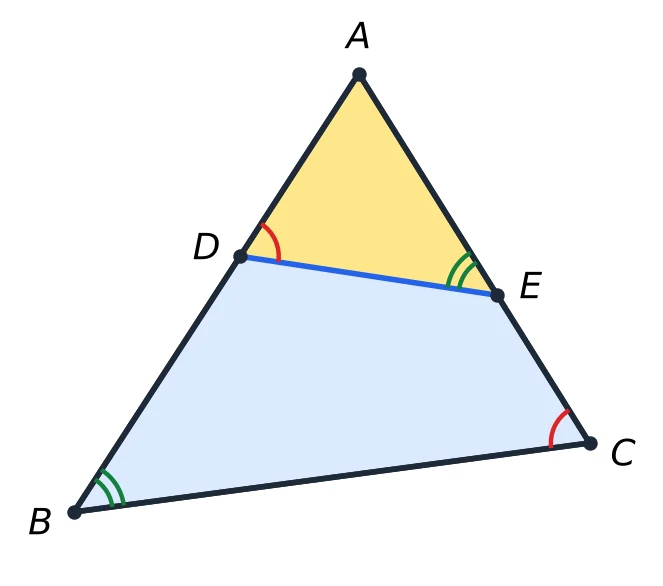
With AB = 6 cm, AC = 5 cm and AD = 2.5 cm, this gives AE = = 3 cm.
Pair the vertices by equal angles, never by the order of letters in the question. Mark the equal angles on a rough figure, write the two triangles with matching vertices in the same position, and only then write the ratios.
Ratios in Similar Triangles: Lengths Go by , Areas by
If with , then every length in the first triangle is times the matching length in the second. That includes:
- the perimeters
- corresponding altitudes, medians and angle bisectors
- the inradii and the circumradii
Areas behave differently. Area is half of base × height, and both the base and the height change by the factor , so the area changes by :
and the same with medians, perimeters or any other pair of matching lengths in place of the sides.
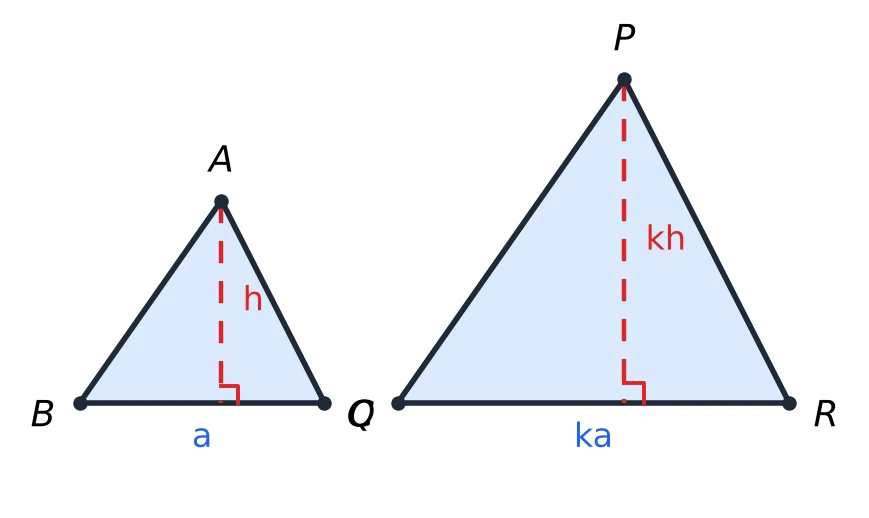
- Sides in the ratio 4 : 7, smaller area 48 sq cm: the larger area is sq cm.
- Perimeters 24 cm and 32 cm: the sides are in the ratio 3 : 4, so the areas are in the ratio 9 : 16.
- Areas in the ratio 49 : 81: every length (side, median, altitude, perimeter) is in the ratio 7 : 9.
From areas to lengths, take the square root first. If two similar triangles have areas 64 sq cm and 100 sq cm, and a side of the smaller one is 12 cm, the matching side of the larger one is cm, not .
Why the square? Join the midpoints of the sides of a triangle and it splits into four copies of itself, each with half the side. Halving the sides divides the area by 4, and in the same way tripling the sides multiplies the area by 9.
The same rule holds for any two similar figures, not only triangles: two squares, two circles or two similar quadrilaterals have areas in the ratio of the squares of their matching lengths. And if two similar triangles have equal areas, then and they are congruent.
[SSC Tip] In a length question the area ratio itself is always one of the wrong options, and in an area question the length ratio is always there too. Before choosing, ask which one is wanted: lengths go with , areas with .
The Basic Proportionality Theorem
A line drawn parallel to one side of a triangle, cutting the other two sides, divides them in the same ratio. In triangle ABC, with D on AB, E on AC and ,
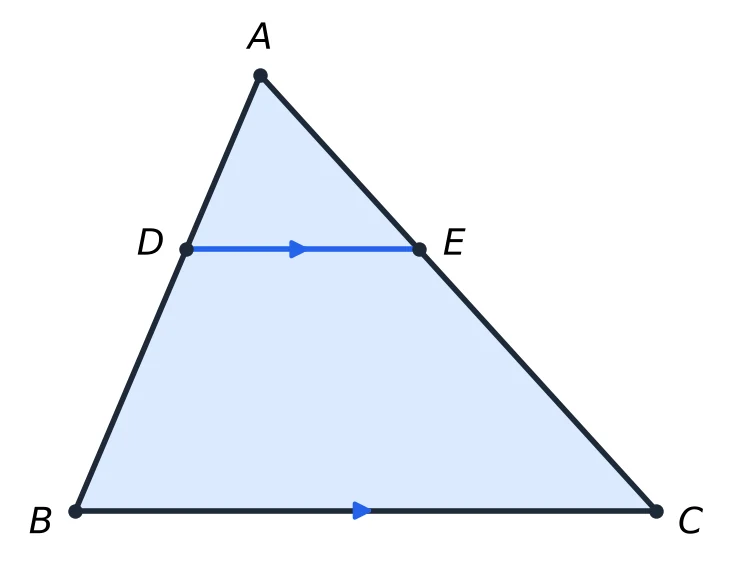
Why it works. Triangles ADE and BDE have the same height from E down to line AB, so their areas are in the ratio AD : DB. In the same way, triangles ADE and CDE have areas in the ratio AE : EC. Finally, triangles BDE and CDE stand on the same base DE between the same two parallels DE and BC, so their areas are equal. The two ratios must therefore be the same.
The whole-side version. Since , the corresponding angles at D and B are equal, and so are those at E and C. So by AA, which gives
This is the one to use whenever DE or BC appears in the question.
- AD = 4 cm, DB = 6 cm and AE = 5 cm: EC = = 7.5 cm.
- AD = 3 cm, AB = 8 cm and BC = 12 cm: DE = = 4.5 cm.
The converse. If , then . SSC asks this as "which of these sets of lengths makes DE parallel to BC": work out both ratios for each option and pick the one where they match.
The algebra version. ", , , and . Find ." Cross-multiply :
Then check that every length is positive: 4, 2, 6 and 3, and indeed 4 : 2 = 6 : 3.
[SSC Tip] DE goes with the whole side: , not . With AD = 3 and DB = 5, DE is of BC, not of it.
Area Questions When DE Is Parallel to BC
When , triangle ADE is a small copy of triangle ABC with ratio . So
and the trapezium DBCE is whatever is left over.
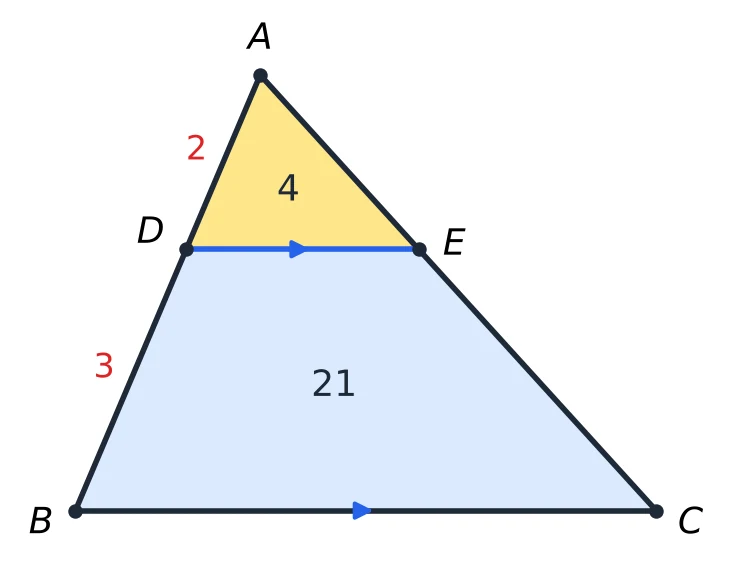
Worked through for AD : DB = 2 : 3. Then AD : AB = 2 : 5, so the areas of ADE and ABC are in the ratio 4 : 25. Out of those 25 parts, the trapezium DBCE has 25 − 4 = 21. So
If area(ABC) = 75 sq cm, then area(ADE) = 12 sq cm and area(DBCE) = 63 sq cm.
Other ratios given.
- DE = of BC: the small triangle is of the whole, and the trapezium is .
- area(ADE) : area(DBCE) = 9 : 16: the whole is 25 parts, so , giving AD : AB = 3 : 5 and AD : DB = 3 : 2.
Cutting the triangle into two equal halves. If splits triangle ABC into two parts of equal area, then the small triangle is half the whole: . So
With AB = 10 cm, AD = cm, about 7.07 cm.
[Tier 2] More equal parts. Two lines parallel to BC that cut the triangle into three parts of equal area meet AB at distances from A in the ratio , because the triangles cut off at A have areas of 1, 2 and 3 parts.
[SSC Tip] The usual mistake is squaring AD : DB. With AD : DB = 2 : 3, the areas of ADE and ABC are in the ratio 4 : 25, not 4 : 9. Always change to AD : AB before squaring.
The Midpoint Theorem
The midpoint theorem is the basic proportionality theorem with the cut made exactly halfway.
The segment joining the midpoints of two sides of a triangle is parallel to the third side and half as long. If F and E are the midpoints of AB and AC, then and FE = BC.
The converse. A line through the midpoint of one side, drawn parallel to a second side, cuts the third side at its midpoint.
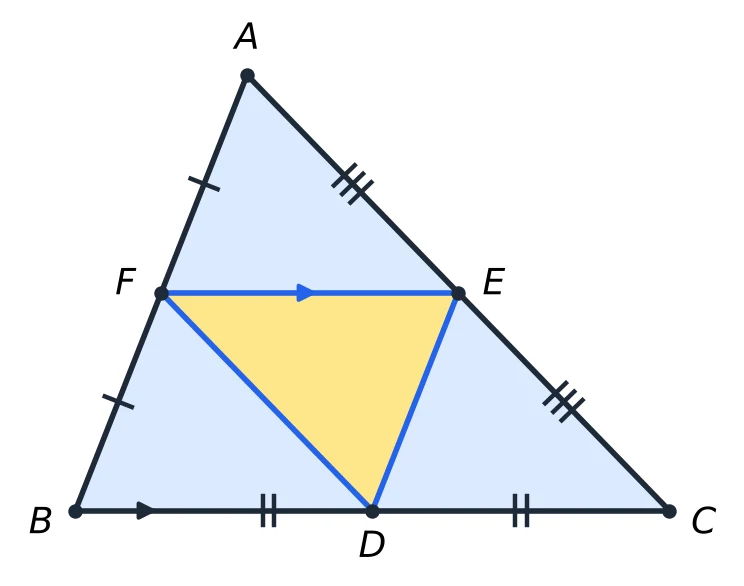
The midpoint triangle. Join all three midpoints D, E and F. Each side of triangle DEF is half of a side of ABC (FE is half of BC, and so on). So:
- the four small triangles AFE, FBD, EDC and DEF are congruent, and each has of the area of ABC
- the perimeter of DEF is half the perimeter of ABC
- triangle DEF is similar to triangle ABC with ratio 1 : 2, and it has the same angles
For a triangle with sides 10, 14 and 18 cm, triangle DEF has sides 5, 7 and 9 cm and perimeter 21 cm. If area(ABC) = 48 sq cm, then area(DEF) = 12 sq cm. Joining the midpoints of DEF again gives a triangle of area 3 sq cm: every round divides the area by 4 and the perimeter by 2.
Any quadrilateral. Join the midpoints of the four sides of any quadrilateral, in order. By the midpoint theorem, two opposite sides of the new figure are both parallel to one diagonal and half of it, and the other two are parallel to the other diagonal. So the new figure is a parallelogram, its perimeter equals the sum of the two diagonals, and its area is half the area of the quadrilateral. Diagonals of 12 cm and 18 cm give a midpoint parallelogram with perimeter 30 cm.
In a midpoint question, find the side that the segment is parallel to and halve it, or double it when going back. If the segments joining the midpoints are 4 cm, 5 cm and 6 cm, the original triangle has sides 8, 10 and 12 cm and perimeter 30 cm.
Three Parallel Lines, and a Line Across a Trapezium
Parallel lines cut transversals in the same ratio. If three or more parallel lines cut two transversals, the pieces on one transversal are in the same ratio as the pieces on the other. With meeting at A, B, C and at D, E, F,
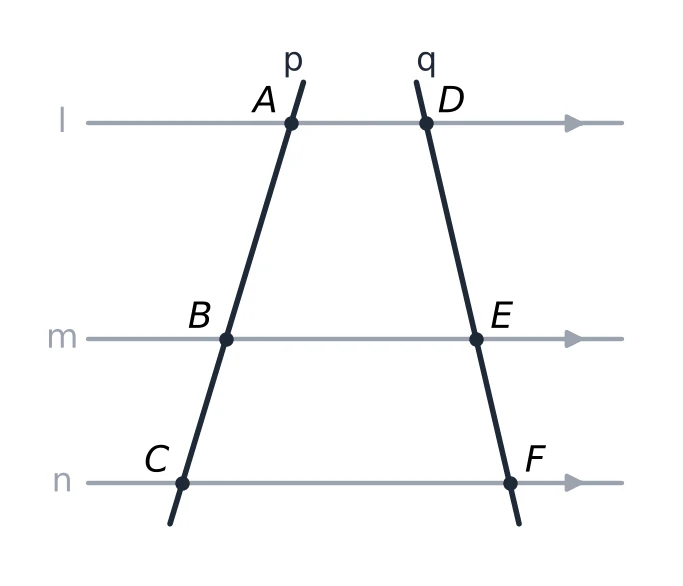
To see why, join A to F; this crosses at a point G. In triangle ACF, , so . In triangle FAD, , so . The two ratios are equal.
If AB = 4 cm, BC = 6 cm and DF = 20 cm, then DE : EF = 2 : 3, so DE = 8 cm and EF = 12 cm. In particular, parallel lines that cut equal pieces on one transversal cut equal pieces on every transversal.
A line across a trapezium. Let ABCD be a trapezium with , top base and bottom base . A line EF parallel to both meets the legs at E (on AD) and F (on BC). The three parallel lines AB, EF and DC cut the legs in the same ratio, so AE : ED = BF : FC. If that ratio is , then
The reason: draw the diagonal AC, cutting EF at G. In triangle ADC, , so . In triangle CAB, , so . Add the two pieces.
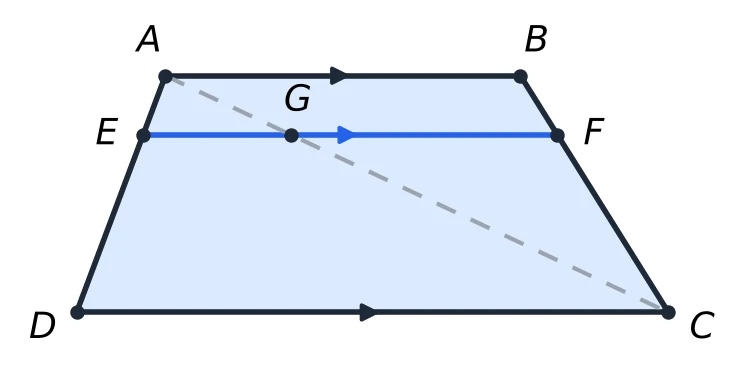
With AB = 12 cm, DC = 20 cm and AE : ED = 1 : 3: EF = = 14 cm. When E is the midpoint (), the formula gives the mid-segment from Lines, Angles, Quadrilaterals and Polygons.
In the trapezium formula each base is weighted by the far part of the leg: the top base gets (the lower part) and the bottom base gets (the upper part). A quick check: EF lies between and , and it is closer to the base it is nearer to.
Area Ratios from Points on the Sides
Many area questions need no similarity at all, only this fact: triangles with the same height have areas in the ratio of their bases.
If D is on BC with BD : DC = 3 : 2, triangles ABD and ADC have the same height from A, so area(ABD) : area(ADC) = 3 : 2. With area(ABC) = 60 sq cm, they are 36 sq cm and 24 sq cm.
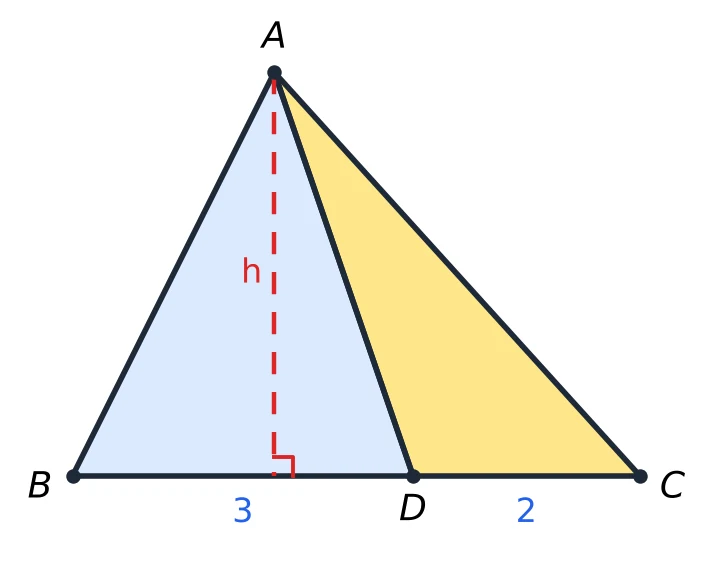
The same fact works again inside a smaller triangle. If E is on AD with AE : ED = 1 : 2, triangles BAE and BED have the same height from B, so area(BED) = sq cm.
Two triangles sharing an angle. If D is on AB and E is on AC (DE need not be parallel to BC), then
Reason: triangles ADE and ADC share the height from D, so their areas are in the ratio AE : AC. Triangles ADC and ABC share the height from C, so their areas are in the ratio AD : AB. Multiply the two.
With AD = of AB and AE = of AC, triangle ADE is of triangle ABC.
Points on all three sides. Let D, E and F divide BC, CA and AB so that BD : DC = CE : EA = AF : FB = 1 : 3. The corner triangle AFE has of the area, and so do the other two corners. Together the corners take , so triangle DEF is of triangle ABC.
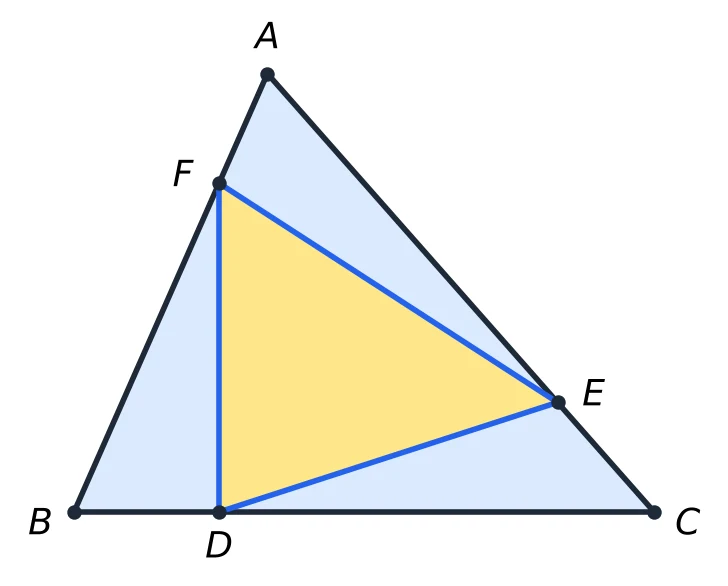
[SSC Tip] Before reaching for similar triangles, look for two triangles with the same top vertex and their bases on one line. Their areas are in the ratio of the bases, and that settles most "D divides BC in the ratio …" questions in one step.
The Angle Bisector Theorem
The bisector of an angle of a triangle divides the opposite side in the ratio of the other two sides. If AD bisects angle A, with D on BC,
where , and .
Why. Triangles ABD and ADC have the same height from A, so their areas are in the ratio BD : DC. But D is on the bisector, so it is the same distance from AB and from AC. Using those equal distances as heights, the same two areas are in the ratio AB : AC.
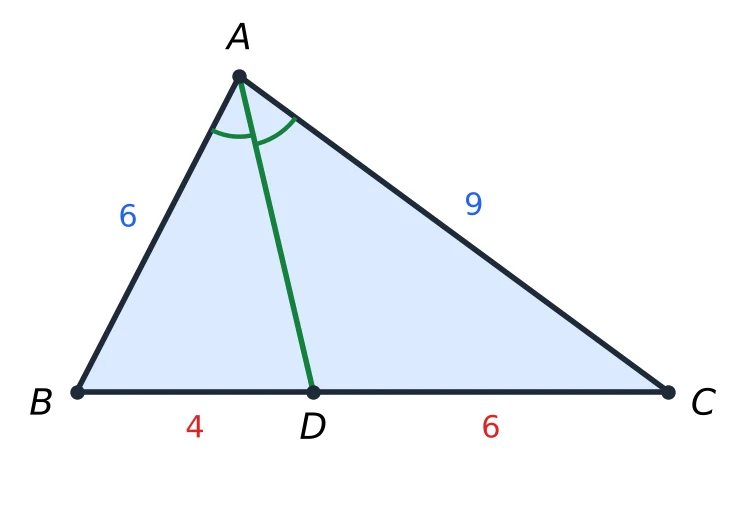
With AB = 6 cm, AC = 9 cm and BC = 10 cm: BD : DC = 6 : 9 = 2 : 3, so BD = 4 cm and DC = 6 cm. The converse holds too: if BD : DC = AB : AC, then AD bisects angle A.
Where the incentre sits on AD. The incentre I lies on AD. In triangle ABD the line BI bisects angle B, so
For the 6, 9, 10 triangle, AI : ID = 15 : 10 = 3 : 2.
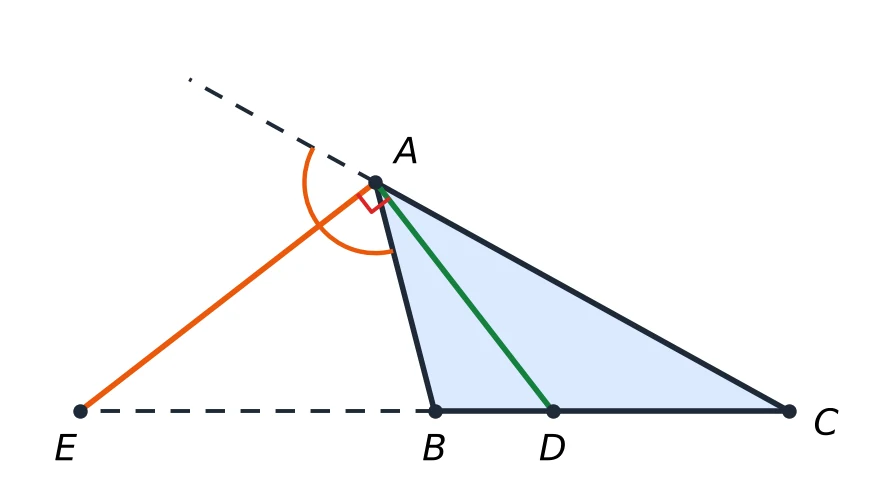
[Tier 2] The external bisector. The bisector of the exterior angle at A meets line BC extended at a point E, and it divides BC externally in the same ratio: . E lies beyond B when AB is the shorter of the two sides, and beyond C when AC is. With AB = 4 cm, AC = 8 cm and BC = 6 cm, E is beyond B, BE : EC = 1 : 2 and EC − BE = 6, so BE = 6 cm and EC = 12 cm. The internal and external bisectors at A are always perpendicular.
[Tier 2] Length of the bisector. . For the 6, 9, 10 triangle, , so AD = cm.
The side next to B goes with the piece next to B: BD goes with AB, and DC with AC. Swapping them (BD = 6 and DC = 4 above) is the standard wrong option.
A Right Triangle with the Altitude to the Hypotenuse
Let angle A = 90° in triangle ABC, and let AD be the altitude to the hypotenuse BC. The altitude cuts the triangle into two smaller right triangles, and all three triangles are similar:
The reason is AA: and are both , and and are both .
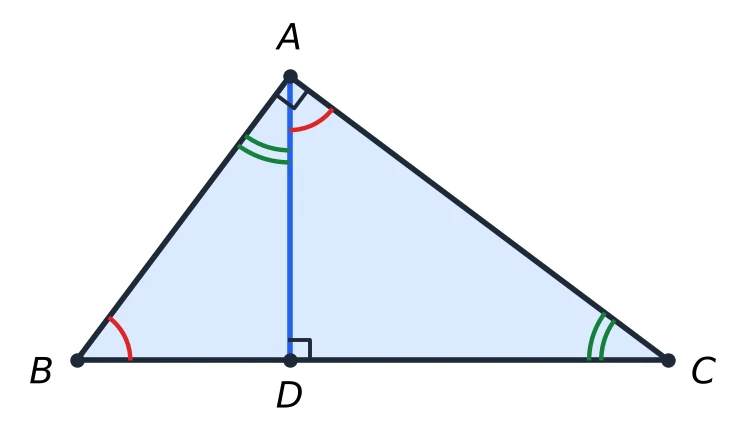
Writing ratios from these three triangles gives five results worth knowing by heart:
In words: the altitude squared is the product of the two pieces of the hypotenuse, and each leg squared is the piece next to it times the whole hypotenuse. The fourth result comes from writing the area in two ways, , and the fifth from squaring it and using .
From the legs. With AB = 15 cm and AC = 20 cm: BC = 25 cm, AD = = 12 cm, BD = = 9 cm and DC = 25 − 9 = 16 cm. Check: , and .
From the pieces of the hypotenuse. With BD = 2 cm and DC = 8 cm: AD = = 4 cm, AB = cm and AC = cm.
Each leg goes with the piece of the hypotenuse that touches it: , since B is on both AB and BD. Pairing AB with DC is the usual slip, and it swaps the two legs.
Trapezium Diagonals and the Four Triangles
Let ABCD be a trapezium with , and let the diagonals AC and BD meet at O. Because , the alternate angles are equal: and . So , with ratio AB : DC. That gives
so the diagonals cut each other in the ratio of the parallel sides (this fact is also listed with the trapezium in Lines, Angles, Quadrilaterals and Polygons). The converse holds too: if the diagonals of a quadrilateral cut each other in the same ratio, it is a trapezium.
The four areas. Call the areas of triangles AOB and COD and .
- , because the two triangles are similar.
- Triangles AOD and BOC have equal areas. Triangles ABD and ABC have the same base AB and the same height, and each is made of triangle AOB plus one of the side triangles.
- Each side triangle has area . Triangles AOB and AOD share the height from A, so their areas are in the ratio BO : OD = AB : DC. Since , area(AOD) = .
- The whole trapezium is .
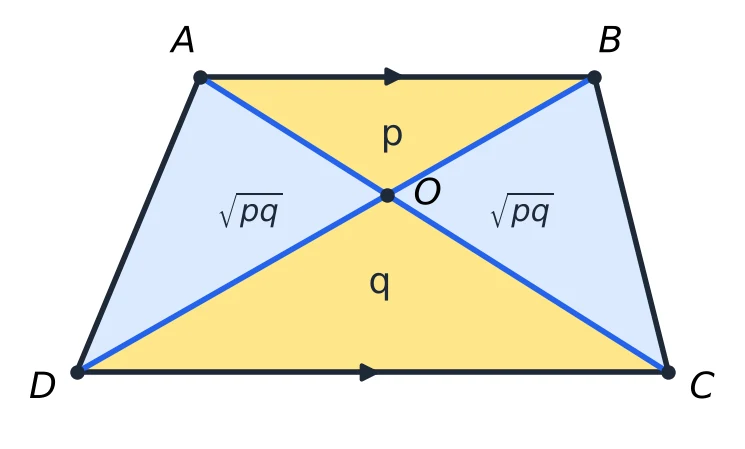
With AB = 8 cm, DC = 12 cm and area(AOB) = 16 sq cm: sq cm, each side triangle is = 24 sq cm, and the trapezium is 16 + 36 + 48 = 100 sq cm, which is .
[Tier 2] The line through O. The segment through O parallel to the two bases, ending on the legs, has length for bases and , and O is its midpoint. For bases 8 cm and 12 cm it is cm.
The two side triangles are equal, and each is the square root of the product of the other two. So any two of the four areas (one of them a top or bottom triangle) give the whole trapezium. Check the total with .
Shadows, Lamp Posts and Two Poles
Sunlight. The sun's rays are parallel, so at a given moment every upright object and its shadow make similar right triangles. Height : shadow is the same for all of them. If a 2 m stick casts a 1.5 m shadow, a building whose shadow is 24 m at the same time is = 32 m tall.
A lamp post. A lamp is different, because its rays spread out from one point. Say a lamp L is 4.8 m high and a man 1.6 m tall stands 4 m from its foot. The ray from the lamp that just passes over his head reaches the ground at S, the tip of his shadow. If the shadow is metres long, the man and the lamp make two similar right triangles with the same corner S, so
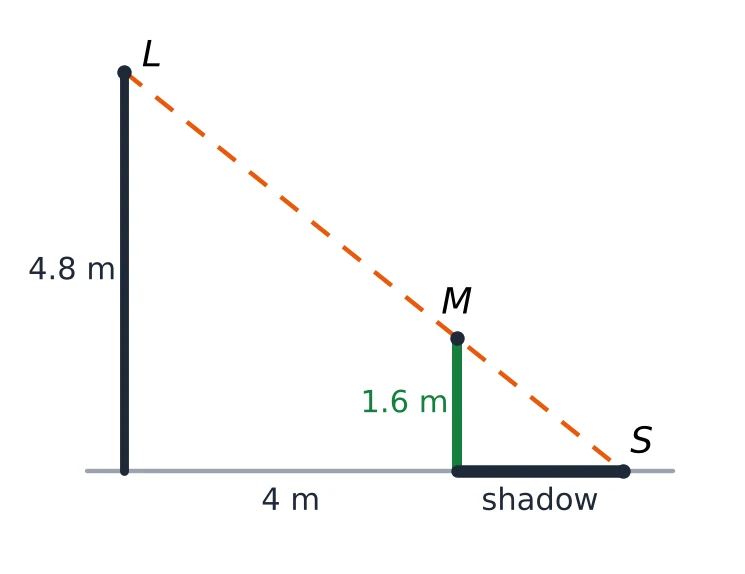
In general, a person of height standing a distance from a lamp of height has a shadow of length . Since the shadow is a fixed fraction of the distance, a person walking away at a steady speed has a shadow that grows at a steady speed too.
Two poles. Poles of heights and stand upright on level ground. The lines from the top of each pole to the foot of the other cross at a point P. The height of P is
and, surprisingly, it does not depend on how far apart the poles are. For poles of 6 m and 12 m, m.
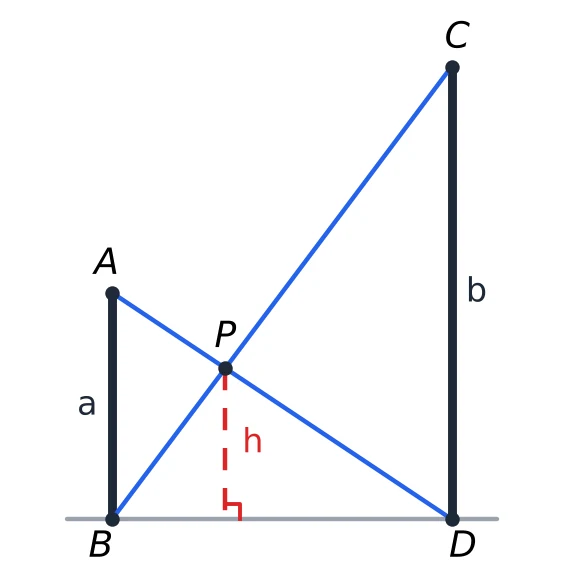
The reason: let P be at height . By similar triangles, is the fraction of the gap between the poles from P's foot to the far pole, and is the fraction from the near pole to P's foot. The two fractions make up the whole gap, so , which gives the formula.
In lamp-post questions the lamp's triangle has base (distance + shadow), measured from the tip of the shadow. Using only the distance between the person and the lamp is the common slip.
Solved Examples
Question 1
Which of these pairs of triangles must be similar? (a) sides 3, 4, 6 cm and sides 6, 8, 10 cm (b) AB = 6, AC = 4.5, in one and PQ = 8, PR = 6, in the other (c) two isosceles triangles whose equal sides are 5 cm and 10 cm (d) , in one and , in the other
Answer. Test each pair. The first pair has ratios , but , so SSS fails. The second gives two sides and an angle that is not between them (SSA), and with these numbers each triangle can be drawn in two different shapes, so they need not be similar. The third says nothing about the angles: two isosceles triangles can have quite different top angles. In the last pair, the third angles are and , so both triangles have angles 50°, 60° and 70°, and AA works. The answer is (d) , in one and , in the other.
Question 2
The sides of a triangle are 5 cm, 7 cm and 9 cm. The shortest side of a similar triangle is 15 cm. What is the perimeter of the second triangle? (a) 63 cm (b) 45 cm (c) 105 cm (d) 27 cm
Answer. The shortest sides match, so the scale factor is . Perimeters go by the same factor as sides: 3 × (5 + 7 + 9) = 3 × 21 = (a) 63 cm.
Question 3
, and their areas are 100 sq cm and 169 sq cm. If EF = 19.5 cm, what is BC? (a) 25.35 cm (b) 13 cm (c) 15 cm (d) 10 cm
Answer. The ratio of the areas is the square of the ratio of the sides, so the sides are in the ratio . BC matches EF, so BC = = (c) 15 cm.
Question 4
The areas of two similar triangles are 36 sq cm and 100 sq cm. An altitude of the smaller triangle is 4.5 cm. What is the corresponding altitude of the larger one? (a) 12.5 cm (b) 7.5 cm (c) 2.7 cm (d) 10 cm
Answer. Lengths are in the ratio of the square roots of the areas: . So the altitude is = (b) 7.5 cm.
Question 5
In triangle ABC, D is on AB and E is on AC with . If AD = 4 cm, AE = 5 cm and AC = 10 cm, what is AB? (a) 12.5 cm (b) 8 cm (c) 10 cm (d) 6.25 cm
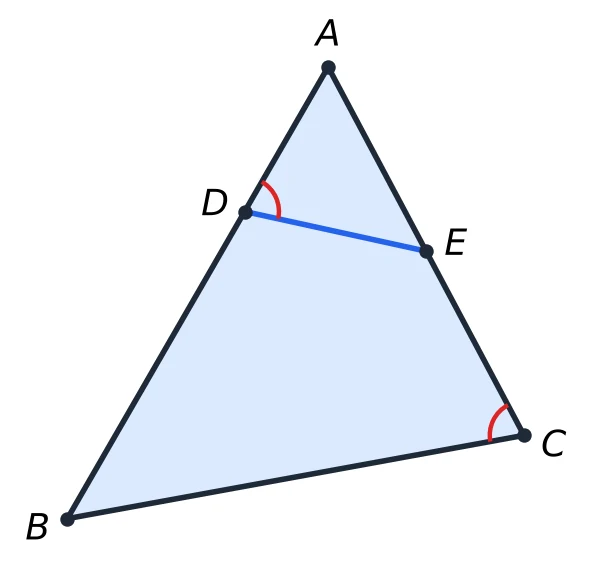
Answer. DE is not parallel to BC here. Triangles ADE and ACB share angle A and have , so , with D matching C and E matching B. Then , that is , so AB = (a) 12.5 cm. (Equivalently AD × AB = AE × AC: 4 × 12.5 = 5 × 10.) 8 cm is what you get by wrongly treating DE as parallel to BC.
Question 6
In triangle ABC, with D on AB and E on AC. If AD = 3.6 cm, DB = 5.4 cm and AE = 2.4 cm, what is EC? (a) 1.6 cm (b) 4.8 cm (c) 6 cm (d) 3.6 cm
Answer. By the basic proportionality theorem, : . The left side is , so EC = = (d) 3.6 cm.
Question 7
In triangle ABC, with D on AB and E on AC. If , , and (all in cm), what is ? (a) 5 (b) 2 (c) 3 (d) 4
Answer. , so cross-multiply: . That is , so and = (c) 3. Check: the lengths are 5, 2, 10 and 4 cm, all positive, and 5 : 2 = 10 : 4.
Question 8
In triangle ABC, with D on AB and E on AC. If AD = 2 cm, DB = 5 cm and BC = 21 cm, what is DE? (a) 8.4 cm (b) 6 cm (c) 15 cm (d) 10.5 cm
Answer. DE goes with the whole side AB, not with DB: . So DE = = (b) 6 cm. Using by mistake gives 8.4 cm.
Question 9
In triangle ABC, with D on AB and E on AC, and AD : DB = 3 : 4. What is the ratio of the area of triangle ADE to the area of trapezium DBCE? (a) 9 : 49 (b) 9 : 16 (c) 3 : 4 (d) 9 : 40
Answer. First change to AD : AB = 3 : 7. Triangle ADE is similar to triangle ABC with this ratio, so their areas are in the ratio 9 : 49. The trapezium is the rest: 49 − 9 = 40 parts. So area(ADE) : area(DBCE) = (d) 9 : 40.
Question 10
A line parallel to BC cuts AB at D and AC at E, and divides triangle ABC into two parts of equal area. If AB = 12 cm, what is AD? (a) 6 cm (b) cm (c) cm (d) cm
Answer. Triangle ADE is half of triangle ABC, so and . So AD = = (c) cm, about 8.49 cm. 6 cm halves the length, but it is the area that is halved.
Question 11
P, Q and R are the midpoints of the sides of triangle ABC, and X, Y and Z are the midpoints of the sides of triangle PQR. If the area of triangle ABC is 96 sq cm, what is the area of triangle XYZ? (a) 6 sq cm (b) 12 sq cm (c) 24 sq cm (d) 3 sq cm
Answer. Joining the midpoints of a triangle gives a triangle with half the sides, so a quarter of the area. Triangle PQR is sq cm, and doing it again, triangle XYZ is = (a) 6 sq cm.
Question 12
In triangle ABC, D is the midpoint of AB. The line through D parallel to BC meets AC at E. If AC = 11 cm and BC = 9 cm, what is AE + DE? (a) 11 cm (b) 10 cm (c) 9 cm (d) 20 cm
Answer. By the converse of the midpoint theorem, E is the midpoint of AC, so AE = 5.5 cm. Then D and E are both midpoints, so DE is half of BC: 4.5 cm. Together, AE + DE = (b) 10 cm.
Question 13
Three parallel lines cut one transversal at A, B, C and another at D, E, F, as shown. If AB = 5 cm, BC = 7 cm and DF = 24 cm, what is DE? (a) 10 cm (b) 14 cm (c) 12 cm (d) 8 cm
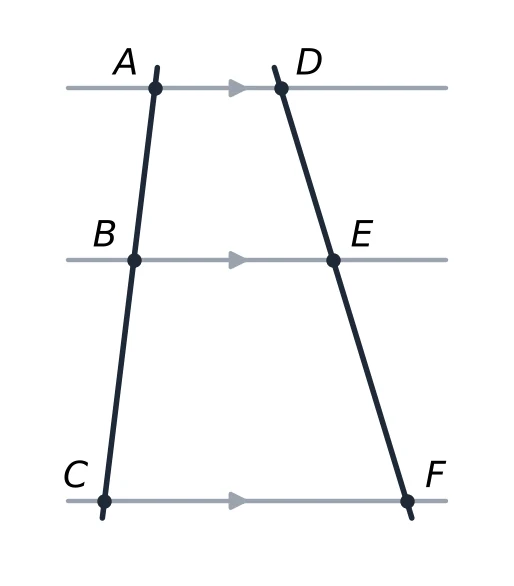
Answer. Parallel lines cut the two transversals in the same ratio, so DE : EF = AB : BC = 5 : 7. DF is the whole, 12 parts, so each part is 2 cm and DE = 5 × 2 = (a) 10 cm.
Question 14
ABCD is a trapezium with , AB = 10 cm and DC = 25 cm. E is on AD and F is on BC with and AE : ED = 2 : 3. What is EF? (a) 19 cm (b) 17.5 cm (c) 14 cm (d) 16 cm
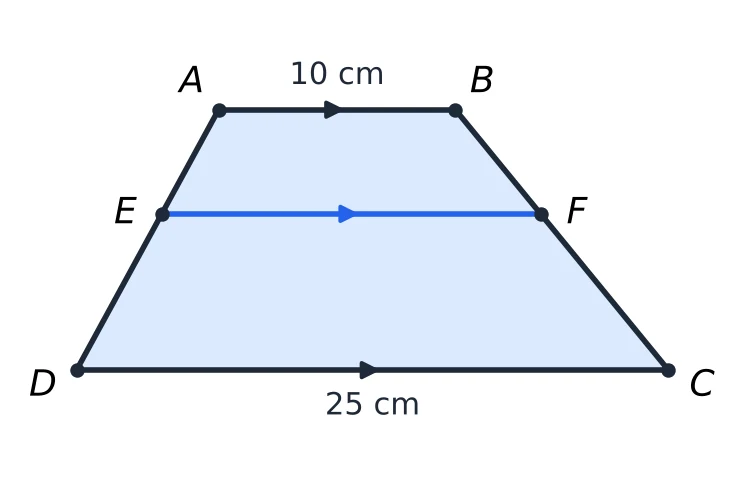
Answer. Draw the diagonal AC, meeting EF at G. In triangle ADC, and AE : AD = 2 : 5, so EG = cm. In triangle CAB, and CG : CA = CF : CB = 3 : 5, so GF = cm. EF = 10 + 6 = (d) 16 cm. The formula gives the same: . Swapping the weights in the formula gives 19 cm.
Question 15
In triangle ABC, D is on BC with BD : DC = 2 : 3, and E is the midpoint of AD. If the area of triangle ABC is 80 sq cm, what is the area of triangle BED? (a) 32 sq cm (b) 24 sq cm (c) 16 sq cm (d) 8 sq cm
Answer. Triangles ABD and ADC have the same height from A, so area(ABD) = sq cm. Inside triangle ABD, triangles BAE and BED have the same height from B and equal bases (AE = ED), so area(BED) = = (c) 16 sq cm.
Question 16
D, E and F are points on BC, CA and AB of triangle ABC with BD : DC = CE : EA = AF : FB = 1 : 2. If the area of triangle ABC is 63 sq cm, what is the area of triangle DEF? (a) 7 sq cm (b) 21 sq cm (c) 14 sq cm (d) 28 sq cm
Answer. Look at the corner triangle AFE. AF is of AB and AE is of AC (since CE : EA = 1 : 2). So its area is of the whole, which is 14 sq cm. The other two corners are the same, 42 sq cm together. Triangle DEF is what is left: 63 − 42 = (b) 21 sq cm.
Question 17
In triangle ABC, AB = 14 cm, AC = 21 cm and BC = 20 cm. The bisector of angle A meets BC at D. What is BD? (a) 8 cm (b) 12 cm (c) 10 cm (d) 7 cm
Answer. The bisector cuts BC in the ratio of the sides next to it: BD : DC = AB : AC = 14 : 21 = 2 : 3. BC is 5 parts of 4 cm, so BD = 2 × 4 = (a) 8 cm.
Question 18
In triangle ABC, the bisector of angle A meets BC at D. If BD = 3 cm, DC = 5 cm and AB = 6 cm, what is AC? (a) 3.6 cm (b) 8 cm (c) 2.5 cm (d) 10 cm
Answer. , so and AC = (d) 10 cm. The triangle then has sides 6, 8 and 10 cm, which is fine.
Question 19
[Tier 2] In triangle ABC, AB = 9 cm, AC = 6 cm and BC = 5 cm. The bisector of the exterior angle at A meets BC produced at E. What is CE? (a) 15 cm (b) 2 cm (c) 10 cm (d) 3 cm
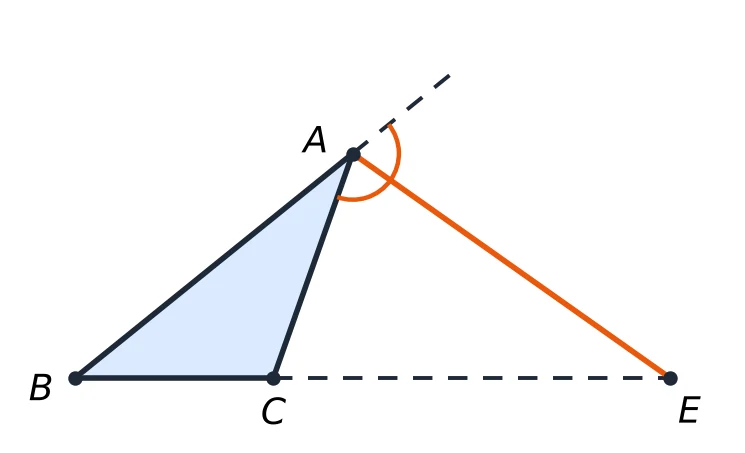
Answer. The external bisector divides BC externally in the ratio AB : AC = 9 : 6 = 3 : 2, so BE : CE = 3 : 2. AC is the shorter side, so E lies beyond C, and BE − CE = BC = 5 cm. One part is 5 cm, so CE = 2 × 5 = (c) 10 cm and BE = 15 cm.
Question 20
In triangle ABC, and AD is perpendicular to BC. If BD = 4 cm and DC = 9 cm, what is AD? (a) 6.5 cm (b) 6 cm (c) 5 cm (d) 13 cm
Answer. The altitude to the hypotenuse squared equals the product of the two pieces: , so AD = (b) 6 cm. 6.5 cm is half of BC, which is the median to the hypotenuse, not the altitude.
Question 21
In triangle ABC, , AB = 9 cm and AC = 12 cm. AD is the altitude to BC. What is AD? (a) 7.5 cm (b) 5.4 cm (c) 9.6 cm (d) 7.2 cm
Answer. First BC = cm. Writing the area two ways, AB × AC = BC × AD, so AD = = (d) 7.2 cm.
Question 22
In triangle ABC, and AD is perpendicular to BC. If BD = 5 cm and BC = 20 cm, what is AB? (a) 10 cm (b) cm (c) cm (d) 15 cm
Answer. A leg squared is the piece next to it times the whole hypotenuse: , so AB = (a) 10 cm.
Question 23
ABCD is a trapezium with and AB = 2 DC. Its diagonals meet at O. If the area of triangle COD is 12 sq cm, what is the area of the trapezium? (a) 84 sq cm (b) 60 sq cm (c) 108 sq cm (d) 144 sq cm
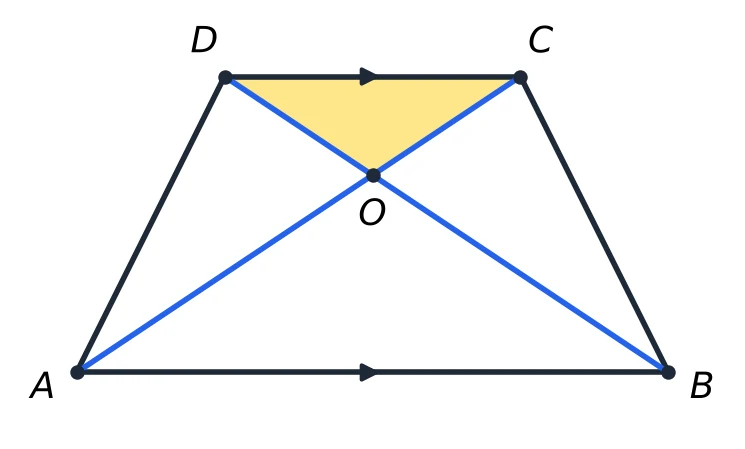
Answer. Triangles AOB and COD are similar with ratio 2 : 1, so area(AOB) = 4 × 12 = 48 sq cm. Each side triangle is sq cm. Total: 12 + 48 + 24 + 24 = (c) 108 sq cm, which is also .
Question 24
A girl 1.5 m tall walks away from the foot of a lamp post at 1.4 m per second. The lamp is 5 m above the ground. How long is her shadow after 5 seconds? (a) 2.1 m (b) 3 m (c) 10 m (d) 2.5 m
Answer. After 5 seconds she is 1.4 × 5 = 7 m from the foot of the lamp. Let the shadow be m. The girl and the lamp make similar triangles with the same corner at the tip of the shadow, so . Then , so and = (b) 3 m. Taking only the 7 m as the base of the lamp's triangle gives 2.1 m; that base must run all the way to the tip of the shadow.