
Four Special Lines and the Centres They Make
A triangle has four kinds of special lines. Draw the three lines of one kind and they always pass through a single point. That point is one of the four centres of the triangle. SSC asks about each centre in two ways: the angle it makes with two of the vertices, and its distance from the vertices or the sides.
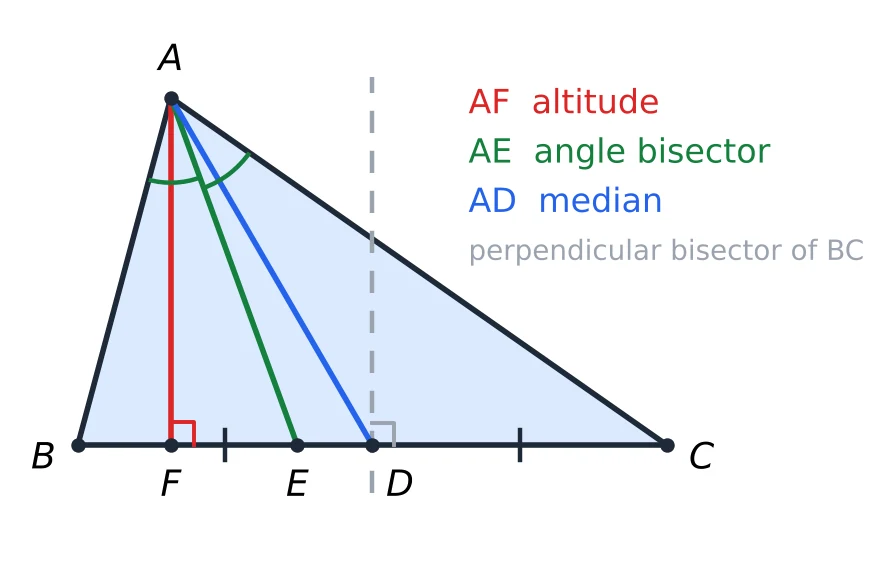
Take triangle ABC with the points D, E and F on side BC.
- Median AD joins A to the midpoint of BC, so BD = DC.
- Angle bisector AE cuts angle A into two equal halves.
- Altitude AF meets BC at a right angle. If angle B or angle C is obtuse, F lands on BC extended.
- Perpendicular bisector of BC goes through the midpoint D at a right angle to BC. It belongs to the side, not to a vertex, so it usually misses A completely.
| The three lines | Meet at | Letter | What is special about it |
|---|---|---|---|
| Medians | Centroid | G | Cuts every median in the ratio 2 : 1 |
| Angle bisectors | Incentre | I | Same distance from all three sides (centre of the incircle) |
| Perpendicular bisectors | Circumcentre | O | Same distance from all three vertices (centre of the circumcircle) |
| Altitudes | Orthocentre | H | Where the three heights cross |
Inside or outside? The centroid and the incentre are always inside the triangle. The circumcentre and the orthocentre are inside only when the triangle is acute. In a right triangle they sit on the triangle itself, and in an obtuse triangle they move outside. Each centre has its own part below with the details.
The bisector sits in the middle. In the figure, F, E and D are three different points. Whenever AB and AC are unequal, the foot of the bisector from A lies between the foot of the altitude and the midpoint. So the angle bisector from a vertex always lies between the altitude and the median from that vertex.
Isosceles and equilateral triangles. If AB = AC, the median, the bisector and the altitude from A are one and the same line, and the perpendicular bisector of BC runs along it too. So all four centres lie on this line of symmetry, though at different heights on it. In an equilateral triangle this happens from every vertex, so the four centres become a single point.
[SSC Tip] One-line theory questions are common. "Equidistant from the vertices" means the circumcentre, "equidistant from the sides" means the incentre, "point where the medians meet" means the centroid, and "point where the altitudes meet" means the orthocentre. To keep the first two apart: the incentre is the centre of the incircle, which sits inside and touches the sides.
The Centroid: Medians Cut in the Ratio 2 : 1
The three medians of every triangle meet at one point inside it, the centroid G. It is the balance point of the triangle: a cardboard triangle rests level on a pencil tip placed at G.
G cuts every median in the ratio 2 : 1, with the longer part on the vertex side:
The same holds for BG : GE and CG : GF. If the median AD is 15 cm, then AG = 10 cm and GD = 5 cm. Going the other way, GD = 4 cm gives AD = 12 cm and AG = 8 cm.
Why 2 : 1. E and F are the midpoints of AC and AB, so FE is parallel to BC and half as long (the midpoint theorem, from Similar Triangles and Proportionality). Triangles GEF and GBC then have the same shape, with sides in the ratio 1 : 2. So GE is half of GB, and the same works for the other medians.
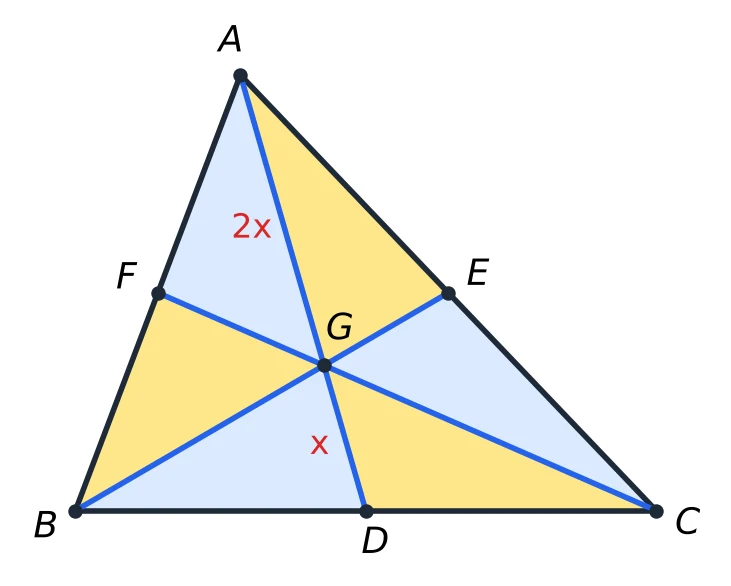
Six equal areas. A median splits a triangle into two parts of equal area, because BD = DC and both parts have the same height from A. Draw all three medians and the triangle breaks into six small triangles, and all six have the same area:
From this:
- triangles BGC, CGA and AGB are each of the whole
- a quadrilateral such as AFGE or BDGF (two small triangles) is also of the whole
- triangles ABD and ABE are each of the whole
With area(ABC) = 72 sq cm, each small triangle is 12 sq cm, triangle BGC is 24 sq cm and quadrilateral BDGF is 24 sq cm.
Height of G. Since GD is one third of AD, G is one third as high above BC as A is. So the distance from G to BC is of the altitude from A.
GD is half of AG and a third of AD. If AG = 8 cm, then AD = 8 + 4 = 12 cm. Doubling AG to get 16 cm is the usual slip, and 16 will be among the options.
Median Facts: the Hypotenuse, Sums of Squares and Medians at Right Angles
The median to the hypotenuse. In a right triangle, the median drawn to the hypotenuse is half the hypotenuse. With angle A = 90° and D the midpoint of BC,
So D is the same distance from all three vertices: the midpoint of the hypotenuse is the circumcentre. The reverse is also true: if the median AD equals half of BC, then angle A is 90°.
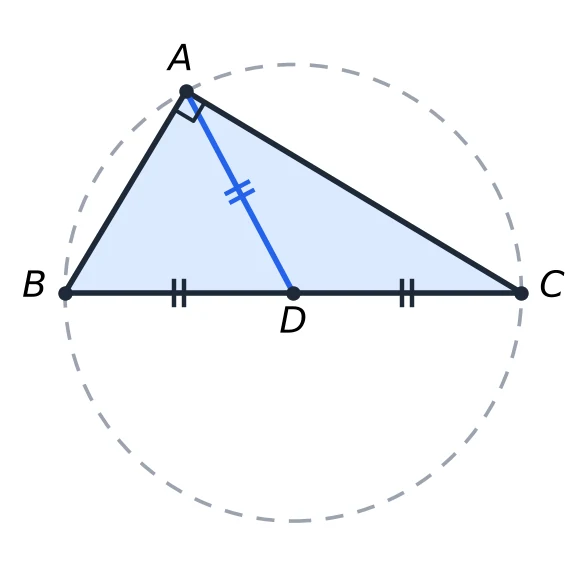
With legs 9 cm and 12 cm, the hypotenuse is 15 cm, the median to it is 7.5 cm, and the centroid is cm from the right-angle vertex. That is always one third of the hypotenuse.
Sum of the squares of the medians. For any triangle,
For sides 4 cm, 6 cm and 8 cm, the squares add to 16 + 36 + 64 = 116, so the squares of the medians add to . Because and so on, the same fact gives , here .
A single median comes from Apollonius' theorem (in Triangles: Angles, Sides, Congruence and Pythagoras): . Add the three versions of this and the identity above appears.
Medians at right angles. Say medians BE and CF meet at G at a right angle. Triangle BGC is then right-angled at G, and GD is the median to its hypotenuse BC, so . Since the whole median AD is 3 times GD,
The second result comes from Apollonius: .
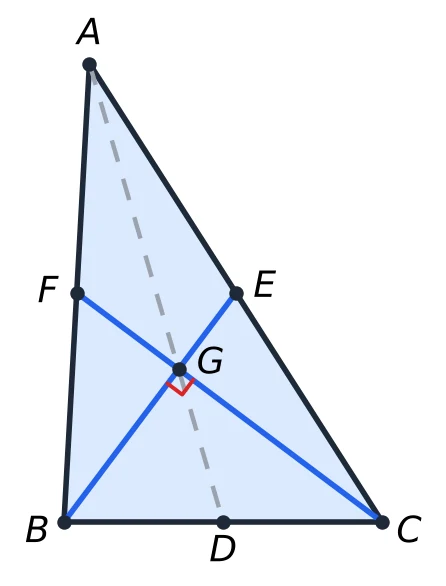
If instead the two medians are given, say BE = 18 cm and CF = 24 cm, take two thirds of each: BG = 12 cm and CG = 16 cm. Pythagoras in triangle BGC gives BC = 20 cm, and then AD = 30 cm.
In the right-angle-at-G question, never use the whole medians in Pythagoras. Only the parts from the vertices to G (two thirds of each median) form the right triangle with BC.
The Incentre and
The three angle bisectors meet at the incentre I. Every point on the bisector of an angle is the same distance from the two arms of that angle, so I is the same distance from all three sides. That distance is the inradius , and the circle with centre I and radius touches all three sides from inside. This is the incircle. I always lies inside the triangle.
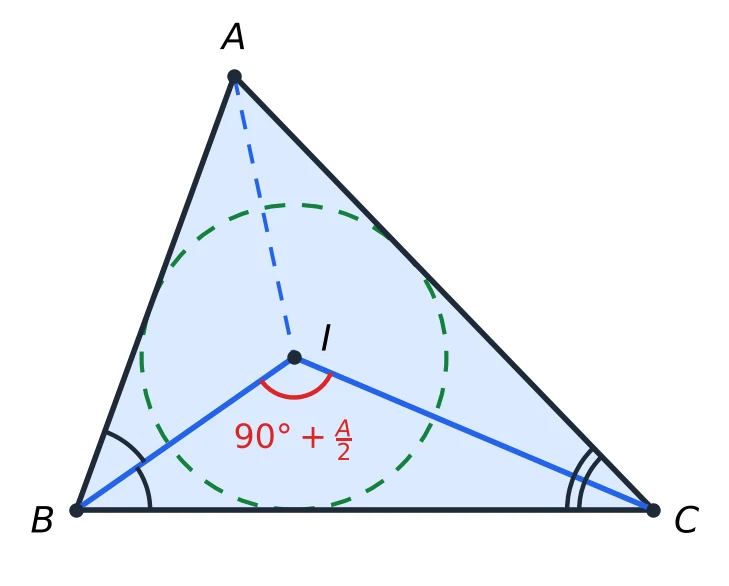
The angle at I. In triangle BIC the angles at B and C are halves: and . Since ,
In the same way and , and the three angles round I add up to 360°.
- A = 70° gives .
- gives = 22°, so A = 44°.
- always lies between 90° and 180°, so an option such as 80° for can be crossed out at once.
Angle chasing with I. Because AI, BI and CI are bisectors, the angle between a vertex's bisector and a side at that vertex is half the vertex angle. If and , then B = 72°, C = 44° and A = 64°. Then , which matches 180° − 36° − 22° from triangle BIC directly.
The three half-angles always add to 90°: . Given two of them, the third is free.
[SSC Tip] Four angle formulas look alike and SSC likes to put all four in the options. For A = 70°: incentre = 125°, excentre = 55°, orthocentre = 110°, circumcentre = 140°. Know which formula belongs to which centre.
Excentres: When the Bisectors Are External
At vertex B there are two bisectors. The internal one halves angle B. The external one halves the exterior angle at B, the angle between BC and AB extended. These two bisectors are always at right angles, because their halves add up to .
The excentre. The external bisectors at B and C meet at a point E outside the triangle, beyond side BC. The internal bisector of angle A passes through E as well. E is the same distance from BC and from AB and AC extended, so it is the centre of a circle (an excircle) that touches BC and the other two sides extended. A triangle has three excentres, one opposite each vertex.
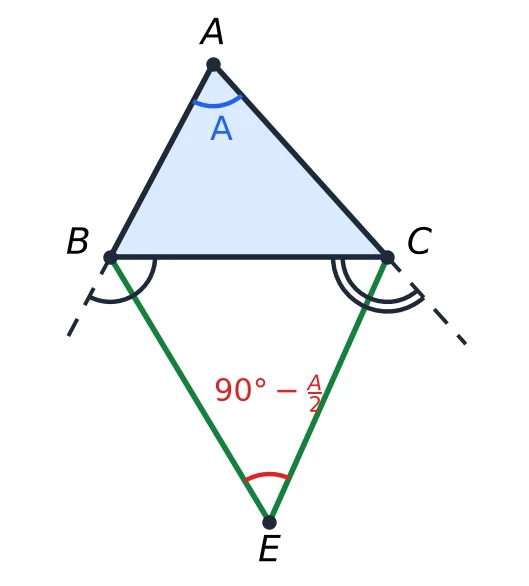
The exterior angle at B is 180° − B, so half of it is , and the same at C. In triangle BEC,
So . (Also IB is perpendicular to BE and IC to CE, so B and C both lie on the circle with diameter IE.)
One internal, one external. Now take the internal bisector of B and the external bisector of C, meeting at K. The exterior angle at C equals A + B (exterior angle theorem), so its half is . That half is also an exterior angle of triangle BKC, so it equals the two opposite interior angles, and :
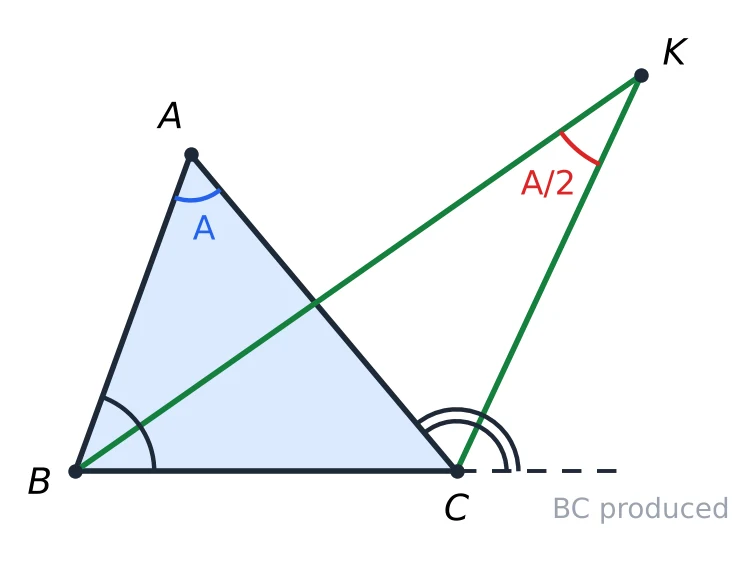
| Bisectors at B and C | Angle where they meet |
|---|---|
| both internal | |
| both external | |
| internal at B, external at C |
With A = 64°, the three answers are 122°, 58° and 32°.
Read the words. "Bisectors of the exterior angles at B and C" means the minus formula. If the question says "the bisector of angle B and the bisector of the exterior angle at C" (or "angle ACD, where BC is produced to D"), the answer is just half of A. A ten-second rough figure shows which case you are in.
Inradius and the Tangent Lengths
Write , , for the sides BC, CA, AB, for the semi-perimeter and for the area. Join I to the three vertices. This cuts triangle ABC into triangles IBC, ICA and IAB, with bases , , and the same height (a radius drawn to a point of contact meets the side at a right angle). Adding their areas,
When only the sides are given, Heron's formula gives the area (the Mensuration 2D chapter covers areas in full). For sides 17 cm, 25 cm and 28 cm: , so , and cm.
Tangent lengths. Let the incircle touch BC, CA and AB at D, E and F. The two tangents from a point to a circle are equal, so AE = AF, BD = BF and CD = CE. Solving these with the three sides gives
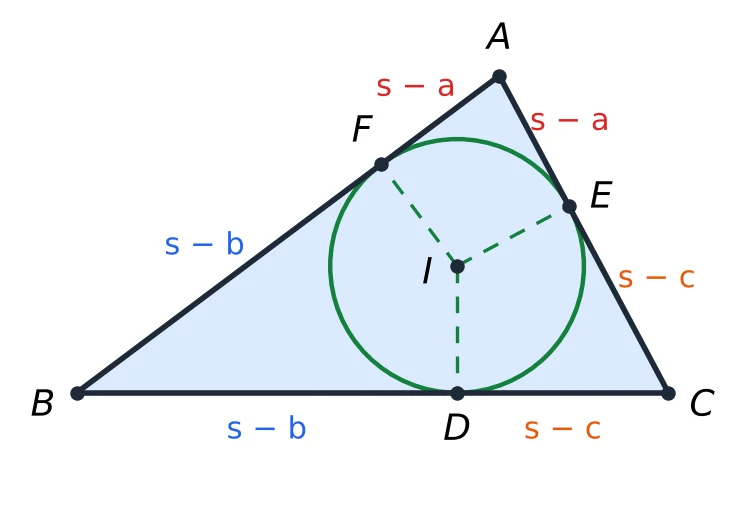
For , , (so ): AF = 7, BD = 18 and CE = 10. Check: AB = 7 + 18 = 25, BC = 18 + 10 = 28 and CA = 10 + 7 = 17. Each tangent length is minus the side opposite that vertex.
Right triangle. Put the right angle at C, with legs and and hypotenuse . The two radii to the legs and the legs themselves make a small square of side at C. So the tangents from C are both , the tangents from A and B are and , and these two add up to the hypotenuse:
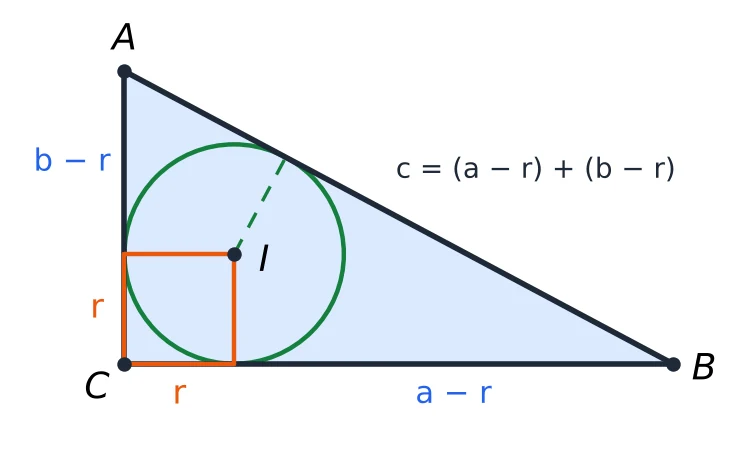
For the 8, 15, 17 triangle, , and the general formula agrees: .
[SSC Tip] Divide by the semi-perimeter, not the perimeter. Dividing by gives exactly half the right answer, and that half is usually one of the options.
The Circumcentre and
The perpendicular bisectors of the three sides meet at the circumcentre O. Any point on the perpendicular bisector of BC is the same distance from B and C, so O is the same distance from all three vertices: . The circle with centre O and radius passes through A, B and C. It is the circumcircle, and is the circumradius.
| Triangle | Where O lies |
|---|---|
| acute | inside |
| right | at the midpoint of the hypotenuse |
| obtuse | outside, beyond the longest side |
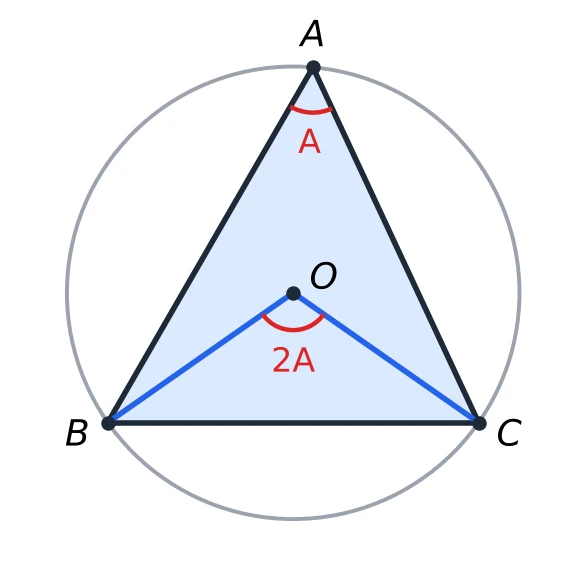
The angle at O. stands at the centre on the arc BC, and A is a point on the circle, so when A is acute (the full theorem is in Circles: Chords, Arcs and Angles). Since OB = OC, triangle OBC is isosceles, and its two base angles share what is left of 180°:
- A = 55° gives and .
- gives A = 90° − 28° = 62°.
- In the same way , from the isosceles triangle OAB.
When A is obtuse. O moves to the other side of BC, and 2A is now the reflex angle at O. The ordinary angle BOC is what is left of 360°:
With A = 110°, and .
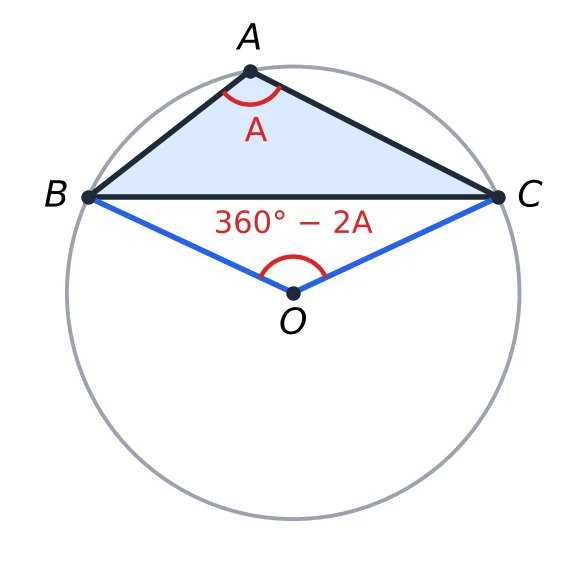
If the obtuse angle is at B or C instead, A is still acute and works as usual. Only the angle that faces BC matters.
If A is more than 90°, 2A is more than 180° and cannot be an angle of triangle BOC. Take it away from 360°. Questions on obtuse triangles nearly always keep the value 2A among the options.
Circumradius:
For any triangle with sides , , and area ,
Where it comes from. Draw the diameter AP of the circumcircle and the altitude AF to BC. In triangle ABP the angle at B is 90° (angle in a semicircle), and because they stand on the same arc AB. So triangles ABP and AFC have the same angles, and , that is . Putting gives , which is the formula.
For sides 17, 25 and 28 cm (area 210 sq cm, from the inradius part above):
Right triangle. The hypotenuse is a diameter of the circumcircle (its midpoint is the circumcentre), so
For legs 11 and 60 and hypotenuse 61: cm and cm. Putting the two formulas together, the legs add up to , so the perimeter of a right triangle is . Here that is 10 + 122 = 132 = 11 + 60 + 61.
Isosceles triangle. Let , base and height . O lies on AD, at height above D. In right triangle OBD, , which simplifies to
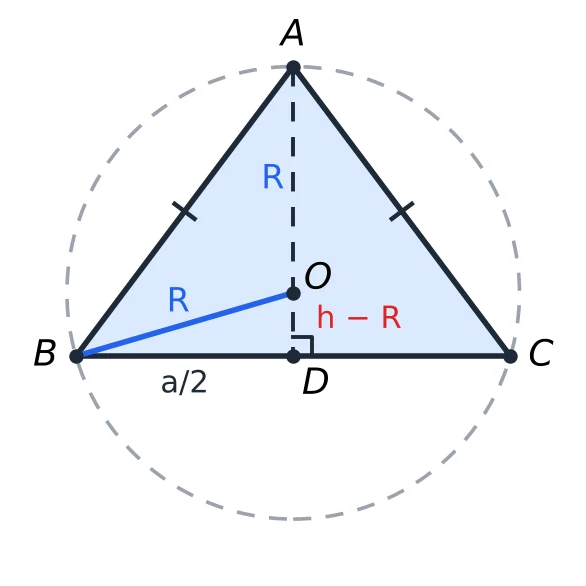
For sides 10, 10 and 12: , so cm. The area is 48 and , so cm.
Get the area first. With the area in hand, and are one line each. For a right triangle skip all that: is half the hypotenuse and is half of (sum of legs minus hypotenuse).
The Orthocentre and
The three altitudes AD, BE and CF meet at the orthocentre H.
| Triangle | Where H lies |
|---|---|
| acute | inside |
| right | at the vertex with the right angle (the two legs are themselves altitudes) |
| obtuse | outside, beyond the obtuse vertex |
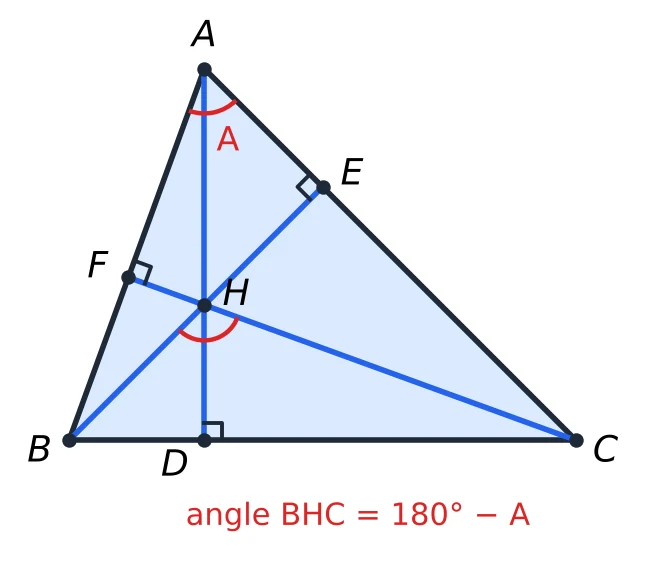
The angle at H. Look at quadrilateral AFHE. Its angles at E and F are right angles, so its other two angles add up to 180°, and . is vertically opposite to , so
and likewise and . With A = 65°, . Going back, means A = 40°.
Angles next to H. Each altitude makes a right triangle with a side, so the small angles near the vertices are all "90° minus something". In right triangle BEC, . In the same way:
The rule: the angle between an altitude and a side at a vertex is 90° minus the angle at the other end of that side.
Obtuse triangles. If A is obtuse, H lies outside beyond A, and still holds (A = 120° gives 60°). If the obtuse angle is at B or at C instead, then equals A itself.
Mixing up (orthocentre) and (incentre) is the mistake to watch for here. They give the same value only when A = 60°, so a wrong formula is caught by any other angle. When two altitudes and some angles are given, write down the "90° minus" angles first; the right triangles do all the work.
The Equilateral Triangle: All Centres in One Place
In an equilateral triangle with side , every median is also an altitude and an angle bisector, and it lies along a perpendicular bisector. So G, I, O and H are the same point. Every one of these lines has the length of the height:
The centre cuts each median in the ratio 2 : 1. Its distance to a vertex is and its distance to a side is , so
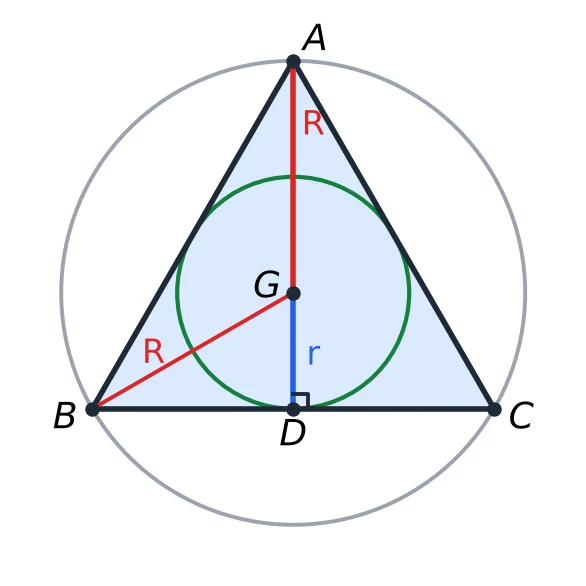
For cm: , and cm. Going the other way, cm gives cm, cm and cm.
The general formulas agree. With and , and .
The two circles have radii in the ratio 1 : 2, so the circumcircle has 4 times the area of the incircle.
Any point inside. From any point P inside an equilateral triangle, the perpendiculars to the three sides add up to the height. To see why, join P to the vertices. The three small triangles have the same base , so , and . If the three distances are 3, 4 and 5 cm, then cm and the side is cm.
[SSC Tip] Memorise the chain . Any one of , , or gives all the others: multiply by 2 for , by 3 for , and by for the side. And if a question says two centres of a triangle coincide (say the centroid and the incentre), the triangle is equilateral.
Bisector and Altitude, the Euler Line and
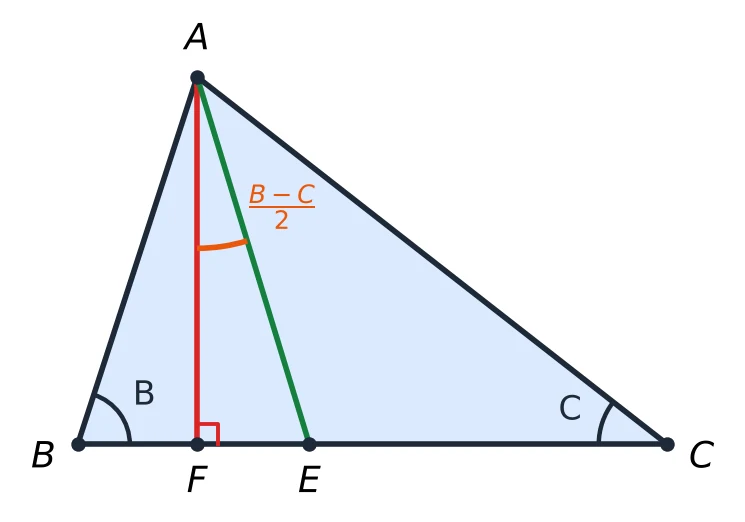
The angle between the bisector and the altitude from A. Let AE bisect angle A and let AF be the altitude, with B larger than C. In right triangle ABF, . Also . The gap between the two lines is the difference:
In general it is , half the difference of the other two angles. With B = 72° and C = 38°, the angle is 17°. When B = C the two lines are the same and the angle is 0.
[Tier 2] The Euler line. In every triangle the circumcentre O, the centroid G and the orthocentre H lie on one straight line, called the Euler line. G is between the other two, and
So if OG = 5 cm, then GH = 10 cm and OH = 15 cm. A second fact on the same line of thought: AH is twice the distance from O to BC.
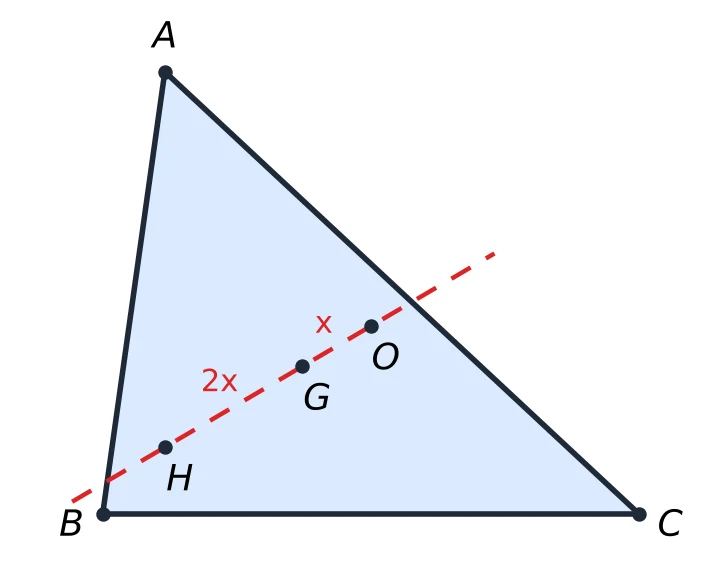
The incentre is not on this line in general; it is only when the triangle is isosceles. In an isosceles triangle the Euler line is the line of symmetry, and in an equilateral triangle it shrinks to a single point.
[Tier 2] The distance between O and I.
For the 10, 10, 12 triangle above (, ): , so OI = cm. Since can never be negative, in every triangle, with only for an equilateral triangle, where O and I are the same point.
For the bisector-and-altitude angle, angle A itself plays no part; only B and C matter. If a question gives A and B, find C first, then halve the difference.
Solved Examples
Question 1
The medians AD and BE of triangle ABC meet at G. If AD = 18 cm and BE = 24 cm, what is AG + GE? (a) 20 cm (b) 28 cm (c) 21 cm (d) 14 cm
Answer. G cuts each median 2 : 1 from the vertex. So AG is two thirds of AD: cm. GE is the short part of BE, one third of it: cm. Adding, AG + GE = 12 + 8 = (a) 20 cm. Taking BG (16 cm) in place of GE gives 28 cm.
Question 2
G is the centroid of triangle ABC, whose area is 96 sq cm. D and F are the midpoints of BC and AB. What is the area of quadrilateral BDGF? (a) 24 sq cm (b) 48 sq cm (c) 32 sq cm (d) 16 sq cm
Answer. The three medians cut the triangle into six small triangles of equal area, sq cm each. Quadrilateral BDGF is made of two of them (triangles BDG and BGF), so its area is 2 × 16 = (c) 32 sq cm.
Question 3
In triangle ABC, , AB = 12 cm and AC = 16 cm. G is the centroid. What is the length of AG? (a) 10 cm (b) cm (c) cm (d) 8 cm
Answer. First the hypotenuse: cm. The median from the right angle to the hypotenuse is half of it, so AD = 10 cm. G is two thirds of the way down that median: = (b) cm. A quick check: AG is always one third of the hypotenuse in a right triangle.
Question 4
Medians BE and CF of triangle ABC meet at G at right angles. If BE = 12 cm and CF = 9 cm, what is the length of the third median AD? (a) 10 cm (b) 5 cm (c) 22.5 cm (d) 15 cm
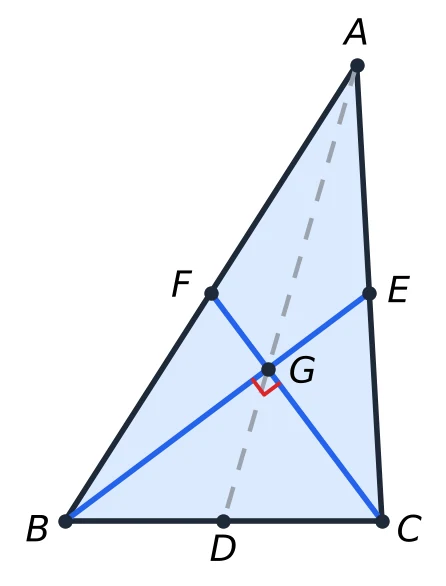
Answer. Only the vertex parts of the medians make the right triangle at G. BG = cm and CG = cm, so in right triangle BGC, cm. GD is the median to the hypotenuse of triangle BGC, so GD = 5 cm. G cuts the median AD in the ratio 2 : 1, so AD = 3 × GD = (d) 15 cm. Putting the whole medians into Pythagoras gives a wrong BC of 15 cm, and from it the wrong 22.5 cm.
Question 5
The sides of a triangle are 6 cm, 8 cm and 12 cm. What is the sum of the squares of its three medians (in sq cm)? (a) 183 (b) 244 (c) 122 (d)
Answer. Use . The squares of the sides add to 36 + 64 + 144 = 244. So the medians give = (a) 183. (The triangle is real: 6 + 8 > 12.)
Question 6
In triangle ABC, and BD is the median to AC. If BD = 6.5 cm and AB = 5 cm, what is BC? (a) 13 cm (b) 8 cm (c) 12 cm (d) 10 cm
Answer. The median to the hypotenuse is half the hypotenuse, so AC = 2 × 6.5 = 13 cm. Now Pythagoras: = (c) 12 cm.
Question 7
I is the incentre of triangle ABC and . What is ? (a) 63° (b) 27° (c) 36° (d) 54°
Answer. For the incentre, . So and A = (d) 54°.
Question 8
In triangle ABC, I is the incentre, and . What is ? (a) 68° (b) 124° (c) 56° (d) 34°
Answer. BI and CI are bisectors, so each given angle is half a vertex angle: B = 2 × 32° = 64° and C = 2 × 24° = 48°. Then A = 180° − 64° − 48° = (a) 68°. A check: should be 90° + 34° = 124°, and in triangle BIC it is 180° − 32° − 24° = 124°. Good.
Question 9
In triangle ABC, . BC is produced to D. The bisector of and the bisector of meet at K. What is ? (a) 52° (b) 38° (c) 128° (d) 76°
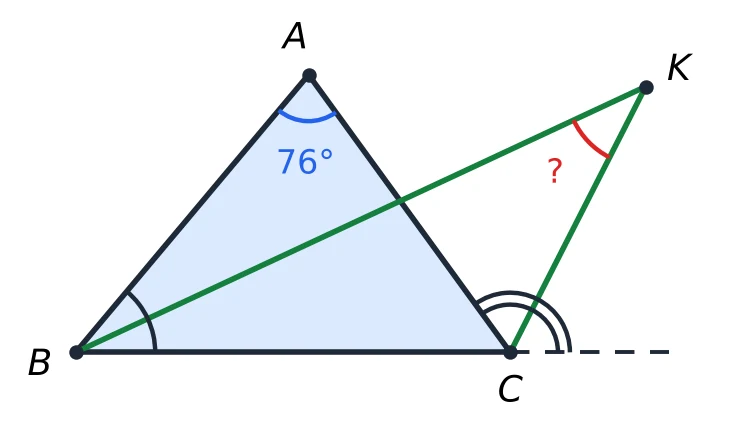
Answer. is the exterior angle at C, so it equals A + B, and its half is . In triangle BKC this half is an exterior angle at C, so it equals . Taking from both sides leaves = (b) 38°.
Question 10
The bisectors of the exterior angles at B and C of triangle ABC meet at E. If , what is ? (a) 33° (b) 114° (c) 66° (d) 123°
Answer. Both bisectors are external, so . Then , and A = (c) 66°.
Question 11
What is the inradius of a triangle with sides 9 cm, 10 cm and 17 cm? (a) 2 cm (b) 1 cm (c) 4 cm (d) 3 cm
Answer. First the semi-perimeter: . Heron's formula gives the area: sq cm. Then = (a) 2 cm. Dividing by the full perimeter 36 gives the wrong 1 cm. (The triangle is obtuse, since , but works for every triangle.)
Question 12
The incircle of triangle ABC touches BC, CA and AB at D, E and F. If AB = 15 cm, BC = 19 cm and CA = 10 cm, what is BD? (a) 7 cm (b) 12 cm (c) 3 cm (d) 9.5 cm
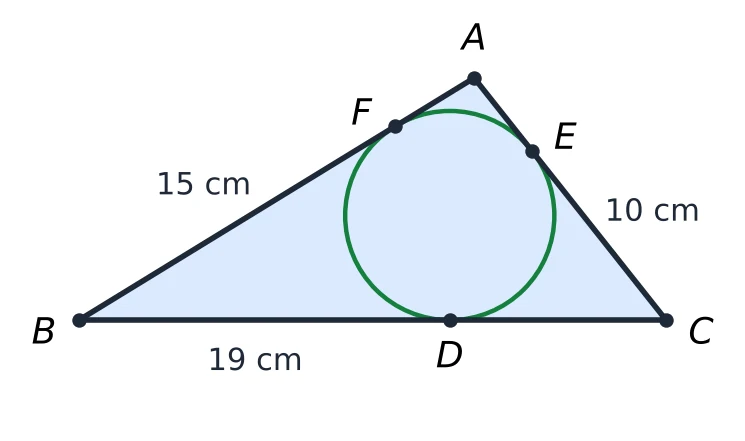
Answer. The semi-perimeter is . The tangent length from B is minus the side opposite B, and the side opposite B is CA. So BD = 22 − 10 = (b) 12 cm. Check: , and BD + CD = 19 = BC.
Question 13
The two shorter sides of a right triangle are 12 cm and 35 cm. What is its inradius? (a) 10 cm (b) 18.5 cm (c) 6 cm (d) 5 cm
Answer. The hypotenuse is cm. For a right triangle = (d) 5 cm. Area over semi-perimeter agrees: .
Question 14
O is the circumcentre of an acute-angled triangle ABC, and . What is ? (a) 68° (b) 112° (c) 56° (d) 34°
Answer. OB = OC (both are radii), so triangle OBC is isosceles and too. Then . The angle at the centre is twice the angle at A, so A = = (c) 56°. In one step: .
Question 15
In triangle ABC, and O is the circumcentre. What is ? (a) 130° (b) 230° (c) 65° (d) 115°
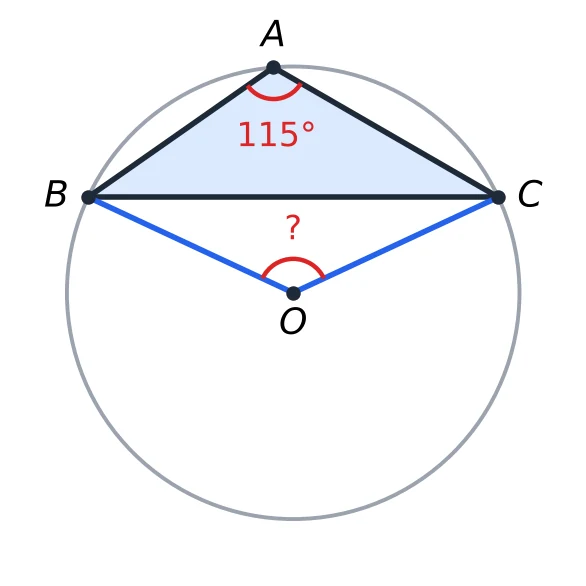
Answer. A is obtuse, so O lies outside the triangle, on the other side of BC from A. The angle 2A = 230° is the reflex angle at O. The angle BOC itself is 360° − 230° = (a) 130°. 230° cannot be an angle of triangle BOC.
Question 16
In triangle ABC, AB = AC = 15 cm and BC = 18 cm. What is its circumradius? (a) 9 cm (b) cm (c) 12 cm (d) cm
Answer. The height from A falls on the midpoint of BC: cm. For an isosceles triangle = (d) cm. The general formula agrees: area = , and .
Question 17
A right triangle has circumradius 8.5 cm and inradius 3 cm. What is its perimeter? (a) 34 cm (b) 40 cm (c) 37 cm (d) 46 cm
Answer. The hypotenuse is a diameter: cm. From , the legs add to cm. Perimeter = 23 + 17 = (b) 40 cm. (The shortcut: perimeter .) The legs really exist: and give 8 and 15.
Question 18
What is the circumradius of a triangle with sides 13 cm, 20 cm and 21 cm? (a) cm (b) cm (c) cm (d) cm
Answer. Area first. , and Heron gives sq cm. Then = (a) cm. cm treats the longest side as a diameter, which is true only for a right triangle.
Question 19
H is the orthocentre of an acute-angled triangle ABC and . What is ? (a) 64° (b) 76° (c) 52° (d) 38°
Answer. For the orthocentre, . So A = 180° − 128° = (c) 52°. Using the incentre rule by mistake gives 76°.
Question 20
In acute-angled triangle ABC, the altitudes BE and CF meet at H. If and , what is ? (a) 36° (b) 28° (c) 64° (d) 26°
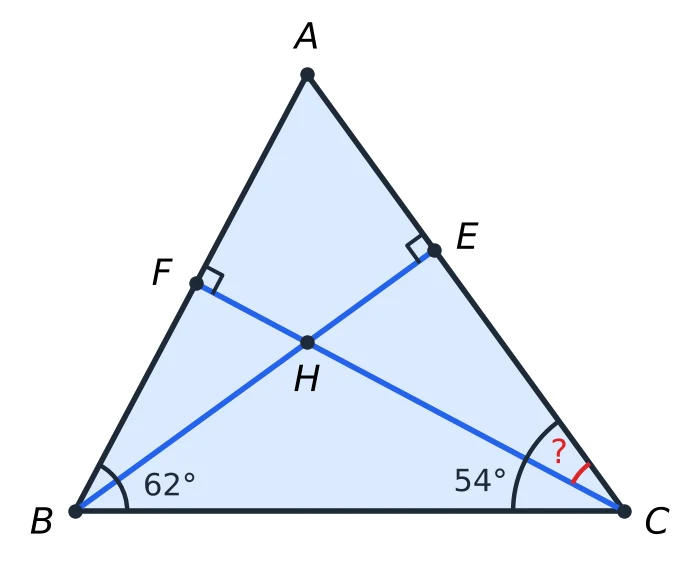
Answer. First the third angle: A = 180° − 62° − 54° = 64°. CF is perpendicular to AB, so triangle AFC has a right angle at F. Its angle at C is , and its angle at A is 64°, so = (d) 26°.
Question 21
P is a point inside an equilateral triangle. The perpendicular distances from P to the three sides are 3 cm, 4 cm and 8 cm. What is the side of the triangle? (a) 15 cm (b) cm (c) cm (d) 30 cm
Answer. The three distances always add up to the height of the triangle, so cm. Then , so = (b) cm.
Question 22
The inradius of an equilateral triangle is 4 cm. What is the length of its side? (a) cm (b) 12 cm (c) cm (d) 8 cm
Answer. In an equilateral triangle , so = (c) cm. Or use the chain . The height is 3 × 4 = 12 cm, and .
Question 23
In triangle ABC, and . What is the angle between the bisector of and the altitude from A? (a) 24° (b) 22° (c) 34° (d) 12°
Answer. The angle between the bisector and the altitude from A is half the difference of the other two angles: = (d) 12°. Longer way: A = 68°, so the bisector makes 34° with AB, while the altitude makes 90° − 68° = 22° with AB. The gap is 34° − 22° = 12°.
Question 24
[Tier 2] O, G and H are the circumcentre, centroid and orthocentre of a scalene triangle. If OH = 12 cm, what is GH? (a) 4 cm (b) 8 cm (c) 6 cm (d) 9 cm
Answer. O, G and H lie on the Euler line with HG = 2GO. So OH is split 1 : 2, giving OG = 4 cm and GH = (b) 8 cm. G does not cut OH in half, so 6 cm is wrong.