
The Angle Sum of a Triangle
The three angles of every triangle add up to 180°. To see why, draw the line XY through A parallel to BC.
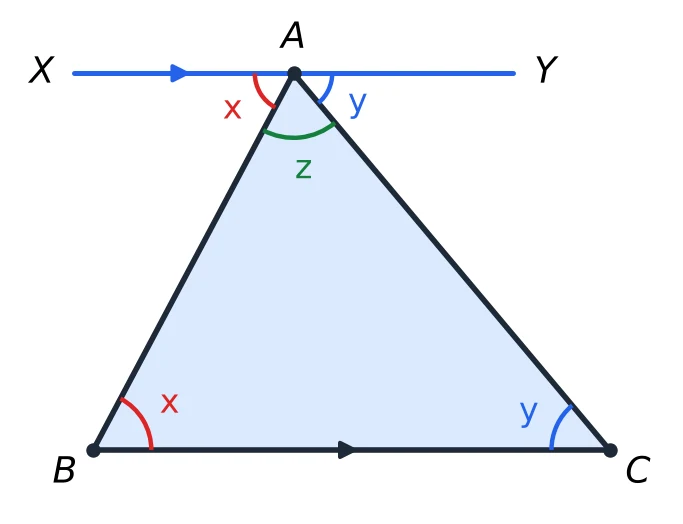
and (alternate angles), and the three angles at A lie along the straight line XY. So , which says exactly that .
Types of triangle.
| By angles | By sides |
|---|---|
| Acute: all three angles less than 90° | Scalene: no two sides equal |
| Right: one angle exactly 90° | Isosceles: two sides equal |
| Obtuse: one angle more than 90° | Equilateral: all three sides equal |
A triangle can have at most one right or obtuse angle, so at least two of its angles are always acute. If one angle equals the sum of the other two, it must be half of 180°, so the triangle is right-angled.
Angles in a ratio. Angles in the ratio 2 : 3 : 4 are 9 parts of 20° each: 40°, 60° and 80°.
Angles given by differences. If and , write all three in terms of : and . The sum gives , so , and .
Sums of pairs. If and , adding them counts twice and everything else once. So , and then and .
Equal multiples. "" means the angles are in the ratio . Multiply by 6 to clear the fractions: 3 : 2 : 1. So the angles are 90°, 60° and 30°, and indeed .
[SSC Tip] In "" questions the trap is to share 180° in the ratio 2 : 3 : 6. The bigger the multiplier, the smaller the angle, so the ratio is made of the reciprocals.
The Exterior Angle Theorem
Extend one side of a triangle, say BC beyond C to D. The angle between the extension and the side CA is an exterior angle of the triangle.
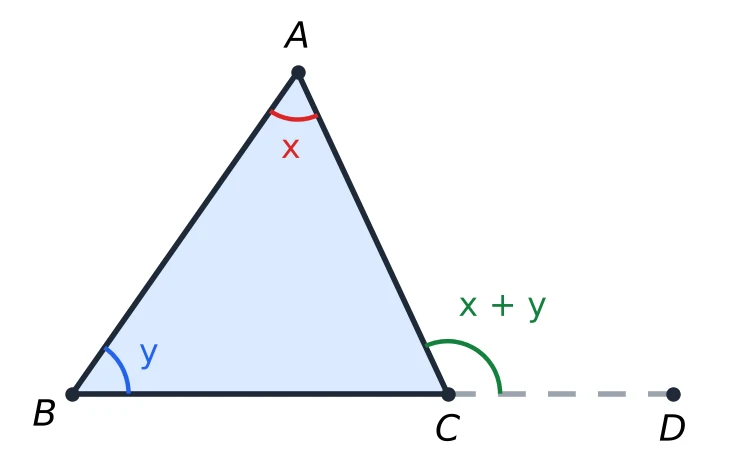
An exterior angle equals the sum of the two interior angles opposite to it. The reason: and form a linear pair, so , and the angle sum says is also . Two things follow. An exterior angle is bigger than either of the opposite interior angles. And the three exterior angles, one at each corner, add up to 360°, as for every polygon.
With an exterior angle of 115° at C and : and .
A side produced both ways. Extend BC beyond B and beyond C, and call the exterior angles there and . Then and , so
With and , (and , ).
Bisector of an interior angle meets bisector of an exterior angle. In triangle ABC, let the bisector of meet the bisector of the exterior angle at E. Then
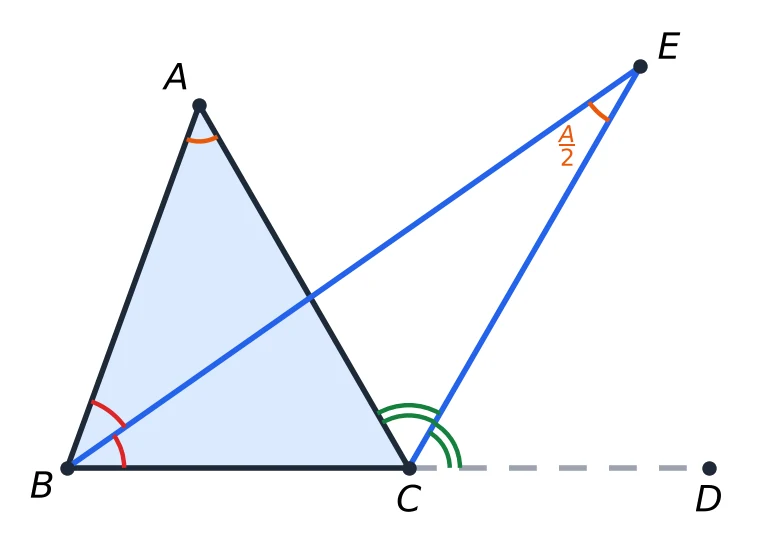
Halve the exterior angle theorem: . In triangle BEC, the exterior angle at C is , and by the same theorem it equals . Comparing the two, . With , . (When both bisectors are interior or both exterior, the answers are and ; those belong to Centres of a Triangle.)
Isosceles and Equilateral Triangles
In an isosceles triangle two sides are equal, and the angles opposite them, the base angles, are equal. It works both ways: if two angles of a triangle are equal, the sides opposite them are equal.
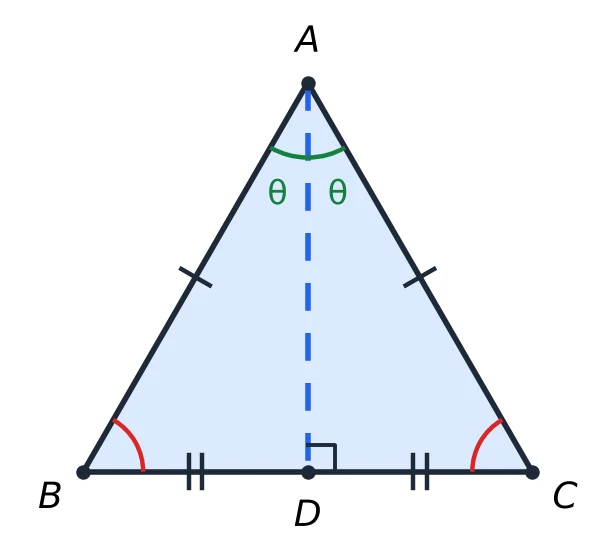
If AB = AC, the line from A to the mid-point D of BC is at the same time the median, the altitude () and the bisector of . Any one of these three facts is enough to make a triangle isosceles.
Apex and base angles. With apex angle , each base angle is . With base angle , the apex is . If the apex is 40°, the base angles are 70° each and the exterior angle at the base is 110°.
Word versions.
- "The apex angle is twice each base angle": , so the angles are 45°, 45° and 90°.
- "Each base angle is twice the apex": , so the angles are 36°, 72° and 72°.
Which angle is the apex? If a question only says "an isosceles triangle has an angle of 50°", both cases are possible: 50°, 50°, 80° or 50°, 65°, 65°. An angle of 100° can only be the apex, since two angles of 100° would already pass 180°, so that triangle is 100°, 40°, 40°.
Equilateral triangles. All three sides equal means all three angles are 60°, and the other way round. An isosceles triangle with one angle of 60°, wherever it sits, is equilateral. The right isosceles triangle has angles 45°, 45° and 90°.
The moment you see two equal sides in a figure, mark the two equal angles opposite them. Almost every isosceles question is solved by that one step and the angle sum.
Isosceles Triangles with an Extra Point
Many SSC questions add a point to an isosceles triangle so that new isosceles triangles appear. The method never changes: call the smallest unknown angle , mark the equal angles opposite equal sides, and use the exterior angle theorem to carry round the figure.
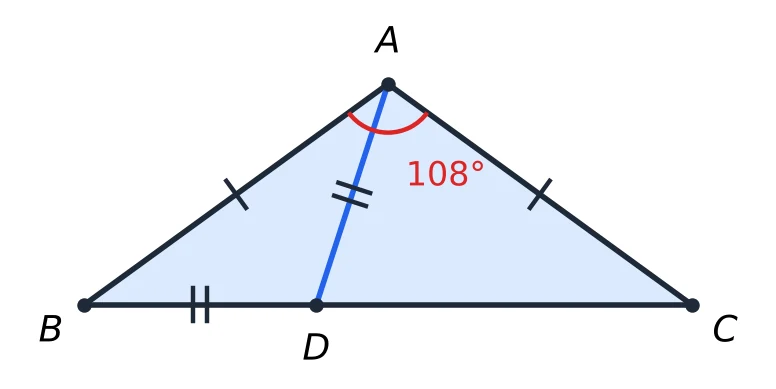
AB = AC with AD = BD. In triangle ABC, AB = AC and , and D is a point on BC with AD = BD.
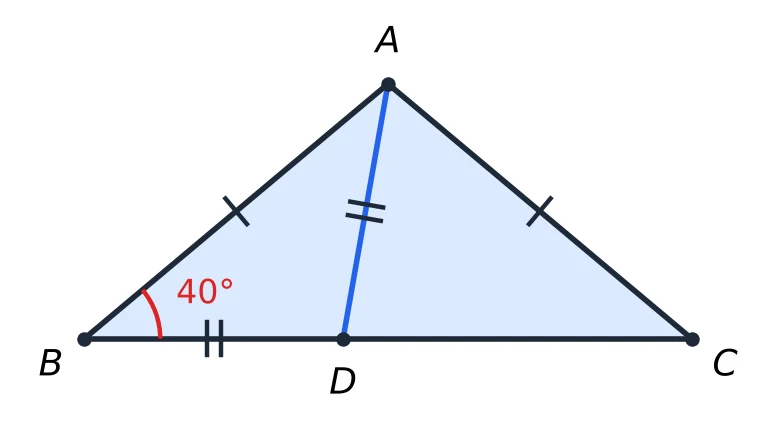
- AB = AC, so and .
- AD = BD, so .
- So , and (the exterior angle of triangle ABD).
Check in triangle ADC: 60 + 80 + 40 = 180.
The 36°, 72°, 72° triangle. AB = AC, and D lies on AC with AD = BD = BC. Call .
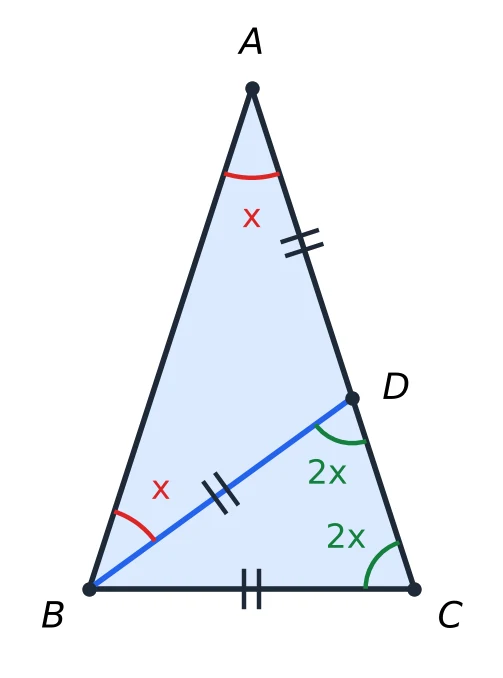
- AD = BD, so .
- is the exterior angle of triangle ABD, so .
- BD = BC, so .
- AB = AC, so .
The angle sum of triangle ABC now reads , so . The angles are 36°, 72° and 72°, and BD bisects .
AB = AC with AD = DC. Here , and the exterior angle at D of triangle ADC gives . One more given angle, such as , then fixes everything through the angle sum of triangle ABD.
Each new isosceles triangle either repeats an angle or, through an exterior angle, doubles it. When the chain gives , , and so on, the answer is usually a neat divisor of 180 such as 36°, 45° or 20°.
Sides and Angles, and the Triangle Inequality
The larger side faces the larger angle. In any triangle the longest side is opposite the largest angle and the shortest side is opposite the smallest angle, and the reverse is true as well. If , and , then BC < CA < AB, because BC faces A, CA faces B and AB faces C. Two results follow:
- the hypotenuse is the longest side of a right triangle, and the side opposite an obtuse angle is the longest side of an obtuse triangle;
- of all the segments from a point to a line, the perpendicular is the shortest, because each slanting segment faces a 90° angle in a right triangle.
The triangle inequality. The sum of any two sides of a triangle is greater than the third side. Put another way, every side lies strictly between the difference and the sum of the other two:
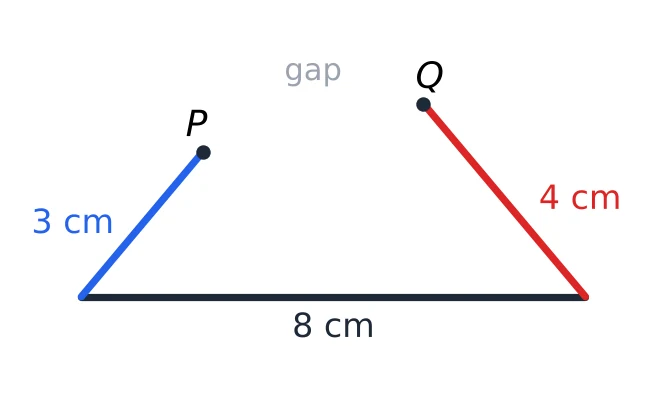
Sticks of 3 cm and 4 cm hinged at the ends of an 8 cm stick cannot meet, because together they reach only 7 cm. If the sum equals the third side, as with 3, 4 and 7, the two sticks lie flat along it and no triangle forms either.
Can these be the sides? One check is enough: the two shorter sides must add up to more than the longest. 5, 8, 12 works (13 > 12); 4, 7, 12 fails (11 < 12); 4, 6, 10 fails (10 is not more than 10).
The third side. With two sides of 6 cm and 11 cm, the third side must satisfy . If is a whole number it can be 6, 7, …, 16: 11 values. In general, for whole-number sides and , the number of whole-number third sides is
so for 6 and 11 it is .
[SSC Tip] Both ends of are strict. Options that include the end values, 5 cm or 17 cm here, are wrong.
Counting Triangles with Whole-Number Sides
With a given perimeter. To count triangles with whole-number sides and perimeter , write the sides as . The longest side must be less than half the perimeter (because means ), and it is at least a third of the perimeter. Fix and count the pairs that make up the rest.
For , the longest side can be 5, 6 or 7.
| Longest side | Triangles |
|---|---|
| 7 | (1, 7, 7), (2, 6, 7), (3, 5, 7), (4, 4, 7) |
| 6 | (3, 6, 6), (4, 5, 6) |
| 5 | (5, 5, 5) |
That makes 7 triangles. There is also a formula: the count is the whole number nearest to when is even, and nearest to when is odd. For 15, , so 7. For 12, , and the triangles are (2, 5, 5), (3, 4, 5) and (4, 4, 4).
Isosceles triangles with a given perimeter. Take equal sides and base . The base must be positive and less than , so
For : , so = 8, 9, …, 14, which gives 7 triangles. One of them, (10, 10, 10), is equilateral.
Choosing three sticks. From sticks of 2, 3, 5, 6 and 7 cm, how many triangles can be made using three sticks at a time? There are 10 ways to choose three sticks. Test each one with "the two shorter add up to more than the longest". Four choices fail: (2, 3, 5), (2, 3, 6), (2, 3, 7) and (2, 5, 7), where the two shorter sticks only reach or fall short of the longest. That leaves 6 triangles.
Two given sides. As in the last part, two sides and allow whole-number third sides. If the question adds a condition, such as "the third side is the longest" or "the triangle is obtuse", narrow the range first and then count.
When counting, fix the longest side first and work down. Starting from the shortest side leads to double counting, and the options are always set one or two away from the right count.
Acute, Right or Obtuse: The Side Test
Take the longest side and compare its square with the sum of the squares of the other two sides and :
| If | The angle opposite is | The triangle is |
|---|---|---|
| less than 90° | acute | |
| exactly 90° | right | |
| more than 90° | obtuse |
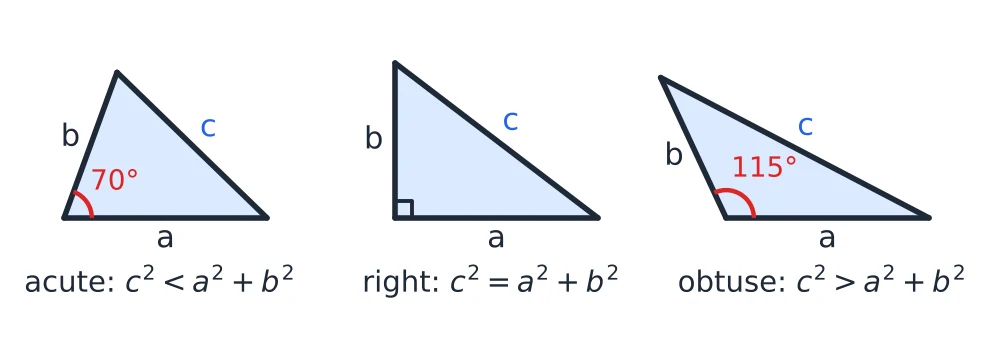
Keep two sides fixed and open the angle between them: the third side grows, and it passes exactly when the angle passes 90°.
- 6, 7, 9: , so acute.
- 5, 12, 13: , so right.
- 7, 8, 12: , so obtuse.
Only the longest side needs testing, because the two smaller angles of a triangle are always acute.
Range of the third side. Two sides are 6 cm and 8 cm, and the third side is .
- The triangle exists for .
- It is right-angled when (and also when , with 8 as the hypotenuse).
- It is acute when , since then no angle reaches 90°.
- It is obtuse when (the angle opposite 8 is obtuse) or (the angle opposite is obtuse).
With whole numbers, = 6, 7, 8 or 9 gives an acute triangle, 10 a right triangle, and 3, 4, 5, 11, 12 or 13 an obtuse one.
If a question says "the third side is the longest side and the triangle is obtuse", only the upper range counts: . Read whether has to be the longest side before you count.
Pythagoras' Theorem and Pythagorean Triplets
In a right triangle the square of the hypotenuse equals the sum of the squares of the other two sides:
The reverse is also true: if , the angle opposite is 90°.
Triplets to know by heart. Whole numbers that fit :
| Triplet | Triplet |
|---|---|
| 3, 4, 5 | 20, 21, 29 |
| 5, 12, 13 | 9, 40, 41 |
| 8, 15, 17 | 12, 35, 37 |
| 7, 24, 25 | 11, 60, 61 |
Any multiple of a triplet is a triplet too: 6, 8, 10; 9, 12, 15; 15, 20, 25; 10, 24, 26. So look for a common factor first. Sides of 18 and 24 are , so the hypotenuse is .
Making your own. For an odd number the triplet is , , : from 9 you get 9, 40, 41. For an even number it is , , : from 8 you get 8, 15, 17.
Everyday uses.
- Walking 8 km north and then 6 km east leaves you 10 km from the start.
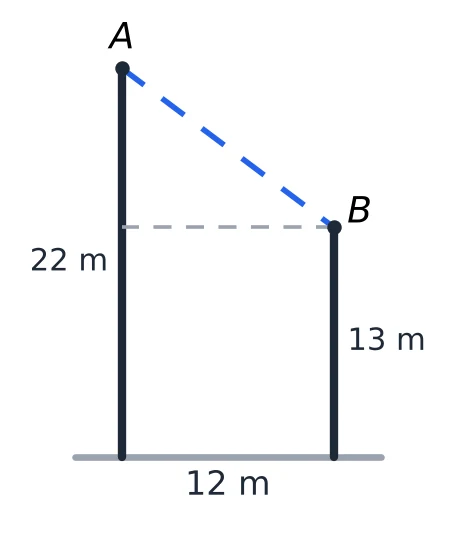
- For two vertical poles, the distance between their tops is the hypotenuse of a right triangle whose base is the gap between the poles and whose height is the difference of their heights.
- For a ladder against a wall, the ladder is the hypotenuse.
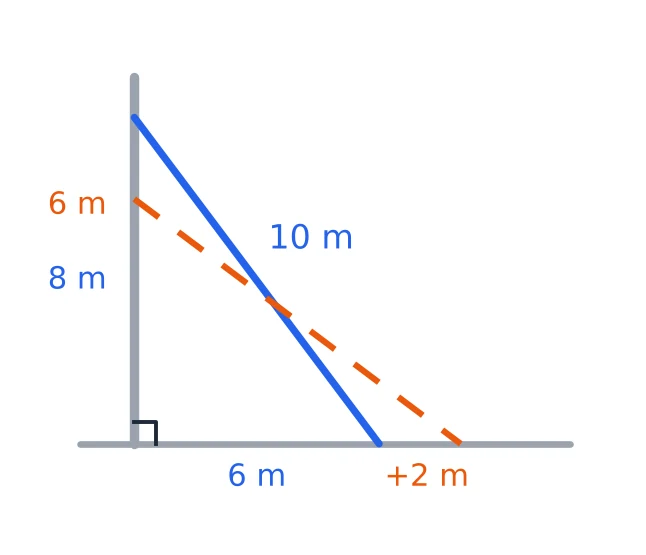
A 10 m ladder with its foot 6 m from the wall reaches 8 m up. If the foot slides 2 m further out, to 8 m, the top drops to m, a fall of 2 m. The fall equals the slide here only because 6 and 8 swap places; in general, work out both positions and subtract.
[SSC Tip] Before squaring big numbers, take out the common factor and look for a triplet. 36 and 48 are , giving 60; 25 and 60 are , giving 65.
Special Right Triangles and the Equilateral Triangle
Two right triangles come up so often that their sides should be known by ratio, without calculation.
45°-45°-90°. This is half of a square cut along a diagonal. The legs are equal and the hypotenuse is times a leg:
30°-60°-90°. This is half of an equilateral triangle. The side opposite 30° is half the hypotenuse, and the side opposite 60° is times the shortest side:
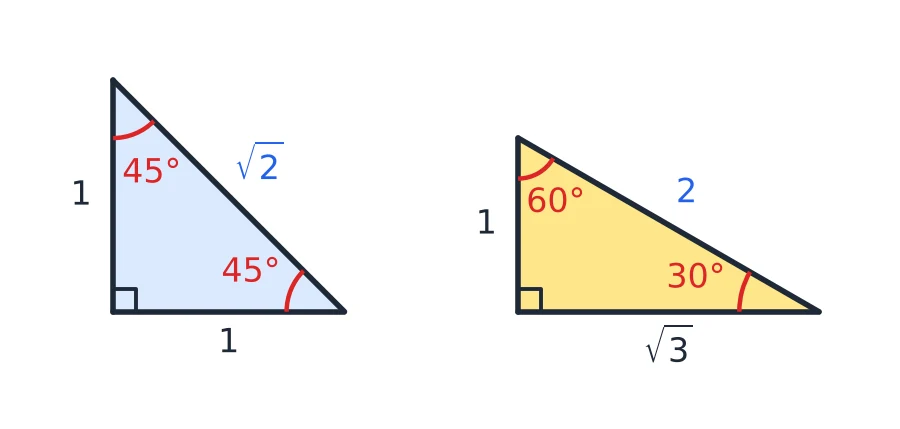
- A hypotenuse of 14 cm with a 30° angle gives sides of 7 cm and cm.
- A right isosceles triangle with hypotenuse 10 cm has legs of cm.
- The diagonal of a square of side is .
Height of an equilateral triangle. The altitude AD cuts an equilateral triangle of side into two 30°-60°-90° triangles, each with hypotenuse and shortest side . So
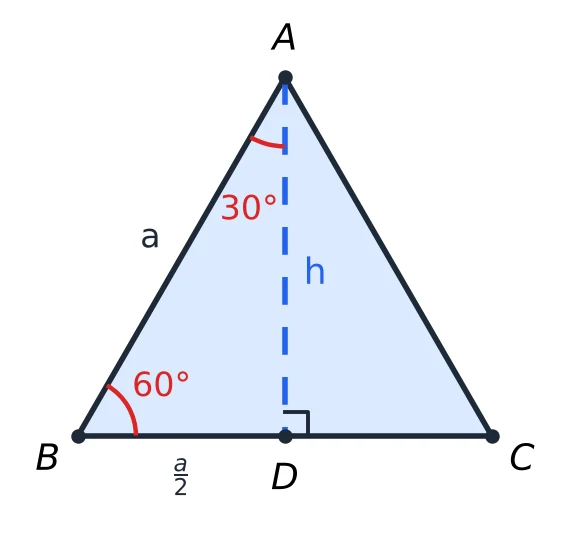
A side of 12 cm gives a height of cm. A height of 9 cm gives a side of cm.
The 30°-30°-120° triangle. An isosceles triangle with apex 120° and equal sides splits into two 30°-60°-90° halves, so its base is . Equal sides of 8 cm give a base of cm.
In a 30°-60°-90° triangle find the shortest side first: it faces 30° and is half the hypotenuse. The other leg is then the shortest side times . Mixing up which leg faces 60° is the usual slip.
Congruent Triangles
Two triangles are congruent when one fits exactly on the other: same shape and same size. We write , and the order of the letters matters. A matches P, B matches Q and C matches R, so AB = PQ, BC = QR, CA = RP, , and .
You never need all six facts. Any one of these five sets of three is enough:
| Rule | What must match |
|---|---|
| SSS | all three sides |
| SAS | two sides and the angle between them |
| ASA | two angles and the side between them |
| AAS | two angles and a side that is not between them |
| RHS | a right angle, the hypotenuse and one other side |
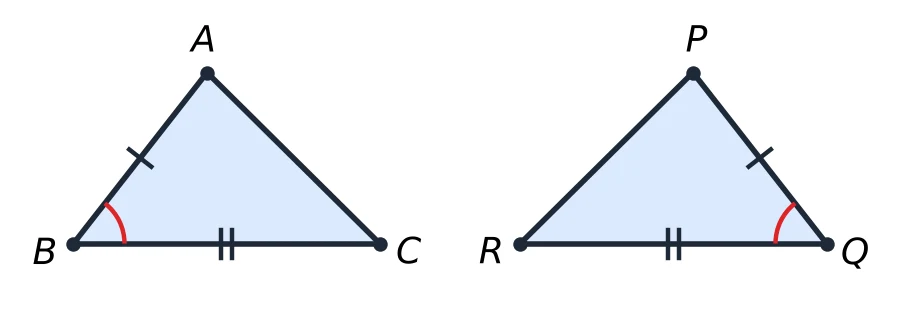
In the figure AB = PQ, BC = QR and , the angle between those sides, so by SAS, even though PQR is turned round. AAS works because two equal angles force the third angles to be equal as well, which turns it into ASA.
CPCT. Once two triangles are known to be congruent, every other pair of matching parts is equal: "corresponding parts of congruent triangles". Most congruence questions end this way, by handing over a length or an angle from the other triangle.
What does NOT prove congruence.
- AAA. Equal angles give the same shape but not the same size; a small and a large equilateral triangle have the same angles. That is similarity (Similar Triangles and Proportionality).
- SSA. Two sides and an angle that is not between them can fit two different triangles.
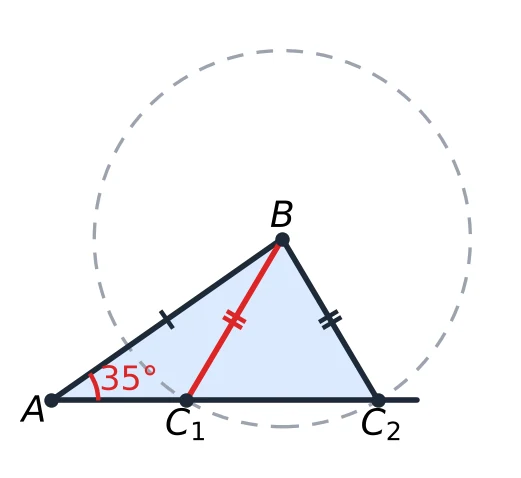
Here AB, the angle at A and the length of the side from B are all the same, yet and are different. RHS is the one safe case of this pattern: when the given angle is 90°, the second triangle cannot form.
Standard uses.
- In triangle ABC with AB = AC, the altitude AD gives by RHS, so BD = DC.
- If two segments AB and CD bisect each other at O, then by SAS (the angles at O are vertically opposite), so AC = BD and .
- In an isosceles triangle the altitudes to the two equal sides are equal, and so are the medians to them.
[SSC Tip] For "which condition makes them congruent", check where the angle sits. Between the two given sides it is SAS; outside them it is SSA, and the answer is "not necessarily congruent" unless the angle is 90°.
[Tier 2] Apollonius' Theorem: The Length of a Median
A median joins a vertex to the mid-point of the opposite side. If AD is the median from A in triangle ABC, so that BD = DC, then
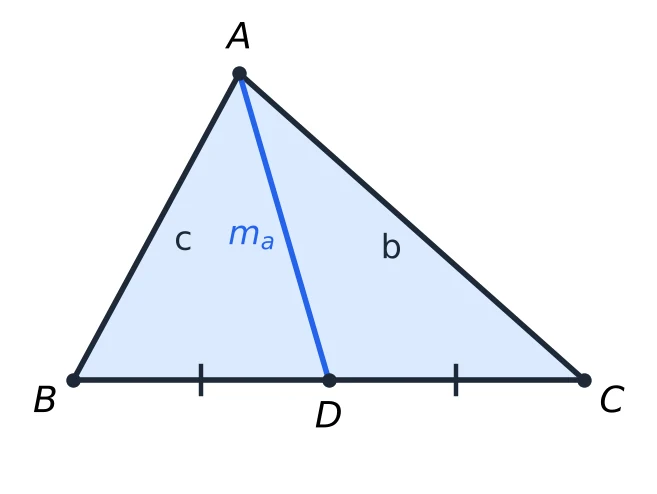
Writing , , and , the same rule solved for the median is
Why it is true. Drop the altitude AE from A to BC, with AE = , and say E lies on DC at a distance from D. Each of BD and DC is . By Pythagoras, and . Adding them, the terms with cancel:
because .
Using it.
- Sides AB = 13 cm, AC = 9 cm and BC = 10 cm: , so and the median is 10 cm.
- Backwards: if AB = 13 cm, AC = 9 cm and the median AD = 10 cm, then gives BD = 5 cm, so BC = 10 cm.
- A check on a right triangle: for sides 6, 8 and 10, gives AD = 5, half the hypotenuse, which is the known fact in Centres of a Triangle.
The rule for parallelograms in Lines, Angles, Quadrilaterals and Polygons () is the same theorem: the diagonals bisect each other, so each half-diagonal is a median of a triangle formed by two sides. The sum of the squares of all three medians is in Centres of a Triangle.
The formula uses BD, half of BC, not BC itself. Using the whole side is the standard wrong answer: for the 13, 9, 10 triangle it gives , a median of 5 cm instead of 10 cm.
Solved Examples
Question 1
The angles of a triangle are in the ratio 3 : 5 : 7. What is the largest angle? (a) 36° (b) 84° (c) 60° (d) 90°
Answer. There are 3 + 5 + 7 = 15 parts in 180°, so one part is 12°. The angles are 36°, 60° and 84°, and the largest one is (b) 84°.
Question 2
In triangle ABC, . What is ? (a) 40° (b) 60° (c) 90° (d) 80°
Answer. If all three products equal , then , and . So the ratio is , and multiplying by 12 gives 4 : 3 : 2. Nine parts make 180°, so one part is 20° and , which is (d) 80°.
Question 3
In triangle ABC, side BC is produced to D. If and , what is ? (a) 80° (b) 48° (c) 52° (d) 100°
Answer. The exterior angle equals the two opposite interior angles together, so . Sharing 128° in the ratio 3 : 5 gives 16° a part, so and is (a) 80°. 52° is the interior angle at C, not .
Question 4
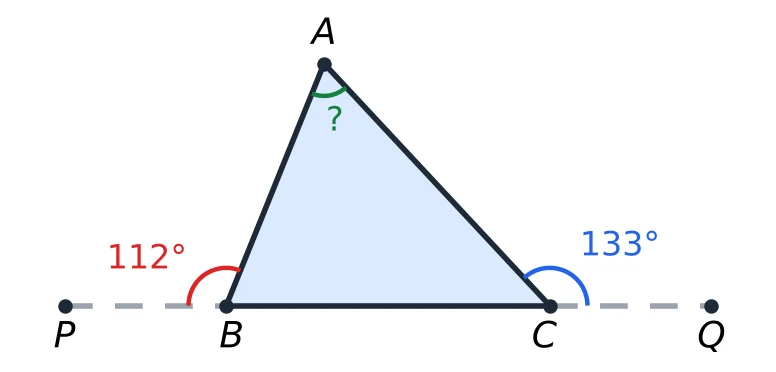
In the figure, side BC of triangle ABC is produced both ways. The exterior angles at B and C are 112° and 133°. What is ?
(a) 68° (b) 47° (c) 65° (d) 115°
Answer. Each exterior angle is the sum of the two far interior angles, so the two of them together are counted twice plus and , which is . So , which is (c) 65°. Check: and , and 65 + 68 + 47 = 180.
Question 5
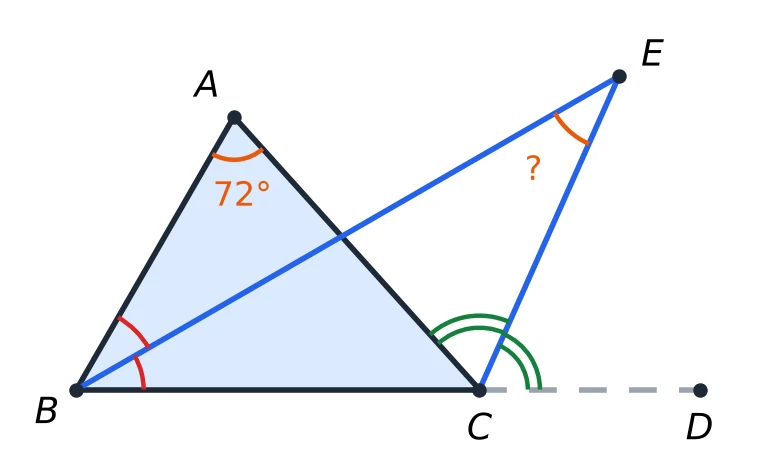
In the figure, the bisector of and the bisector of the exterior angle meet at E. If , what is ?
(a) 54° (b) 36° (c) 126° (d) 72°
Answer. Half the exterior angle at C equals half of plus half of . In triangle BEC, that same half (the angle ) equals , and is half of . So is half of , which is (b) 36°. 54° is , the answer when both bisectors are exterior.
Question 6
In an isosceles triangle, each base angle is 15° more than twice the vertex angle. What is the vertex angle? (a) 75° (b) 50° (c) 40° (d) 30°
Answer. Call the vertex angle . Each base angle is , so , which gives and = (d) 30°. The base angles are then 75° each, and 30 + 75 + 75 = 180.
Question 7
In the figure, AB = AC and D is a point on BC with AD = BD. If , what is ?
(a) 72° (b) 36° (c) 54° (d) 90°
Answer. AB = AC, so the base angles are each. AD = BD, so . That leaves , which is (a) 72°. A nice extra: too, so triangle ADC is also isosceles with DC = AC.
Question 8
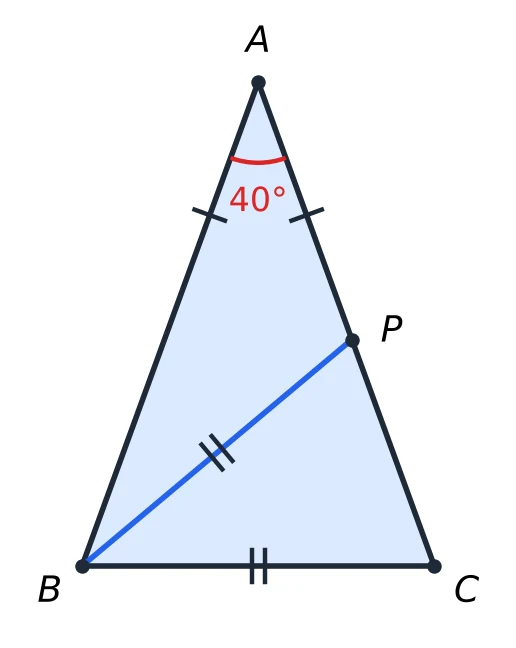
In the figure, AB = AC and . P is a point on AC such that BP = BC. What is ?
(a) 40° (b) 70° (c) 30° (d) 20°
Answer. The base angles of triangle ABC are each. In triangle BPC, BP = BC, so and . So , which is (c) 30°.
Question 9
In triangle PQR, and . Which of these is correct? (a) PQ < QR < PR (b) PR < QR < PQ (c) QR < PR < PQ (d) PR < PQ < QR
Answer. . The smaller the angle, the shorter the side opposite it. The angles in order are Q (45°), P (65°), R (70°), and the sides opposite them are PR, QR and PQ. So the order is (b) PR < QR < PQ.
Question 10
Which of these sets of lengths can be the sides of a triangle? (a) 3 cm, 5 cm, 9 cm (b) 4 cm, 6 cm, 10 cm (c) 2 cm, 4 cm, 7 cm (d) 5 cm, 8 cm, 12 cm
Answer. Check whether the two shorter sides add up to more than the longest. , is not more than 10, and , so those three fail. Only works, so the answer is (d) 5 cm, 8 cm, 12 cm.
Question 11
Two sides of a triangle are 9 cm and 14 cm. How many whole-number values can the third side take? (a) 17 (b) 16 (c) 18 (d) 15
Answer. The third side must be more than and less than . The whole numbers from 6 to 22 make (a) 17 values, which matches . 18 would count one of the end values, 5 or 23, and neither gives a triangle.
Question 12
How many isosceles triangles with whole-number sides have a perimeter of 20 cm? (a) 5 (b) 3 (c) 4 (d) 9
Answer. Let the equal sides be , so the base is . The base must be positive and shorter than , so , and can be 6, 7, 8 or 9. That gives (c) 4 triangles: (6, 6, 8), (7, 7, 6), (8, 8, 4) and (9, 9, 2).
Question 13
A triangle has sides of 8 cm, 15 cm and 16 cm. What kind of triangle is it? (a) Right-angled (b) Acute-angled (c) Obtuse-angled (d) It cannot exist
Answer. It exists, because . Test the longest side: , while . Since 256 is less than 289, the largest angle is less than 90°, so the triangle is (b) Acute-angled. With 17 in place of 16 it would be right-angled (8, 15, 17).
Question 14
Two sides of an obtuse-angled triangle are 12 cm and 16 cm, and the third side is the longest side. How many whole-number values can the third side take? (a) 8 (b) 6 (c) 3 (d) 7
Answer. For the angle opposite the third side to be obtuse, , so . For a triangle at all, . So can be 21, 22, …, 27: (d) 7 values. 8 wrongly includes 20, which gives a right triangle (12, 16, 20).
Question 15
A 25 m ladder leans against a wall with its foot 7 m from the wall. If the foot is pulled 8 m further away from the wall, how far does the top of the ladder slide down? (a) 4 m (b) 8 m (c) 5 m (d) 20 m
Answer. At first the top is m high. The foot then moves to m from the wall, so the top is m high. The top slides down , which is (a) 4 m. 8 m assumes the top moves as far as the foot, which it does not.
Question 16
Two vertical poles of heights 22 m and 13 m stand 12 m apart on level ground, as shown. What is the distance between their tops?
(a) 9 m (b) 21 m (c) 15 m (d) 35 m
Answer. Draw a horizontal line from the top of the shorter pole to the taller one. It makes a right triangle with base 12 m and height m. The distance between the tops is , which is (c) 15 m.
Question 17
In triangle ABC, , and AC = 22 cm. What is BC? (a) 11 cm (b) cm (c) cm (d) cm
Answer. AC faces the right angle, so it is the hypotenuse. AB faces the 30° angle, so AB is half of AC, 11 cm. BC faces the 60° angle at A, so BC is times the shortest side: (b) cm.
Question 18
The height of an equilateral triangle is 15 cm. What is the length of its side? (a) cm (b) cm (c) 30 cm (d) cm
Answer. The height is times the side, so the side is . Multiply top and bottom by : , which is (d) cm.
Question 19
The two equal sides of an isosceles triangle are 14 cm each, and the angle between them is 120°. What is the length of the third side? (a) cm (b) 14 cm (c) cm (d) cm
Answer. The altitude from the 120° corner splits the triangle into two 30°-60°-90° triangles with hypotenuse 14 cm. In each, the side facing 60° is cm, and that is half the base. So the base is (a) cm.
Question 20
In triangles ABC and PQR, AB = PQ, BC = QR and . What can you say? (a) They are congruent by SAS (b) They are congruent by SSS (c) They are not necessarily congruent (d) They are congruent by RHS
Answer. The equal angles are at C and R, but the equal sides AB and BC meet at B, not at C. The angle is not between the two sides, so this is SSA, which is not a congruence rule: two different triangles can have these measurements. So (c) They are not necessarily congruent. SAS would need , and RHS would need the equal angle to be 90°.
Question 21
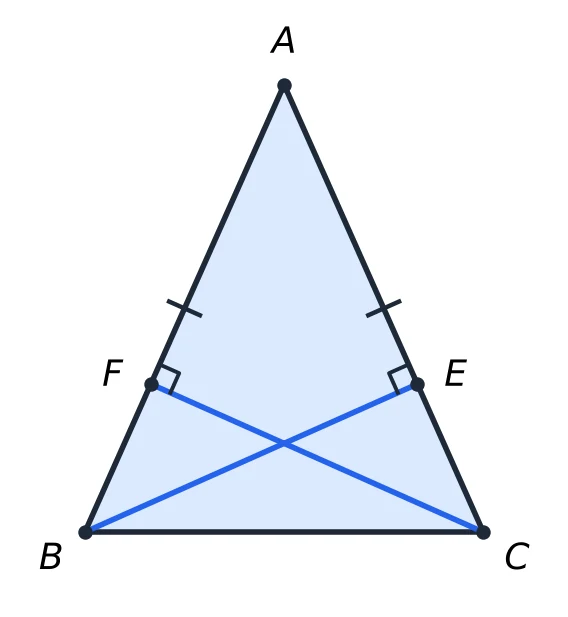
In the figure, AB = AC, and . Which rule shows that , and so BE = CF?
(a) SAS (b) AAS (c) SSS (d) RHS
Answer. Look at what the two triangles share. is common to both, , and AB = AC. That is two angles and a side that is not between them, so the rule is (b) AAS, and then BE = CF by CPCT. RHS would need a second pair of equal sides besides the hypotenuses AB and AC, which we are not given.
Question 22
[Tier 2] In triangle ABC, AB = 11 cm, AC = 7 cm and BC = 12 cm. What is the length of the median AD? (a) cm (b) cm (c) 7 cm (d) 6 cm
Answer. By Apollonius' theorem, with cm. So , giving , and AD = (c) 7 cm. cm is what you get if you leave in.