
Combined Solids: Add the Volumes, Count Only the Outside
A combined solid is made of two or more simple solids joined together: a toy, a tent, a capsule. Two rules cover all of them.
- Volume: add the volumes of the parts, and subtract any part that has been cut out.
- Surface: add only the surfaces you can touch from outside. Where two solids are joined, the joint is covered on both sides, so it counts for neither solid.
A toy: a cone on a hemisphere. Both have radius r; the cone has height h and slant l.
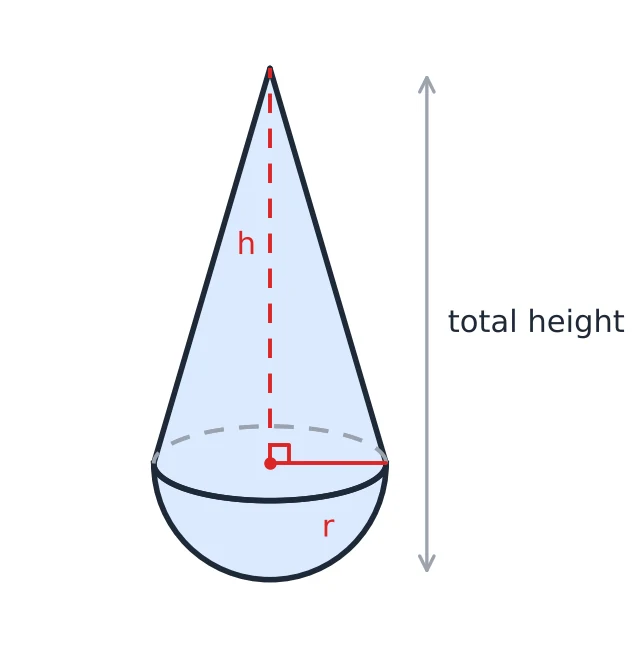
Take r = 7 cm and a total height of 31 cm. The hemisphere uses up 7 cm of that height, so the cone is 24 cm high and its slant is cm.
- Surface cm².
- Volume cm³.
Two errors are common here. Taking 31 cm as the cone's height ignores the part of the height that belongs to the hemisphere. Adding the two total surfaces (704 cm² for the cone and 462 cm² for the hemisphere) counts the hidden joint once for each solid and gives 1166 cm², which is too much.
The same rule works in both directions: joining two solids hides two faces, one on each, and cutting a solid creates two new faces.
Tents and Towers: a Cylinder with a Cone or a Dome on Top
A tent is a cylinder of height with a cone of height on top, both of radius r.
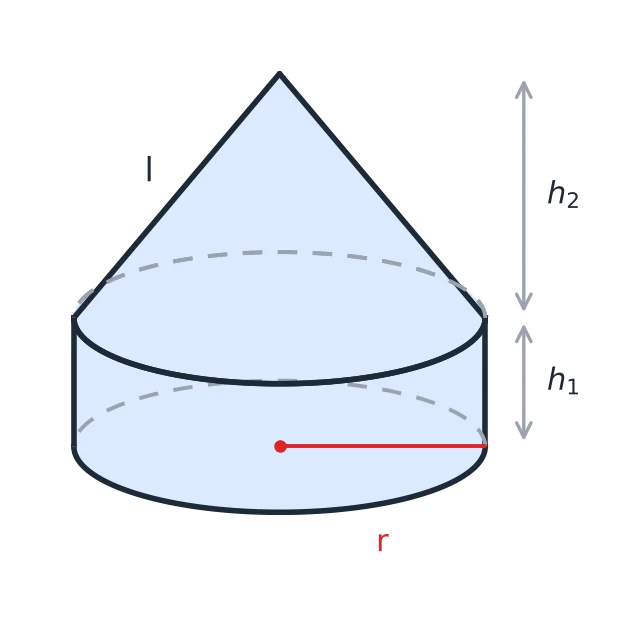
No canvas goes on the floor, and none at the joint between the two parts.
Radius 10.5 m, a cylindrical part 3 m high and a conical part 14 m high: the slant is m.
- Canvas m².
- Air m³.
- If the canvas comes in a roll 3 m wide, the length needed is 775.5 ÷ 3 = 258.5 m. Multiply that by the rate per metre to get the cost.
A cylinder with a hemispherical dome on top (a storage tank, a silo, a temple building):
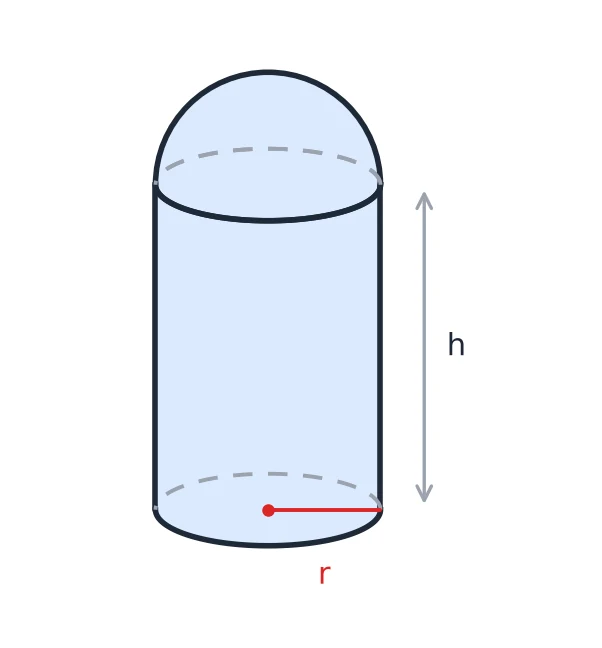
Add for the floor only if the question asks for it. A silo of radius 7 m with a cylindrical part 20 m high holds m³, and its walls and dome together are 880 + 308 = 1188 m².
A pencil or rocket shape, a cylinder with a cone on top, works the same way, with the cone's in place of the dome's .
Capsules and Ice-Cream Cones
A capsule is a cylinder with a hemisphere on each end. The two ends together make one full sphere.
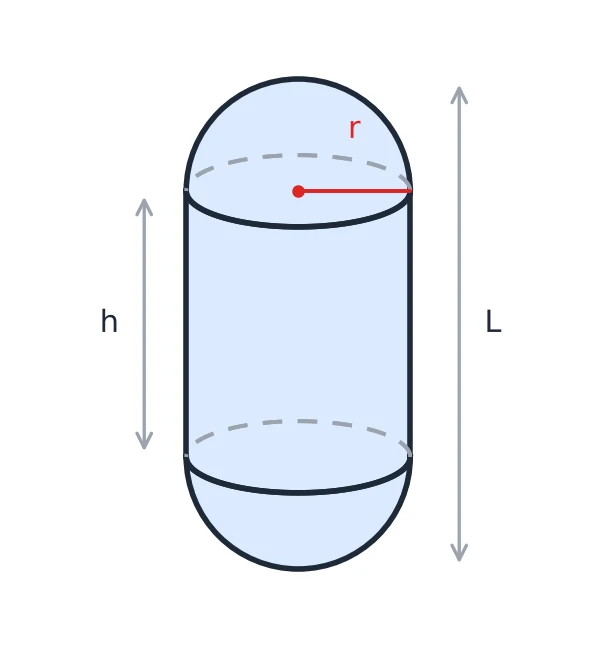
If the cylindrical part is h long, the whole capsule is L = h + 2r long, and
So the surface of a capsule is simply times its full length, the same as an open tube of that length. A capsule 15 mm long and 7 mm across has r = 3.5 mm and a cylindrical part 15 − 7 = 8 mm long.
- Surface mm².
- Volume mm³.
An ice-cream cone is a cone filled with ice cream and topped with a hemisphere of ice cream. It is the toy turned upside down:
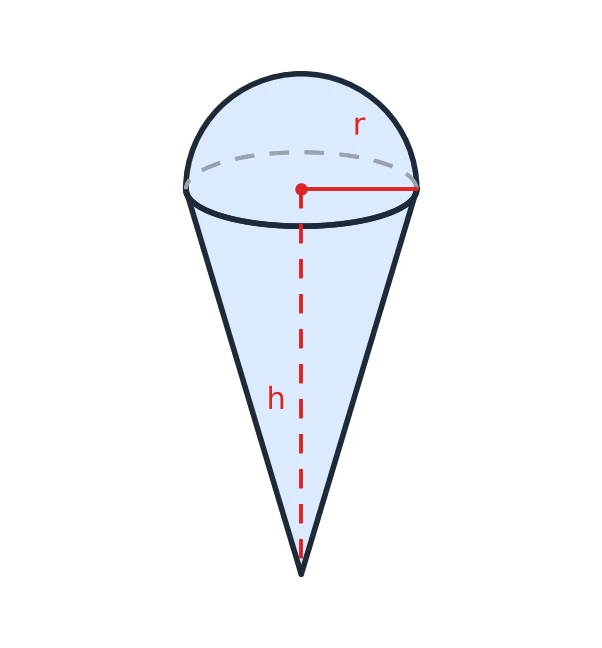
With r = 3 cm and a cone 10 cm deep, each cone holds cm³. A cylindrical tub of radius 6 cm and height 16 cm holds cm³, enough for such cones. In a "how many" question like this the cancels, so keep it as until you divide.
Solids with a Part Scooped Out
Carving a hollow out of a solid lowers the volume but usually raises the surface: the flat circle where the hollow opens is lost, and the curved inside of the hollow is gained.
A hemisphere scooped out of a cube. The largest such hemisphere has a diameter equal to the edge a, so .
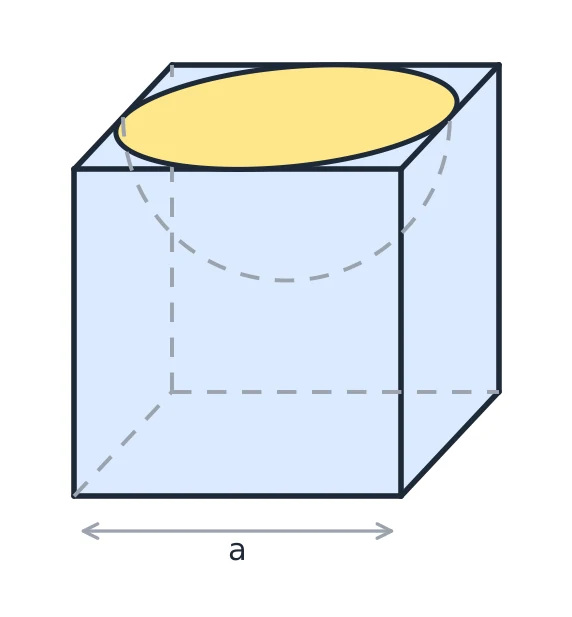
A cube of edge 14 cm with a hemisphere of diameter 14 cm scooped from one face: surface = 1176 + 154 = 1330 cm², volume = cm³.
A hemisphere scooped out of each end of a cylinder, as in a wooden article of this shape: both flat ends disappear and two hemispherical hollows appear.
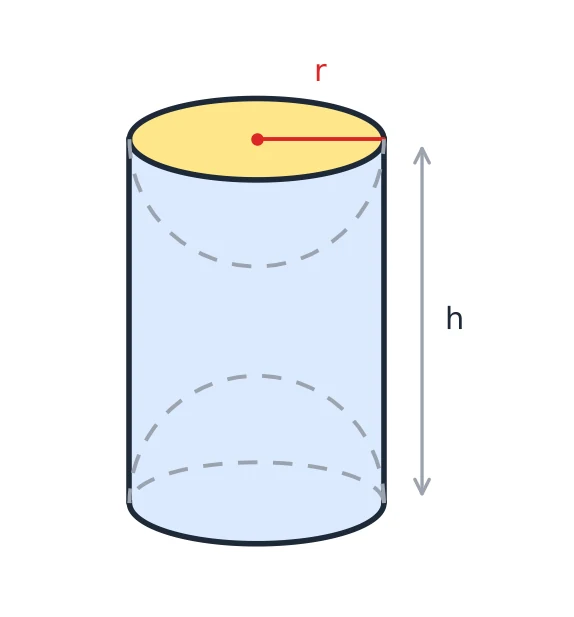
Radius 3.5 cm and height 10 cm: surface = 220 + 154 = 374 cm², volume = cm³. The height has to be at least 2r, or the two hollows would meet in the middle.
A cone carved out of a cylinder with the same base and height: the top circle goes, and the inside of the cone appears.
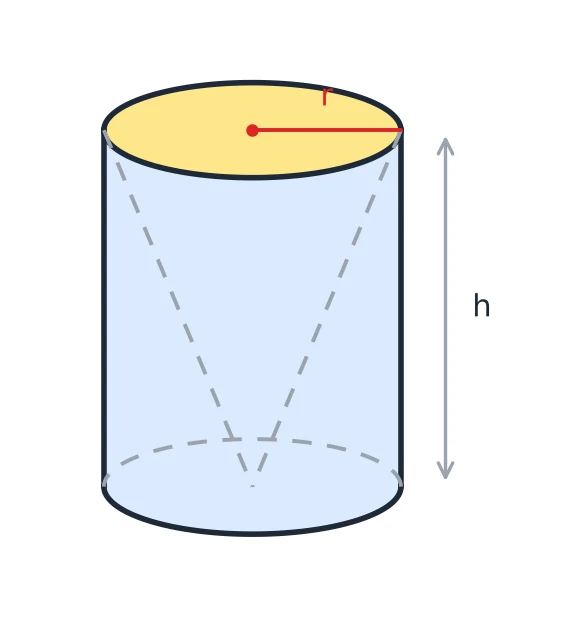
Radius 5 cm and height 12 cm (slant 13 cm): surface cm², volume left cm³.
[SSC Tip] For any scooped solid, write the surface as "old surface − circle removed + inside of the hollow" and fill in each part. Most wrong answers either keep the removed circle or leave out the inside of the hollow.
Melting and Recasting: How Many Pieces?
When a solid is melted and recast into new solids, the amount of metal, that is its volume, stays the same (unless the question says some is wasted). The shape changes, and so does the surface.
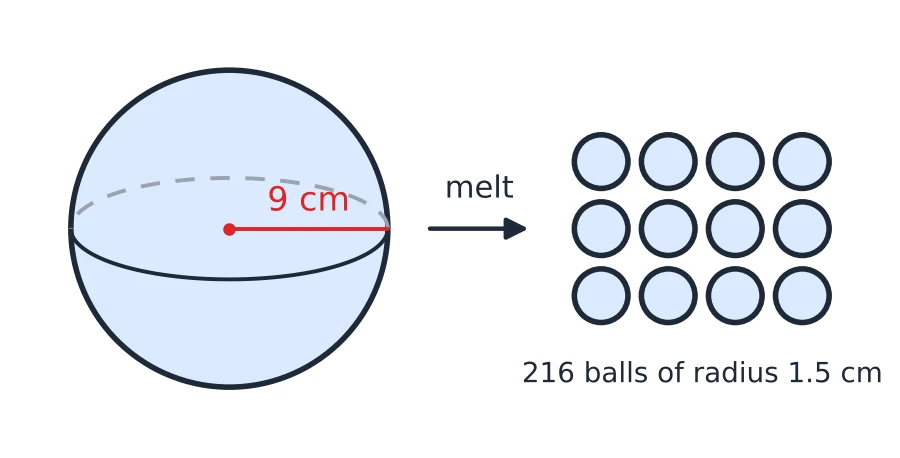
A sphere into small spheres. The cancels and leaves . A sphere of diameter 18 cm makes balls of diameter 3 cm. You can use the diameters directly, because their ratio is the same as the ratio of the radii.
The small balls have a total surface of cm², against cm² for the big sphere: 6 times as much, which is . Breaking a solid into small pieces always adds surface, which is why crushed ice cools a drink faster than one big cube.
Coins from a block. A coin is a thin cylinder. A metal cuboid 22 cm × 14 cm × 10 cm (3080 cm³) is made into coins of radius 1 cm and thickness 2 mm. Change 2 mm to 0.2 cm first. One coin is cm³, so the number of coins is .
Bullets from a cube. A lead cube of edge 22 cm (10,648 cm³) is made into spherical bullets of radius 1 cm, each cm³: bullets.
Cones from a cylinder. A cylinder makes exactly 3 cones of its own radius and height. For different sizes, .
The answer to "how many" must be a whole number. If yours is not, check the units (mm mixed with cm) and whether a diameter went in as a radius.
Recasting into One New Shape: Wires, Cones and One Big Sphere
When only one new solid is made, write old volume = new volume and solve for the missing length.
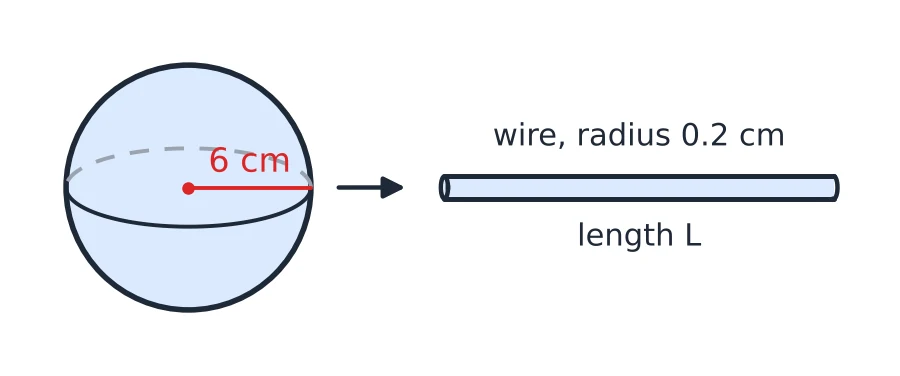
A sphere drawn into a wire. The wire is a long, thin cylinder, so . A copper sphere of radius 6 cm drawn into wire of radius 2 mm = 0.2 cm:
A cone recast as a sphere: , so . A cone of radius 6 cm and height 24 cm gives , so R = 6 cm.
A cylinder recast as a cone: . A cylinder of radius 4 cm and height 9 cm recast as a cone of radius 6 cm: , so h = 12 cm.
A hollow ball melted down: only the metal counts, (see Spheres and Hemispheres).
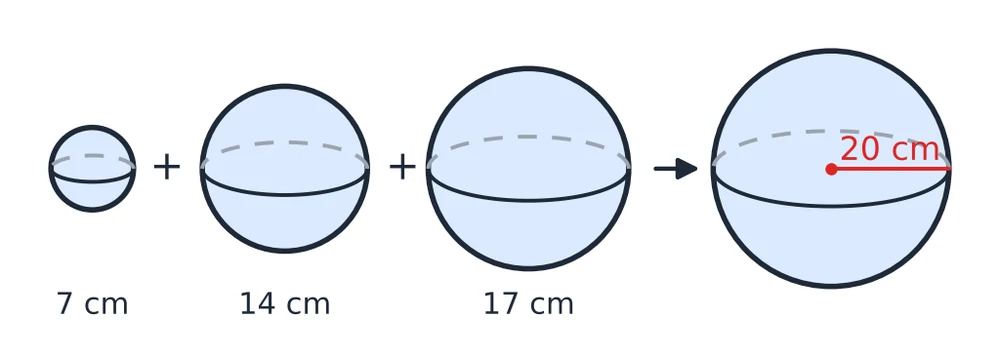
Several spheres melted into one. The volumes add, so
Spheres of radii 7 cm, 14 cm and 17 cm give , so R = 20 cm. The radii themselves do not add: 7 + 14 + 17 = 38 cm is far too big. This time the surface goes down, from cm² to cm².
[SSC Tip] In wire questions the units decide the answer. The wire's radius is usually given in mm and the length is asked in metres, so change everything to cm first and divide by 100 at the end.
Water Displacement: How Much Does the Level Rise?
A solid that sinks completely pushes up exactly its own volume of water. In a vessel with a flat bottom and straight sides,
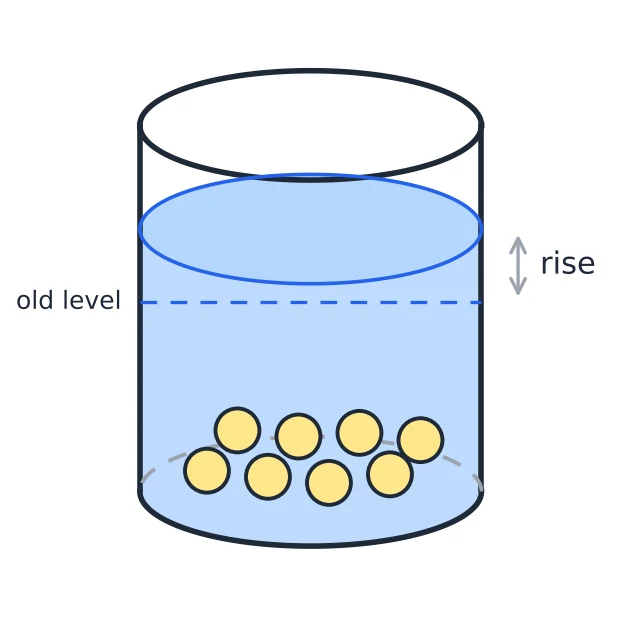
A ball in a cylindrical jar: , so the rise is . A ball of radius 9 cm in a jar of radius 12 cm: rise cm. The cancels, so no value of is needed.
How many marbles? Marbles of diameter 1.4 cm are dropped into a cylindrical vessel of diameter 7 cm until the water rises by 5.6 cm. The marbles' radius is 0.7 cm, and 3.5 = 5 × 0.7, 5.6 = 8 × 0.7, so
A cube in a rectangular tank: rise . A metal cube of edge 20 cm in a tank 80 cm × 50 cm raises the water by cm.
Take the solid out and the level falls by the same amount. If the vessel was full to the brim, the same volume spills over instead.
When Every Length Changes: the and Rule
If every length of a solid (radius, height, slant, edge) is multiplied by k, the shape stays the same, every surface becomes times and the volume becomes times. This holds for any solid: a cube, a cylinder, a cone, a sphere or a toy made of them.
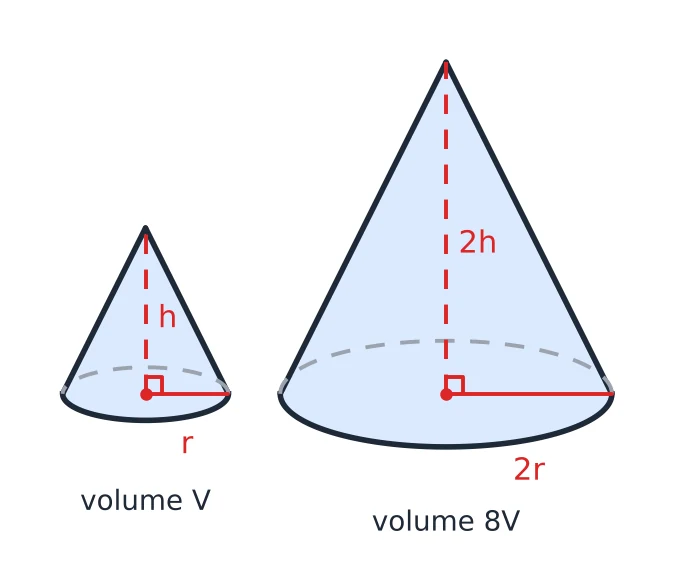
So two similar solids with lengths in the ratio a : b have surfaces in the ratio and volumes in the ratio .
Percentage form. If every length goes up by x%:
- the surface goes up by %;
- the volume goes up by %.
| Every length | Surface | Volume |
|---|---|---|
| up 10% | up 21% | up 33.1% |
| up 20% | up 44% | up 72.8% |
| up 50% | up 125% | up 237.5% |
| doubled | 4 times (up 300%) | 8 times (up 700%) |
| down 10% | down 19% | down 27.1% |
| down 20% | down 36% | down 48.8% |
| halved | down 75% | down 87.5% |
The volume column is the successive-change rule of Chapter 3 applied three times. For 20%: 20 + 20 + 4 = 44, and then .
Only some lengths change. Multiply the factors inside the formula. A cylinder whose radius goes up 10% and height down 10%: , so its volume rises by 8.9%. A cone whose radius is doubled and height halved: , so its volume doubles.
Going backwards. If the volume becomes times, then and the surface becomes times, an increase of 125%. If the volume rises by 33.1%, every length rose by 10% and the surface by 21%.
[SSC Tip] "Increased by 100%" means doubled. The volume then becomes 8 times, which is an increase of 700%, not 800%.
Comparing Solids with Equal Volumes
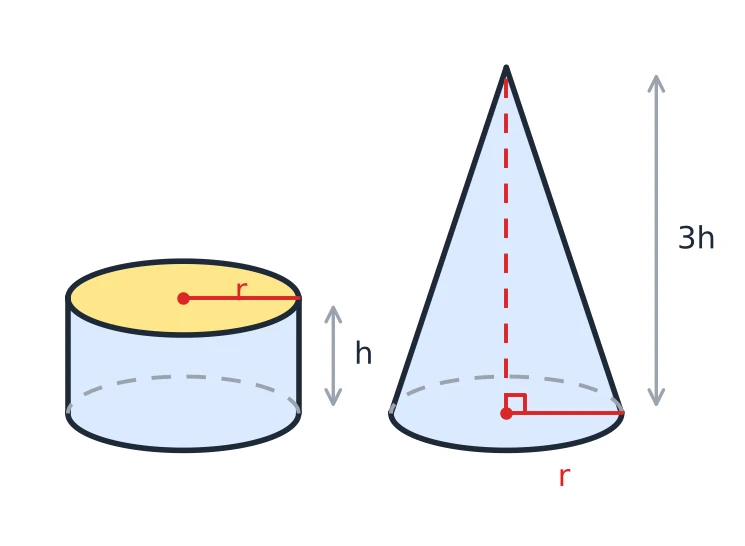
When two solids hold the same amount, set their volume formulas equal; the cancels.
| Same radius r and same volume | Then |
|---|---|
| cone and cylinder | cone's height = 3 × cylinder's height |
| cylinder and sphere | cylinder's height = |
| cone and sphere | cone's height = 4r |
| cone and hemisphere | cone's height = 2r |
A cone and a cylinder on equal bases hold the same amount of water. If the cylinder is 8 cm tall, the cone is 24 cm tall. A sphere of radius 9 cm melted into a cylinder of the same radius makes a cylinder cm high.
Same height, same volume. For a cone and a cylinder, gives : the cone's radius is times the cylinder's.
Same volume, different surfaces. Of all solids with a given volume, the sphere has the least surface. A cube with the same volume as a sphere has about 1.24 times the sphere's surface.
The Largest Solid Cut from a Cube or a Cuboid
From a cube of edge a: the largest sphere has , and the largest cylinder and the largest cone both have and height a.
For a cube of edge 6 cm: cone cm³, sphere cm³, cylinder cm³.
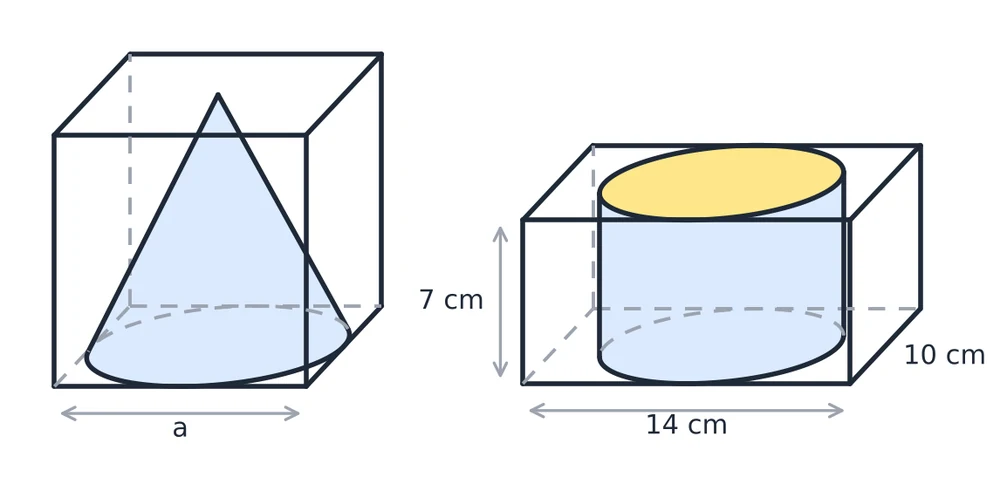
From a cuboid: the largest sphere has its diameter equal to the shortest edge. A cylinder (or a cone) can stand on any of the three faces: its diameter is the shorter side of that face, and its height is the third edge. Work out all three and take the biggest.
For a cuboid 14 cm × 10 cm × 7 cm:
| Standing on | Radius | Height | Volume () |
|---|---|---|---|
| the 14 × 10 face | 5 cm | 7 cm | 550 cm³ |
| the 14 × 7 face | 3.5 cm | 10 cm | 385 cm³ |
| the 10 × 7 face | 3.5 cm | 14 cm | 539 cm³ |
The largest cylinder is 550 cm³, and the largest sphere has r = 3.5 cm and a volume of cm³. The wood wasted is the cuboid's volume minus the solid cut from it.
Solved Examples
Question 1
A toy is a cone mounted on a hemisphere of the same radius, 9 cm. The whole toy is 21 cm tall. What is its total surface area? (a) cm² (b) cm² (c) cm² (d) cm²
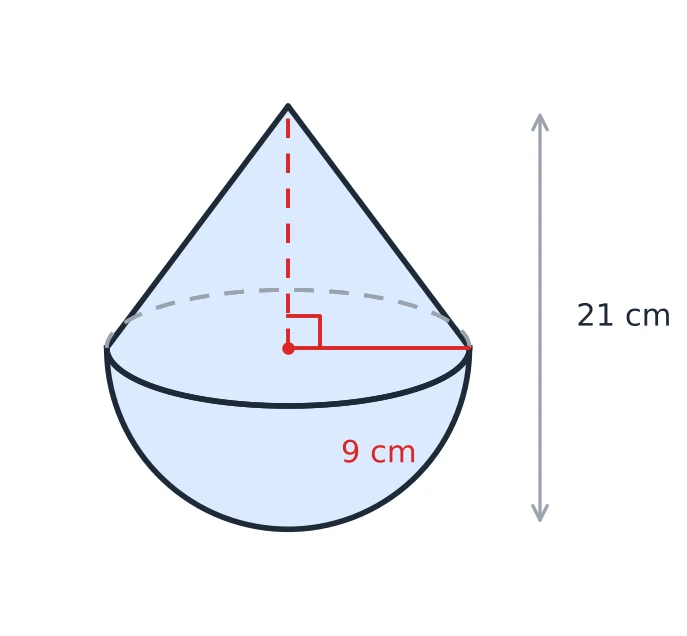
Answer. The toy is 21 cm tall and the hemisphere takes 9 cm of that, so the cone is 12 cm high. Its slant is cm. Outside surface = curved part of the cone + curved part of the hemisphere = (c) cm². The two flat circles are glued together, so I count neither of them.
Question 2
A toy is a cone of radius 6 cm and height 8 cm standing on a hemisphere of the same radius. What is the volume of the toy? (a) cm³ (b) cm³ (c) cm³ (d) cm³
Answer. Volumes simply add. Cone: . Hemisphere: . Total (a) cm³. A full sphere under the cone would give cm³, but this toy has only half a sphere.
Question 3
A tent is a cylinder of radius 21 m and height 4 m with a cone of the same radius and height 28 m on top. How much canvas is needed to make it (no floor)? (Take .) (a) 4224 m² (b) 2838 m² (c) 2310 m² (d) 2376 m²
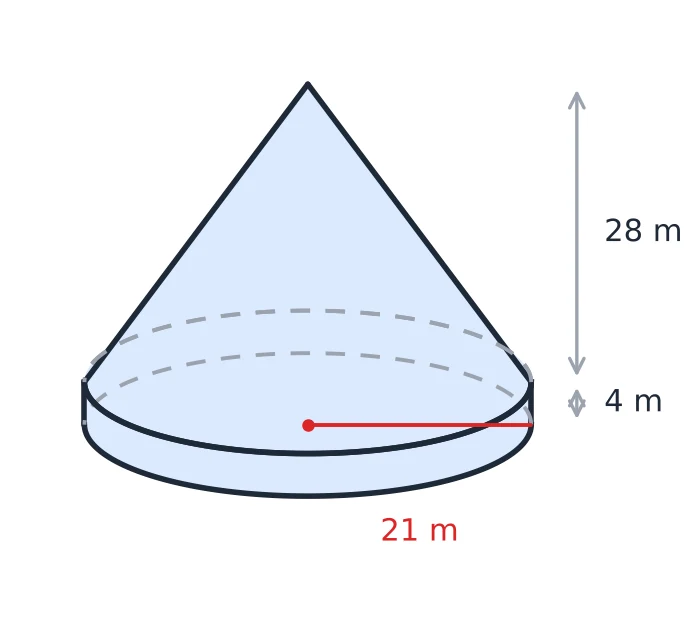
Answer. Canvas covers the cylinder's wall and the cone's roof; there is no floor and nothing at the joint. The cone's slant is m. Wall m². Roof m². Canvas = 528 + 2310 = (b) 2838 m². Using the height 28 m in place of the slant would give 2376 m².
Question 4
A capsule is 21 mm long, made of a cylinder with a hemisphere at each end, and its diameter is 7 mm. What is its surface area? (Take .) (a) 616 mm² (b) 308 mm² (c) 385 mm² (d) 462 mm²
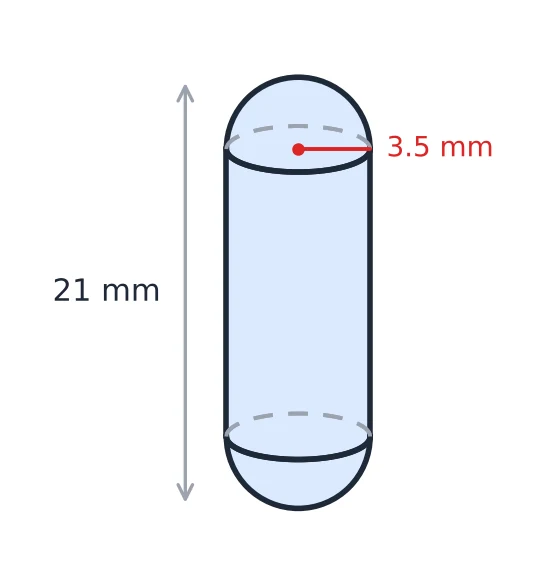
Answer. The 21 mm includes a hemisphere of radius 3.5 mm at each end, so the cylindrical part is 21 − 7 = 14 mm long. Surface , which is times the full length: = (d) 462 mm².
Question 5
A cylindrical tub of radius 6 cm and height 15 cm is full of ice cream. It is shared out into cones of radius 3 cm and height 12 cm, each filled and topped with a hemisphere of ice cream. How many cones can be served? (a) 10 cones (b) 15 cones (c) 30 cones (d) 12 cones
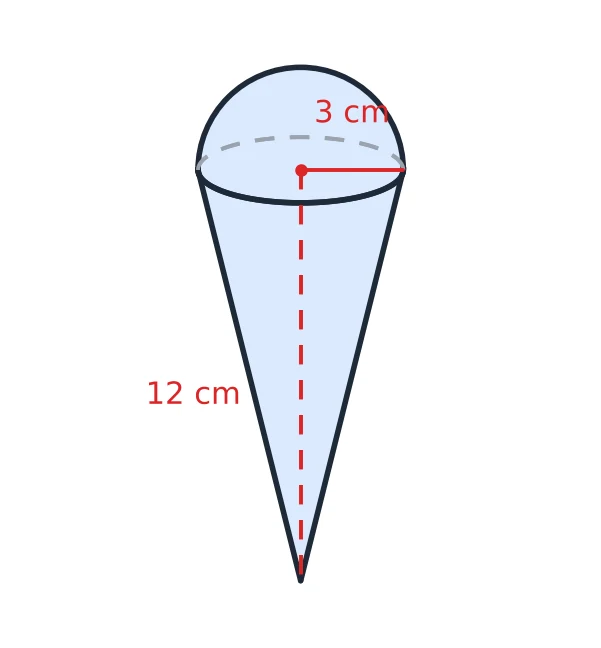
Answer. Ice cream in one cone = cone + hemisphere cm³. The tub holds cm³. Number of cones , so (a) 10 cones. Without the hemispherical top I would get 15.
Question 6
A hemisphere of the largest possible size is scooped out of one face of a cube of edge 10 cm. What is the total surface area of the solid left? (Take .) (a) 521.5 cm² (b) 678.5 cm² (c) 757 cm² (d) 600 cm²
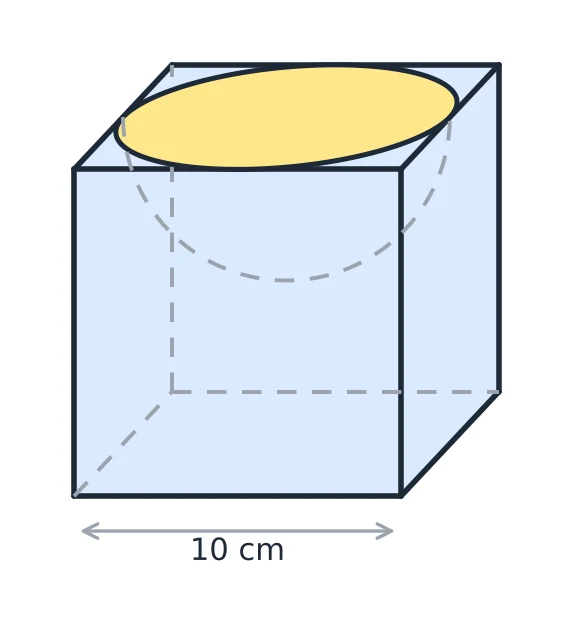
Answer. The cube had 6 × 100 = 600 cm² of surface. The hollow has diameter 10 cm, so r = 5 cm. It removes a circle of 3.14 × 25 = 78.5 cm² from the top face and adds the inside of the bowl, 2 × 3.14 × 25 = 157 cm². New surface = 600 − 78.5 + 157 = (b) 678.5 cm². In one line: .
Question 7
From a solid cylinder of radius 3.5 cm and height 15 cm, a hemisphere of the same radius is scooped out of each end. What is the total surface area of what remains? (Take .) (a) 407 cm² (b) 330 cm² (c) 484 cm² (d) 561 cm²
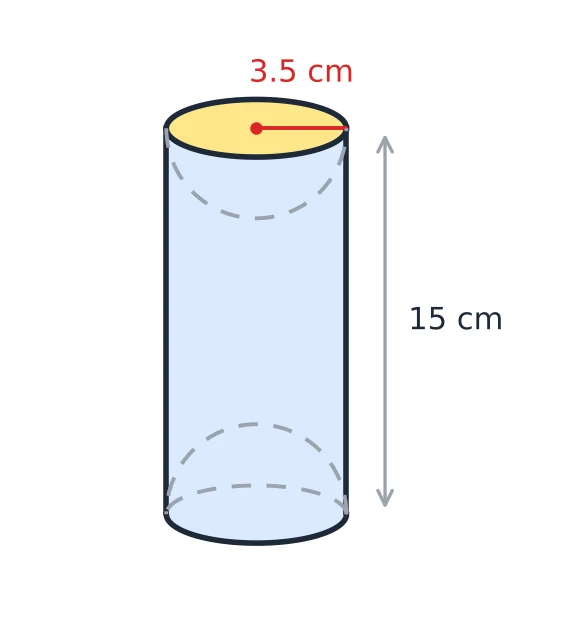
Answer. Both flat ends are gone, and each is replaced by the inside of a hemisphere. Curved side cm². Two hemispherical hollows cm². Total = 330 + 154 = (c) 484 cm².
Question 8
A solid is made of a cylinder of radius 7 cm and height 10 cm with a cone of the same radius and height 24 cm on top. What is its total surface area, including the base? (Take .) (a) 990 cm² (b) 1122 cm² (c) 1298 cm² (d) 1144 cm²
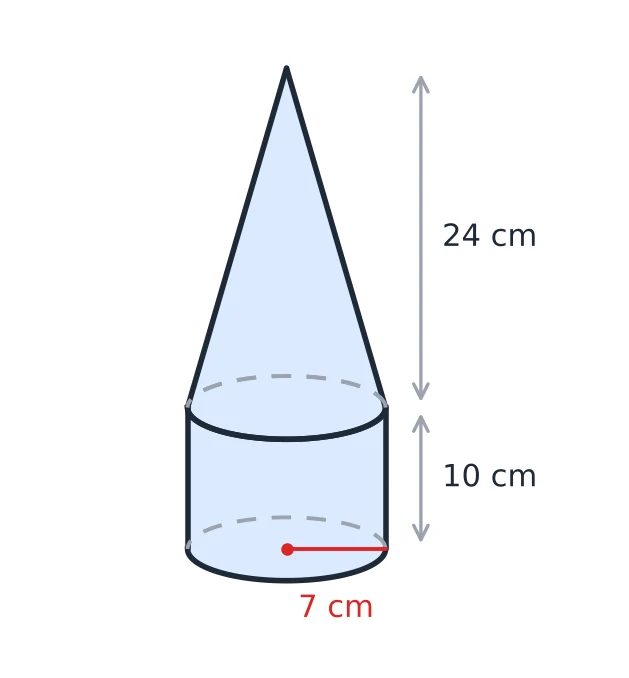
Answer. What I can touch: the cylinder's curved side, the cone's curved surface and the flat base at the bottom. The top of the cylinder is covered by the cone. Slant cm. Side , cone , base = 154. Total = (d) 1144 cm².
Question 9
A metal sphere of diameter 15 cm is melted and made into small balls of diameter 3 cm. How many balls are made? (a) 125 balls (b) 25 balls (c) 5 balls (d) 375 balls
Answer. The volume is shared out, so the number is . The diameters are in the same ratio as the radii, , so the answer is , (a) 125 balls. 25 would be the ratio of the surfaces of a big ball and a small one.
Question 10
A solid metal cylinder of diameter 14 cm and height 30 cm is melted and made into coins of diameter 3.5 cm and thickness 2 mm. How many coins are made? (a) 240 coins (b) 600 coins (c) 2400 coins (d) 24,000 coins
Answer. First the thickness in cm: 2 mm = 0.2 cm. Both shapes are cylinders, so cancels and the number is , which is (c) 2400 coins. Leaving the thickness as 2 cm would give only 240.
Question 11
A lead block 44 cm × 21 cm × 12 cm is melted into spherical bullets of diameter 3 cm. How many bullets can be made? (Take .) (a) 1568 bullets (b) 784 bullets (c) 98 bullets (d) 392 bullets
Answer. Block = 44 × 21 × 12 = 11,088 cm³. One bullet has radius 1.5 cm: cm³. Number , which is (b) 784 bullets.
Question 12
A solid metal sphere of radius 3 cm is drawn into a wire of diameter 4 mm. How long is the wire? (a) 2.25 m (b) 36 m (c) 90 m (d) 9 m
Answer. The sphere is cm³. The wire is a long cylinder of radius 2 mm = 0.2 cm, so and L = 900 cm. In metres that is (d) 9 m. Taking 4 mm as the radius gives 2.25 m, so halve the diameter first.
Question 13
A metal sphere of diameter 18 cm is melted and recast into a solid cone with a base of diameter 36 cm. What is the height of the cone? (a) 36 cm (b) 9 cm (c) 4.5 cm (d) 18 cm
Answer. Sphere: R = 9 cm, volume . Cone: r = 18 cm, volume . So 108h = 972 and h is (b) 9 cm.
Question 14
Three metal balls of radii 3 cm, 10 cm and 18 cm are melted together into one big ball. What is the radius of the big ball? (a) 31 cm (b) 21 cm (c) 19 cm (d) 18.5 cm
Answer. The total volume stays the same and cancels, so . Since , R = (c) 19 cm. Adding the radii to get 31 cm is wrong: it is the volumes that add, not the lengths.
Question 15
Spherical balls of radius 1.5 cm are dropped into a cylindrical vessel of radius 6 cm that is partly filled with water. How many balls are needed to raise the water level by 5 cm? (a) 40 balls (b) 20 balls (c) 5 balls (d) 120 balls
Answer. The water rises by exactly the volume of the balls. Water pushed up cm³. One ball cm³. Number , so (a) 40 balls.
Question 16
A solid cone of radius 5 cm and height 18 cm is dropped into a cylindrical vessel of radius 10 cm containing enough water to cover it. By how much does the water level rise? (a) 4.5 cm (b) 1.5 cm (c) 6 cm (d) 3 cm
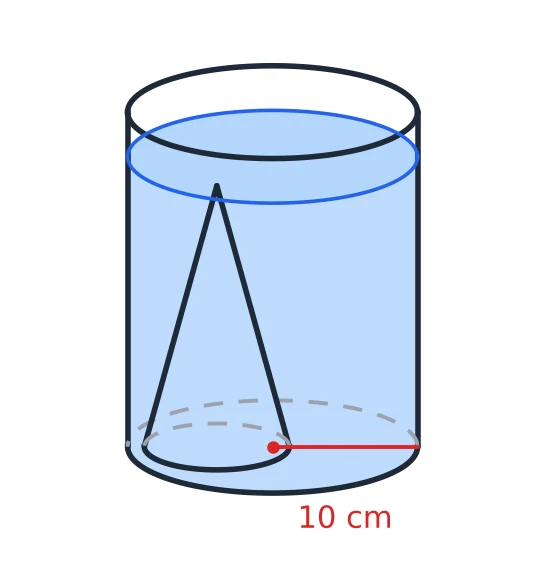
Answer. Base area of the vessel × rise = volume of the cone. Cone cm³. Vessel base . Rise = (b) 1.5 cm. Forgetting the of the cone makes it 4.5 cm.
Question 17
Every edge of a cuboid is increased by 30%. By what percentage does its volume increase? (a) 90% (b) 69% (c) 119.7% (d) 219.7%
Answer. Every length is multiplied by 1.3, so the volume is multiplied by . The increase is 2.197 − 1 = 1.197 times the old volume, that is (c) 119.7%. 69% would be the change in the surface ().
Question 18
The radius of a cone is decreased by 20% and its height is increased by 50%. What happens to its volume? (a) It decreases by 4% (b) It increases by 30% (c) It increases by 20% (d) It does not change
Answer. Volume , so the radius factor is squared: . The height factor is 1.5. Together , so (a) It decreases by 4%. Multiplying 0.8 by 1.5 without squaring the radius gives the 20% answer.
Question 19
The volume of a sphere becomes 8 times what it was. By what percentage does its surface area increase? (a) 700% (b) 400% (c) 100% (d) 300%
Answer. Volume 8 times means every length is times. The surface becomes times, so it has gone up by 4 − 1 = 3 times the old surface: (d) 300%. 400% is what the surface becomes, not the increase.
Question 20
A cone and a hemisphere have equal bases and equal volumes. The hemisphere has radius 7 cm. What is the height of the cone? (a) 7 cm (b) 14 cm (c) 21 cm (d) 28 cm
Answer. gives h = 2r, so the height is (b) 14 cm. 28 cm would be right if the cone matched a whole sphere.
Question 21
A cylinder and a cone have equal heights and equal volumes. What is the ratio of the radius of the cylinder to the radius of the cone? (a) (b) (c) 1 : 3 (d) 3 : 1
Answer. Write R for the cylinder and r for the cone. gives , so , which is (a) . The cone needs the wider base to make up for its .
Question 22
What is the volume of the largest cylinder that can be cut from a wooden block 21 cm × 14 cm × 10 cm? (Take .) (a) 1540 cm³ (b) 1100 cm³ (c) 1650 cm³ (d) 2156 cm³
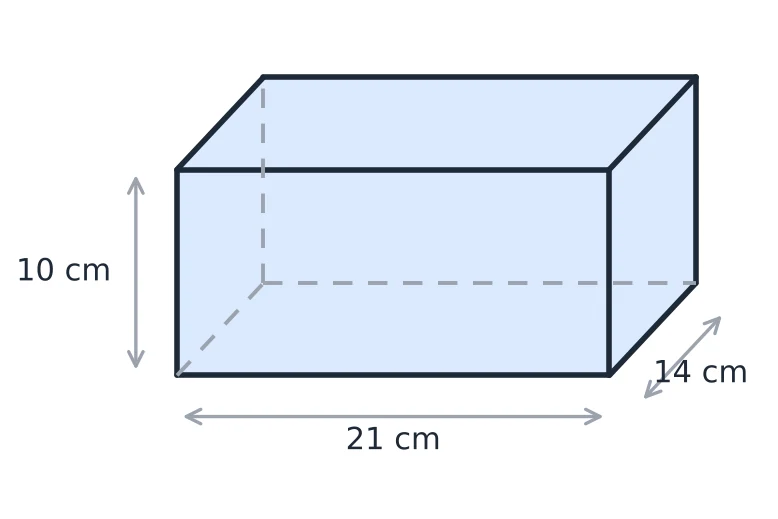
Answer. I try each face as the base. On the 21 × 14 face the radius is 7 and the height 10: . On the 21 × 10 face, r = 5 and h = 14: 1100. On the 14 × 10 face, r = 5 and h = 21: . The biggest is (c) 1650 cm³. The first one looks best because its radius is largest, but the third wins on height.
Question 23
What is the volume of the largest cone that can be cut from a cube of edge 21 cm? (Take .) (a) 2425.5 cm³ (b) 7276.5 cm³ (c) 4851 cm³ (d) 9702 cm³
Answer. The cone's base has to fit inside one face, so r = 10.5 cm, and its height is the edge, 21 cm. Volume = (a) 2425.5 cm³. As a check, the largest cylinder from the same cube is three times this.
Question 24
A hemispherical bowl of inner radius 9 cm is full of a liquid. The liquid is poured into cylindrical bottles of diameter 3 cm and height 4 cm. How many bottles are filled? (a) 108 bottles (b) 72 bottles (c) 36 bottles (d) 54 bottles
Answer. Liquid in the bowl cm³. One bottle cm³. Bottles , so (d) 54 bottles. If you got 108, you took the bowl as a full sphere.