
How to Use These Questions
The 36 questions below mix every solid in this chapter, in no fixed order, the way a paper does. A room can follow a capsule, and a bucket can follow a heap of wheat, so before any working, name the solid and write down what is asked: the volume, the curved surface, the total surface, or a count of pieces.
Work each one on paper before you read the answer. Mark the radius on a sketch, because a diameter used as a radius is behind a large share of wrong answers here, and change every length to one unit before you multiply. In a combined solid, list only the surfaces you could touch from outside; the circle where two parts meet is not one of them. In a melting question, write volume before = volume after and cancel straight away.
About a third of the questions are on cuboids, cubes, prisms and pyramids, a third on cylinders, cones and spheres, and the rest on combined solids, recasting, water levels and percentage change. The three marked [Tier 2] need a regular tetrahedron, a pyramid on a triangular base or an embankment round a well. A Tier 1 question of this kind should take you under a minute; if one takes much longer, find its fast route in Shortcuts & Speed Methods and try it again the next day.
Solved Examples
Question 1
The total surface area of a cube is 1350 cm². Find its volume and the length of its diagonal.
Answer. , so and the edge is 15 cm. Volume = 3375 cm³. The diagonal of a cube is , so here it is cm, about 25.98 cm.
Question 2
The radius and height of a cylinder are in the ratio 2 : 3, and its volume is 12936 cm³. Find its total surface area.
Answer. I take the radius as and the height as . Then , which gives , so . The radius is 14 cm and the height 21 cm. Total surface = 3080 cm².
Question 3
A toy is a cone of radius 4.2 cm standing on a hemisphere of the same radius. The whole toy is 9.8 cm tall. Find its total surface area.
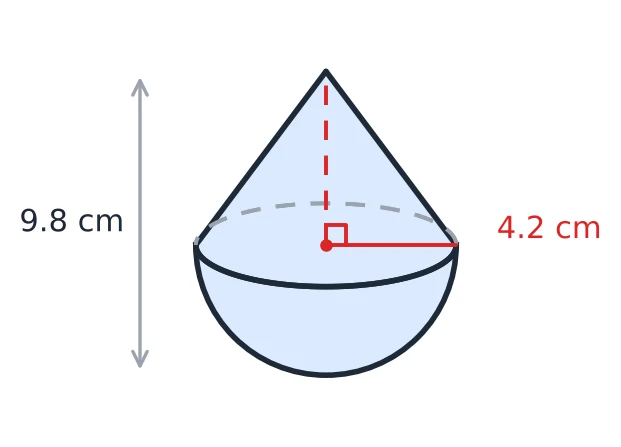
Answer. The hemisphere takes 4.2 cm of the height, so the cone is 5.6 cm tall. Its slant is cm (3-4-5 times 1.4). Cone's curved surface cm². Hemisphere's curved surface cm². The flat circle where they meet is hidden, so I add only these two: 203.28 cm².
Question 4
The length, breadth and height of a cuboid are in the ratio 6 : 3 : 2, and its diagonal is 35 cm. Find its total surface area and its volume.
Answer. Take the sides as , and . The diagonal is , so and . The cuboid is 30 cm by 15 cm by 10 cm. Total surface = 1800 cm², and volume = 4500 cm³.
Question 5
A conical tent is 9.6 m high and the radius of its base is 2.8 m. How many metres of canvas 1.1 m wide are needed to make it, and what is the cost at ₹125 per metre?
Answer. The slant height is m (it is 7-24-25 times 0.4). Canvas needed m². With a width of 1.1 m, the length is = 80 m, which costs = ₹10,000. A tent has no floor, so the base is not counted.
Question 6
A spherical balloon is blown up so that its radius grows from 10.5 cm to 21 cm. Find the ratio of its surface areas before and after, and the volume of air pumped in.
Answer. The radius doubles, so the surface becomes 4 times: the ratio is 1 : 4 (1386 cm² to 5544 cm²). The volume goes from 4851 cm³ to 38808 cm³, so the air pumped in is = 33957 cm³.
Question 7
From each corner of a rectangular sheet 32 cm by 24 cm, a square of side 4 cm is cut off, and the sides are folded up to make an open box. Find the volume of the box and the area of the sheet used in it.
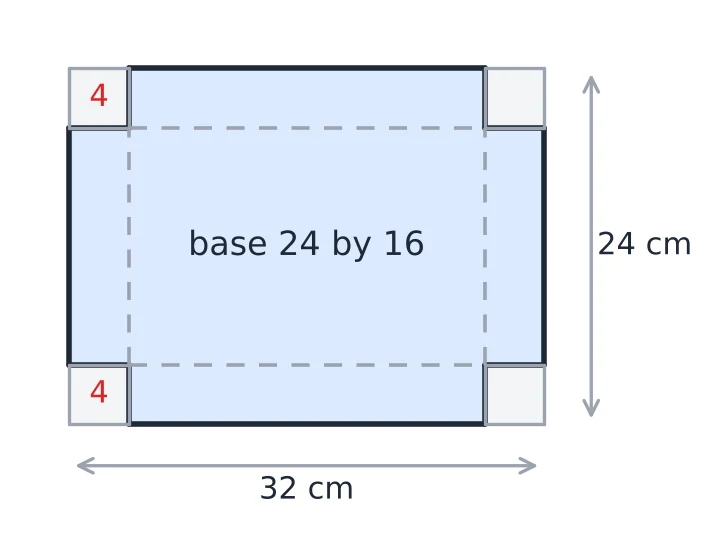
Answer. Cutting 4 cm from both ends takes 8 cm off each side, so the base is 24 cm by 16 cm, and the folded-up flaps make the height 4 cm. Volume = 1536 cm³. The sheet used is the whole sheet minus the four squares: = 704 cm². As a check, base plus four walls is .
Question 8
A pyramid has a square base of side 32 cm and a height of 12 cm. Find its volume and its total surface area.
Answer. Volume = 4096 cm³. For the side faces I need the slant height, from the height and half the base side: cm. Lateral surface cm², and with the base, total surface = 2304 cm².
Question 9
A copper pipe 2.1 m long has an outer diameter of 10 cm and an inner diameter of 6 cm. If 1 cm³ of copper weighs 9 g, find the weight of the pipe.
Answer. In cm, , and the length is 210. Metal cm³. Weight g = 95.04 kg.
Question 10
How many coins, each 1.4 cm across and 0.25 cm thick, must be melted to make a cuboid 15.4 cm by 7 cm by 2.5 cm?
Answer. Each coin is a flat cylinder of radius 0.7 cm: cm³. The cuboid is cm³. Number of coins = 700.
Question 11
A room is 12 m long and 4.5 m high. Painting its four walls at ₹30 per m² costs ₹5,400. Find the breadth of the room, and the cost of carpeting its floor at ₹250 per m².
Answer. The walls have an area of m². Four walls , so , which gives and a breadth of 8 m. The floor is m², and carpeting it costs = ₹24,000.
Question 12
A rectangular sheet 44 cm by 18 cm is rolled into a hollow cylinder, first with the 44 cm side going round, then with the 18 cm side going round. Find the volume in each case.
Answer. When the 44 cm side goes round, it is the circumference: gives and the height is 18, so the volume is = 2772 cm³. When the 18 cm side goes round, cm and the height is 44, so the volume is = 1134 cm³. The two volumes are in the ratio , the same as . Rolling with the longer side going round gives the bigger cylinder.
Question 13 [Tier 2]
Find the total surface area, the height and the volume of a regular tetrahedron with every edge 6 cm.
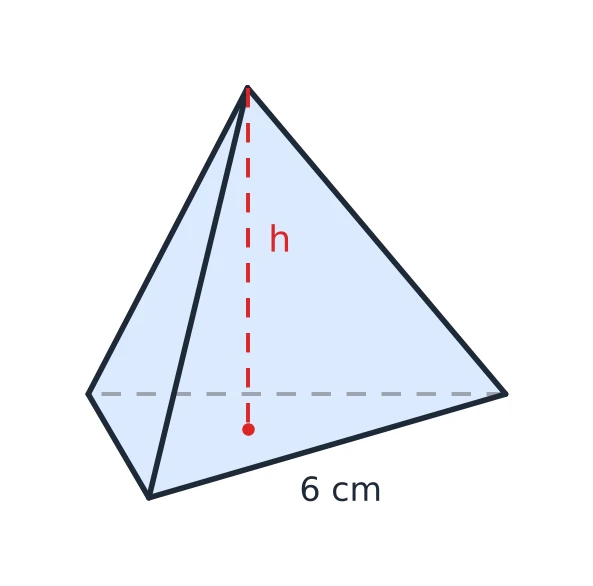
Answer. All four faces are equilateral triangles of side 6, so the surface is = cm². The apex sits right above the centre of the base, which is cm from each corner. So the height is = cm, about 4.9 cm. Volume = cm³, which matches the formula .
Question 14
A hemispherical vessel has an inner radius of 21 cm. Find how many litres it holds, and the cost of tin-plating its inner surface at ₹4 per 100 cm².
Answer. Volume cm³, which is 19.404 litres. The inner surface is only the curved part, cm². Tin-plating costs = ₹110.88.
Question 15
A tent is a cylinder of base radius 2.1 m and height 4 m with a cone of the same base and height 2.8 m on top. Find the canvas needed, and its cost at ₹500 per m².
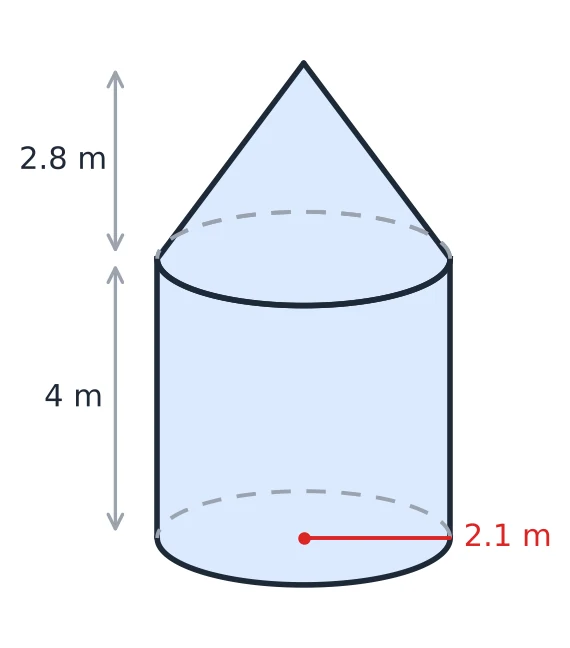
Answer. The cone's slant is m (3-4-5 times 0.7). Canvas = curved surface of the cylinder + curved surface of the cone = 75.9 m². Cost = ₹37,950. The floor and the circle where the cone sits on the cylinder get no canvas.
Question 16
A wall 18 m long, 30 cm thick and 2.5 m high is built with bricks 25 cm by 12.5 cm by 7.5 cm. If the mortar takes up of the wall, how many bricks are used?
Answer. In cm, the wall is cm³, and the bricks fill of it, 12150000 cm³. One brick is cm³. Number of bricks = 5184.
Question 17
The curved surface of a cone of radius 8 cm and height 6 cm is cut along a slant line and opened out flat. Find the radius and the angle of the sector formed.
Answer. The slant height is cm, and that becomes the radius of the sector: 10 cm. The arc of the sector is the rim of the cone's base, so , and the angle is = .
Question 18
A hollow metal sphere has an outer radius of 9 cm and an inner radius of 6 cm. It is melted and made into a solid cylinder of radius 6 cm. Find the height of the cylinder.
Answer. Only the metal counts: . The cylinder has radius 6, so , and the height is = 19 cm.
Question 19
The base of a right prism is a triangle with sides 11 cm, 60 cm and 61 cm, and the prism is 8 cm tall. Find its volume and its total surface area.
Answer. , so the right angle is between the 11 cm and 60 cm sides, and the base has area cm². Volume = 2640 cm³. Lateral surface cm², and the two triangular ends add 660 cm², so the total surface is 1716 cm².
Question 20
A bucket is a frustum of a cone, 45 cm deep, with a radius of 28 cm at the top and 7 cm at the bottom. How many litres of water can it hold?
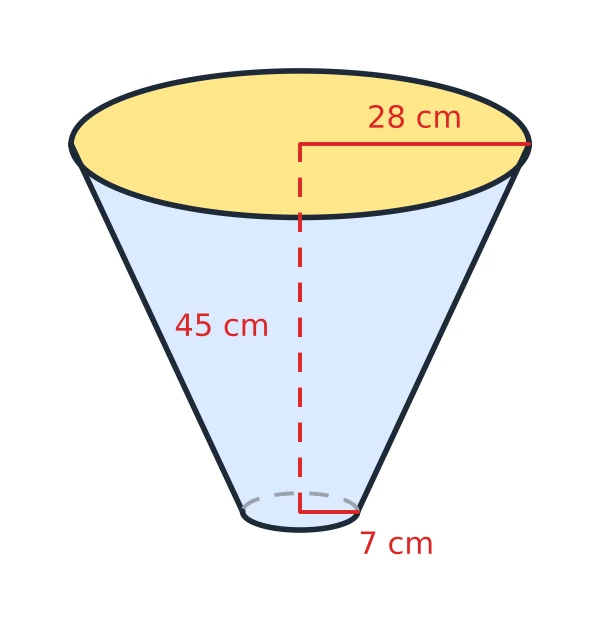
Answer. Frustum volume . The bracket is 1029, which is , so the 7 cancels: cm³. That is 48.51 litres.
Question 21
A solid cone of radius 6 cm and height 16 cm is dropped into a cylindrical vessel of radius 8 cm that is partly full of water, and the cone goes fully under. By how much does the water rise?
Answer. The cone pushes up its own volume: cm³. The vessel's base is cm², so the water rises by = 3 cm. I never needed a value of .
Question 22
A garden roller is 1.4 m long and 70 cm across. It makes 500 complete turns to level a lawn. Find the area of the lawn and the cost of levelling it at ₹2.50 per m².
Answer. In one turn the roller presses its own curved surface: m². In 500 turns that is 1540 m², and the cost is = ₹3,850.
Question 23
A medicine capsule is a cylinder with a hemisphere at each end. It is 14 mm long from end to end and 5 mm across. Find its surface area.
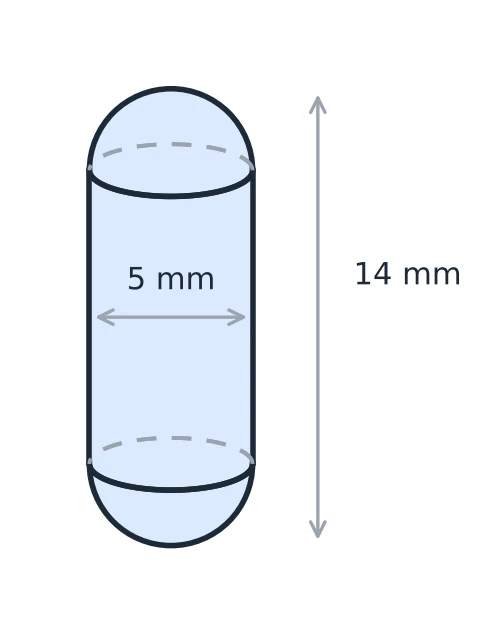
Answer. The radius is 2.5 mm, so the two hemispheres take 5 mm of the length and the cylinder is 9 mm long. Surface . That is = 220 mm². So a capsule's surface is just .
Question 24
The radius of a cylinder is decreased by 20%. By what percentage must its height be increased so that its volume stays the same?
Answer. The base area becomes times, so the height must become times. That is an increase of = 56.25%. Taking 40% (double the 20%) is not enough, because the radius is squared.
Question 25
The base of a right prism is a regular hexagon of side 8 cm, and its volume is cm³. Find its height and its lateral surface area.
Answer. The hexagon is six equilateral triangles of side 8: area cm². Height = 15 cm. Lateral surface = 720 cm².
Question 26 [Tier 2]
A well 3 m across is dug 14 m deep. The earth taken out is spread evenly all round it to make an embankment 4 m wide. Find the height of the embankment.
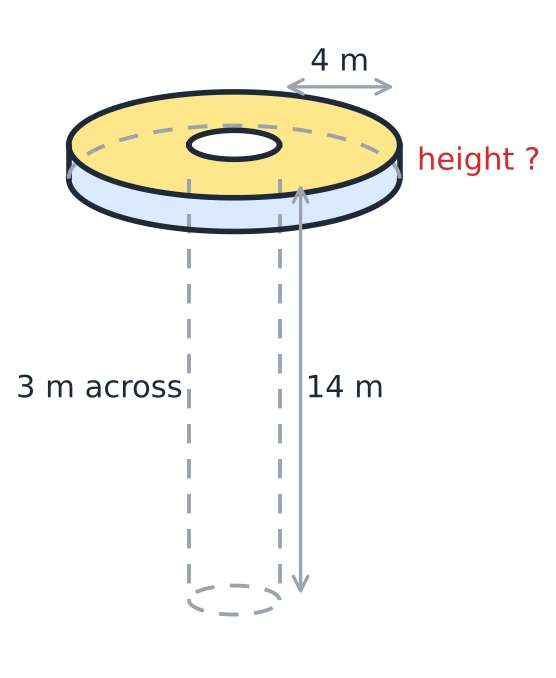
Answer. Earth dug out m³. The embankment is a ring from radius 1.5 m out to m, so its area is m². Height = 1.125 m. The usual slip is to take the outer radius as 4 m: the 4 m is the width of the ring, measured from the edge of the well.
Question 27
A heap of wheat is a cone of base diameter 12 m and height 8 m. Find its volume, and the area of canvas needed to just cover it. (Take .)
Answer. and , so the slant is 10 m. Volume = 301.44 m³. Canvas covers only the sloping surface: = 188.4 m².
Question 28
A closed wooden box measures 52 cm by 40 cm by 29 cm on the outside, and the wood is 2 cm thick. Find the volume of wood used.
Answer. The wood is on both sides of every measurement, so each inside length is 4 cm less: 48 cm by 36 cm by 25 cm. Outside volume cm³ and inside volume cm³. Wood used = 17120 cm³.
Question 29
An ice-cream cone is a cone of radius 4 cm and height 10 cm, filled with ice cream and topped with a hemisphere of the same radius. How many such cones can be filled from a cylindrical tub of radius 8 cm and height 18 cm?
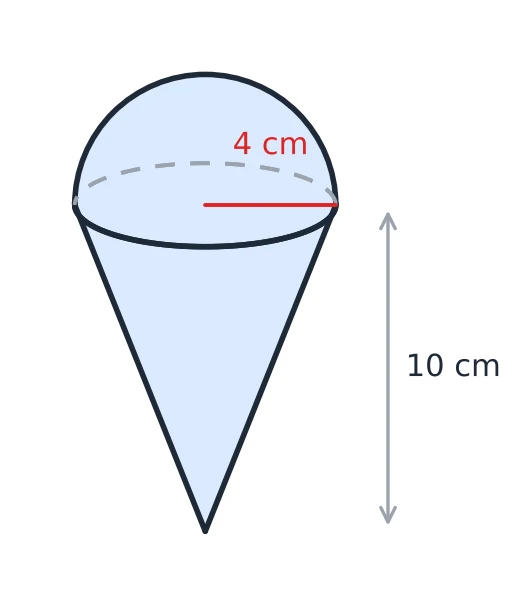
Answer. One cone holds cm³. The tub holds cm³. Number of cones = 12. I kept as a letter, so it cancelled at the end.
Question 30
Three solid metal spheres of radii 4 cm, 17 cm and 22 cm are melted into one sphere. Find its radius, and the ratio of the total surface of the three spheres to the surface of the new one.
Answer. Volumes add: , so the new radius is 25 cm. Surfaces go with : before, ; after, . The ratio is 789 : 625, so some surface is lost when small spheres are melted into one big one.
Question 31 [Tier 2]
A right pyramid stands on an equilateral triangle of side cm. The slant height of each side face is 5 cm. Find the height and the volume of the pyramid, and its lateral surface area.
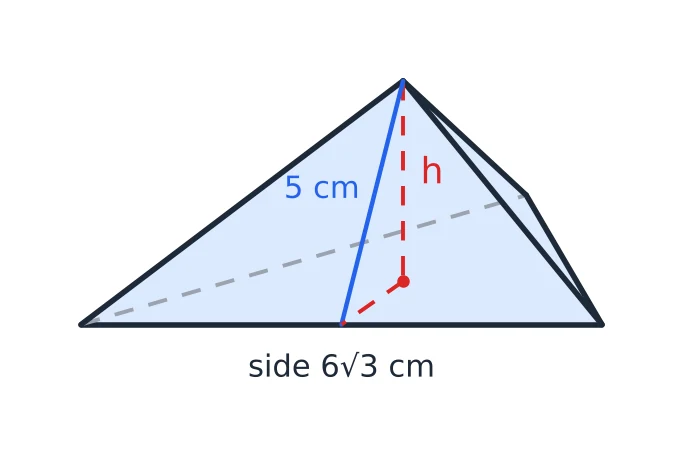
Answer. The foot of the height is the centre of the triangle, and its distance from each side is the inradius cm. The slant height runs from the apex to the middle of a side, so height = 4 cm (the 3-4-5 triangle). The base has area cm², so the volume is = cm³. Lateral surface = cm².
Question 32
A hollow cylinder, open at both ends, is 15 cm long. Its outer radius is 10.5 cm and its inner radius is 7 cm. Find its total surface area: outside, inside and the two rims.
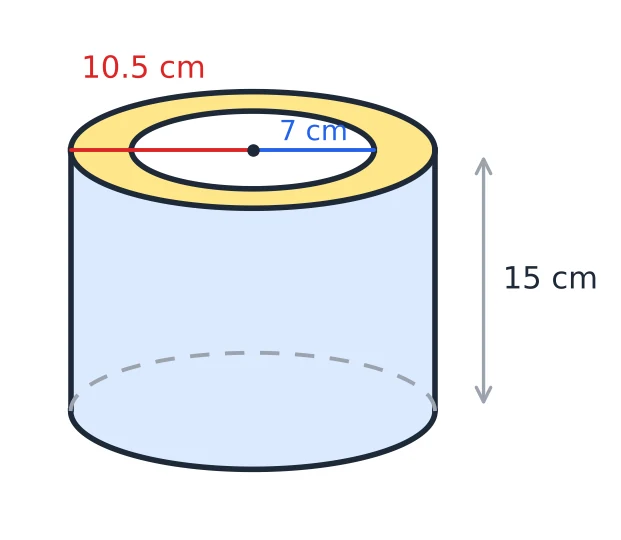
Answer. Outside cm², inside cm², and the two rims cm². Total = 2035 cm². In one line: , the same 2035.
Question 33
The largest possible hemisphere is scooped out of one face of a solid cube of edge 14 cm. Find the surface area of what is left.
Answer. The hemisphere's radius is half the edge, 7 cm. Scooping removes a circle of cm² from the top face but opens up a bowl of cm² inside. So the surface is = 1330 cm², more than the cube had.
Question 34
A prism has 30 edges. How many faces and vertices does it have? How many faces, edges and vertices does a pyramid on the same base have?
Answer. A prism on an -sided base has edges, so . It has = 12 faces and = 20 vertices (, as Euler's rule says). The pyramid on a 10-sided base has = 11 faces, = 20 edges and = 11 vertices.
Question 35
A frustum of a cone has end radii 20 cm and 12 cm and a height of 15 cm. Find its curved surface area and its total surface area, in terms of .
Answer. The slant height comes from the height and the difference of the radii: cm. Curved surface = cm². Adding the two circular ends, , the total surface is cm².
Question 36
A cone 32 cm high is cut by a plane parallel to its base so that the curved surface of the small cone on top is of the curved surface of the whole cone. At what height above the base is the cut made?
Answer. Surfaces go as squares of lengths, so the small cone's height is of the whole: 8 cm, measured from the apex. The cut is = 24 cm above the base. Two slips to avoid: taking the cube root (that is for volumes), and answering 8 cm, which is measured down from the top.