
The Cuboid: Faces, Edges and Volume
A cuboid is the shape of a brick, a matchbox, a room or a water tank. It has 6 rectangular faces (opposite faces are equal), 12 edges and 8 vertices (corners). Its three measurements are the length l, the breadth b and the height h.
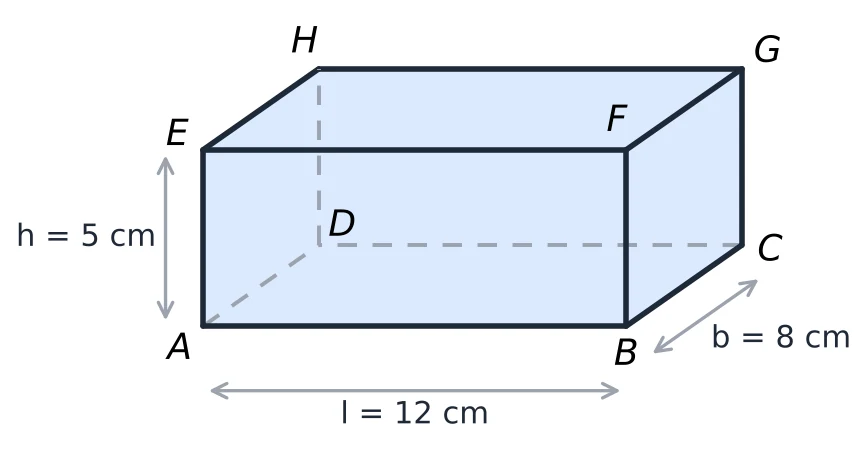
The 12 edges come in three sets of four. In the figure AB, DC, EF and HG are lengths; BC, AD, FG and EH are breadths; AE, BF, CG and DH are heights. So
For the 12 cm × 8 cm × 5 cm cuboid in the figure the volume is 12 × 8 × 5 = 480 cm³, and a wire frame of it uses 4 × (12 + 8 + 5) = 100 cm of wire.
Volume as base area × height. l × b is the area of the bottom face, so the volume is (area of the base) × (height). Any face can serve as the base, with the edge at right angles to it as the height. The same idea gives the volume of every prism and cylinder later in the chapter.
A missing edge. Turn the formula round: . A cuboid of volume 960 cm³ standing on a base 12 cm × 10 cm is cm high.
Units. Put all three lengths in the same unit before multiplying. Since 1 m = 100 cm,
which is ten lakh cubic centimetres. A concrete slab 2 m long, 1.5 m wide and 20 cm thick takes 2 × 1.5 × 0.2 = 0.6 m³ of concrete. Multiplying 2 × 1.5 × 20 = 60 and calling it 60 m³ mixes metres with centimetres.
Total Surface Area and Lateral Surface Area of a Cuboid
Cut a closed cuboid along some edges and open it out flat. You get its net: six rectangles in three equal pairs. Top and bottom are l × b, front and back are l × h, and the two sides are b × h.
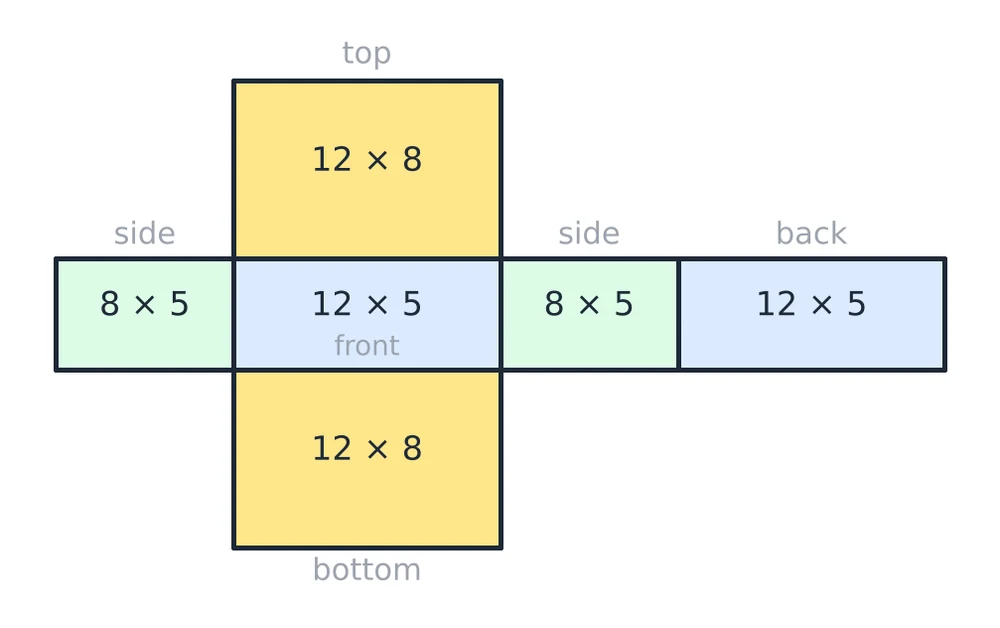
Adding all six gives the total surface area (TSA):
For the 12 × 8 × 5 cuboid: lb = 96, bh = 40 and hl = 60. These add up to 196, so the TSA is 2 × 196 = 392 cm².
Lateral surface area (LSA) leaves out the top and the bottom. It is the four side faces only, which for a room means the four walls:
The same cuboid has LSA = 2 × 5 × (12 + 8) = 200 cm². Check: 392 − 2 × 96 = 200.
Look at the middle row of the net: side, front, side, back. Together they make one long strip of length 2(l + b) and height h. That is why the LSA is the base perimeter times the height.
Third edge from the TSA. If the TSA and two edges are known, halve the TSA, take away the product of the known edges and divide by their sum:
With TSA 392 cm², l = 12 cm and b = 8 cm: cm.
Which area goes with which job. Painting or polishing the outside of a closed box uses the TSA. Plastering or painting the four walls of a hall uses the LSA. Multiply the right area by the rate per m² (or per cm²).
The Diagonal of a Cuboid
The diagonal of a cuboid joins two opposite corners through the inside, like AG in the figure. It is the longest straight rod that fits in a box or a room.
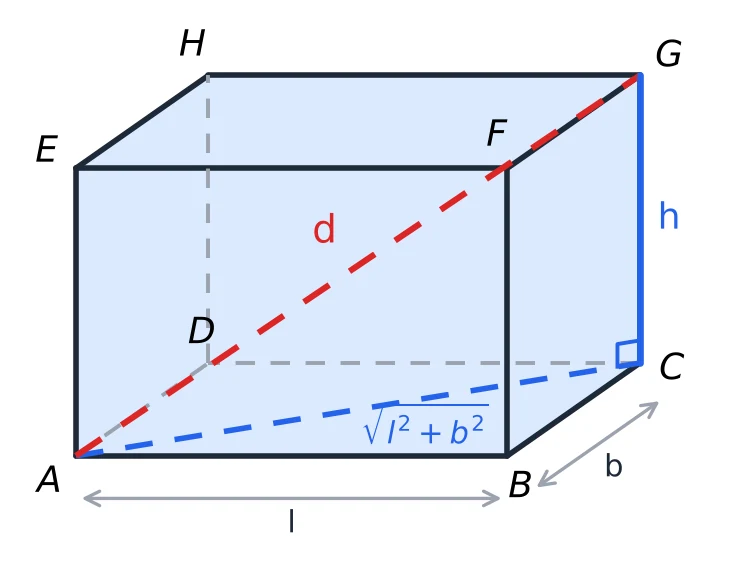
Find it in two steps. On the floor, AC is the diagonal of an l × b rectangle, so . The edge CG stands straight up from C, so triangle ACG has its right angle at C:
A room 12 m long, 9 m wide and 8 m high has diagonal m, so 17 m is the longest pole that fits in it. A pole lying on the floor can only be m long.
The face diagonals are , and , one for each pair of opposite faces.
Edges, diagonal and TSA together. Square the sum of the three edges:
So any two of these (the sum of the edges, the diagonal, the TSA) give the third. Suppose the twelve edges of a cuboid add up to 116 cm and its diagonal is 17 cm. Then and
The room above is such a cuboid: 12 + 9 + 8 = 29, and 2(108 + 72 + 96) = 552. In the exam you never need the separate edges for this.
[SSC Tip] The longest rod in a room lies along the body diagonal, from a bottom corner to the opposite top corner, not along the diagonal of the floor (15 m in the room above).
The Cube: Volume, Surfaces and Diagonals
A cube is a cuboid with l = b = h = a. Every face is a square of side a, and the cuboid formulas become:
| Measure | Formula | For a = 6 cm |
|---|---|---|
| Volume | 216 cm³ | |
| Total surface area | 216 cm² | |
| Lateral surface (4 faces) | 144 cm² | |
| Face diagonal | cm | |
| Diagonal of the cube | cm | |
| Sum of edges | 12a | 72 cm |
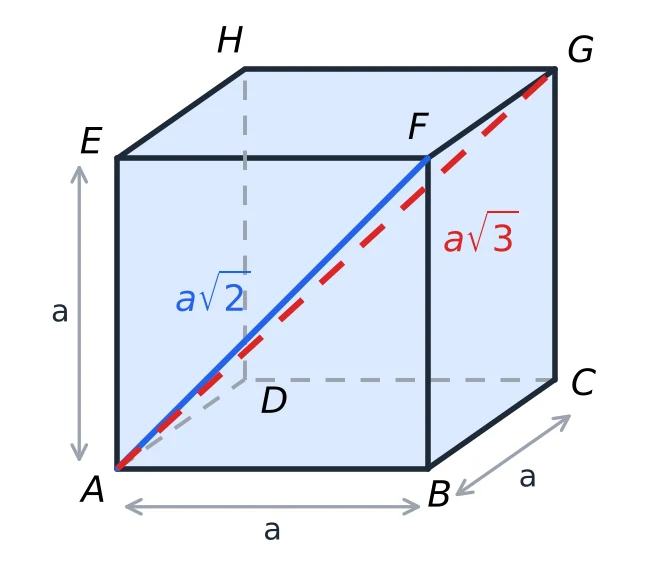
The cube's diagonal is , straight from the cuboid formula. Edge 6 is the only cube whose volume and TSA are the same number (216), though one is in cm³ and the other in cm².
Find the edge first. Almost every cube question becomes easy once you have a.
- From the volume, . Volume 512 cm³ gives a = 8 cm and TSA 6 × 64 = 384 cm².
- From the TSA, . TSA 294 cm² gives , a = 7 cm and volume 343 cm³.
- From the diagonal, . Diagonal cm gives a = 9 cm, volume 729 cm³ and TSA 486 cm².
- From a face diagonal, . Face diagonal cm gives a = 5 cm.
TSA straight from the diagonal. Since ,
A cube with diagonal 12 cm has TSA 2 × 144 = 288 cm², with no square root anywhere. Its edge is cm and its volume is cm³.
Volume from the Three Face Areas, and Edges in a Ratio
Sometimes only the areas of three faces that meet at a corner are given. Call them x = lb, y = bh and z = hl, and multiply:
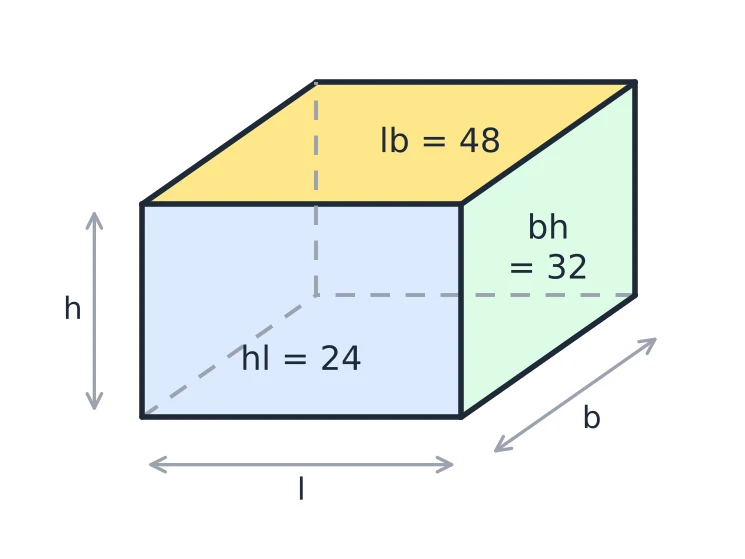
In the figure the faces are hl = 24 cm², bh = 32 cm² and lb = 48 cm², so . Break each number into primes before multiplying: . The square root is = 192 cm³.
Each edge is the volume divided by the face that does not contain it: cm, cm and cm.
For a cube the three faces are equal, so one face is enough: a face of 64 cm² means a = 8 cm and a volume of 512 cm³.
Edges in a ratio. Write the edges as multiples of one number k.
- Volume given. Edges in the ratio 4 : 3 : 2 and volume 3000 cm³: , so and k = 5. The edges are 20, 15 and 10 cm, and the TSA is 2(300 + 150 + 200) = 1300 cm².
- TSA given. Edges in the ratio 3 : 2 : 1 and TSA 1078 cm²: , so and k = 7. The edges are 21, 14 and 7 cm, and the volume is 21 × 14 × 7 = 2058 cm³.
A volume gives you , so take a cube root; an area gives you , so take a square root. Multiplying the ratio by 125 or by 49 instead of by k makes every edge far too long.
Rooms: Four Walls, Floor, Ceiling and Papering
A room is a cuboid seen from the inside, and room questions come up often in CGL papers. The floor and the ceiling are each l × b, and the four walls are the lateral surface:
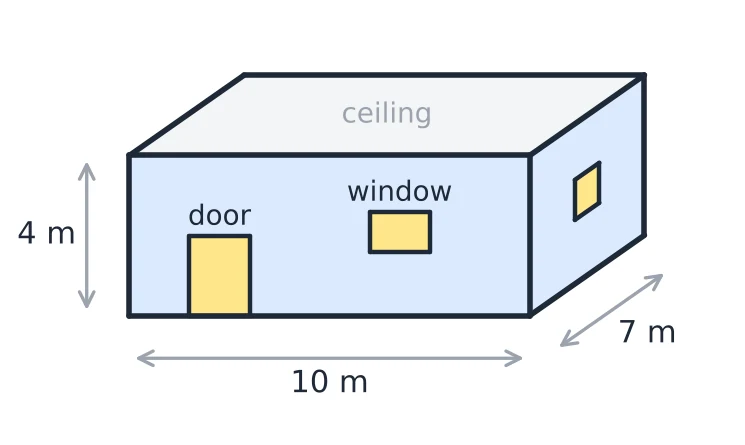
Painting with a door and windows. The room in the figure is 10 m × 7 m × 4 m. Its four walls cover 2 × 4 × (10 + 7) = 136 m². It has a door 2 m × 1.5 m and two windows 1.5 m × 1 m each. These are not painted, so take off 3 + 1.5 + 1.5 = 6 m², which leaves 130 m². At ₹25 per m² the walls cost 130 × 25 = ₹3,250. If the ceiling is painted as well, add 10 × 7 = 70 m²: 200 m² in all, for ₹5,000.
Paper or carpet sold by the metre. Wallpaper and carpet come in rolls of a fixed width and are priced per metre of length. Then
with the width in metres. Covering the 130 m² of wall with paper 50 cm wide needs m of paper; at ₹12 per metre that is ₹3,120. Carpeting the 70 m² floor with carpet 2 m wide needs 35 m of carpet.
Working backwards. The cost and the rate give the area, and the area gives the missing measurement. Painting the four walls of a room 10 m × 7 m at ₹20 per m² costs ₹3,400. So the walls are m², which means 2h × 17 = 170 and h = 5 m.
Air in the room. The volume of the room is the air it holds: 10 × 7 × 4 = 280 m³. If each person needs 8 m³ of air, the room is enough for 35 people.
[SSC Tip] Write the width in metres before dividing. Paper 50 cm wide is 0.5 m wide, so 130 m² of wall needs 260 m of paper. Dividing by 50 gives 2.6 m, which cannot cover a wall.
Open Boxes, and a Box Folded from a Sheet
An open box has no lid. Its outer surface is the TSA without the top face:
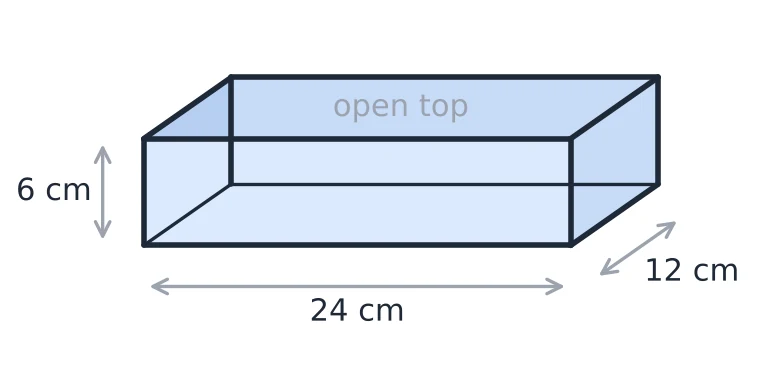
The open box in the figure is 24 cm × 12 cm × 6 cm. Its base is 24 × 12 = 288 cm² and its four walls are 2 × 6 × (24 + 12) = 432 cm², which makes 720 cm² in all. A closed box of the same size needs 2(288 + 72 + 144) = 1008 cm², exactly one lid of 288 cm² more. If a thin open box is painted inside and outside, double the area: 1440 cm².
A box folded from a sheet. Take a rectangular sheet L × B, cut a square of side x from each corner and fold up the flaps. The flaps become the walls, so the box measures
Each side of the sheet loses x at both ends, which is why it is 2x and not x.
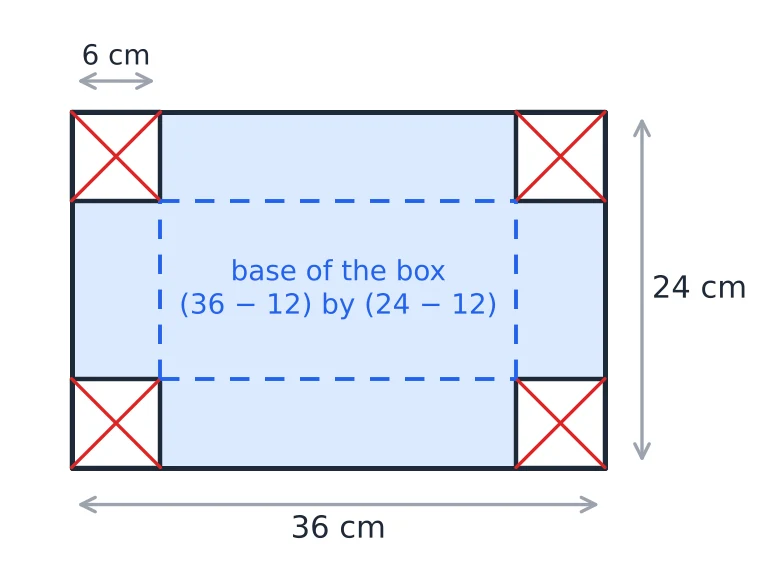
The sheet in the figure is 36 cm × 24 cm with 6 cm squares cut away. The box is (36 − 12) × (24 − 12) × 6 = 24 × 12 × 6, so its volume is 1728 cm³. It is the same open box as in the first figure.
A neat check: the sheet left after cutting is 864 − 4 × 36 = 720 cm², the same as the surface of the open box. Folding does not add or remove any material.
Thickness of the Walls: Inner and Outer Measurements
A wooden or metal box has walls of some thickness t, so the measurements taken outside are larger than those inside.
- Closed box: each measurement loses t at both ends. The inside is (l − 2t) × (b − 2t) × (h − 2t).
- Open box (no lid): the length and breadth still lose 2t, but the height loses only t, for the bottom.
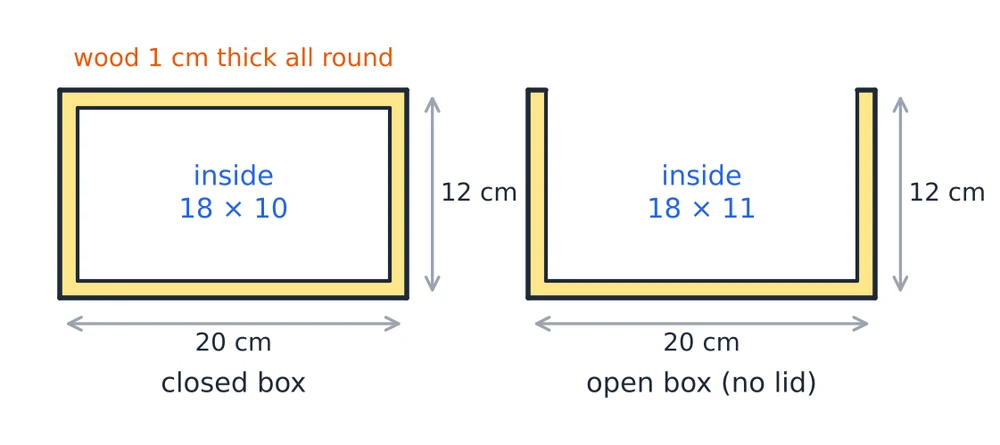
Capacity is the volume inside the box. Wood used is the outer volume minus the inner volume.
Take a closed box whose outer measurements are 20 cm × 16 cm × 12 cm, made of wood 1 cm thick.
- Inside: 18 × 14 × 10 = 2520 cm³. Since 1000 cm³ make a litre, the box holds 2.52 litres.
- Outside: 20 × 16 × 12 = 3840 cm³.
- Wood: 3840 − 2520 = 1320 cm³. If 1 cm³ of this wood weighs 0.6 g, the empty box weighs 1320 × 0.6 = 792 g.
The same box without a lid measures 18 × 14 × 11 = 2772 cm³ inside, and uses 3840 − 2772 = 1068 cm³ of wood.
Inner measurements given. Go the other way: for a closed box add 2t to each inner measurement to get the outer one.
[SSC Tip] For an open box take t off the height only once. Taking 2t off the height of the open box above gives 2520 cm³ instead of 2772 cm³, and both numbers can appear as options.
Tanks and Water: Litres, Capacity, Rise in Level and Rain
Liquids are measured in litres. Keep these facts ready:
- 1 litre = 1000 cm³, and 1 ml = 1 cm³
- 1 m³ = 1000 litres (also called a kilolitre)
- 1 m³ = 10,00,000 cm³
Capacity of a tank. A tank 3 m × 2 m × 1.5 m holds 3 × 2 × 1.5 = 9 m³ = 9000 litres. A pump that delivers 300 litres a minute fills it in minutes.
Rise in the water level. Water poured into a cuboid tank spreads over the whole base, so
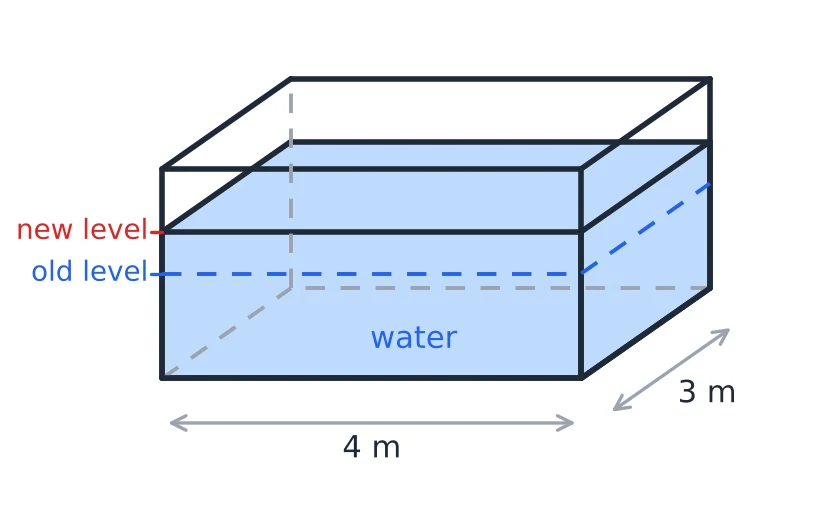
Pour 4800 litres into a tank whose base is 4 m × 3 m. 4800 litres is 4.8 m³ and the base is 12 m², so the level rises m, that is 40 cm. The same rule gives the fall in level when water is drawn out. A solid dropped into the tank raises the level in the same way; that case is done in Combined Solids, Melting and Recasting.
Rain on a roof or a field. Rainfall is given as a depth. The water that falls is (area) × (depth of rain), with the depth in metres. 3 cm of rain on a flat roof 20 m × 15 m gives 20 × 15 × 0.03 = 9 m³ = 9000 litres. Sent into the 3 m × 2 m tank above, it raises the level by m and fills the tank exactly.
Changing 3 cm to 0.03 m is the step to check. Left as 3, the same roof would collect 900 m³, a hundred times too much.
How Many Bricks, Boxes or Cubes Fit
Bricks in a wall. When small cuboids fill a big one completely,
with both volumes in the same unit. A wall 15 m long, 30 cm thick and 4 m high has volume 15 × 0.3 × 4 = 18 m³ = 1,80,00,000 cm³. A brick 25 cm × 12 cm × 8 cm is 2400 cm³, so the wall needs 1,80,00,000 ÷ 2400 = 7500 bricks. If mortar (the cement between bricks) takes up of the wall, only of it is brick, and 6750 bricks are needed.
Boxes in a carton. Boxes cannot be cut, so count how many fit along each edge and multiply.
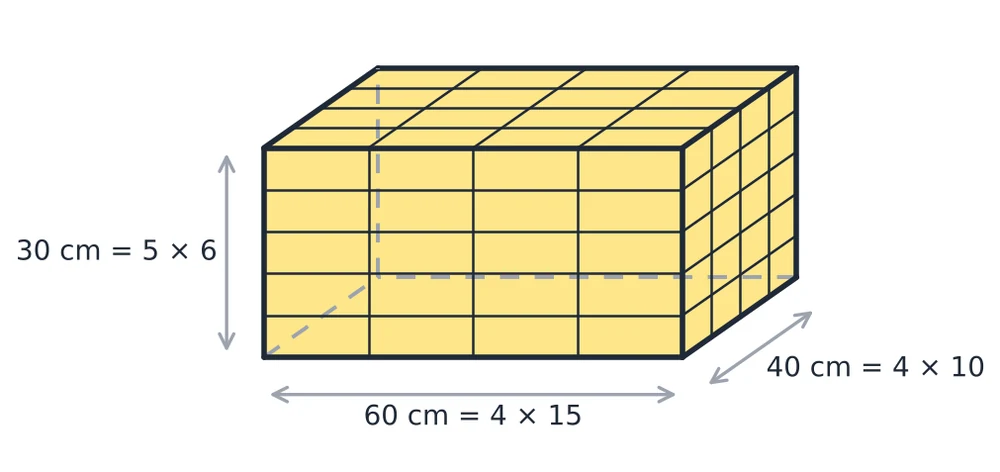
A carton 60 cm × 40 cm × 30 cm and boxes 15 cm × 10 cm × 6 cm, all placed the same way: 4 fit along the length, 4 along the breadth and 5 one above the other, so the carton takes 4 × 4 × 5 = 80 boxes. Dividing the volumes also gives 72000 ÷ 900 = 80, because every edge divides exactly.
Now make the carton 50 cm long. Only 3 boxes fit along 50 cm (3 × 15 = 45, and 5 cm is left over), so it takes 3 × 4 × 5 = 60 boxes. Dividing the volumes gives 66.67, which is impossible.
Largest equal cubes from a cuboid. The edge of the largest cube that cuts a cuboid with nothing left over is the HCF of its three edges. A cuboid 28 cm × 21 cm × 14 cm has HCF 7 cm, so it gives 4 × 3 × 2 = 24 cubes.
Smallest cube made of bricks. To stack bricks 12 cm × 9 cm × 6 cm into a solid cube, the edge must be a multiple of all three: the LCM, 36 cm. That takes 3 × 4 × 6 = 72 bricks.
[SSC Tip] Divide the volumes only when the pieces fill the space exactly, or when the question says to ignore wastage. For boxes in a carton, check each edge separately.
Cutting a Cube into Small Cubes, and Joining Cubes
Cutting. A cube of edge A cut into small cubes of edge a gives cubes. The total volume stays the same, but every cut opens up new faces, so the total surface grows.
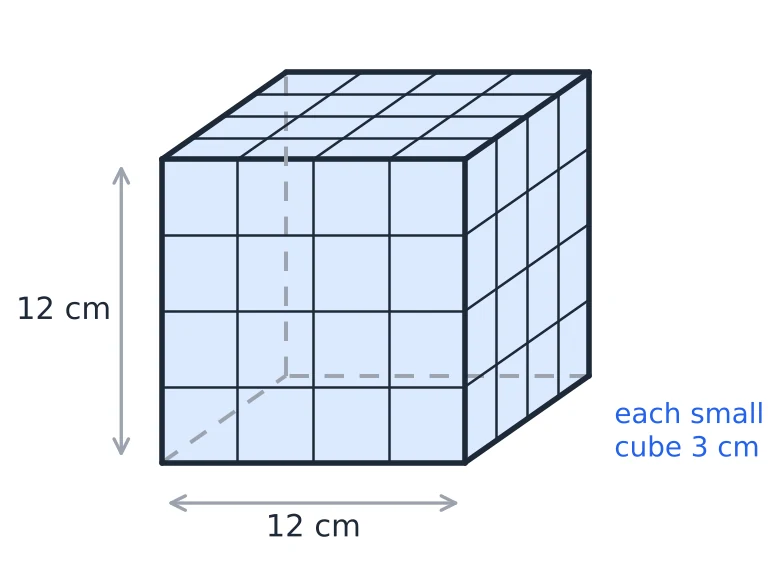
A 12 cm cube cut into 3 cm cubes gives 4 cubes along each edge, so small cubes.
- TSA before: 6 × 144 = 864 cm².
- TSA after: 64 × 6 × 9 = 3456 cm², which is 4 times as much.
The factor 4 is just : the total surface always becomes times. Here it increases by 3456 − 864 = 2592 cm², which is 300% of the old surface. A cube cut into 8 equal cubes has each edge halved, so its total surface doubles; cut into 27, the surface becomes 3 times.
Joining cubes end to end. n equal cubes of edge a placed in a row make a cuboid na × a × a. Each joint hides two faces, one from each cube.
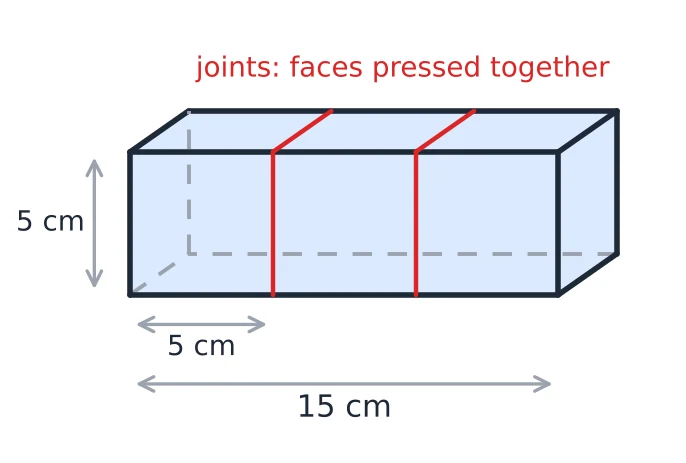
Three 5 cm cubes make a 15 × 5 × 5 cuboid with TSA 2(75 + 25 + 75) = 350 cm². Separately they have 3 × 150 = 450 cm². The two joints hide 4 faces of 25 cm² each, and 450 − 100 = 350. In general
Two cubes give and three give . The volume is simply n times the volume of one cube.
Changing the Edges: What Happens to Volume and Surface
Cube. Double the edge and the volume becomes times, while the surface becomes only times. The figure shows the 8 cubes of edge a that fill a cube of edge 2a.
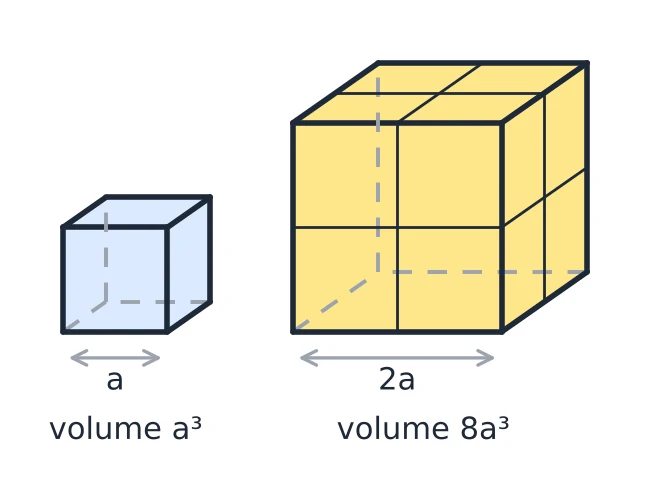
Percentage changes work the same way. Edge up 10%: the volume is multiplied by (a 33.1% rise) and the surface by (a 21% rise). Edge up 20%: the volume is multiplied by 1.728, a 72.8% rise. Backwards, a volume up 33.1% means the edge went up 10%, since . The same squares-and-cubes rule for every solid is set out in Combined Solids, Melting and Recasting.
Cuboid with different changes. Volume = l × b × h, so multiply the three factors. Length up 10%, breadth up 20% and height down 25%:
The volume falls by 1%. Successive percentage change (Chapter 3) gives the same: the first two changes make 10 + 20 + 2 = 32%, and then 32 − 25 − 8 = −1.
Keeping the volume fixed. The length and breadth of a tank are both increased by 25%. The base becomes 1.25 × 1.25 = 1.5625 times as big, so to hold the same water the depth must become times. The depth goes down by 36%.
The surface of a cuboid cannot be found from one factor unless all three edges change by the same percentage. Otherwise find the new edges and work out the new TSA.
Solved Examples
Question 1
A cuboid measures 15 cm × 10 cm × 8 cm. What is its total surface area? (a) 1,200 cm² (b) 400 cm² (c) 700 cm² (d) 350 cm²
Answer. I need the three different faces: 15 × 10 = 150, 10 × 8 = 80 and 8 × 15 = 120. They add up to 350, and each face comes twice (top and bottom, front and back, two sides), so TSA = 2 × 350 = (c) 700 cm². Stopping at 350 is the common slip.
Question 2
The volume of a cuboid is 1,440 cm³. Its length is 16 cm and its breadth is 12 cm. What is its total surface area? (a) 804 cm² (b) 402 cm² (c) 420 cm² (d) 1,608 cm²
Answer. First the height: 1440 ÷ (16 × 12) = 1440 ÷ 192 = 7.5 cm. Now the faces: 16 × 12 = 192, 12 × 7.5 = 90 and 7.5 × 16 = 120. They add to 402, so the TSA is 2 × 402 = (a) 804 cm².
Question 3
What is the length of the longest rod that can be placed in a room 18 m long, 9 m wide and 6 m high? (a) 21 m (b) 33 m (c) m (d) 27 m
Answer. The longest rod goes from one bottom corner to the opposite top corner, so I need the diagonal of the room: = (a) 21 m. m is only the diagonal of the floor.
Question 4
The sum of the lengths of all the edges of a cuboid is 88 cm and its diagonal is 14 cm. What is its total surface area? (a) 144 cm² (b) 470 cm² (c) 680 cm² (d) 288 cm²
Answer. There are 4 edges of each kind, so l + b + h = 88 ÷ 4 = 22. Now I use : TSA = 484 − 196 = (d) 288 cm². I never needed the actual edges (they are 4, 6 and 12 cm). If you got 470 cm², you subtracted 14 instead of .
Question 5
The total surface area of a cube is 1,350 cm². What is its volume? (a) 2,744 cm³ (b) 3,375 cm³ (c) 4,096 cm³ (d) 1,125 cm³
Answer. A cube has 6 equal square faces, so one face is 1350 ÷ 6 = 225 cm². The edge is cm, and the volume is = (b) 3,375 cm³.
Question 6
The diagonal of a cube is 15 cm. What is its total surface area? (a) 1,350 cm² (b) 225 cm² (c) 450 cm² (d) 675 cm²
Answer. The diagonal is , so and . The TSA is = 6 × 75 = (c) 450 cm². Quicker: TSA = = 2 × 225. Taking 15 cm as the edge gives 1,350 cm², which is wrong because 15 cm is the diagonal.
Question 7
The areas of three adjacent faces of a cuboid are 20 cm², 36 cm² and 45 cm². What is its volume? (a) 180 cm³ (b) 101 cm³ (c) 360 cm³ (d) 32,400 cm³
Answer. The product of the three face areas is , the square of the volume. 20 × 36 × 45 = 32400, and = (a) 180 cm³. (The edges are 5, 4 and 9 cm: 5 × 4 = 20, 4 × 9 = 36, 9 × 5 = 45.) 32,400 is the square of the volume, so don't stop before taking the root.
Question 8
The edges of a cuboid are in the ratio 5 : 4 : 2 and its total surface area is 1,216 cm². What is its volume? (a) 640 cm³ (b) 2,560 cm³ (c) 1,280 cm³ (d) 5,120 cm³
Answer. I take the edges as 5k, 4k and 2k. The faces are , and , so TSA = . That gives and k = 4, so the edges are 20, 16 and 8 cm. Volume = 20 × 16 × 8 = (b) 2,560 cm³. Putting where belongs gives 40 × 16 = 640 cm³, which is wrong.
Question 9
A room is 8 m long, 6 m wide and 4 m high. It has one door 2 m × 1 m and two windows of 1.5 m × 1 m each. What will it cost to paint its four walls at ₹30 per m²? (a) ₹3,210 (b) ₹3,360 (c) ₹4,650 (d) ₹3,255
Answer. The four walls: 2 × 4 × (8 + 6) = 112 m². The door is 2 m² and the two windows are 1.5 m² each, so 5 m² is not painted. That leaves 107 m², and 107 × 30 = (a) ₹3,210. Only the walls are asked, so I don't add the ceiling.
Question 10
The four walls of a room 6 m long, 5 m wide and 3.5 m high are to be covered with paper 70 cm wide. The paper costs ₹15 per metre. What is the total cost? (Ignore doors and windows.) (a) ₹1,155 (b) ₹825 (c) ₹3,300 (d) ₹1,650
Answer. Wall area = 2 × 3.5 × (6 + 5) = 77 m². The paper is 70 cm = 0.7 m wide, so its length must be 77 ÷ 0.7 = 110 m. At ₹15 a metre that is 110 × 15 = (d) ₹1,650. ₹1,155 treats the rate as if it were per m².
Question 11
The cost of painting the four walls of a room 9 m long and 6 m wide at ₹20 per m² is ₹2,400. What is the height of the room? (a) 8 m (b) 4 m (c) 5 m (d) 2 m
Answer. The painted area is 2400 ÷ 20 = 120 m². The four walls are 2h(l + b) = 2h × 15 = 30h, so 30h = 120 and h = (b) 4 m. Missing the 2 in 2h(l + b) would give 8 m.
Question 12
Squares of side 5 cm are cut from each corner of a rectangular sheet 30 cm × 20 cm, and the flaps are folded up to make an open box. What is the volume of the box? (a) 1,875 cm³ (b) 3,000 cm³ (c) 1,000 cm³ (d) 2,000 cm³
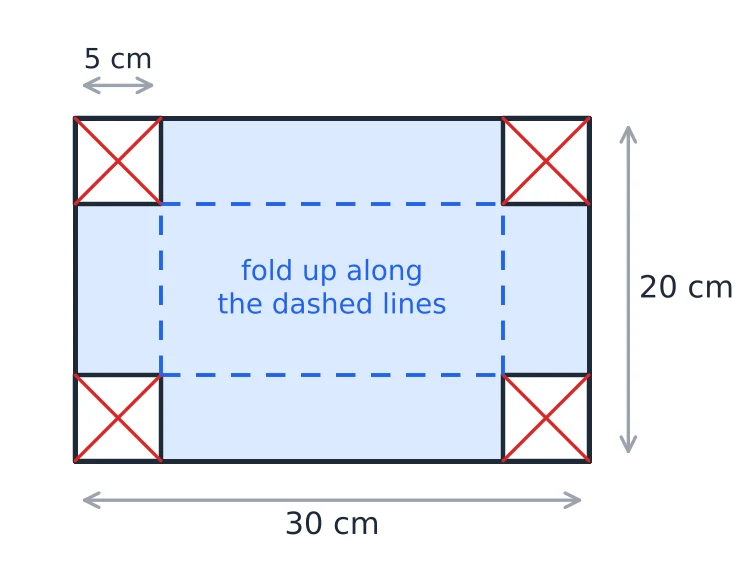
Answer. Each side of the sheet loses 5 cm at both ends. So the box is (30 − 10) × (20 − 10) × 5 = 20 × 10 × 5 = (c) 1,000 cm³. Taking only 5 cm off each side gives 25 × 15 × 5 = 1875, and that is wrong because a square is cut at both ends.
Question 13
A closed wooden box has outer measurements 30 cm × 20 cm × 15 cm and the wood is 2.5 cm thick. What volume of wood was used? (a) 5,250 cm³ (b) 3,750 cm³ (c) 4,312.5 cm³ (d) 9,000 cm³
Answer. The box is closed, so every measurement loses 2.5 cm on both sides: inside it is 25 × 15 × 10 = 3750 cm³. Outside it is 30 × 20 × 15 = 9000 cm³. The wood is the difference: 9000 − 3750 = (a) 5,250 cm³. 3,750 cm³ is the capacity, not the wood.
Question 14
An open box (no lid) made of metal 2 cm thick has outer measurements 54 cm × 34 cm × 26 cm. How many litres does it hold? (a) 33 litres (b) 360 litres (c) 3.6 litres (d) 36 litres
Answer. Length and breadth lose 2 cm at both ends: 50 cm and 30 cm. There is no lid, so the height loses 2 cm only once, for the bottom: 24 cm. Inside volume = 50 × 30 × 24 = 36000 cm³, and 1000 cm³ make a litre, so it holds (d) 36 litres. 33 litres is what you get if you treat it as a closed box.
Question 15
A tank is 2.5 m long, 1.6 m wide and 1.2 m deep. A pipe pours in 240 litres of water a minute. How long will it take to fill the empty tank? (a) 2 minutes (b) 20 minutes (c) 200 minutes (d) 12 minutes
Answer. Volume = 2.5 × 1.6 × 1.2 = 4.8 m³. One m³ is 1000 litres, so the tank holds 4800 litres. Time = 4800 ÷ 240 = (b) 20 minutes.
Question 16
A rectangular tank 6 m long and 4 m wide has water in it. How many litres must be drawn out to lower the water level by 30 cm? (a) 7,200 litres (b) 720 litres (c) 72,000 litres (d) 60,000 litres
Answer. The water taken out is a thin cuboid with the tank's base and a height of 30 cm = 0.3 m. Its volume is 6 × 4 × 0.3 = 7.2 m³, and 7.2 m³ = (a) 7,200 litres.
Question 17
2.5 cm of rain falls on a flat roof 22 m × 20 m. All the water flows into a tank whose base is 4 m × 2.75 m. By how much does the water in the tank rise? (a) 10 cm (b) 25 cm (c) 1 m (d) 1.1 m
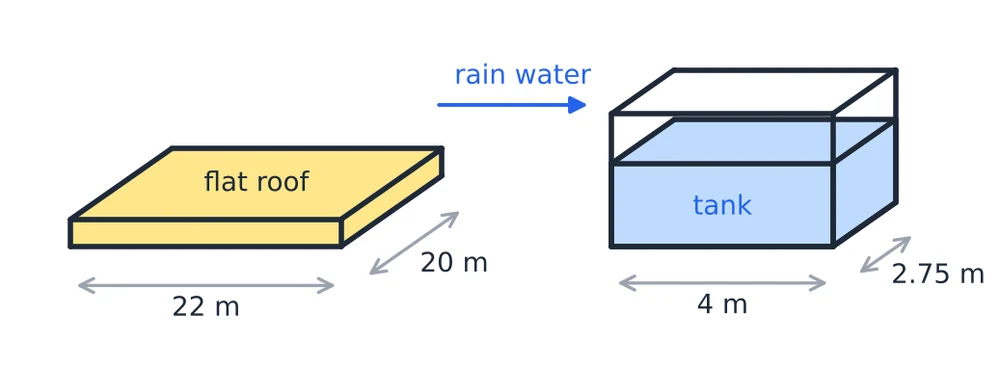
Answer. Water from the roof = 22 × 20 × 0.025 = 11 m³ (2.5 cm is 0.025 m). The tank's base is 4 × 2.75 = 11 m². Rise = 11 ÷ 11 = (c) 1 m.
Question 18
A wall 10 m long, 24 cm thick and 3 m high is built with bricks 24 cm × 12 cm × 8 cm. Mortar takes up one-fifth of the wall. How many bricks are used? (a) 3,125 (b) 625 (c) 3,750 (d) 2,500
Answer. In centimetres the wall is 1000 × 24 × 300 = 72,00,000 cm³, and one brick is 24 × 12 × 8 = 2304 cm³. If the whole wall were brick it would take 72,00,000 ÷ 2304 = 3125 bricks. Only four-fifths of it is brick, so the answer is × 3125 = (d) 2,500.
Question 19
Boxes 20 cm × 15 cm × 12 cm are packed in a carton 90 cm × 60 cm × 50 cm, with the 20 cm side along the 90 cm side, the 15 cm side along the 60 cm side and the 12 cm side upright. How many boxes fit? (a) 75 (b) 64 (c) 80 (d) 60
Answer. I count along each edge. Along 90 cm: 4 boxes (80 cm, and 10 cm is left). Along 60 cm: exactly 4. Upright in 50 cm: 4 boxes (48 cm, and 2 cm is left). So 4 × 4 × 4 = (b) 64. Dividing the volumes gives 75, but that counts the empty gaps as if they were boxes.
Question 20
A cube of edge 10 cm is cut into small cubes of edge 2 cm. By what percentage does the total surface area increase? (a) 400% (b) 500% (c) 125% (d) 2,400%
Answer. Five small cubes fit along each edge, so there are of them. Surface before: 6 × 100 = 600 cm². Surface after: 125 × 6 × 4 = 3000 cm², five times as much. The increase is 2400 cm², which is (a) 400% of 600. The total becomes 500% of the old one, but the question asks for the increase.
Question 21
Four cubes, each of edge 4 cm, are joined end to end in a row. What is the total surface area of the cuboid formed? (a) 384 cm² (b) 256 cm² (c) 288 cm² (d) 320 cm²
Answer. The cuboid is 16 cm × 4 cm × 4 cm. TSA = 2(16 × 4 + 4 × 4 + 4 × 16) = 2(64 + 16 + 64) = (c) 288 cm². Check another way: the four cubes have 4 × 96 = 384 cm², and the three joints hide 6 faces of 16 cm² each, so 384 − 96 = 288.
Question 22
Each edge of a cube is increased by 50%. By what percentage does its volume increase? (a) 150% (b) 125% (c) 337.5% (d) 237.5%
Answer. The edge is multiplied by 1.5, so the volume is multiplied by . The volume goes up by 3.375 − 1 = 2.375 times the old value, which is (d) 237.5%. 337.5% is what the new volume is, compared with the old one.
Question 23
The length and breadth of a cuboid tank are each increased by 20%. By what percentage must its depth be reduced so that it holds the same amount of water? (a) 40% (b) (c) 44% (d) 36%
Answer. The base becomes 1.2 × 1.2 = 1.44 times as big. To keep the volume the same, the depth must become of what it was. It falls by of itself, that is = (b) . 44% is the rise in the base area, not the cut in depth.
Question 24
A cuboid 30 cm × 24 cm × 18 cm is cut into the largest possible equal cubes, with nothing left over. How many cubes are obtained? (a) 120 (b) 20 (c) 60 (d) 6
Answer. The edge of the largest cube must divide 30, 24 and 18 exactly, so it is their HCF, 6 cm. Along the three edges I get 5, 4 and 3 cubes, so there are 5 × 4 × 3 = (c) 60 cubes. Check: 12960 ÷ 216 = 60.