
The Cylinder and Its Volume
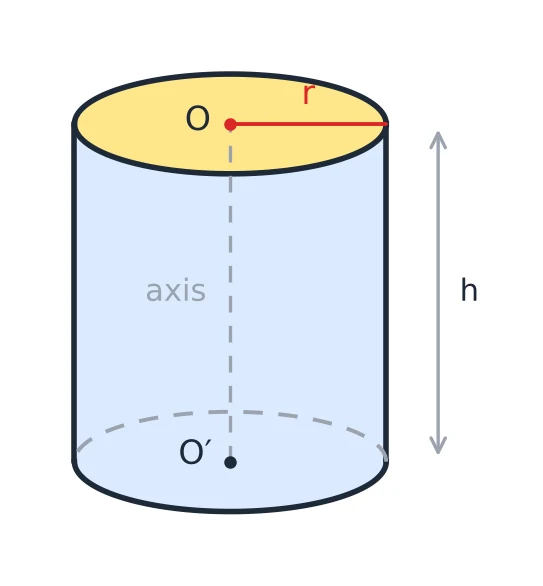
A right circular cylinder has two equal circular ends, joined by a curved surface. The line through the centres of the two ends (the axis) is at right angles to them. Drums, tins, pipes, pillars and road rollers are all cylinders, and two measurements fix one completely: the radius r of the base and the height h.
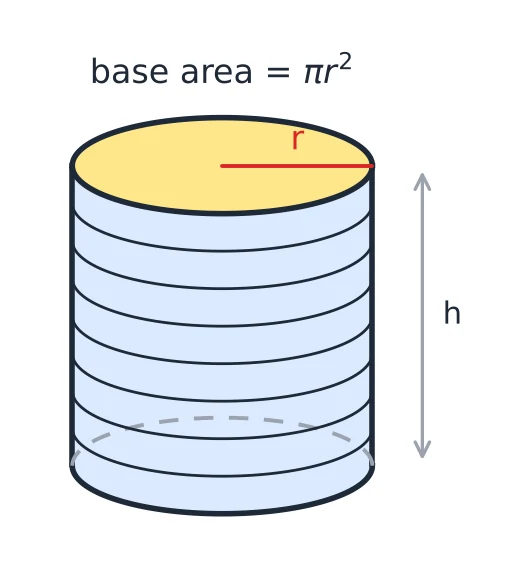
Think of a cylinder as a pile of identical coins. Each coin covers the base area and the pile is h high, so the volume is base area × height, the same rule as for a cuboid or a prism:
A cylinder of radius 7 cm and height 10 cm holds cm³. With r = 5 cm and h = 8 cm the volume is cm³ when the options keep , or 628 cm³ with 3.14.
Diameter given. Halve it before squaring, or use . A tank of diameter 1.4 m and height 2.5 m has r = 0.7 m and volume m³. Taking 1.4 m as the radius gives 15.4 m³, four times too much.
Capacity in litres. 1 litre = 1000 cm³ and 1 m³ = 1000 litres (see Cuboid and Cube). So the tank above holds 3.85 × 1000 = 3850 litres, and the 1540 cm³ cylinder holds 1.54 litres. When the radius is in cm and the height in m, bring them to one unit before you multiply.
Which value of . A radius or diameter that is a multiple of 7 (or 3.5) means ; 'take = 3.14' means 3.14; options written with mean keep it as (see Chapter 13). Cancel the 7 early: , the base area for r = 7, comes up again and again in this section.
Curved Surface and Total Surface
Cut the curved surface along a straight line from top to bottom and open it out flat. It becomes a rectangle. One side of the rectangle is the height h. The other side used to go round the base, so its length is the circumference .
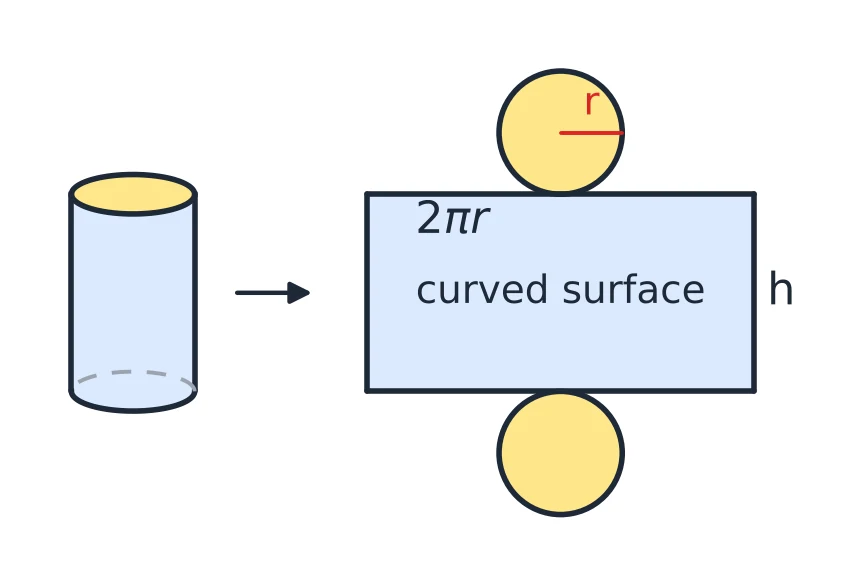
A closed cylinder also has two circular ends of area each:
For r = 7 cm and h = 10 cm, the curved surface is cm², the two ends add 2 × 154 = 308 cm², and the total is 748 cm². The factored form is quicker: and r + h = 17, so the total is 44 × 17 = 748 cm².
Which surface does the object have? Decide this before any arithmetic.
| Object | Surface to use |
|---|---|
| Closed drum, tin with a lid, solid rod | |
| Tank, glass or tumbler open at the top | (one end) |
| Pipe, tube, pillar, roller, paper label on a tin | only |
A tank open at the top with r = 7 cm and h = 10 cm has 440 + 154 = 594 cm² of surface.
Two handy links. TSA − CSA = , the two ends alone, so the difference of the two surfaces gives the radius directly. And
so if the curved surface is half the total, h = r; if it is of the total, h = 2r.
[SSC Tip] For a total-surface question the options usually include the curved surface alone (440 cm² here) and the surface with one end (594 cm²). Count the ends the object really has, then add.
Finding the Radius or the Height
Most questions give two facts and ask for a third. Get the radius first; everything else follows from it.
- Volume and height given. . Volume 6160 cm³ and height 10 cm: , so r = 14 cm.
- Curved surface and height given. . Curved surface 1320 cm² and h = 15 cm: cm.
- Volume and curved surface given. Divide one by the other: , so . With V = 4620 cm³ and CSA = 660 cm², cm, and then cm. The height never had to be guessed.
- Total surface and r + h given. Since TSA = , divide the total by r + h to get . TSA 2200 cm² with r + h = 25 cm gives , so r = 14 cm and h = 11 cm.
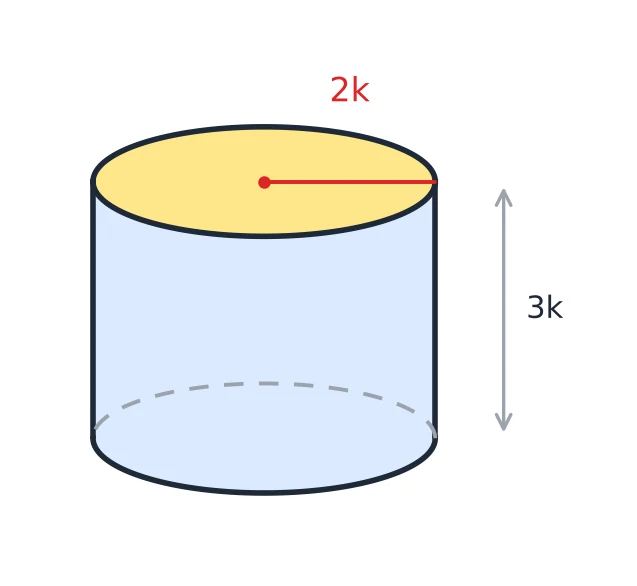
Radius and height in a ratio. Write r = ak and h = bk and put them into the formula. A volume then gives , not k. With r : h = 2 : 3 and volume 12936 cm³:
so k = 7, r = 14 cm and h = 21 cm. A surface given with a ratio gives instead: here the curved surface would be .
Relations in words. 'The curved surface equals the sum of the areas of the two ends' means , so h = r. 'The height is three times the diameter' means h = 6r. Turn the sentence into one equation in r before you touch the numbers.
Comparing Two Cylinders
Volume is and the curved surface is , so for two cylinders
The cancels, so a ratio question never needs its value.
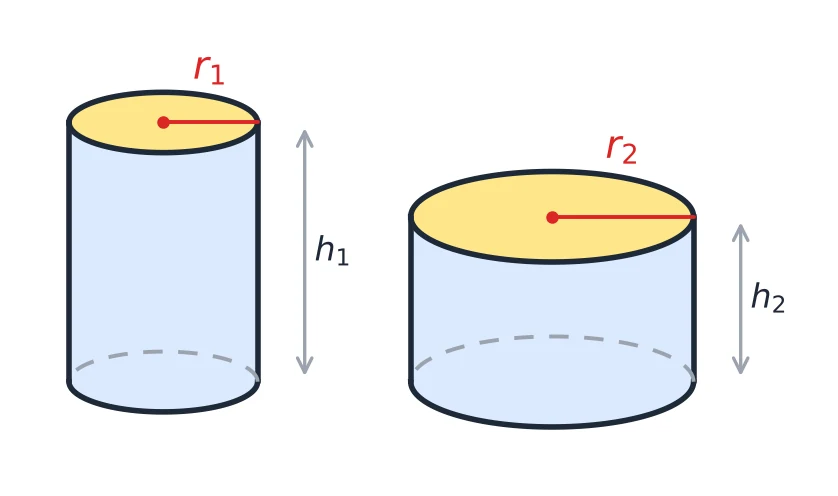
Radii 2 : 3 and heights 5 : 3 give volumes and curved surfaces . The radius ratio is squared for the volume only.
Equal volumes. If , the heights go the opposite way to the squares of the radii:
Radii 3 : 4 with equal volumes give heights 16 : 9. The thinner cylinder has to be taller.
Equal curved surfaces. Then , so radii 3 : 4 give heights 4 : 3, with no squaring.
Radius ratio from the volume ratio. Volumes 9 : 8 and heights 1 : 2: , so the radii are 3 : 2. Take the square root at the end.
Doubling. Double both the radius and the height and the volume becomes times, while the curved surface becomes 4 times. Double only the radius and the volume becomes 4 times; double only the height and it becomes 2 times. The same idea for any solid scaled up evenly is in Combined Solids, Melting and Recasting.
Total surfaces cannot be compared from ratios alone, because mixes the two lengths. For a total-surface ratio you need actual values of r and h.
Rolling a Rectangular Sheet into a Cylinder
Bend a rectangular sheet until two opposite edges meet, and you get a hollow cylinder open at both ends. The edge that goes round becomes the circumference of the base, and the other edge becomes the height. The area of the sheet becomes the curved surface, whichever way you roll it.
Take a sheet 44 cm by 22 cm.
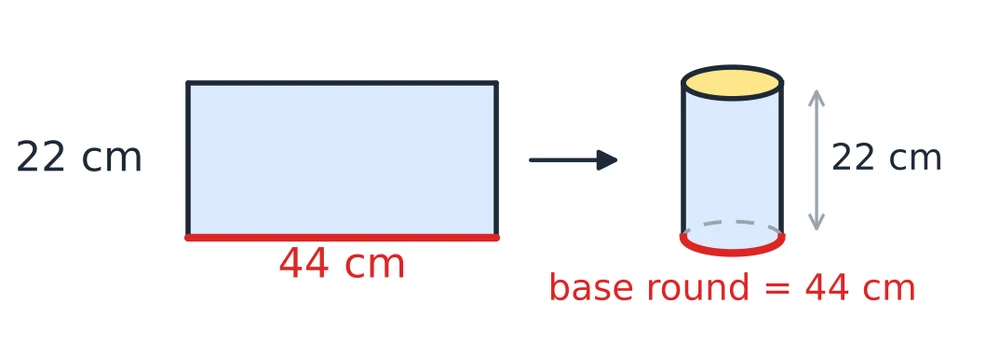
The 44 cm side goes round ('rolled along its length'). Then , so r = 7 cm, and the height is 22 cm. Volume = 154 × 22 = 3388 cm³.
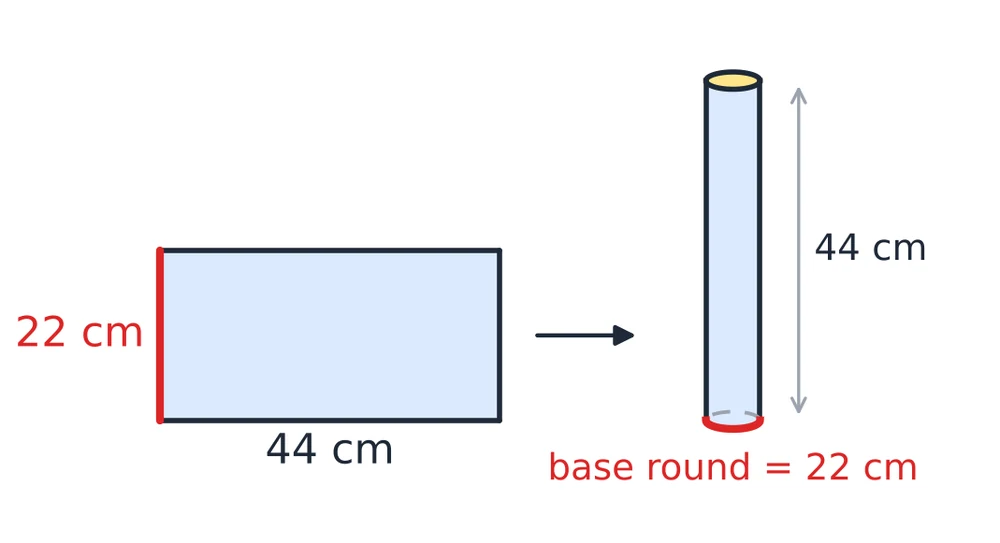
The 22 cm side goes round ('rolled along its breadth'). Then , so r = 3.5 cm, and the height is 44 cm. Volume = 38.5 × 44 = 1694 cm³.
The curved surface is 968 cm² both times (44 × 22), but the volumes are different. Their ratio is 3388 : 1694 = 2 : 1, the same as 44 : 22. In general, if side a goes round and side b is the height,
So swapping the sides changes the volume in the ratio a : b, and the longer side going round gives the bigger cylinder.
Reading the wording. 'Rolled along its length' or 'the length is bent round' means the length becomes the circumference. 'Rolled so that its shorter edges meet' also sends the longer side round. A sheet is never rolled so that a side becomes the radius or the diameter: the first line is always = the side that goes round, which with means .
Hollow Cylinders and Pipes: Volume of Metal
A pipe, a hollow pillar or a metal tube has an outer radius R and an inner radius r. The metal fills the space between them: a ring of area carried along the whole length h.
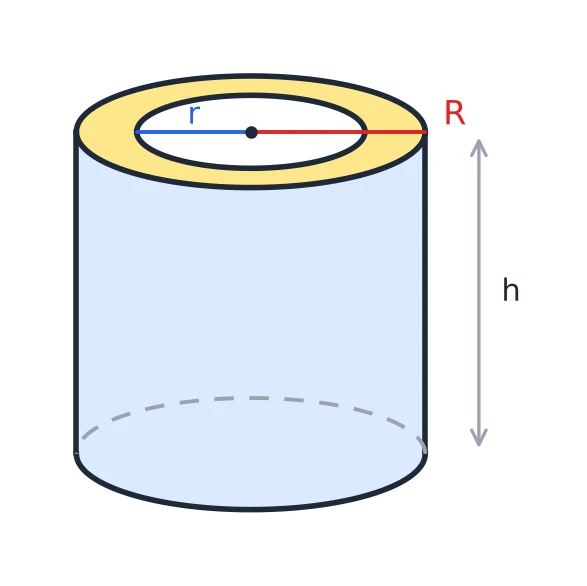
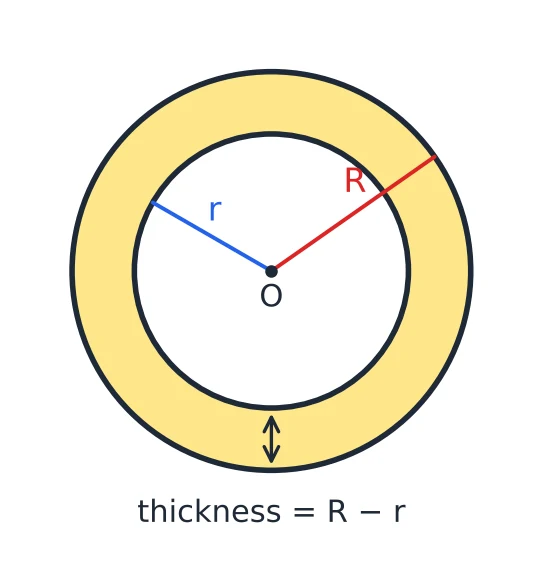
The thickness of the wall is R − r. When diameters are given, halve them first: an outer diameter of 8 cm and an inner diameter of 6 cm mean R = 4 cm, r = 3 cm and a thickness of 1 cm, not 2 cm.
The factored form saves time. An iron pipe 70 cm long with R = 4 cm and r = 3 cm contains cm³ of iron. No squaring at all.
Weight. Multiply the volume of metal by the weight of 1 cm³. If 1 cm³ of iron weighs 8 g, this pipe weighs 1540 × 8 = 12320 g = 12.32 kg.
Inner radius or thickness from the volume. A pipe 21 cm long with outer radius 13 cm contains 1650 cm³ of metal. Then
so , r = 12 cm, and the thickness is 1 cm.
From the circumferences. Outer and inner circumferences give R and r through . Their difference, , gives the thickness in one step.
For the metal, subtract the squares; never square the difference. is a thin solid rod as wide as the wall, far smaller than the right answer.
Surfaces of a Pipe
A pipe has four surfaces: the outer curved surface, the inner curved surface, and a flat ring at each end.
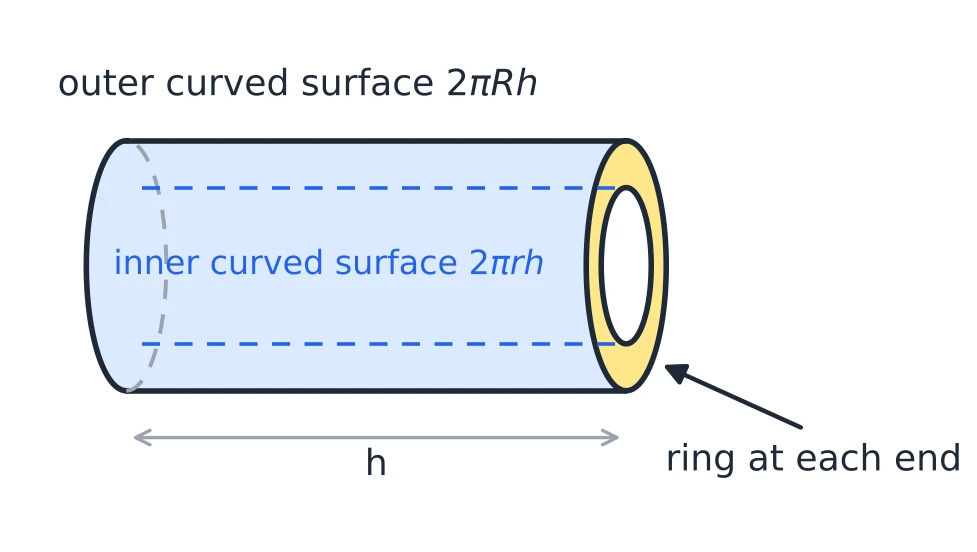
- Outer curved surface =
- Inner curved surface =
- The two end rings =
- Total surface =
For the pipe of the last part (R = 4 cm, r = 3 cm, h = 70 cm): outer 1760 cm², inner 1320 cm², ends cm², total 3124 cm². By the factored form, cm².
Match the words to the surfaces.
- 'Painted inside and outside' (a tube open at both ends): outer + inner = , here 3080 cm².
- 'Total surface area of the pipe': all four, 3124 cm².
- 'Polished on the outside' or 'outer surface': alone.
The difference of the two curved surfaces is , which depends only on the thickness and the length. A pipe 14 cm long whose outer and inner curved surfaces differ by 88 cm² is cm thick. The sum, , gives R + r in the same way, and the sum and the difference together give R and r.
[SSC Tip] The ends of a hollow cylinder are rings, not full circles. Adding for the ends is the usual slip in a total-surface question, so subtract the hole: .
Rollers, Pillars and the Cost of Painting
Rollers. A garden or road roller is a cylinder lying on its side. In one revolution its whole curved surface touches the ground once, so it presses an area equal to its curved surface:
Here h is the length of the roller, the width of the strip it presses.
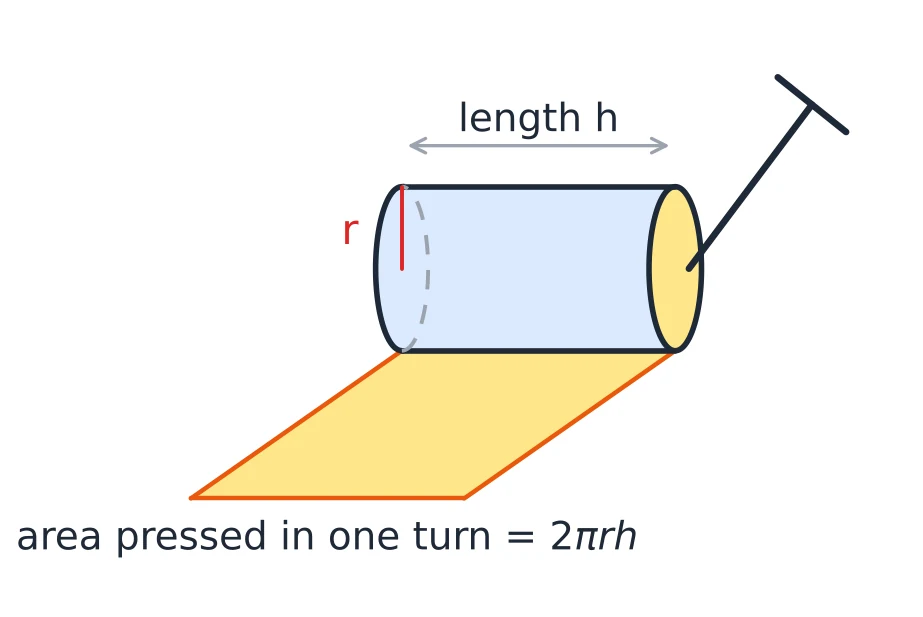
A roller of diameter 84 cm and length 1.2 m has r = 0.42 m, so one turn presses m². In 500 revolutions it levels 1584 m², and at ₹2.50 per m² the levelling costs ₹3,960. Going backwards, a ground of area A needs revolutions. Write r and h in metres first, since the ground is measured in m².
Painting and polishing. The cost is the area times the rate. The only real decision is which faces are exposed.
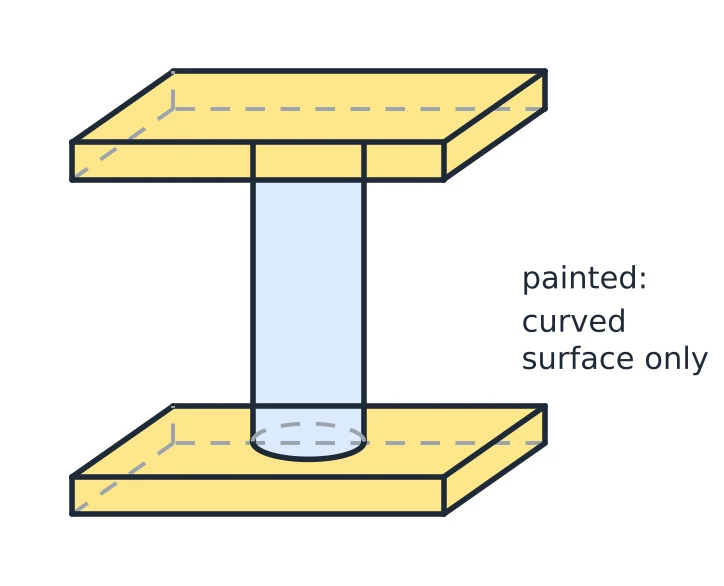
- A pillar stands on the floor and holds up the roof, so only its curved surface is painted. Ten pillars of diameter 70 cm and height 4 m: each has m², the ten have 88 m², and at ₹12 per m² the cost is ₹1,056.
- Plastering the inside wall of a well is the curved surface; add only when the floor is plastered too.
- A closed drum painted all over needs the total surface; a tank open at the top, painted inside, needs the curved surface and the floor.
A rate per m² with the sizes in cm needs a conversion: 10,000 cm² = 1 m². Do it before multiplying by the rate, not after.
Water Flowing Through a Pipe
Water leaving a pipe of inner radius r at speed v forms a long cylinder of water of radius r. In time t the front of the water has moved v × t, so that is the length of the water cylinder.
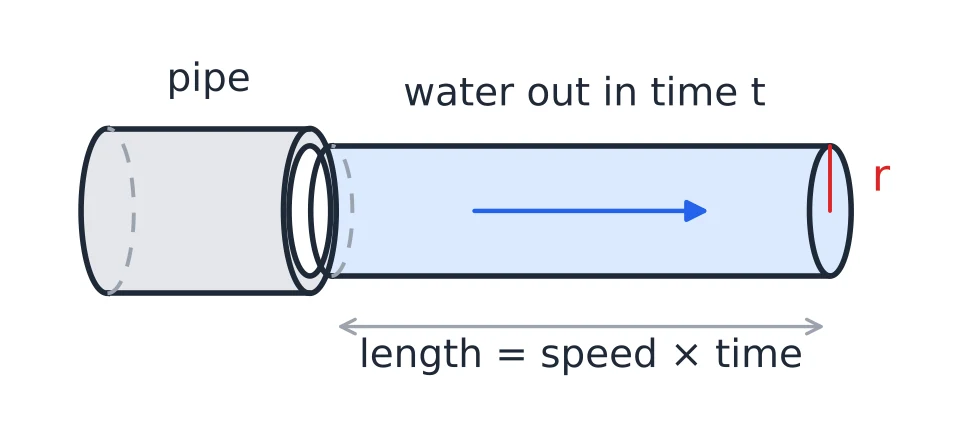
Units first. The radius is usually in cm and the speed in km/h or m/s. Put both lengths in one unit and the time in the unit the question wants: 4 km/h is 4000 m in an hour, or m in a minute; 2 m/s is 200 cm in a second (see Chapter 10 for speed conversions).
Rise in level of a tank. Water flows at 4 km/h through a pipe of inner radius 7 cm into a cylindrical tank of radius 7 m. In one hour the water column is 4000 m long, so its volume is m³. The tank's base is m², so the level rises m every hour, and filling it to a depth of 2 m takes 5 hours.
Time to fill, in litres. A pipe of inner radius 3.5 cm carries water at 2 m/s. Each second 200 cm of water comes out, a volume of cm³, which is 7.7 litres. A 4620-litre tank fills in seconds, that is 10 minutes.
The two working lines to remember:
[SSC Tip] If the pipe's diameter is given, halve it. Using the diameter makes the flow four times too big and the time four times too small, and both of those wrong values tend to appear among the options.
[Tier 2] Wells, Embankments and Earth Spread on a Field
Digging a well takes out a cylinder of earth whose volume is depth. When that earth is piled up somewhere else, its volume stays the same (questions ignore the way loose earth swells).
An embankment round the well. The earth is spread evenly round the mouth of the well in a ring of width w. The embankment is a hollow cylinder with inner radius r and outer radius r + w, so
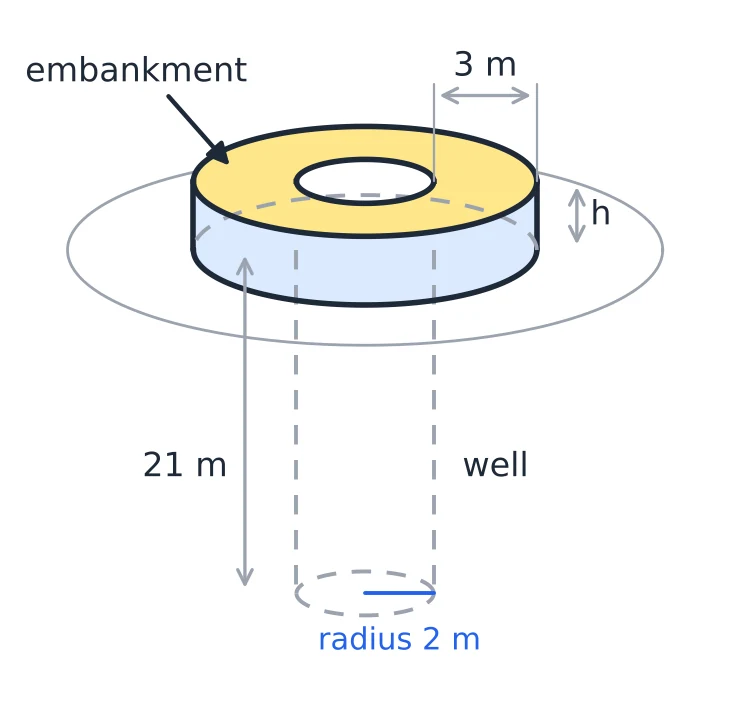
The cancels on both sides, so its value never matters. A well of diameter 4 m is dug 21 m deep and the earth forms an embankment 3 m wide. Then r = 2 m and r + w = 5 m, so (25 − 4)H = 4 × 21, which gives 21H = 84 and H = 4 m. In volumes: the earth is m³ and the ring is m², and 264 ÷ 66 = 4.
Earth spread over a field. Height raised = volume of earth ÷ area it covers. If the well is inside the field, the earth cannot lie over the well's own mouth, so use the field's area minus the well's area.
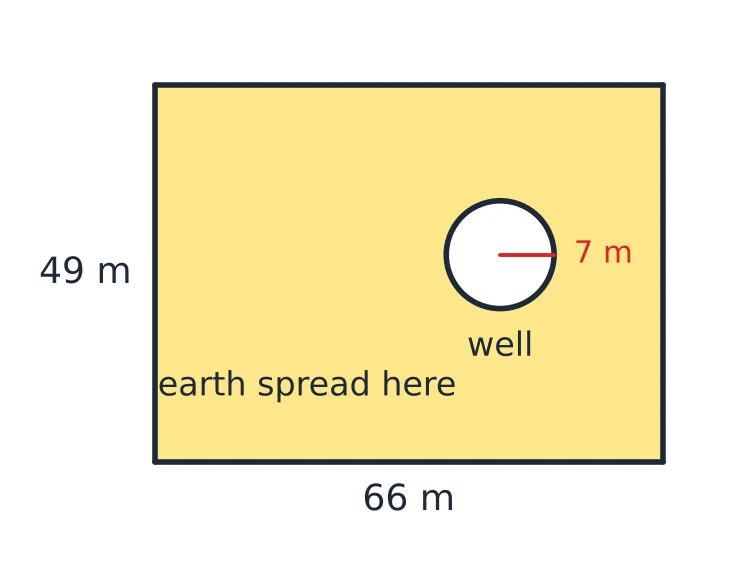
A well of diameter 14 m and depth 10 m is dug in a field 66 m by 49 m. The earth is m³. The area left to cover is 3234 − 154 = 3080 m², so the field rises m, or 50 cm. Dividing by the whole field (3234 m²) gives a little under 48 cm, which is not the answer here.
Read where the earth goes: an embankment is a ring (subtract the well), a field containing the well loses the well's area, and a separate plot of land uses its full area.
Percentage Change in Volume and Surface
In the radius counts twice and the height once. So if the radius is multiplied by a and the height by b,
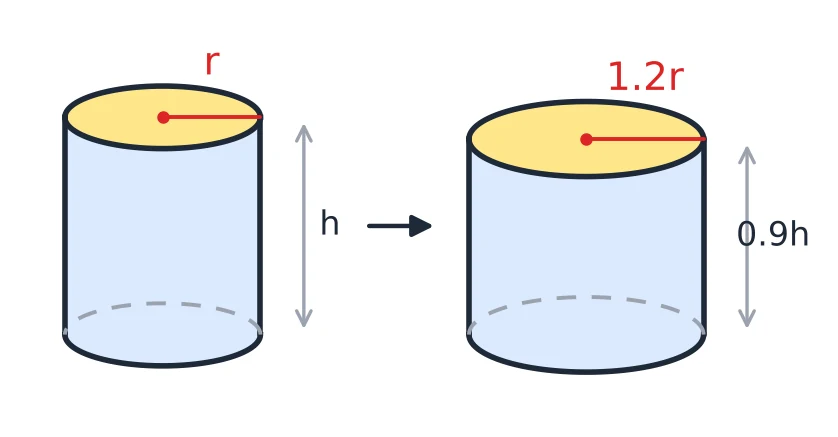
Radius up 20% (a = 1.2) and height down 10% (b = 0.9): the volume factor is 1.44 × 0.9 = 1.296, an increase of 29.6%, and the curved-surface factor is 1.2 × 0.9 = 1.08, an increase of 8%. This is the successive-change rule of Chapter 3 applied three times: +20%, +20% and −10%.
| Change | Volume | Curved surface |
|---|---|---|
| r up 10%, h same | up 21% | up 10% |
| r same, h up 10% | up 10% | up 10% |
| r and h both up 10% | up 33.1% | up 21% |
| r doubled, h halved | doubled | no change |
| r halved, h doubled | halved | no change |
Keeping the volume the same. If the radius goes up 25%, becomes 1.5625 times, so the height must become times, a fall of 36%. If the radius goes down 20%, becomes 0.64 times and the height must become times, a rise of 56.25%.
Total surface. has a single factor only when r and h change by the same percentage; then it changes like the curved surface. When they change differently, take sample values (r = 10, h = 10 works well) and compare the totals.
Percentage questions never need or the actual size of the cylinder: work with the factors alone.
Solved Examples
Question 1
A cylindrical water tank has a diameter of 2.8 m and a height of 3 m. How many litres of water can it hold? (Take .) (a) 18,480 litres (b) 73,920 litres (c) 1,848 litres (d) 6,160 litres
Answer. The diameter is 2.8 m, so the radius is 1.4 m. Volume = m³. One cubic metre is 1000 litres, so the tank holds (a) 18,480 litres. Had I used 2.8 m as the radius, I would have got four times as much, 73,920 litres.
Question 2
Find the total surface area of a closed cylinder of radius 10.5 cm and height 9.5 cm. (Take .) (a) 627 cm² (b) 973.5 cm² (c) 1320 cm² (d) 660 cm²
Answer. It is closed, so both ends count. I use TSA = . Here and r + h = 20, so TSA = 66 × 20 = (c) 1320 cm². The curved part alone would be 66 × 9.5 = 627 cm².
Question 3
The curved surface area of a cylinder is 1760 cm² and its volume is 12320 cm³. What is its height? (Take .) (a) 14 cm (b) 20 cm (c) 10 cm (d) 28 cm
Answer. I divide the volume by the curved surface: . So and r = 14 cm. Now , so h = (b) 20 cm. Careful: 14 cm is the radius, and the question asks for the height.
Question 4
The total surface area of a cylinder is 1232 cm², and the sum of its radius and height is 28 cm. What is its volume? (Take .) (a) 1078 cm³ (b) 6468 cm³ (c) 2156 cm³ (d) 3234 cm³
Answer. TSA = , and r + h = 28, so . That gives , so r = 7 cm and h = 28 − 7 = 21 cm. Volume = = (d) 3234 cm³.
Question 5
The radius and height of a cylinder are in the ratio 1 : 2, and its volume is 2156 cm³. What is its total surface area? (Take .) (a) 924 cm² (b) 616 cm² (c) 1232 cm² (d) 462 cm²
Answer. I take r = k and h = 2k. Then the volume is , so and k = 7. So r = 7 cm and h = 14 cm. TSA = = (a) 924 cm². 616 cm² is the curved surface alone; the question wants the total.
Question 6
The curved surface area of a cylinder is half of its total surface area, and the total surface area is 616 cm². What is its volume? (Take .) (a) 2156 cm³ (b) 539 cm³ (c) 1078 cm³ (d) 1232 cm³
Answer. , so 2h = r + h and h = r. Then TSA = , which gives and r = 7 cm = h. Volume = 154 × 7 = (c) 1078 cm³.
Question 7
The radii of two cylinders are in the ratio 3 : 5 and their heights are in the ratio 2 : 3. What is the ratio of their volumes? (a) 2 : 5 (b) 6 : 25 (c) 9 : 25 (d) 3 : 5
Answer. Volume goes with . So the ratio is , and dividing by 3 gives (b) 6 : 25. If you get 2 : 5, you have found the ratio of the curved surfaces (), not the volumes.
Question 8
Two cylinders have equal volumes and their radii are in the ratio 2 : 3. What is the ratio of their heights? (a) 3 : 2 (b) 4 : 9 (c) 2 : 3 (d) 9 : 4
Answer. Equal volumes means , so . The heights are (d) 9 : 4. It makes sense: the thinner one has to be taller.
Question 9
A rectangular sheet of paper 66 cm by 30 cm is rolled along its length to make a hollow cylinder, so the 66 cm side goes round. What is the volume of the cylinder? (Take .) (a) 10,395 cm³ (b) 4,725 cm³ (c) 20,790 cm³ (d) 3,465 cm³
Answer. The 66 cm side becomes the circumference, so , which gives cm. The 30 cm side is the height. Volume = = (a) 10,395 cm³.
Question 10
A sheet 44 cm by 33 cm is rolled into a cylinder in two different ways: first with the 44 cm side going round, then with the 33 cm side going round. What is the ratio of the larger volume to the smaller? (a) 16 : 9 (b) 1 : 1 (c) 4 : 3 (d) 64 : 27
Answer. With side a going round and side b as the height, the volume is . Swapping gives . Dividing, the ratio is a : b = 44 : 33 = (c) 4 : 3. Check: 44 cm round gives r = 7, h = 33 and 5082 cm³; 33 cm round gives r = 5.25, h = 44 and 3811.5 cm³. The curved surfaces are equal, but the volumes are not, so 1 : 1 is wrong.
Question 11
An iron pipe is 21 cm long. Its external diameter is 16 cm and its internal diameter is 12 cm. If 1 cm³ of iron weighs 7.5 g, what is the weight of the pipe? (Take .) (a) 55.44 kg (b) 13.86 kg (c) 31.68 kg (d) 1.98 kg
Answer. Radii first: R = 8 cm and r = 6 cm. Volume of iron = cm³. Weight = 1848 × 7.5 = 13860 g = (b) 13.86 kg. Using the diameters 16 and 12 in the formula makes it four times too heavy, 55.44 kg.
Question 12
A hollow cylindrical pipe is 28 cm long and its external radius is 12 cm. If it contains 5544 cm³ of metal, how thick is the pipe? (Take .) (a) 9 cm (b) 6 cm (c) 1.5 cm (d) 3 cm
Answer. Volume of metal = , so . Then and r = 9 cm. The thickness is R − r = 12 − 9 = (d) 3 cm.
Question 13
A metal pipe is 10 cm long. Its outer radius is 7 cm and its inner radius is 3.5 cm. What is its total surface area? (Take .) (a) 891 cm² (b) 660 cm² (c) 968 cm² (d) 440 cm²
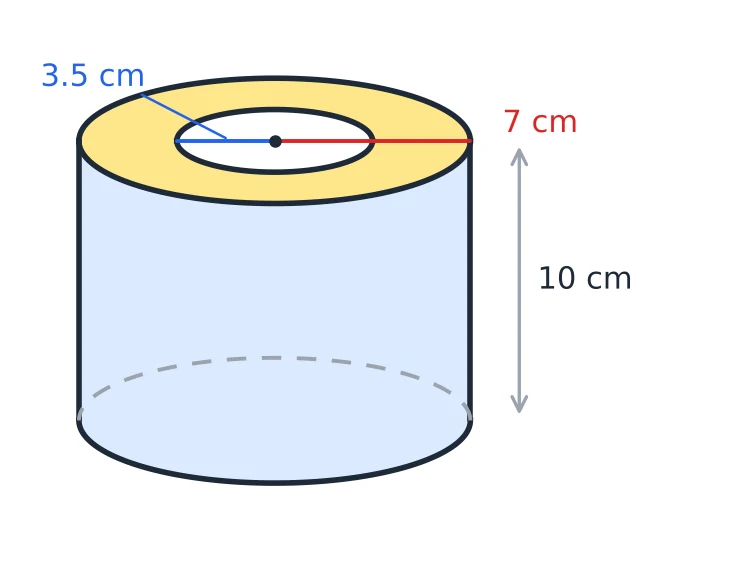
Answer. I add all four surfaces. Outer: . Inner: . The two end rings: . Total = 440 + 220 + 231 = (a) 891 cm². The quick formula gives the same. If you got 968 cm², you took the ends as full circles.
Question 14
A road roller has a diameter of 1.4 m and a length of 2 m. What area does it level in 750 revolutions? (Take .) (a) 13200 m² (b) 3300 m² (c) 6600 m² (d) 8910 m²
Answer. In one turn the roller presses its curved surface: m². In 750 turns: 8.8 × 750 = (c) 6600 m². The ends of the roller never touch the ground, so the total surface (which gives 8910 m²) is not used.
Question 15
A garden roller has a radius of 35 cm and a length of 1 m. How many revolutions must it make to level a lawn 55 m long and 40 m wide once? (Take .) (a) 500 (b) 1000 (c) 2000 (d) 100
Answer. One turn presses m² (I changed 35 cm to 0.35 m first). The lawn is 55 × 40 = 2200 m². Number of turns = = (b) 1000.
Question 16
A hall has 14 cylindrical pillars, each of diameter 50 cm and height 3.5 m. What is the cost of painting their curved surfaces at ₹16 per m²? (Take .) (a) ₹2,464 (b) ₹616 (c) ₹1,320 (d) ₹1,232
Answer. Only the curved surface of a pillar can be painted; the top and bottom are against the roof and the floor. With r = 0.25 m and h = 3.5 m, one pillar has m². Fourteen pillars have 77 m², and the cost is 77 × 16 = (d) ₹1,232.
Question 17
A cylindrical tank open at the top has an inner diameter of 4.2 m and a depth of 3 m. What is the cost of plastering its inner surface (wall and floor) at ₹50 per m²? (Take .) (a) ₹2,673 (b) ₹1,980 (c) ₹3,366 (d) ₹693
Answer. The tank has a wall and a floor but no lid. With r = 2.1 m: wall = m², floor = m². Total 53.46 m², and the cost is 53.46 × 50 = (a) ₹2,673. Adding two ends (₹3,366) would plaster a lid the tank does not have.
Question 18
Water flows at 5 m per second through a pipe of internal diameter 7 cm into a cylindrical tank of radius 70 cm and height 1.5 m. How long will it take to fill the tank? (Take .) (a) 30 seconds (b) 8 minutes (c) 2 minutes (d) 20 minutes
Answer. I work in cm and seconds. The pipe's radius is 3.5 cm, and in one second the water moves 500 cm. Flow per second = cm³. The tank holds cm³. Time = seconds = (c) 2 minutes.
Question 19
Water flows at 6 km/h through a pipe of internal diameter 7 cm into a cylindrical tank of radius 3.5 m. By how much does the water level in the tank rise in 30 minutes? (Take .) (a) 60 cm (b) 30 cm (c) 1.2 m (d) 7.5 cm
Answer. In 30 minutes the water moves 3 km = 3000 m along the pipe. The pipe's radius is 3.5 cm = 0.035 m, so the water that comes in is m³. The tank's base is m². Rise = m = (b) 30 cm. Watch the time: 60 cm is the rise in a full hour.
Question 20
[Tier 2] A well of diameter 6 m is dug 20 m deep. The earth taken out is spread evenly all round it to form an embankment 4 m wide. What is the height of the embankment? (a) 11.25 m (b) 2.25 m (c) 9 m (d) 4.5 m
Answer. The well's radius is 3 m, so the embankment is a ring from radius 3 m to radius 3 + 4 = 7 m. Earth in = earth out: . The cancels: 40H = 180, so H = (d) 4.5 m.
Question 21
[Tier 2] A well of diameter 14 m and depth 18 m is dug in one corner of a field 70 m long and 55 m wide. The earth dug out is spread evenly over the rest of the field. By how much does the level of the field rise? (Take .) (a) 75 cm (b) 72 cm (c) 50 cm (d) 1.5 m
Answer. Earth = m³. The field is 70 × 55 = 3850 m², but the well's mouth takes 154 m² of it, so the earth covers 3850 − 154 = 3696 m². Rise = m = (a) 75 cm. Spreading over all 3850 m² would give 72 cm, but the earth cannot sit over the well.
Question 22
The radius of a cylinder is increased by 10% and its height is decreased by 20%. What happens to its volume? (a) It decreases by 10% (b) It decreases by 3.2% (c) It does not change (d) It increases by 3.2%
Answer. Volume goes with , so I multiply the factors: . The new volume is 96.8% of the old one, so (b) It decreases by 3.2%. Simply adding the percentages (10 + 10 − 20 = 0) suggests 'no change', but here the factors multiply; they do not add.
Question 23
The radius of a cylinder is decreased by 20%. By what percentage must its height be increased so that its volume stays the same? (a) 20% (b) 25% (c) 56.25% (d) 44%
Answer. The new radius is 0.8 times the old, so becomes 0.64 times. To keep the same, the height must become times, an increase of (c) 56.25%.
Question 24
The radius of a cylinder is increased by 25% and its height is decreased by 20%. Which statement is true? (a) Volume increases by 25%, curved surface does not change (b) Volume does not change, curved surface increases by 25% (c) Both increase by 5% (d) Volume increases by 56.25%, curved surface increases by 25%
Answer. Volume factor = , so the volume goes up by 25%. Curved-surface factor = 1.25 × 0.8 = 1, so the curved surface stays the same. That is (a) Volume increases by 25%, curved surface does not change.